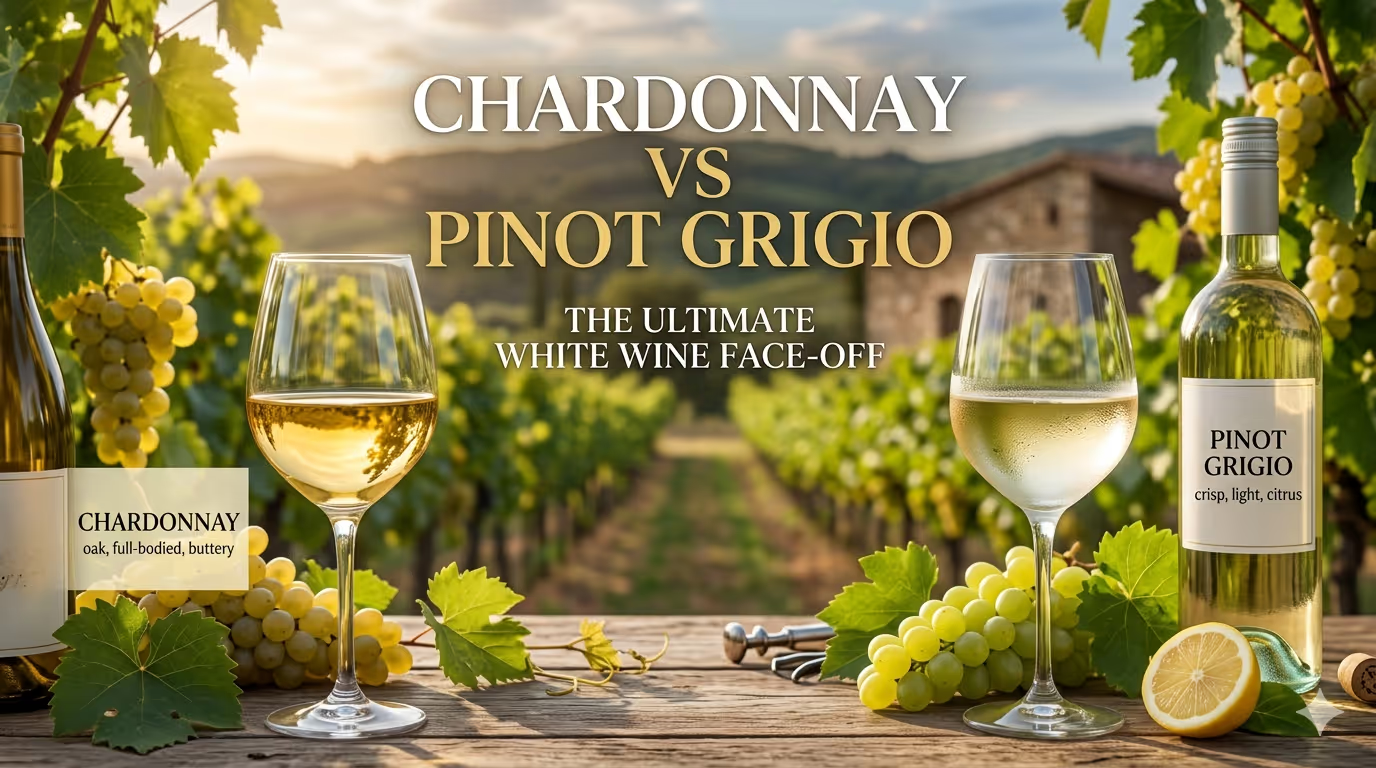


If you love rich, buttery, oaky Chardonnay, the closest wines are Viognier from the Rhône or California, white Rhône blends built on Roussanne and Marsanne, and a barrel-aged white Rioja Reserva. If the Chardonnay you love is crisp and unoaked, the Chablis kind, go to dry Chenin Blanc from the Loire, Godello from Spain or Pinot Blanc from Alsace. Both lists work because they copy the part of Chardonnay you actually enjoy, and that part is usually the winemaking rather than the grape.
So before you pick a replacement, it's worth knowing which Chardonnay has been your favorite, because the two styles are close to opposites and an alternative for one will disappoint a fan of the other.
What are the closest wines to Chardonnay?
The closest wines to Chardonnay are Viognier, Roussanne, Marsanne, white Rioja, Chenin Blanc, Godello, Pinot Blanc and white Bordeaux, and each one lines up with a different version of Chardonnay. Viognier and the white Rhône grapes match the full, round California style, Godello and Pinot Blanc match the leaner Burgundy style, and Chenin Blanc can do either depending on who made it.
Here's the short version, so you can find your row before reading the rest.
| Wine | Where to look | Closest to which Chardonnay | What changes |
|---|---|---|---|
| Viognier | Condrieu (Rhône), California | Rich, oaked California | More perfume: apricot, peach, honeysuckle |
| Roussanne and Marsanne | Rhône Valley, California Central Coast | Rich, oaked California | Waxier and nuttier, a little less fruit |
| White Rioja Reserva | Rioja, Spain | Rich, oaked | More savory, with a nutty, mature edge |
| White Bordeaux (Sémillon blends) | Bordeaux, France | Rich, oaked | Lemon and beeswax, with a grassy streak |
| Chenin Blanc | Loire Valley, South Africa | Either, depending on the producer | Much higher acidity, apple and quince |
| Godello | Valdeorras and Bierzo, Spain | Elegant, lightly oaked Burgundy | Brinier and more herbal |
| Pinot Blanc | Alsace, Alto Adige, Oregon | Unoaked, crisp | Lighter and gentler, with less to say |
None of these is a Chardonnay copy, so what you're really choosing is which part of Chardonnay you want to keep.
Which Chardonnay do you actually like?
Most people who say "I love Chardonnay" love one of two very different wines: a golden, creamy California bottle that tastes of butter, vanilla and baked apple, or a pale, tight Chablis-style bottle that tastes of lemon and green apple with a chalky finish. They're the same grape, and the gap between them is almost entirely what happened in the winery.
The buttery note has a specific cause. Most Chardonnay goes through a second fermentation, called malolactic fermentation, in which bacteria turn the wine's sharp malic acid into softer lactic acid, and one of the compounds produced along the way is diacetyl. The Australian Wine Research Institute's fact sheet on malolactic fermentation describes diacetyl as the source of "the buttery or butterscotch aroma and flavour of wine", and makes a point that matters for this article: butteriness "can be masked by strong oak or very fruity characters", which is why two equally buttery wines can taste nothing alike.

Oak and yeast do the rest of the work. New barrels add vanilla, toast and baking spice, and aging the wine on its spent yeast (the lees) adds a bready, nutty depth, which Wine Folly's Chardonnay profile lists alongside malolactic as the three levers behind the rich style. Leave all three out and you get the lean, citrusy wine that Chablis is famous for. We've written about how to tell a buttery Chardonnay from the label and the matching trick for spotting an unoaked one, and either is worth a minute if you're not sure which camp you're in.
This is the useful bit for finding an alternative. Malolactic fermentation, oak and lees aging can be applied to almost any white grape, so the "Chardonnay" you love is partly a recipe, and other grapes cooked with the same recipe will taste familiar. The rest of this article sorts the alternatives by which recipe you're after.
What should you drink if you love buttery, oaky Chardonnay?
If buttery, oaky Chardonnay is your wine, start with Viognier, then try a white Rhône blend of Roussanne and Marsanne, and keep a barrel-aged white Rioja Reserva in mind for dinner. All three are full-bodied whites with a soft, round texture, and all three take to oak in a way that lands close to a California Chardonnay.
Viognier is the most natural next step. Wine Folly's Viognier profile describes it as often full-bodied "with a characteristically oily texture" and says outright that if you like full-bodied Chardonnay, you'll probably appreciate it. The difference is the smell, which is far more perfumed, with tangerine, peach and honeysuckle jumping out of the glass before you've taken a sip. That perfume makes people expect sweetness, but Viognier is usually dry. Its home is Condrieu in the northern Rhône, a single-grape appellation of about 216 hectares according to the Rhône Valley wine council, so the real thing is small and pricey. California makes plenty of good Viognier for less, and we've laid out the head-to-head in more detail in Chardonnay vs Viognier.
Roussanne and Marsanne are the white grapes of the northern Rhône, used in white Hermitage and Crozes-Hermitage, and they're often blended together. They're less showy than Viognier, more about texture than aroma, with notes of beeswax, pear and toasted nuts. Wine Folly notes that American producers make "richer oak-aged" Roussanne that is "reminiscent of Chardonnay" in its Roussanne entry, and California's Central Coast, Paso Robles in particular, is where you'll find most of them. A bottle labelled Côtes du Rhône Blanc is the cheaper French doorway into the same family, usually blended with Grenache Blanc and sometimes Viognier.
White Rioja Reserva is the one most Chardonnay drinkers have never tried and the one we'd most like you to. It's made mostly from Viura, and the Rioja regulator's aging categories require a white Reserva to age for two years, at least six months of that in 225 liter oak barrels, with a Gran Reserva going to four years. The result has the weight and the oak of a rich Chardonnay but turns savory with time, picking up hazelnut, dried citrus peel and a faint sherry-like edge. It's an acquired taste for some, and a revelation for anyone who has started to find California Chardonnay a little sweet.
White Bordeaux is the last of the rich options, a blend of Sémillon and Sauvignon Blanc. Sémillon is the one doing the Chardonnay impression. The Bordeaux wine council puts it at 42% of the region's white plantings, close behind Sauvignon Blanc at 45%, and the barrel-fermented bottles from Pessac-Léognan and Graves have the same lemony, waxy richness that oaked Chardonnay drinkers tend to enjoy.
If what you really want is another Chardonnay in the same mold, rather than a different grape, that's a different question, and we've covered it bottle by bottle in our page on alternatives to Rombauer Chardonnay.
What should you drink if you love crisp, unoaked Chardonnay or Chablis?
If you love crisp, unoaked Chardonnay or Chablis, go to dry Chenin Blanc from the Loire first, then Godello from northwest Spain, then Pinot Blanc from Alsace. All three keep the clean, mineral, apple-and-citrus profile of a Chablis without the butter, and they do it at prices that make Chablis look expensive.
Chenin Blanc is the closest match in structure. Wine Folly puts it neatly in its Chenin Blanc profile: "Riesling's acidity meets Chardonnay's body and texture." Look for Vouvray marked "sec" (dry), Savennières or Saumur Blanc from the Loire, where the wines are taut and smell of green apple and quince. Chenin is also the grape that moves between our two camps, because South Africa makes a richer, barrel-fermented style that sits much closer to California Chardonnay. If you're curious whether it suits you, our piece on whether you'll like Chenin Blanc walks through the styles.
Godello is the grape most wine people reach for when they want to describe a white Burgundy that isn't one. It grows in Valdeorras and Bierzo in Galicia and Castilla y León, and Wine Folly's Godello entry describes a medium body with "a silky, slightly creamy texture, not unlike an elegant Chardonnay", sometimes with light vanilla and toast "much like a well-made White Burgundy" when it sees oak. If your favorite Chardonnay is a Mâcon or a village Burgundy, with a little texture but no butter, Godello is the one to try.
Pinot Blanc is the gentlest of the three. The Alsace wine council's Pinot Blanc page calls it light-bodied with well-balanced acidity, and adds that it's often blended with Auxerrois, so a bottle labelled Pinot Blanc may not be all Pinot Blanc. It's the right pick if you like Chardonnay mostly because it's easy and never shouts. Alto Adige in Italy, where it's called Pinot Bianco, and Oregon both make clean, inexpensive versions.
Two more grapes are worth knowing about here. Albariño from Rías Baixas, which we compare with its Italian cousin in Albariño vs Vermentino, has the brightness of Chablis with more peach and a salty finish. Grüner Veltliner from Austria is crisp and dry with a white-pepper note that Chardonnay never has, and our post on what Grüner Veltliner tastes like is the place to check before you buy one. And for anything that leans toward Sauvignon Blanc rather than Chardonnay, our list of wines similar to Sauvignon Blanc picks up where this one stops.
Is Viognier the closest match to Chardonnay?
Viognier is the closest single-grape match to rich California Chardonnay, but it isn't the closest match to Chardonnay in general. It shares the full body, the soft acidity and the comfort with oak, and it parts company in the nose, where Viognier is floral and stone-fruity while Chardonnay is quieter and more about apple, citrus and the winemaking.
For a crisp Chardonnay fan, Viognier is close to the worst pick on this list. Its acidity sits at medium-low and its alcohol usually runs between 13.5% and 15%, according to Wine Folly, so it can feel heavy and a bit flabby to someone used to the snap of a Chablis. Godello or a dry Loire Chenin will serve that drinker far better.
So the honest answer depends on which Chardonnay you started with. If it's a big, golden California bottle, yes, start with Viognier. If it's a Chablis or an unoaked bottle from a cooler place, Chenin Blanc is the grape with the best claim to the title, because it can be made in either style and still taste like itself.
Which Chardonnay alternative should you pour with dinner?
For dinner, match the alternative to the weight of the dish, the same way you'd choose between a rich and a crisp Chardonnay. Roast chicken, lobster with butter, creamy pasta and pork tenderloin with a cream sauce want the rich side: Roussanne, a white Rioja Reserva or a South African Chenin. Oysters, grilled fish, goat cheese and anything with lemon want the crisp side: a Loire Chenin, Godello or Pinot Blanc.
A few pairings are especially good. Viognier's perfume and soft acidity make it a natural partner for mildly spiced food, like a Thai green curry or chicken tagine with apricots, where a crisp Chardonnay can taste thin. White Rioja Reserva is brilliant with roast pork and with mushroom dishes, because its nutty, savory side meets them halfway. Godello is one of the few whites that's genuinely comfortable next to octopus or grilled sardines, which is no surprise given where it grows.

If you're pouring for a table that normally drinks Chardonnay and you want one bottle to please everyone, choose a Godello or a Saumur Blanc. They're fuller than a typical Pinot Grigio, so the Chardonnay crowd won't feel short-changed, and fresh enough that nobody will find them heavy.
How do you find these on a shelf or a wine list?
You find them by reading the region and a handful of key words, because most of these wines are labelled by place rather than by grape. A few cues do most of the work.
For the rich side, look for "Condrieu" or "Viognier" on the label, "Côtes du Rhône Blanc" or "Crozes-Hermitage Blanc" for Rhône whites, and "Rioja Blanco" plus "Reserva" or "Crianza" for the oaked Spanish style. On a California bottle, "barrel fermented" or "sur lie" (aged on the lees) is a strong hint that you're getting the Chardonnay-style treatment, whatever the grape. South African Chenin often says "old vine" or "barrel fermented" when it's made in the rich style.
For the crisp side, look for "Vouvray Sec", "Savennières" or "Saumur" for Loire Chenin, "Valdeorras" or "Bierzo" for Godello, and "Pinot Blanc" or "Pinot Bianco" with Alsace or Alto Adige on the label. On a restaurant list, these often sit in an "other whites" section that most people skip, and they're frequently the best value on the page.
If you're standing in a shop holding a bottle you've never heard of, Find Similar in Sommy is built for exactly this moment: tell it the Chardonnay you already love and it surfaces bottles like it by grape, region and character, so you're starting from a wine you know rather than a guess.
Frequently asked questions
What wine is most similar to Chardonnay?
Viognier is the wine most similar to rich, oaked California Chardonnay, with the same full body and soft acidity plus more perfume. For crisp, unoaked Chardonnay or Chablis, Godello from Spain and dry Chenin Blanc from the Loire are the closest matches.
What are good wines similar to Chardonnay but not buttery?
Dry Chenin Blanc from Vouvray or Savennières, Godello from Valdeorras, Pinot Blanc from Alsace and Albariño from Rías Baixas are all wines similar to Chardonnay without the butter. The buttery note comes from malolactic fermentation and oak, and these wines are usually made without much of either.
Is Chablis a Chardonnay?
Yes, Chablis is 100% Chardonnay, grown in the far north of Burgundy and usually made with little or no new oak, which is why it tastes so different from California Chardonnay. Our post on Chablis and Chardonnay explains the difference in detail.
What red wine is closest to Chardonnay?
Pinot Noir is the red wine closest to Chardonnay, partly because the two are Burgundy's signature grapes and partly because both are medium-bodied, soft and food-friendly. A lightly oaked Pinot Noir from Oregon or California will feel familiar to most Chardonnay drinkers.
Is Sauvignon Blanc similar to Chardonnay?
Sauvignon Blanc isn't very similar to Chardonnay, because it's lighter, sharper and much more aromatic, with grapefruit and cut grass where Chardonnay offers apple and, often, butter. It's a reasonable switch only for fans of crisp, unoaked Chardonnay who want something zestier.
Is Pinot Grigio like Chardonnay?
Pinot Grigio is lighter and more neutral than most Chardonnay, so it's only a close match for the leanest, unoaked bottles. If you want something in between, Pinot Blanc or a fuller Oregon Pinot Gris gets you closer to Chardonnay's body.
Which one should you open first?
We'd start a buttery Chardonnay fan with a Viognier from California, because it's the smallest step: the same weight and roundness, with a burst of apricot and flowers on top that tells you straight away you're somewhere new. If that lands, try a white Rioja Reserva next, which keeps the richness and swaps the fruit for something savory and much more grown-up.
For a Chablis fan, open a Godello first. It has the same quiet, mineral confidence and a little more texture, and it usually costs noticeably less than a Chablis of similar quality. And if you find yourself missing Chardonnay the whole time, that's useful too, because it probably means you don't want a different grape at all, you want a different Chardonnay, made with more or less of the butter, oak and lees that defined the one you started with. Our guide to what Chardonnay tastes like is a good map for that search.