If you want a wine similar to Sauvignon Blanc, the right answer depends entirely on why you're looking for one. If the acidity is what bothers you, go to Verdejo from Rueda in Spain, which keeps the citrus and the green notes but lands softer. If you're just bored and want the same crisp shape with a different flavor, go to Albariño or Grüner Veltliner. And if you actually love Sauvignon Blanc and only want a better version of it, the fix is usually a different country rather than a different grape.
That last one catches people out more than it should, because Sauvignon Blanc from Marlborough and Sauvignon Blanc from the Loire Valley are so far apart in style that plenty of drinkers who say they've gone off the grape have only gone off one expression of it.
What are the closest wines to Sauvignon Blanc?
The closest wines to Sauvignon Blanc are Verdejo, Grüner Veltliner, Albariño, Vermentino, Picpoul, Assyrtiko and Sauvignon Gris, and they're close in different ways rather than close in the same way. Some match the acidity, some match the green herbal streak, and a couple match the tropical fruit without any of the grass.

Here's how the main options sort out, so you can find your row before reading the rest of the piece.
| Wine | Where it's from | What it shares with Sauvignon Blanc | What changes |
|---|---|---|---|
| Verdejo | Rueda, Spain | Citrus, green herbal edge, dry finish | Softer acidity, a slightly bitter almond note |
| Grüner Veltliner | Austria | Green savory character, lively acidity | Swaps grass for white pepper and celery leaf |
| Albariño | Rías Baixas, Spain | Bright acidity, aromatic lift | Peach and salt instead of gooseberry |
| Vermentino | Sardinia and Provence | Lime, herbs, mouthwatering finish | Rounder texture, less pungent aroma |
| Picpoul | Languedoc, France | Bone-dry, high acid, green apple | Almost no herbaceous smell at all |
| Assyrtiko | Santorini, Greece | Piercing acidity, mineral drive | Heavier body, smoky lemon rather than tropical |
| Sauvignon Gris | Bordeaux and Chile | The Sauvignon aroma, closely related grape | Riper stone fruit, gentler on the palate |
| Sémillon blend | Bordeaux Blanc | Often literally blended with Sauvignon Blanc | Waxy weight that rounds the sharp edges |
None of these is a copy, and we'd be suspicious of any list that promised one. What you're doing is picking which part of Sauvignon Blanc you want to keep.
Why do you want something other than Sauvignon Blanc?
Almost everyone asking this question is asking one of three different things, and answering the wrong one is how you end up with a bottle you like even less. The most-read discussion of this exact question on r/wine opens with a drinker who likes the crisp acidity but finds it can be a bit much, and the replies split cleanly into three camps that map onto three completely different shopping trips.
The first reason is that the wine is too sharp for you, whether it feels like biting a lemon or the grassy smell reads as green pepper. The second is that nothing is wrong at all and you're simply tired of drinking the same thing every Friday. The third is that you had one glorious bottle once and everything since has disappointed you, which is a quality and region problem rather than a grape problem.
Sort yourself into one of those before buying anything, because the rest of this piece is organized the same way.
Which wines taste like Sauvignon Blanc with less acidity?
If Sauvignon Blanc feels too sharp, the best swap is Verdejo from Rueda, and the reason is more than a coincidence of style. Rueda's own rulebook treats Verdejo and Sauvignon Blanc as interchangeable building blocks: both are listed as principal white varieties of the appellation, and a white Rueda has to be at least 75 percent principal varieties, which means the bottle in your hand may legally contain some actual Sauvignon Blanc (Spanish Ministry of Agriculture, PDO-ES-A0889, revised 12 June 2025). That percentage was raised in the 2024 amendment, so the older 50 percent figure you'll still see quoted around the internet is out of date.
Verdejo gives you the same citrus and the same faint green herbal lift, with a rounder middle and a soft bitter-almond finish that takes the edge off. It's also one of the cheaper wines in this conversation, so it's a low-risk experiment.
Two Italian whites do a similar job from a different direction. Soave, made from Garganega in the Veneto, trades the aromatic punch for gentle pear and almond while staying bone dry, and Gavi, made from Cortese in Piedmont, keeps a little more zip without ever shouting. Both are the kind of wine that disappears politely into a meal.
Then there's Chenin Blanc, which deserves care because it comes in several sweetness levels and the label rarely helps. A dry South African Chenin has orchard fruit and a rounder body with acidity that's present rather than piercing, and it's one of our favorite ways to keep the freshness while losing the bite. Look for the word "dry" or a South African producer if you want to avoid an off-dry Loire version by accident.
The last option in this group hides in plain sight. Sémillon is blended with Sauvignon Blanc all over Bordeaux to make dry white wine, and it's one of the three grapes behind the sweet wines of Sauternes (UC Davis Foundation Plant Services). A dry Bordeaux Blanc gives you Sauvignon Blanc with a waxy, lanolin-like weight wrapped around it, and that weight is what dulls the sharp corners.
Which wines keep the crispness but change the flavor?
If nothing is wrong with Sauvignon Blanc and you just want a new flavor at the same energy level, the five wines to know are Albariño, Grüner Veltliner, Vermentino, Picpoul and Assyrtiko. Every one of them holds onto the acidity that makes Sauvignon Blanc refreshing, and each replaces the gooseberry-and-grass signature with something else entirely.
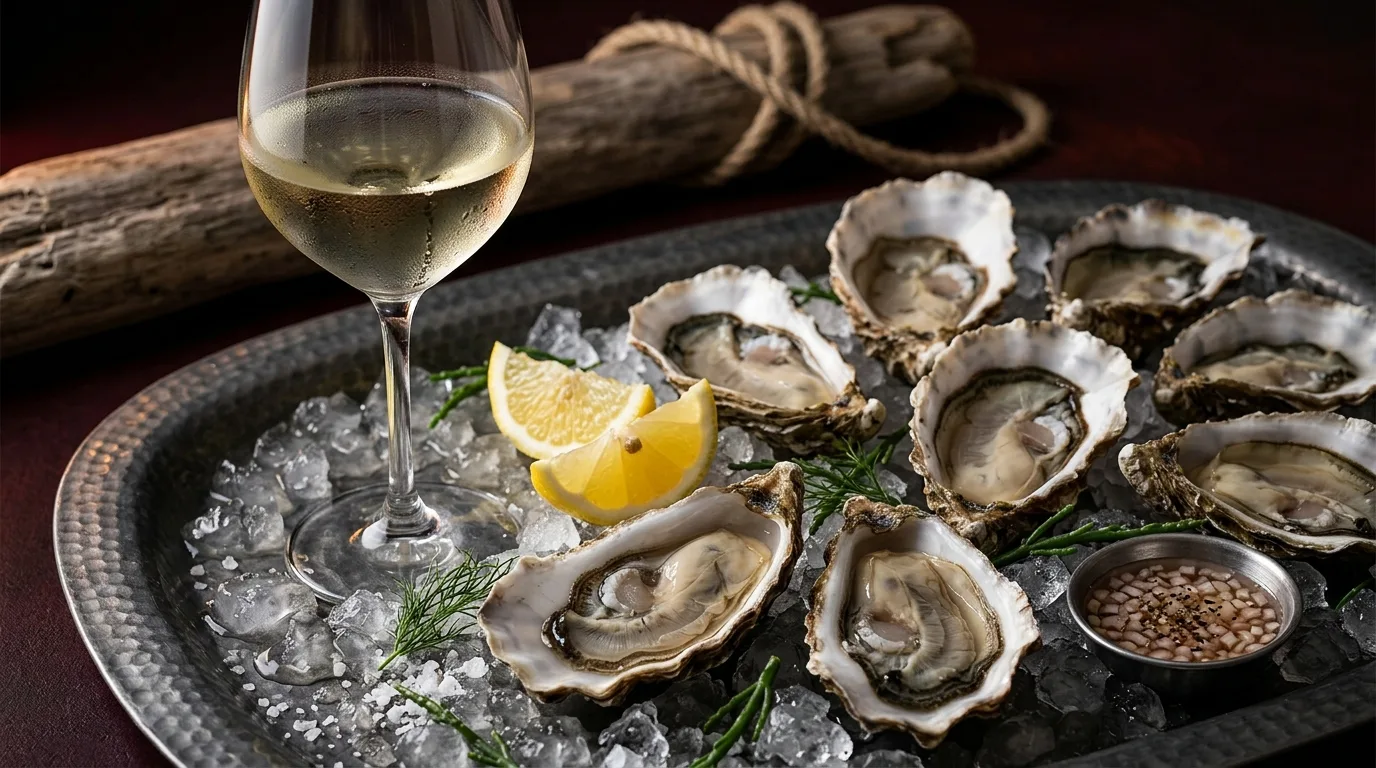
Albariño, from Rías Baixas on Spain's Atlantic coast, leans into white peach and grapefruit with a salty tang that suits shellfish better than almost anything. Vermentino, grown in Sardinia and across southern France where it's called Rolle, is rounder and more herbal, with lime and a bruised-mint quality. We've written a full head-to-head on Albariño and Vermentino because those two get confused constantly and they suit different moods.
Grüner Veltliner is the savory choice. Austria's signature white keeps a green streak but expresses it as white pepper and celery leaf rather than cut grass, and it handles awkward vegetables like asparagus and artichoke without falling apart. Picpoul, from the Languedoc, is the plainest of the group in the best sense: bone dry, lemon and green apple, almost no aromatic smell, and traditionally poured next to Mediterranean oysters. Its old nickname translates roughly as lip stinger, which tells you most of what you need to know.
Assyrtiko is the biggest step of the group. Grown on the volcanic soils of Santorini, it has an acidity that can genuinely outgun Sauvignon Blanc, but it carries more body and a smoky, saline lemon character instead of tropical fruit. If you like Sancerre for its mineral tension rather than its fruit, this is the bottle to try next.
Are these wines actually related to Sauvignon Blanc?
Several of them are, which is not a coincidence and is the single most useful thing to know about this whole category. Microsatellite DNA work by INRA Montpellier and Domaine de Vassal shows that Sauvignon Blanc is a seedling of Savagnin Blanc, the old Jura grape also known as Traminer, and that Savagnin is a parent of a long list of other varieties too (UC Davis Foundation Plant Services).
That list is worth reading slowly, because it includes Chenin Blanc, Grüner Veltliner and Verdejo, all of them full or half siblings of Sauvignon Blanc, alongside Silvaner, Petit Manseng, Trousseau, Räuschling, Verdesse and Verdelho da Madeira. The wines that generations of drinkers arrived at by trial and error, and that every alternatives list on the internet recommends, turn out to be the grape's own family.
Sauvignon Gris is closer still, because it isn't a relative at all but a berry-color mutation of Sauvignon Blanc itself, a pink-skinned version of the same vine. The UC Davis records note that the selection brought over from Chile in 1980 was picked up because it seemed to have a more intense Sauvignon aroma. It's rare on American shelves and mostly comes from Bordeaux or Chile, but it's the answer for anyone who wants more Sauvignon character, not less.
The family tree also explains a gap. Albariño, Vermentino, Picpoul and Assyrtiko aren't related to Sauvignon Blanc in any of this work, and they're the ones that feel like a genuine change of subject rather than a variation on a theme. If you want a small step, drink a relative. If you want a real change, drink a stranger.
Is it the grape or the bottle you picked?
Before you give up on Sauvignon Blanc, check whether you've only ever drunk one version of it, because the styles are far apart. France has roughly 65,000 acres of the grape, with about 15,000 in Bordeaux, 10,000 around Sancerre and 9,500 more across the rest of the Loire Valley, and a 2015 OIV survey found plantings in 38 countries with eight of them above 10,000 acres (UC Davis Foundation Plant Services). Those places do not make the same wine.
New Zealand, and Marlborough above all, is the loud one: passionfruit, cut grass and an aroma you can smell across a table. If that's what you're tired of, the Loire is the obvious next stop. Sancerre's white wines are Sauvignon Blanc and nothing else, from an appellation that also makes Pinot Noir reds and rosés (INAO), and they're flinty and restrained where Marlborough is exuberant. Loire Sauvignon is also typically made at a lower alcohol level of around 11 percent, which is part of why it feels lighter on a warm evening.
California sits between the two, riper than the Loire and less aromatic than New Zealand, and it hides behind a second name that confuses a lot of shoppers. Fumé Blanc is simply Sauvignon Blanc under another name. Robert Mondavi coined the term in 1966 and 1967 for a dry, Loire-inspired style, borrowing it from Blanc Fumé, the local synonym for the grape around Pouilly-sur-Loire. He thought "Sauvignon Blanc" was hard to pronounce and too closely associated with sweet wine, so he renamed his and the label stuck across the state.
If you want the full breakdown of what the grape tastes like region by region, we've covered Sauvignon Blanc's taste separately.
If you like Sauvignon Blanc, what red wine will you like?
Start with Cabernet Franc, because you're already related to it by marriage. In 1997 Carole Meredith and John Bowers at UC Davis used DNA fingerprinting to establish that Cabernet Sauvignon is the offspring of a spontaneous cross between Cabernet Franc and Sauvignon Blanc, most likely in Bordeaux (UC Davis). Cabernet Franc is the parent that carries the herbal, leafy, slightly green aromatics that Sauvignon Blanc drinkers already enjoy, and a Loire version from Chinon or Bourgueil delivers them in a light-bodied red with real acidity. We've written about what Cabernet Franc tastes like if you want the detail before you order one.

The other geographic answer is even simpler. Sancerre makes red wine from Pinot Noir, so the growers whose white you already like are pressing a pale, tart, red-fruited Pinot from the same hillsides. Sancerre rouge is not easy to find in the United States, but any cool-climate Pinot Noir does a similar job.
Gamay is the third route and probably the easiest to buy. It's light, tart, low in tannin and genuinely good served cool, which matters if what you actually love about Sauvignon Blanc is the chill and the refreshment rather than the color. Our comparison of Pinot Noir and Gamay walks through which of the two suits which drinker.
What all three share is high acidity and light tannin, tannin being the drying, tea-like grip that makes big reds feel heavy. Sauvignon Blanc drinkers tend to want as little of it as possible.
What can you use instead of Sauvignon Blanc in cooking?
For cooking, any dry, unoaked, high-acid white will do the job, and Pinot Grigio, Muscadet, Verdejo and dry Vermentino are all fine substitutes. A pan mostly wants acid and a clean flavor, so the aromatic personality you'd fuss over in a glass barely survives the heat.
What to avoid is more specific. Oaked Chardonnay turns bitter and slightly resinous as it reduces, off-dry Riesling makes a sauce taste faintly sweet in a way you notice too late, and bottled cooking wine from the supermarket aisle carries added salt that takes the seasoning out of your hands. A cheap dry white you'd happily drink is the better choice, and you get to finish the bottle.
How do you find these on a shelf or a wine list?
The main obstacle is that half these wines are sold under a place name rather than a grape name, so nothing on the front label says Verdejo or Cortese. Rueda means Verdejo, Rías Baixas means Albariño, Gavi means Cortese, Soave means Garganega, and Sancerre and Pouilly-Fumé both mean Sauvignon Blanc. Learning those five pairs turns most restaurant lists from a wall of unfamiliar words into a short set of choices.
Two more shelf notes save real money. Fumé Blanc is Sauvignon Blanc under a marketing name, so you don't need to look for both, and a bottle labeled simply Rueda can contain Sauvignon Blanc alongside the Verdejo, which is either a bonus or a reason to read the back label depending on which way you're going.
If you'd rather not memorize any of it, this is the exact problem Find Similar exists for. You name a bottle you already like, Sommy works out which parts of it you're actually responding to, and it points you at the ones nearby that fit. That's a much better question than "what else is crisp", which is all a shelf can tell you.
Frequently asked questions
Is Pinot Grigio similar to Sauvignon Blanc?
They're both dry, light and crisp, so they overlap on the shelf, but they aren't very similar in the glass. Sauvignon Blanc is far more aromatic, with grass, gooseberry and tropical fruit, while Italian Pinot Grigio is deliberately neutral with green apple and pear. Pinot Grigio is a good swap if the smell of Sauvignon Blanc is what puts you off, and we've compared Sauvignon Blanc and Pinot Grigio in full.
Why do I like Sauvignon Blanc but not Chardonnay?
Usually it's the oak and the texture rather than the grape itself. Most widely sold Chardonnay is fermented or aged in oak barrels, which adds vanilla, butter and a creamy weight at the opposite end of the scale from Sauvignon Blanc's sharp aromatic lightness. Unoaked Chardonnay, including most Chablis, is a different drink and often converts people who thought they hated the grape.
Is Chardonnay similar to Sauvignon Blanc?
Only in the narrow sense that both are dry French white wines that traveled everywhere. Chardonnay is a neutral grape that takes its character from winemaking, so it can be lean and mineral or rich and buttery, while Sauvignon Blanc carries a loud aromatic signature that survives almost any treatment. Unoaked Chablis is the version that comes closest.
What French wine is similar to Sauvignon Blanc?
Picpoul de Pinet from the Languedoc is the closest French wine made from a different grape, with Muscadet a close second. If you're happy to stay on Sauvignon Blanc itself, Sancerre, Pouilly-Fumé, Quincy and Touraine are all Loire appellations built on it in a leaner style than New Zealand.
What is the smoothest white wine?
Among the wines here, dry Chenin Blanc and Sémillon-based Bordeaux Blanc feel the smoothest, because both carry a rounder texture that softens the acidity. Soave and unoaked Chardonnay are smoother still. Smooth usually means lower acid and a little more body rather than sweetness.
If I like Sauvignon Blanc, what red wine will I like?
Cabernet Franc from the Loire, cool-climate Pinot Noir and Gamay are the three to try, in that order. All three are light in body, high in acidity and low in tannin, and Cabernet Franc adds the herbal green note that Sauvignon Blanc drinkers already like. Serving any of them slightly chilled makes the transition easier.
Which one should you open first?
We'd start you on the Verdejo. It costs very little, it's on most shelves, it's a genuine blood relative of Sauvignon Blanc rather than a loose stylistic match, and it answers the most common complaint about the grape by keeping the flavor while dialing down the sharpness. If it lands well, work outward through Grüner Veltliner and Albariño, which are the two biggest steps you can take while still recognizing what you're drinking.
And if the Verdejo leaves you missing the thing you'd been drinking, that's useful information rather than a failed experiment. It probably means you don't want an alternative to Sauvignon Blanc at all, you want a better one, in which case skip Spain and spend the same money on a Loire bottle instead.