
If you're asking what wine you'll like, the honest answer comes down to a handful of things you can actually pin down: how sweet or dry you want it, how much acidity (that fresh, mouth-watering zip) you enjoy, how much tannin (the grippy, drying feel you get from bold reds) sits right with you, and how full or light you like the body. A quick online quiz guesses at all of that once and hands you a tidy label. A better approach learns your taste from real bottles you've actually tried, keeps getting sharper every time you rate one, and lets you point at a specific bottle and get a straight answer before you spend a dime.
That living picture of your palate, plus an instant read on any bottle, is exactly what Sommy's Taste Profile and Fit Check are built for.
Most of us arrive at this question the same way. You liked a glass at a friend's dinner, or you're staring at a wall of bottles that all look identical, and you just want to know which one is for you. The usual advice is to take a wine quiz, and there are plenty of them. They're fun for about ninety seconds. Then they leave you exactly where you started, holding a bottle in a shop with no real idea whether you'll enjoy it, and that's the gap worth closing properly.
Why can't a quiz tell me what wine I'll like?
A quiz gives you a fun starting guess, but it can't really tell you what wine you'll like because it asks the wrong questions and only asks them once. Look at the popular ones and you'll notice they lean on personality proxies, asking how you take your coffee, whether you go for dark chocolate or milk chocolate, a beach vacation or a mountain cabin. These make for a shareable result, and there's a loose logic to them, but your coffee order doesn't actually predict whether the tannin in a young Cabernet will taste smooth or harsh to you. Two people who both drink their coffee black can have completely opposite reactions to the same bottle.
The deeper problem is that a quiz is a single snapshot. You answer five questions on a Tuesday and it decides you're a "bold red person" forever. Taste doesn't work like that, because your palate shifts as you drink more, and it shifts fast in the first year. The crisp, tart Sauvignon Blanc that felt sharp to you in month one often becomes the exact thing you crave by month six. A static result can't follow that. It also tends to funnel you toward whatever the quiz owner happens to sell, which is why so many of them live on wine-shop and subscription sites.
There's nothing wrong with a quiz as a five-minute icebreaker. Just don't mistake it for an answer. The thing you actually want is a way to figure out your taste from real wines, keep that knowledge somewhere it won't get lost, and check any given bottle against it when you're the one deciding. If you want the full walk-through on choosing bottles with that mindset, our guide on how to pick wine you'll actually love covers the shopping side in detail.
What actually predicts which wines you'll like?
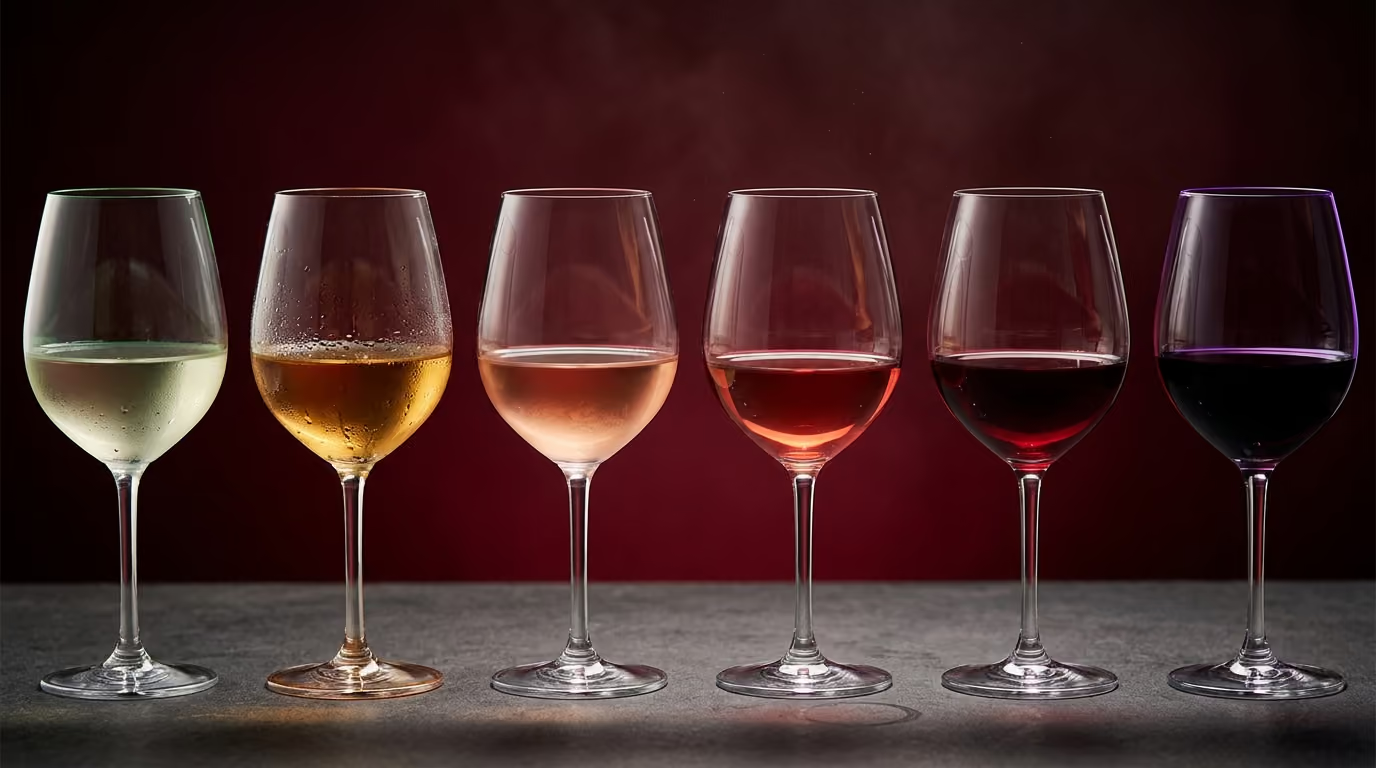
What predicts whether you'll like a wine is its structure, not its label, and structure comes down to four things you can feel in every glass: sweetness, acidity, tannin, and body. Grape names and regions are shorthand that sit on top of these, but the structure is what your mouth reacts to. Once you can name what you're tasting, "what wine will I like" stops being a mystery and becomes a short checklist.

Sweetness is the easiest to spot. A wine is dry when there's no noticeable sugar left, and off-dry or sweet when there is. Plenty of people who think they dislike wine actually just started with bone-dry bottles and would love something with a touch of sweetness. Our breakdown of dry versus sweet wine and how to tell before you buy is worth a read if this is where you keep getting tripped up.
Acidity is the fresh, tart, mouth-watering quality that makes a white feel crisp and a red feel lively. High-acid wines taste bright and go beautifully with food. Low-acid wines feel rounder and softer. If you love a squeeze of lemon on almost everything, you probably lean toward higher acidity, and our piece on what acidity in wine really means explains how to spot it in a single sip.
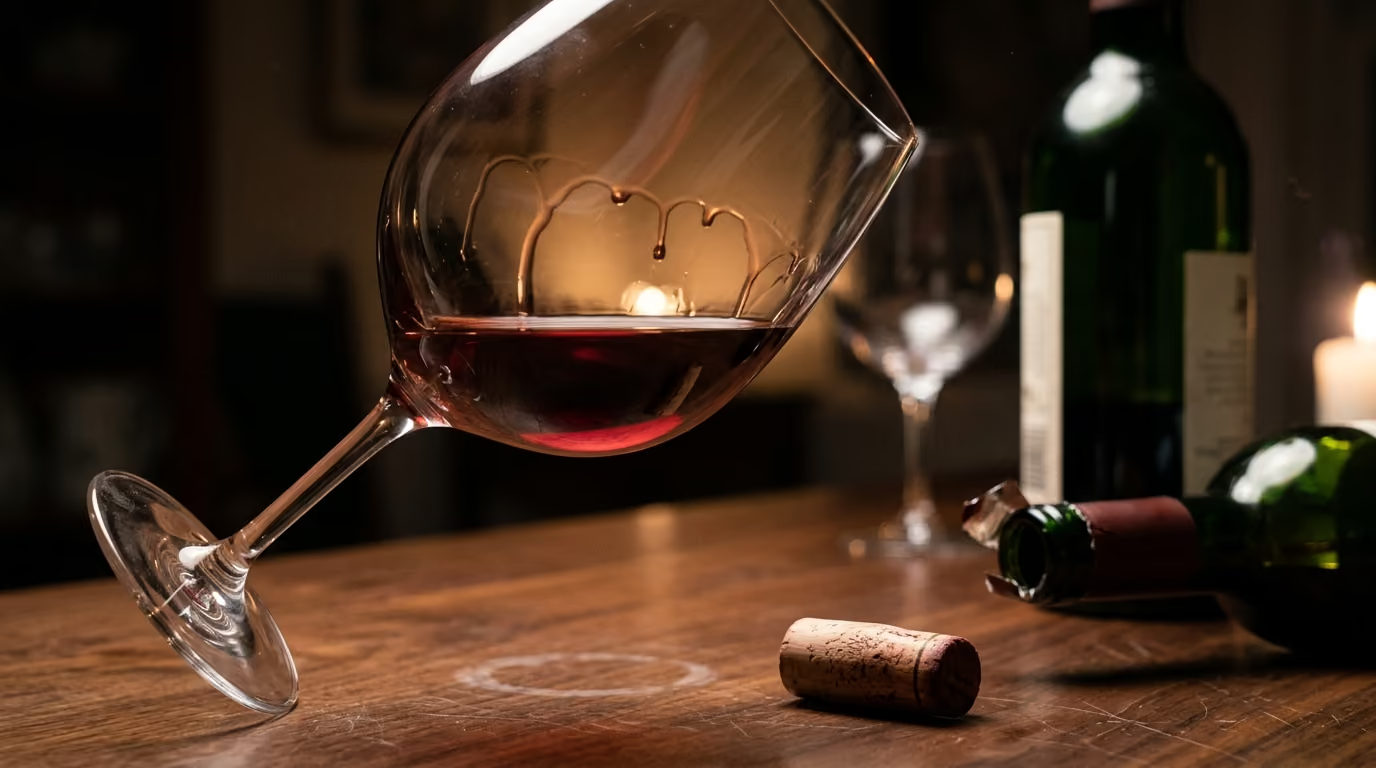
Tannin is the one that trips up new red drinkers. It's that drying, slightly grippy feeling on your gums and the sides of your tongue, strongest in young, bold reds like Cabernet Sauvignon. Some people find high tannin bracing and satisfying. Others find it harsh and much prefer a softer, low-tannin red, and neither reaction is wrong. Body is the last piece, the overall weight and richness of the wine, from light and delicate to full and mouth-filling. Put those four together and you have a real profile: maybe you like dry, high-acid, low-tannin, medium-bodied wines, which points you straight at bottles like Pinot Noir or a good Beaujolais without needing to memorize a single appellation.
How does Sommy learn what wine you'll like?
Sommy learns what you'll like by building a living model of your palate from the wines you actually rate, starting from your very first minute in the app. Instead of a one-time quiz, it treats your taste as something that grows, a living, evolving model rather than a fixed verdict. The onboarding feature that gets you going is called Find Your Taste, and it's designed to hand you a real recommendation in under a minute, then sharpen every time you come back.
There are multiple ways to get started:
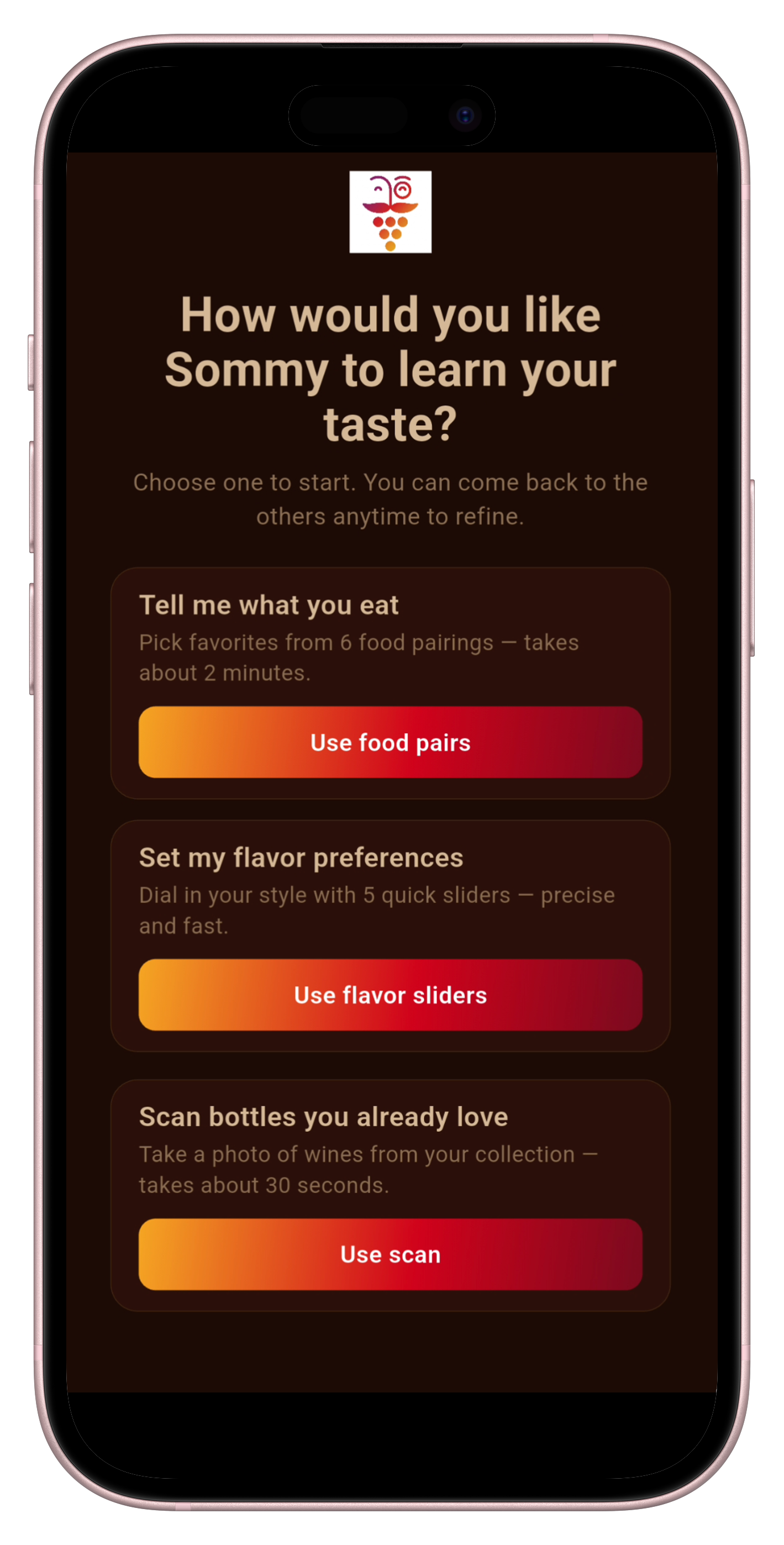
You can use the Food Pairings flow:
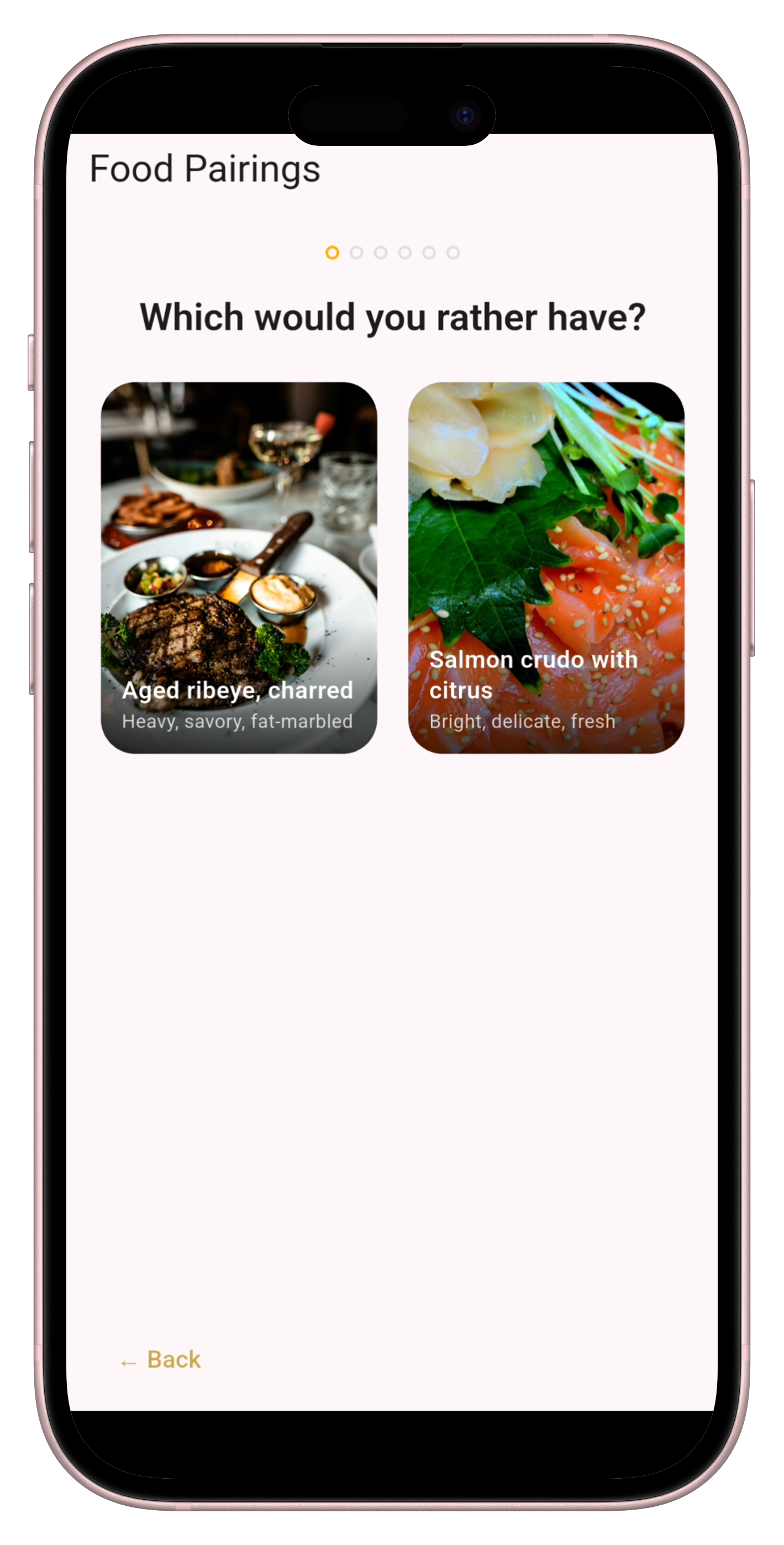
Or the Taste Sliders:
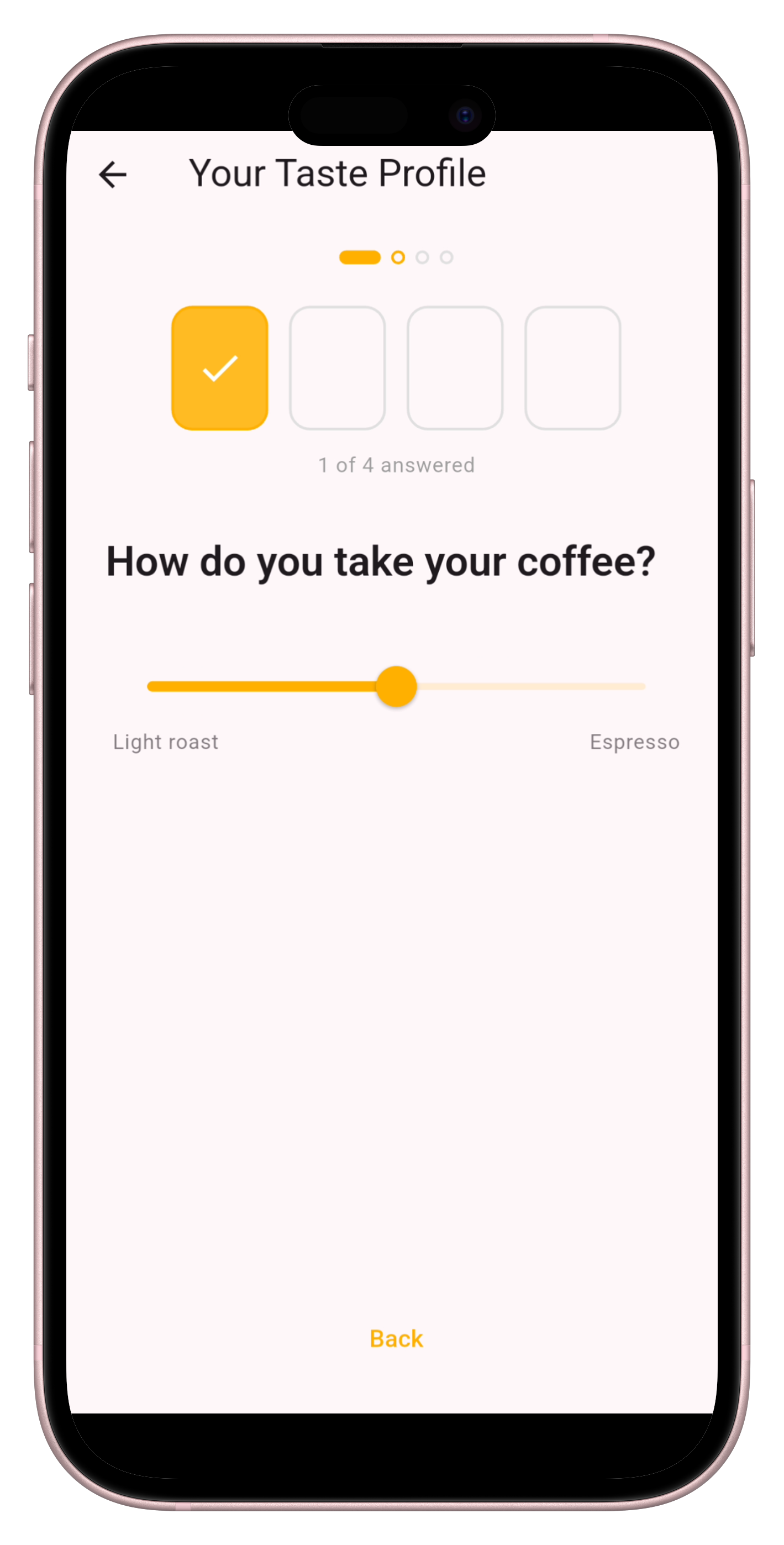
Here's the difference in plain terms. A quiz asks you to describe yourself, while Sommy watches what you actually enjoy. Every bottle you rate, every wine you save, every one you skip feeds your Taste Profile, the living picture of your palate that sits behind every recommendation. Rate a juicy Malbec highly and mark a lean, austere red as not-for-you, and the profile learns that you lean toward ripe fruit and softer tannin. It keeps adjusting as your taste drifts, so it stays accurate months later when a static quiz result would be long out of date. If you're switching over from another app, Vivino Import brings your existing ratings in so Sommy understands your taste from day one instead of starting cold.
You don't have to understand any of the machinery for it to work, but if you're curious about what's happening under the hood, we wrote up how to train an AI wine palate and teach Sommy your taste. The short version: the more honestly you rate, the better it gets, and it never stops updating. That's the part a quiz fundamentally can't do.
Will you like a specific bottle? Meet Fit Check
Once Sommy knows your taste, Fit Check answers the question you actually have in the moment: will I like this exact bottle in front of me? You type the name, say it out loud, or point your camera at the label, and Sommy describes in plain language how that wine matches your profile, in seconds. No score out of a hundred, no jargon, just a read on whether it's your style and why.
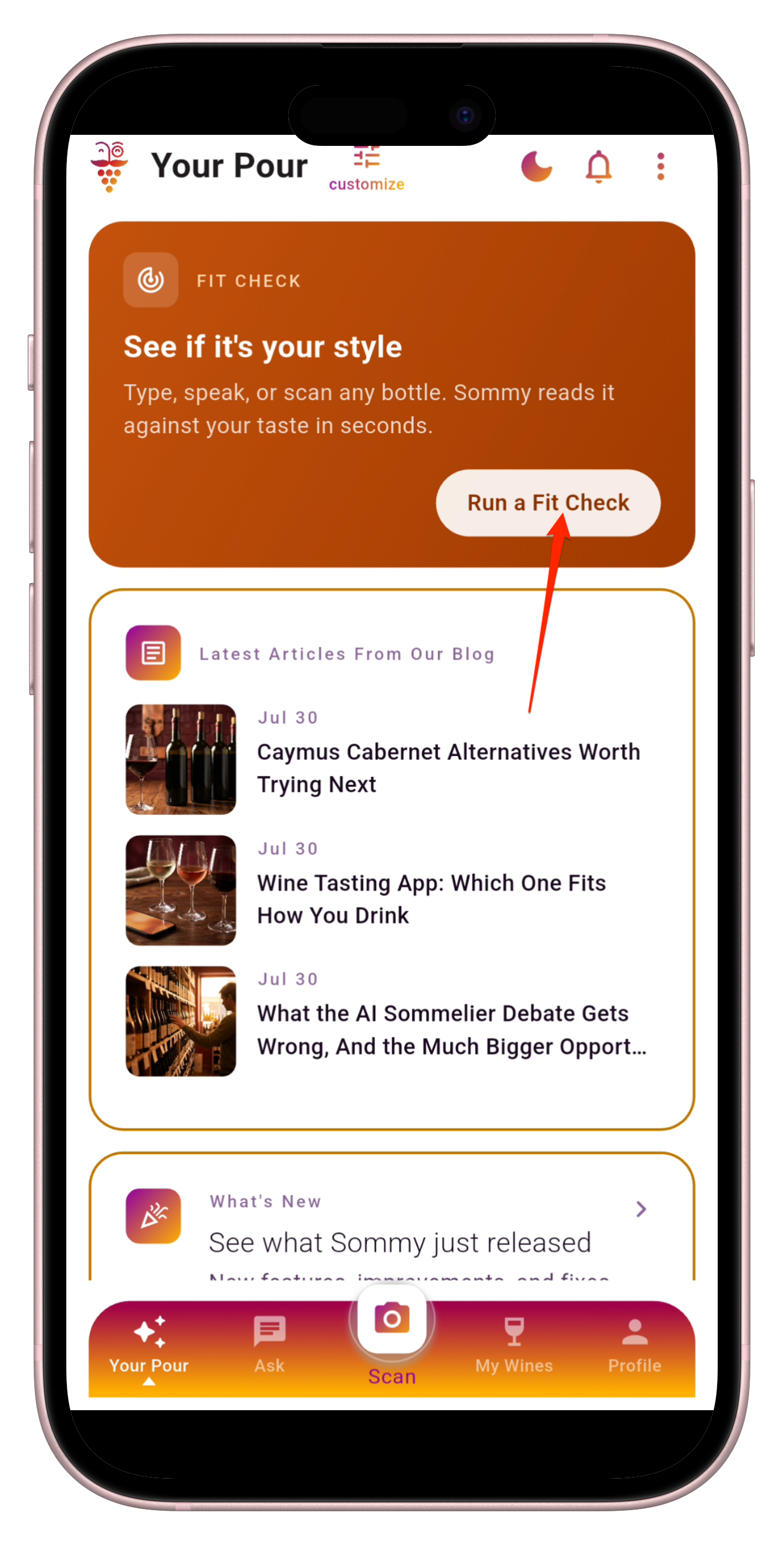
This is the piece every quiz and every DIY tasting method leaves out. You can spend a weekend buying six bottles and writing tasting notes on index cards, which is a genuinely good exercise, and still be stuck the next time you're holding an unfamiliar bottle that wasn't one of your six. Fit Check closes that gap, because it reads a specific wine against your specific palate and can tell you that the bottle you're eyeing is riper and softer than your usual picks, or that it's got the bright acidity you tend to love, or that the tannin is probably higher than you enjoy. It's the difference between a horoscope and a straight answer about the thing in your hand.
It works three ways so it fits however you're standing there. Type the name if you're browsing online. Speak it if your hands are full. Scan the label with your camera if you're in a shop and don't want to thumb in a long French name. All three run the same check against your Taste Profile, and all three give you the same honest, in-voice verdict. That's the whole point of Fit Check: it turns "what wine will I like" from a question you carry around into a question you can settle on the spot.
How do you use Fit Check when you're actually buying wine?
You use Fit Check at the exact moments you'd otherwise be guessing: the shop aisle, the restaurant list, and the gift decision. Those are places the question gets real, and each one is where a static quiz result quietly fails you.

In the shop, you're facing a shelf of bottles that all promise the world on the front label. Pick one up, scan it, and you get a read on whether it's your style before it goes in the basket. Do it with two or three and you're comparing them against your own palate instead of against marketing copy. It's the fastest way we know to stop buying the same safe bottle out of fear and actually branch out with confidence. If the wall of options is what usually defeats you, the same idea applies to reading labels, and how to read a wine label pairs well with a quick Fit Check.
At a restaurant, the wine list is its own kind of overwhelm, often pages of names with no descriptions and a server waiting. You can scan or type a bottle from the list and get a quick sense of whether it suits you, which beats defaulting to the second-cheapest red every time out of nerves. For the bigger picture on decoding a list under pressure, we put together how to read a restaurant wine list without feeling lost, and Fit Check slots right into that flow.
Buying wine as a gift is the sneaky-hard one, because you're guessing at someone else's taste, not your own. Fit Check won't read your friend's palate for you, but if you know a bottle they loved, Find Similar can surface wines with the same character by grape, region, or overall vibe, so you're giving something in the right neighborhood rather than grabbing whatever has the prettiest label. Across all three moments, the pattern is the same. You stop guessing and start checking.
When does Fit Check help, and when might it not?
Fit Check helps most once Sommy has a little to go on regarding your taste profile, and it's least useful on your very first day before you've rated anything. That's the honest trade-off, and it's worth being clear about. The whole system runs on knowing your taste, so a brand-new profile with zero ratings gives a thinner read than one built from twenty or thirty honest ratings. The fix is simple: rate a few wines you already have opinions about, or import your history, and the accuracy climbs quickly.

It's also worth saying plainly that no tool, ours included, can promise a wine will taste a certain way to you. Taste is personal, which is the entire reason a shared quiz result falls short and a personal profile works better. Fit Check tells you how a bottle lines up with the preferences you've shown, not that you're guaranteed to love it. Some nights you'll want to ignore the read entirely and try something wildly outside your usual lane, and that's a great instinct. Discovery is half the fun of wine, and a profile that's honest about your defaults actually makes it easier to take a smart risk, because you know exactly what you're stepping away from.
Where it shines is the everyday decision, the one you make dozens of times a year with real money on the line. Standing in a shop, sitting at a table, buying a bottle to bring to dinner. In those moments a quick, personal, in-context read is worth far more than a personality-quiz label you took once and forgot. Use it as a confident co-pilot, not an oracle, and it earns its place in your pocket. If you're brand new to all of this, our best wine for beginners primer is a gentle place to start before you lean on the app.
Frequently asked questions
What wine will I like if I'm a total beginner?
If you're just starting, a good default is a dry but fruit-forward, lower-tannin red like Pinot Noir, or a crisp white like Pinot Grigio, because both are easy to enjoy without strong tannin or heavy oak getting in the way. From there, rate what you drink so your taste comes into focus fast. The point isn't to memorize a starter list, it's to notice what you actually enjoy and build from it.
Are online wine quizzes accurate for figuring out what wine I'll like?
Online wine quizzes are fine as a fun starting point but not accurate enough to rely on, because they use personality proxies like your coffee order and only measure you once. Your palate changes as you drink more, so a snapshot taken today drifts out of date within months. A profile that updates every time you rate a wine gives a far more reliable read.
How is Fit Check different from a wine rating score?
Fit Check describes how a specific bottle matches your personal taste, while a rating score tells you what a critic thought about the wine in general. A 92-point wine can still be wrong for you if it's high in tannin and you prefer soft reds. Sommy deliberately skips numeric scores and instead tells you whether a bottle fits your style and why.
Do I need to know wine terms to use Sommy?
No, you don't need to know any wine terms to use Sommy, because it explains matches in plain language and learns from what you rate rather than from what you can name. Over time you'll pick up the useful words like acidity and tannin naturally, but you can get a helpful read from your very first rating without them.
Can Sommy tell me what wine I'll like at a restaurant?
Yes, you can type or scan a bottle from a restaurant's wine list and Fit Check will give you a quick read on whether it suits your taste. Current Venue takes it further by reading and filtering a restaurant's whole list against your profile, so you can spend less time deciphering names and more time enjoying dinner.
Turn the question into a habit
The reason "what wine will I like" feels so stubborn is that we keep answering it with one-time guesses and then throwing the guess away. Swap that for a running picture of your taste and a quick check on the bottle in front of you, and the whole thing gets easier every month instead of resetting to zero. Rate the wines you drink, be honest about the ones you didn't love, and let the profile do the remembering so you don't have to. Next time you're in front of a shelf or a wine list, you won't be guessing. You'll be checking, and that's a much better place to choose from. Download Sommy, spend a minute on Find Your Taste, and let Fit Check settle the next bottle for you.