A wine quiz sorts you into a broad style family by asking how you feel about sweetness, acidity, tannin and body, then names a handful of grapes or bottles that usually sit inside that family. That's a genuinely useful starting point, and it's about as far as five or six questions can carry anyone. Most of the quizzes you'll find on the first page of results are run by companies that sell wine, so the bottles waiting at the end come from that company's own shelves rather than from everything available to you.
None of that makes them worthless. It just means you should know what you're getting before you hand over your name and email. Below are the questions a good taste quiz asks, what each of your answers actually reveals about your palate, who owns the quizzes currently ranking, and the things no quiz can work out about you no matter how many questions it asks.
What does a wine quiz actually tell you?
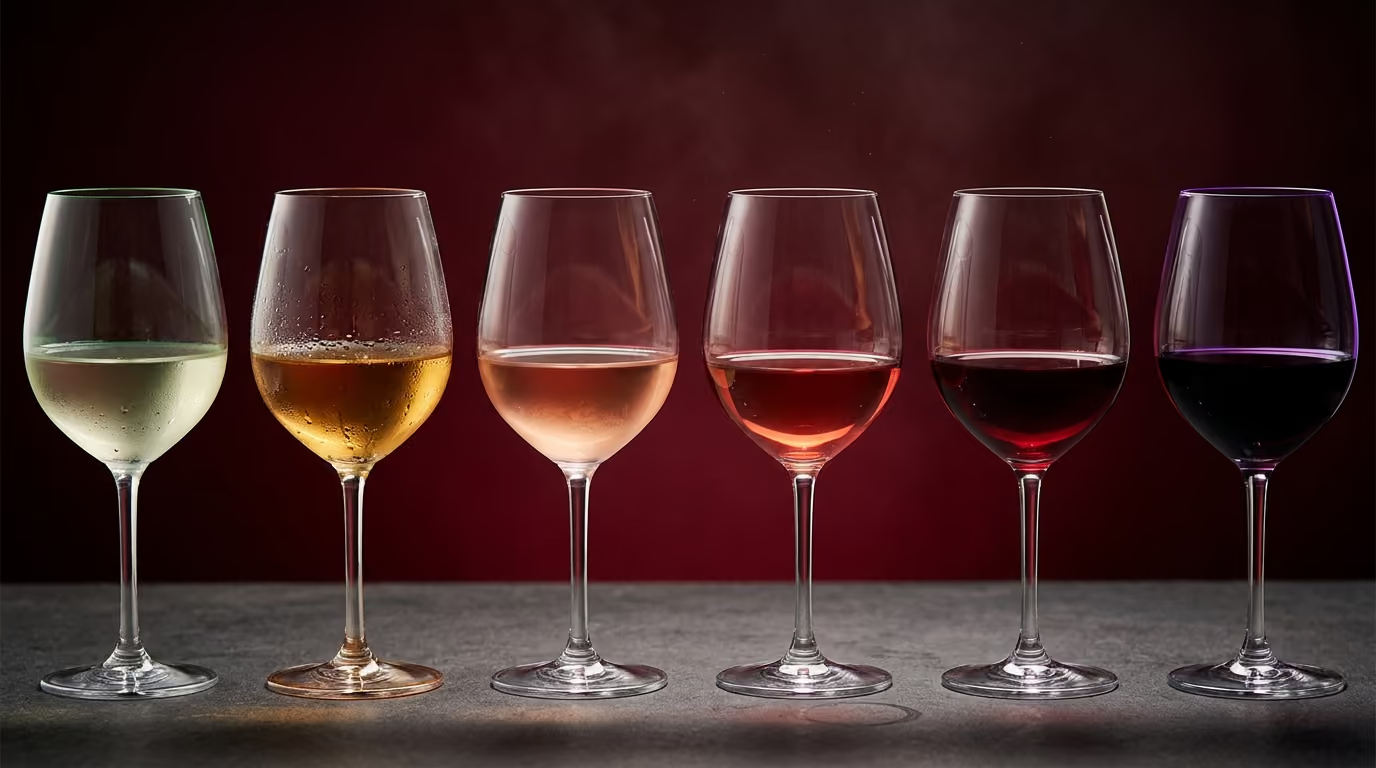
A wine quiz tells you which broad style family your palate probably belongs to, and very little that's more specific than that. Style families are things like crisp unoaked whites, richer barrel-aged whites, light and perfumed reds, firm full-bodied reds, dry rosé, off-dry aromatic whites and sparkling wine. Landing in one of those groups is the difference between staring at four hundred bottles and looking seriously at a dozen.
That narrowing is worth more than people give it credit for. If a quiz tells you that you sit with light perfumed reds, you've learned that Pinot Noir, Gamay, Frappato and lighter Grenache deserve your attention and that big Cabernet probably doesn't, which saves you from repeatedly buying bottles that leave you cold. We'd rather someone walked into a shop knowing that much than walked in knowing nothing at all.
What a style family can't do is pick between the bottles inside it. Two Pinot Noirs from the same country in the same year can taste wildly different depending on the producer, the site and how much new oak they saw. A quiz result gets you to the right aisle and then leaves you there, which is exactly where most people get stuck. Our piece on what wine will I like goes deeper on turning a style into an actual bottle.
What are the two kinds of wine quiz?
Search results for a wine quiz mix two completely different products, and it's worth knowing which one you're about to click. One kind measures your taste so it can recommend wine to you. The other kind measures your knowledge so it can tell you how much you know about wine.
The taste quizzes are the ones asking whether you take your coffee black and whether you like the sourness of green apple. They're short, usually between five and ten questions, and they finish by naming grapes, styles or specific bottles. Good Pair Days, Wine.com and One Stop Wine Shop all run this kind, and all three sit near the top of the results for a wine quiz.
The knowledge quizzes are a different world. Wine Spectator runs a long-standing series under the name Wine IQ, with multiple-choice rounds on topics like sustainability, Bordeaux, sparkling wine, wine history and the people who make it, each one usually running to eleven questions. The American Wine School publishes quizzes aimed at students working through formal wine courses. These are graded tests of what you've learned rather than tools for finding something to drink on Friday. They're genuinely fun if you're the kind of person who enjoys being tested, and they'll tell you nothing whatsoever about which bottle to buy.
If you came looking for something to drink, you want the first kind. If you came to find out whether you can tell a Chablis from a Chardonnay on paper, the second kind is the one you want, and Wine Spectator's archive is the deepest of them.
What questions does a good wine taste quiz ask?
A good wine taste quiz asks about roughly eight things, and each one maps onto something you can actually taste in a glass. Here they are with what your answer reveals, so you can run the whole thing in your head right now without giving anyone an email address.
Sweetness usually comes first, often disguised as a question about how you take your coffee or your iced tea. If you sweeten both, you'll probably be happier with off-dry wines like a German Riesling with a touch of sugar or a fruity Moscato than with something bone dry. If you drink coffee black, dry wines are your territory. This one question eliminates more bad purchases than any other, because a great many people who say they hate wine have only ever been handed bone-dry bottles.
Acidity hides behind questions about lemon, green apple, vinaigrette or sour candy. Loving that mouth-watering sourness points you at Sauvignon Blanc, Albariño, Chablis, Vermentino and dry Riesling. Disliking it steers you toward softer, rounder whites like Viognier or a warm-climate Chardonnay.
Tannin is the one quizzes describe worst. It's the drying, slightly grippy feeling you get from strong black tea left to steep too long, or from the papery skin on a walnut. If that texture appeals to you, Cabernet Sauvignon, Nebbiolo, Tannat and young Bordeaux will feel structured and satisfying rather than harsh. If it makes you wince, Pinot Noir, Gamay, Merlot and Grenache will treat you far better. Our explainer on wine tannins covers this in more depth, because it's the single most common reason people decide they don't like red wine.
Body gets asked as a question about milk, comparing skim to whole, or about whether you prefer a light broth or a rich stew. Your answer separates delicate wines from weighty ones, which matters more than colour does when you're matching wine to a meal.
Oak shows up as a question about vanilla, toast, butter, baking spice or coconut. Enjoying those flavours points at barrel-aged Chardonnay, Rioja with age on it and American oak-aged reds. Disliking them points at stainless-steel whites and fresher, unoaked reds. This is the axis that splits Chardonnay drinkers into two camps that barely recognise each other.
Fruit against earth is the question that separates New World from Old World in practice. Some people want ripe blackberry and plum jumping out of the glass, and others want the savoury side of wine: forest floor, dried herbs, olive, leather and wet stone. Neither answer is more sophisticated than the other, whatever anyone tells you.
Price comfort matters and honest quizzes ask it. There's a real difference between the $12 to $18 bracket, the $20 to $35 bracket where a lot of the best value in wine lives, and anything above $50. Answering this honestly stops a quiz from recommending bottles you'd never actually buy.
Occasion is the last one, covering weeknight drinking, cooking, dinner with friends and ordering in a restaurant. The same person often needs different wines for different nights, which is why a single result can only ever be a partial picture.
Why do most wine quizzes recommend only their own bottles?
Nearly every taste quiz ranking on the first page belongs to a business that sells wine, so its recommendation set is that business's catalog. This isn't dishonest and it isn't hidden, but it's rarely stated on the quiz page either, and it changes how much weight the result deserves.
Good Pair Days currently holds the top spot, and its quiz opens by asking your name before it asks a single question about wine. The page is built around wine subscriptions paired to your tastes, so the result is a subscription proposal. Worth knowing if you're reading this from the United States: the business is based in Sydney, prices in Australian dollars and carries an Australian liquor licence, and there's no US storefront behind that quiz at the moment. The number one result for a great many American searchers can't actually ship them anything.
Wine.com's version invites you to take the quiz to find your wine style and get three instant recommendations, drawn from the wine.com catalog. Their current promotion, live at the time of writing, takes $20 off orders of $150 or more with the code FIRSTSIP for new customers on orders placed by 8/31/2026, and free shipping runs through their StewardShip membership. The quiz itself is well built, and it's also a shop doing what shops do.
One Stop Wine Shop, based in St. Helena, California, files its quiz under a discovery menu and promises to find your best wine match. The shop's own brands include Trinchero Napa Valley, Napa Cellars and Sutter Home, so the matching happens largely inside one producer's portfolio. Their shipping terms currently run at $20 for orders over $100 or $10 for orders over $175, with shipping included on a first order of $150 or more.
The pattern holds across all three. You answer questions about your palate, and the answer comes back drawn from whatever that company happens to have in stock. A quiz run by a shop with eight hundred wines and a quiz run by a producer with thirty will hand you very different results from identical answers.
What can a wine quiz never tell you?
A quiz can't tell you how the specific bottle in your hand will land, because it only knows the answers you gave it on one afternoon. That gap between a style family and a real bottle is where most of the frustration lives.
Your own taste also moves over the years. Almost everyone starts out preferring softer, fruitier, sweeter wines and drifts toward drier and more structured ones as they drink more widely, and a result you got two years ago will quietly stop describing you. A one-shot quiz has no way of noticing that, because nothing you drink afterwards feeds back into it. We wrote about how taste profiles change over time if you want the longer version.
There's a deeper problem with asking people to describe their own palate, which is that you can only answer honestly about wines you've already tasted. Someone who's never knowingly drunk a high-acid white can't meaningfully say whether they enjoy high acidity, so they guess, and the guess shapes the entire result. Beginners are hit hardest by this, which is a shame given how many of these quizzes are aimed squarely at them. If that's where you are, starter bottles for beginners is a more reliable route than any quiz.
Context does the rest of the damage. The same bottle behaves differently served at the right temperature or too warm, on its own or alongside a rich dinner, on a hot afternoon or a cold evening, and no set of questions captures that. A result is a hypothesis about you, and the only thing that tests it is drinking the wine and paying attention to how it went.
So treat the result as a direction rather than an answer. Buy two or three bottles from the family it pointed you at, note down what you liked and what you didn't, and let that record build up. That's the thinking behind how Sommy works: Find Your Taste gets you a first recommendation in under a minute, and your Taste Profile, the living picture of your palate, keeps sharpening every time you rate something. When you're standing in the aisle holding a bottle you've never heard of, Fit Check gives you a straight read on whether it suits you, with no numeric rating to argue with. If you've already been rating wines elsewhere, Vivino Import brings that history across so nothing starts from zero. Sommy is free to start at $0, and our roundup of wine apps worth your time covers the alternatives honestly.
Frequently asked questions about a wine quiz
Are wine quizzes accurate?
They're accurate about broad style families and unreliable about individual bottles. A quiz that puts you with crisp dry whites is probably right about that, and it can't know whether you'll enjoy one particular Sauvignon Blanc from one particular producer. Treat the family as reliable and the bottle list as a set of suggestions to test.
How long does a wine quiz take?
Most taste quizzes run between five and ten questions and take under three minutes, including the part where they ask for your email. Knowledge quizzes like Wine Spectator's Wine IQ rounds tend to run to eleven questions and take a little longer because you're actually thinking about the answers.
Is there a wine quiz that doesn't ask for my email?
The eight questions in this article are the ones the major taste quizzes ask, so you can work through them yourself without handing anything over. Most of the hosted quizzes gate the result behind a name or an email address, because collecting that address is the reason they built the quiz.
What's the best wine quiz for someone completely new to wine?
For a genuine beginner, the honest answer is that a quiz asking you to rate acidity and tannin will struggle, because you haven't tasted enough to answer. Starting with a few well-chosen bottles across different styles and noticing your own reactions will teach you more in a month than any quiz will in three minutes.
Can a wine quiz tell me which bottle to buy tonight?
It can narrow you to a style and give you a shortlist, and whether that shortlist is available in your local shop is another matter entirely. If you want a verdict on a specific bottle sitting in front of you, you need something that reads that bottle against your own history rather than a general questionnaire.
Do I need to know wine terms to take a wine quiz?
No, and the better quizzes deliberately avoid the vocabulary, asking about coffee, tea, lemons and milk instead of acidity, tannin and body. If a quiz opens by asking whether you prefer malolactic fermentation, it wasn't written for you.
Turning your quiz result into bottles you'll actually enjoy
A wine quiz earns its three minutes if you treat the result as the beginning of the work rather than the end of it. You'll come away knowing roughly which family suits you, which is genuinely more than most people have when they walk into a shop, and you'll be spared the bottles that were never going to work.
What decides whether you keep finding wines you love is what happens after that. Buy a few bottles inside the family your result pointed at, spread across different producers and price points, and pay attention to which ones you'd happily buy again. Keep some record of it, whether that's a notebook, a photo of every label or an app that does the remembering for you. The picture that builds up from wines you've actually drunk beats any answers you gave to a questionnaire, because it's made of evidence instead of guesses.
That's the whole idea behind Sommy. Take a minute with Find Your Taste, rate what you drink, and let your Taste Profile get sharper every time. Ask Sommy Chat what to open with dinner, or point the camera at a shelf or a restaurant list and see what actually fits you. You can start free at sommy.ai and let your own glass do the deciding.