
The wines closest to Pinot Noir are Gamay from Beaujolais, Schiava from the Italian Alps, Zweigelt from Austria, Frappato from Sicily and Nerello Mascalese from the slopes of Mount Etna. All five share the three things that make Pinot Noir behave the way it does, which are a light to medium body, soft tannin and bright acidity. Which of them you should actually buy depends on which Pinot Noir you drink, because a savory red Burgundy and a ripe Californian Pinot Noir want different substitutes. Most lists of alternatives skip that step and hand everyone the same five bottles.
What wines are most similar to Pinot Noir?
Pinot Noir is defined less by a flavor than by a build. Wine Folly's grape profile for Pinot Noir puts it at medium body, low tannin, medium to high acidity and 12 to 14 percent alcohol, and explains that the low tannin comes from the grape's unusually thin skins. Any wine you swap in has to land near those numbers or it won't feel like a substitute, no matter how good it is on its own.
That gives a much more useful way to compare the candidates than adjectives do. Here are the ten grapes most often suggested as Pinot Noir alternatives, measured on the same four things, using Wine Folly's own grape profiles so the readings are consistent rather than gathered from ten different writers.
Read the table from the top down and the list sorts itself. The wines in the first half sit where Pinot Noir sits. The wines at the bottom are further from it on every line, and two of them are further away than almost any red you already know you don't like.
Why does the right answer depend on which Pinot Noir you drink?
Because Pinot Noir isn't one taste, it's three. The grape reads its growing site more faithfully than almost any other red, so where it comes from changes what's in the glass more than the winemaker's choices do.
Old World Pinot Noir, which for most people means red Burgundy, leans savory. You get tart red cherry, a forest-floor earthiness, firm acidity and not much sweetness of fruit. New World Pinot Noir from warmer places like California's Central Coast leans the other way, with riper darker fruit, more body and more alcohol, and often a little oak-derived vanilla. Oregon sits between the two and is the reason so many American drinkers think they like Burgundy. Our Pinot Noir taste guide walks through how to tell which one you're holding before you open it.
This matters for substitutes because the two ends want opposite things. If you love the savory end, a juicy fruit-forward red will taste simple to you. If you love the ripe end, a lean earthy red will taste thin and sour. Serve either to the wrong person and they'll conclude the grape is the problem. So work out which end you're on first, then pick from the right column below.
Which wines work if you like earthy, Old World Pinot Noir?
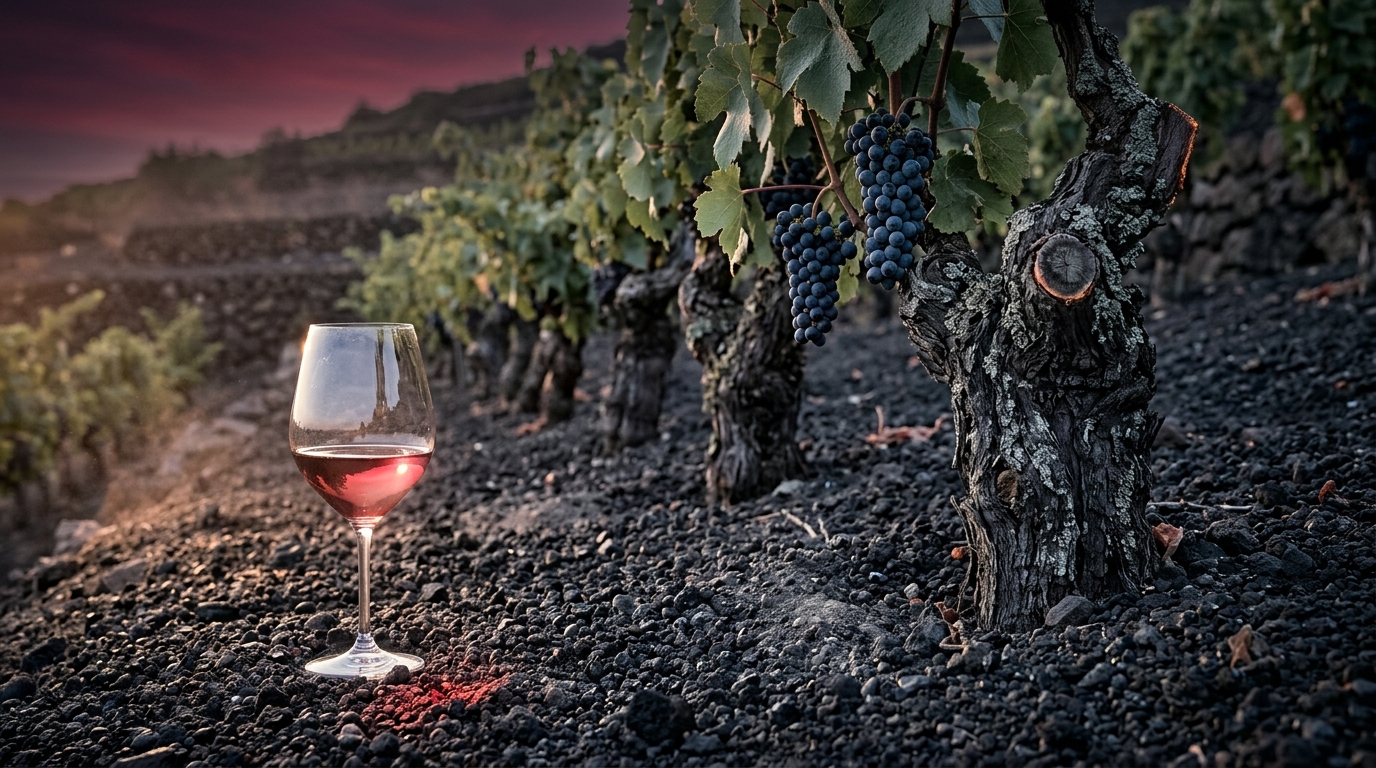
Start with Nerello Mascalese from Mount Etna, the closest thing in wine to a Sicilian Burgundy. Wine Folly's Nerello Mascalese profile reads medium-light body, medium tannin and 11.5 to 13.5 percent alcohol, with dried cherry, orange zest, dried thyme and a crushed-gravel minerality that comes off the volcano's black soil. It's savory before it's fruity, which is exactly the trade you want here.
Schiava, grown high up in Italy's Alto Adige and sometimes labelled Vernatsch, is the gentlest wine on the whole list. Wine Folly's Schiava profile puts it at 10 to 11.5 percent alcohol with low tannin, tasting of strawberry, rose and a faint smokiness. If what you like about Burgundy is its lightness and its lack of grip rather than its earthiness, this is the swap, and it's almost impossible to buy a heavy one.
Then there's the option nobody mentions, which is Pinot Noir itself from somewhere other than France. Germany calls it Spätburgunder and grows a great deal of it. The German Wine Institute records 11,519 hectares planted to Pinot Noir in 2023, around 11 percent of the country's entire vineyard area, which makes it Germany's number one red grape, with 5,029 hectares in Baden alone and 64 percent of the small Ahr region given over to it. German Pinot Noir is grown in a cool climate, picked at moderate ripeness and tastes broadly the way Burgundy drinkers want Pinot Noir to taste. It's the same grape, so it isn't really a substitute, and that's the point.
Further down the same road sit Trousseau and Poulsard from the Jura, two pale mountain reds that people either adore or find far too wispy. They're worth trying once you've decided lightness is what you're after.
Which wines work if you like ripe, fruit-forward Pinot Noir?
Go to Gamay first, and go to the named villages of Beaujolais rather than the cheap stuff. Wine Folly's Gamay profile puts its tannin at essentially none and its alcohol at 10 to 11.5 percent, with pomegranate, blackberry bramble and violet on top. It's brighter and bouncier than Pinot Noir and has more obvious fruit, which is why it works for people who like the New World style.
Gamay also isn't Pinot Noir's cousin, whatever every other article tells you. It's one of Pinot Noir's direct offspring. The Vitis International Variety Catalogue record for Gamay Noir gives its pedigree, confirmed by genetic markers, as Heunisch Weiss crossed with Pinot Noir, Heunisch Weiss being the old white grape usually called Gouais Blanc. We went through what that inheritance did to each of them in our piece on Gamay versus Pinot Noir.
Zweigelt and Saint Laurent, both Austrian, are the next stop. Zweigelt gives red cherry, raspberry and a twist of black pepper at low tannin, and Saint Laurent is a little fuller with raspberry, sweet tobacco and baking spice. Both are easy to like and neither asks anything of you. Frappato from Sicily is the third option, lighter still, tasting of dried strawberry and pomegranate with a whisper of white pepper.
One practical note that changes these wines more than the grape does. Every one of them is better with a short chill, and Wine Folly puts the serving window for Gamay, Schiava, Frappato and Nerello Mascalese at 55 to 60 degrees Fahrenheit, the same as Pinot Noir. Room temperature in an American house is nowhere near that. Twenty minutes in the fridge is the single cheapest upgrade available, and our guide to wine serving temperatures covers the rest.
Which Italian wines are similar to Pinot Noir?
Italy has more genuine options than anywhere else, which is why so many people search for this specifically. Nerello Mascalese from Etna and Schiava from the Alto Adige are the two closest, for the reasons above. Frappato is the brightest of them. Grignolino from Piedmont is the odd one out, since it makes a pale, fruity, high-acid red that comes close to Pinot Noir in aroma while carrying more tannin than its colour suggests. Bardolino, made around Lake Garda and led by Corvina, is the easiest of them to actually find in an American shop, and Wine Folly's Corvina profile notes that the grape gives light-bodied, low-tannin, high-acid wines in a style close to Beaujolais when the grapes are used fresh rather than dried for Amarone.
What Italy does not offer you, despite what half the internet says, is Nebbiolo. It shows up on almost every alternatives list because sommeliers love the comparison, and the comparison is real in one narrow sense, which is that both grapes make pale wines that taste strongly of where they grew. Everything else about it is wrong for this purpose.
Which Pinot Noir alternatives don't actually work?
Nebbiolo is the one to be careful with. Wine Folly's Nebbiolo profile reads medium-full body, high tannin and 13.5 to 15 percent alcohol, with a recommendation to decant it for an hour and a note that you should seek out fatty dishes to counteract the intense tannin. Pinot Noir is low tannin and 12 to 14 percent. The two wines look similar in the glass and feel nothing alike in the mouth, and if grip is the thing you avoid in red wine, this is the last grape you want. Our explainer on wine tannins covers what that texture actually is and why some people are so much more sensitive to it than others.
Blaufränkisch has the same problem in a milder form. Wine Folly's Blaufränkisch profile puts it at medium-high tannin and 13.5 to 15 percent, and recommends serving it warmer, at 60 to 68 degrees, which tells you it's built differently. It's a very good wine on any other evening, and it simply isn't the wine you're looking for here. Mencía from Bierzo is a closer call. Wine Folly's Mencía profile says outright that Pinot Noir drinkers will probably love it, and it's genuinely aromatic and floral, but the same page puts its alcohol at 13.5 to 15 percent and its tannin a step above Pinot Noir's, so treat it as an adjacent pleasure rather than a like-for-like swap.
Lambrusco turns up on these lists too, and it's sparkling, which is a fairly large difference to gloss over. Merlot and Shiraz get suggested by people who are thinking about color rather than structure. Merlot is softer than Pinot Noir but much fuller and darker, and Shiraz is a different wine in almost every respect.
How do you find a wine like the specific Pinot Noir you liked?
Everything above is routing by style, which is as far as an article can go, because we don't know which bottle is in your head. A page can tell you that savory Burgundy drinkers tend to get on with Etna Rosso. It can't tell you that the specific Sonoma Coast Pinot Noir you loved last November was unusually lean for its region and that the swap you want is therefore nothing like the swap your friend wants.
That gap is what Find Similar is for. You give Sommy one wine as an anchor, by typing the name, picking it out of your own history, scanning the label with Label Scan or just naming it while you're talking to Sommy Chat. Sommy then matches on how the wine behaves rather than what it's called, so it will happily cross a grape boundary when the wine on the other side is closer to what you enjoyed. There's a setting for either approach, one that stays near the grape and region and one that deliberately roams.

Two things about it are worth knowing before you try it. Every result carries an honest label for how close it is, from Strong down through Good, Fair and Loose to Stretch, so a reach is presented as a reach instead of being dressed up as a twin.
And you can keep going: tap any result and Sommy finds wines similar to that one, with a breadcrumb across the top showing the path you've taken and a tap-back to any earlier point if a branch stops being interesting. It won't show you a bottle twice in the same session, and the trail stops after five hops, because by then you've drifted too far from the wine you actually loved for the matches to mean much.

What do you ask for in a shop or a restaurant?
Ask for the structure, not the grape name. The sentence that works is some version of "I drink a lot of Pinot Noir and I'd like something light, high in acid and low in tannin", and then the useful half, which is whether you want it earthy or fruity. Any decent shop assistant can work with that, and it survives the very common situation where they have none of the eleven wines above.
If you're looking at a restaurant list rather than a person, the same filter applies. Scan the reds for the regions rather than the grapes, since Beaujolais, Alto Adige, Etna, Jura and Baden all signal the style you're after before you've recognised a single producer. Current Venue does that reading for you when the list is long and the table is waiting.
Frequently asked questions
What wines are similar to Pinot Noir?
Gamay, Schiava, Zweigelt, Frappato, Saint Laurent and Nerello Mascalese are the closest, because all of them share Pinot Noir's light to medium body, low tannin and bright acidity. Nerello Mascalese and Schiava suit people who like savory Old World Pinot Noir, while Gamay, Zweigelt and Frappato suit people who like the riper New World style.
What should I drink if I like Pinot Noir?
Start with a cru Beaujolais if you like your Pinot Noir fruity, or an Etna Rosso if you like it earthy. Both are widely available in the United States, both sit within a point or two of Pinot Noir on alcohol, and neither will hit you with tannin. German Spätburgunder is the other easy answer, since it's the same grape grown in a cool climate, and Germany has far more of it planted than most people outside the country realise.
What Italian wines are similar to Pinot Noir?
Nerello Mascalese from Etna and Schiava from the Alto Adige are the two closest Italian matches. Frappato from Sicily, Grignolino from Piedmont and Bardolino from Lake Garda are the next tier. Nebbiolo is the one to avoid despite how often it gets recommended, because its high tannin and higher alcohol make it feel nothing like Pinot Noir in the mouth.
Is Merlot similar to Pinot Noir?
Merlot is not a close match, though it's closer than most. Merlot is softer and rounder than most reds, which is why the two get mentioned together, but it's fuller bodied, darker and more tannic than Pinot Noir. We compared them directly in our piece on Merlot versus Pinot Noir, including which one is the safer buy at a given price.
Is Shiraz similar to Pinot Noir?
Shiraz is not similar to Pinot Noir in any useful way. Shiraz is full bodied, dark, peppery and high in both tannin and alcohol, which puts it at the opposite end of the red wine spectrum. If someone has recommended it as a Pinot Noir alternative, they're matching on the fact that both are red and little else.
What can I substitute for Pinot Noir in cooking?
Any dry, light to medium red with decent acidity and low tannin will do the job, so Gamay, Zweigelt and a light Sangiovese all work. Avoid anything very tannic or heavily oaked, because both concentrate as the sauce reduces and can turn bitter. Our guide to wine for beef bourguignon goes through what to cook with and what to drink alongside it.
Is Pinot Noir a sweet or a dry wine?
Pinot Noir is a dry wine. It often reads as sweeter than it is because ripe New World examples carry a lot of upfront red fruit and sometimes a touch of vanilla from oak, but the sugar has been fermented out. If a Pinot Noir tastes sweet to you, you're tasting fruit and alcohol rather than residual sugar.
What is a good but inexpensive Pinot Noir?
The reliable move is to look outside the famous names. Chile, Germany, southern France and the cooler corners of New Zealand all sell Pinot Noir well below what Burgundy and the Sonoma Coast ask. Our own view, which is a judgement rather than a measurement, is that most of that gap is the reputation of the address rather than the care in the cellar. Our piece on what makes the best Pinot Noir covers what you're actually paying for as the price climbs.

I have spent four decades building software. Wine was the one thing I never quite cracked: an ocean of possibility with no reliable way in. I wanted a tool that could tell me whether I'd like a bottle, not whether a critic did, and waited years for the technology to make it possible. Sommy is that tool. I write about wine from the data side. What 150,000 bottles look like when you try to predict a single person's palate.