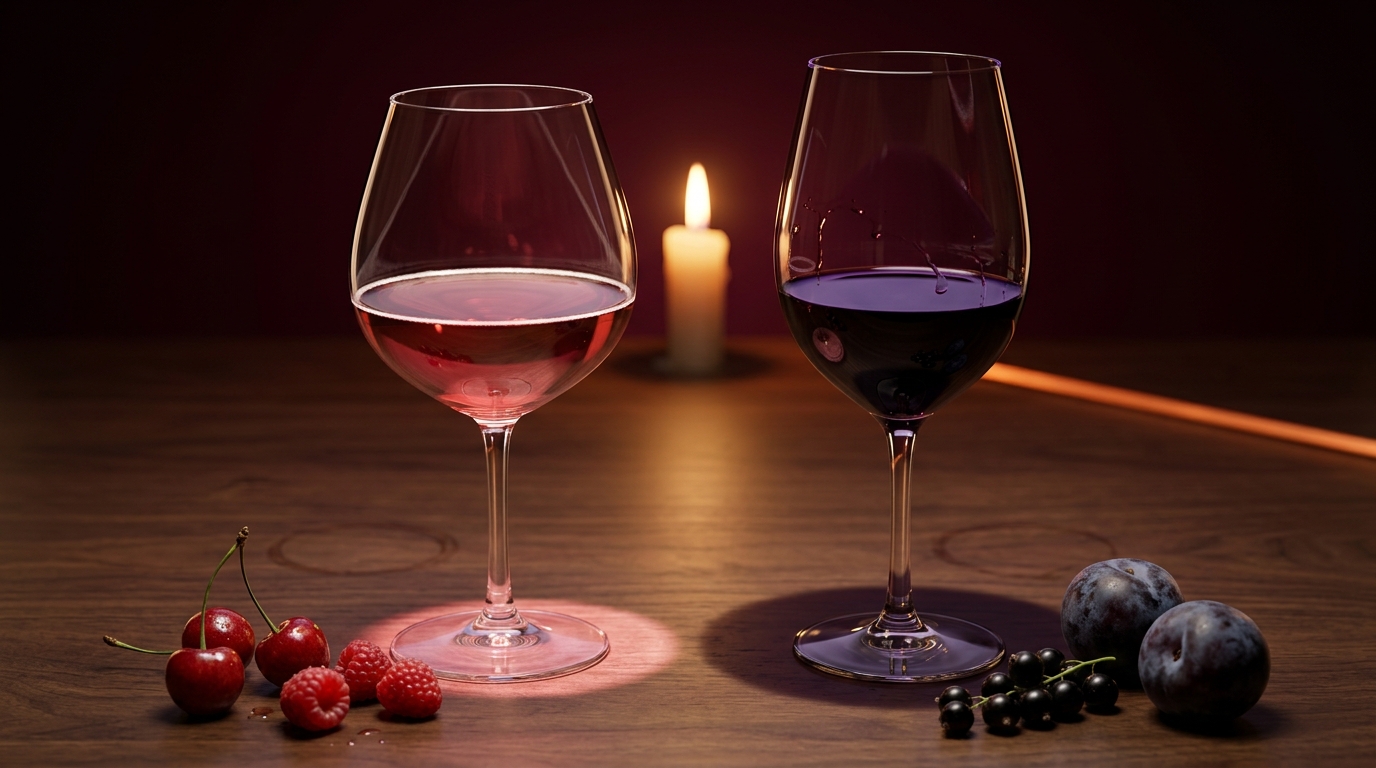


Merlot and Pinot Noir sit at opposite ends of the red wine range. Merlot is the fuller and darker of the two, built on plum and black cherry with a soft, rounded texture, while Pinot Noir is lighter and brighter, built on red cherry and cranberry with a savory, earthy edge underneath. Neither one is sweet in any meaningful sense, and neither is harder to enjoy than the other. The thing that actually decides which bottle you'll be happy with is the price you're paying, because two decades of American sales data show these two grapes ended up in very different places at the cheap end of the shelf.

What is the difference between Merlot and Pinot Noir?
The difference starts in the vineyard, with the skin of the grape. Pinot Noir has famously thin skins, and since color and tannin both come out of the skins during fermentation, the wine ends up pale, translucent and gentle on the gums. Merlot's skins are thicker, so the wine comes out deeper in color, rounder in the mouth and noticeably heavier on your palate. Everything else people say about these two wines follows from that one physical fact.
Merlot is also the workhorse of the most famous red wine region on earth. According to the Bordeaux wine council, Merlot makes up 60% of the appellation's plantings, well ahead of Cabernet Sauvignon, which means most everyday Bordeaux is a Merlot-led blend whether the label spells that out or not. Pinot Noir has the opposite reputation, as a grape that is difficult to grow, prone to disease and fussy about where it will ripen properly, which is a large part of why good bottles cost what they do.
Where each one grows tells you a lot about what to expect in the bottle. Merlot travels well and ripens almost anywhere, so it turns up as a varietal wine from Chile, Washington State, northern Italy, Australia and California as well as in the Bordeaux blends it was bred for, and it keeps roughly the same friendly character across all of them. Pinot Noir behaves differently, changing so much from one place to the next that two bottles can taste like unrelated wines. Burgundy leans savory and mineral, Oregon sits somewhere in the middle with bright red fruit, and warmer parts of California give a riper, softer style that sometimes edges toward the fuller shape people associate with Merlot. If you tried one Pinot Noir once and did not care for it, the region on the label may well have been the reason rather than the grape.
| Characteristic | Merlot | Pinot Noir |
|---|---|---|
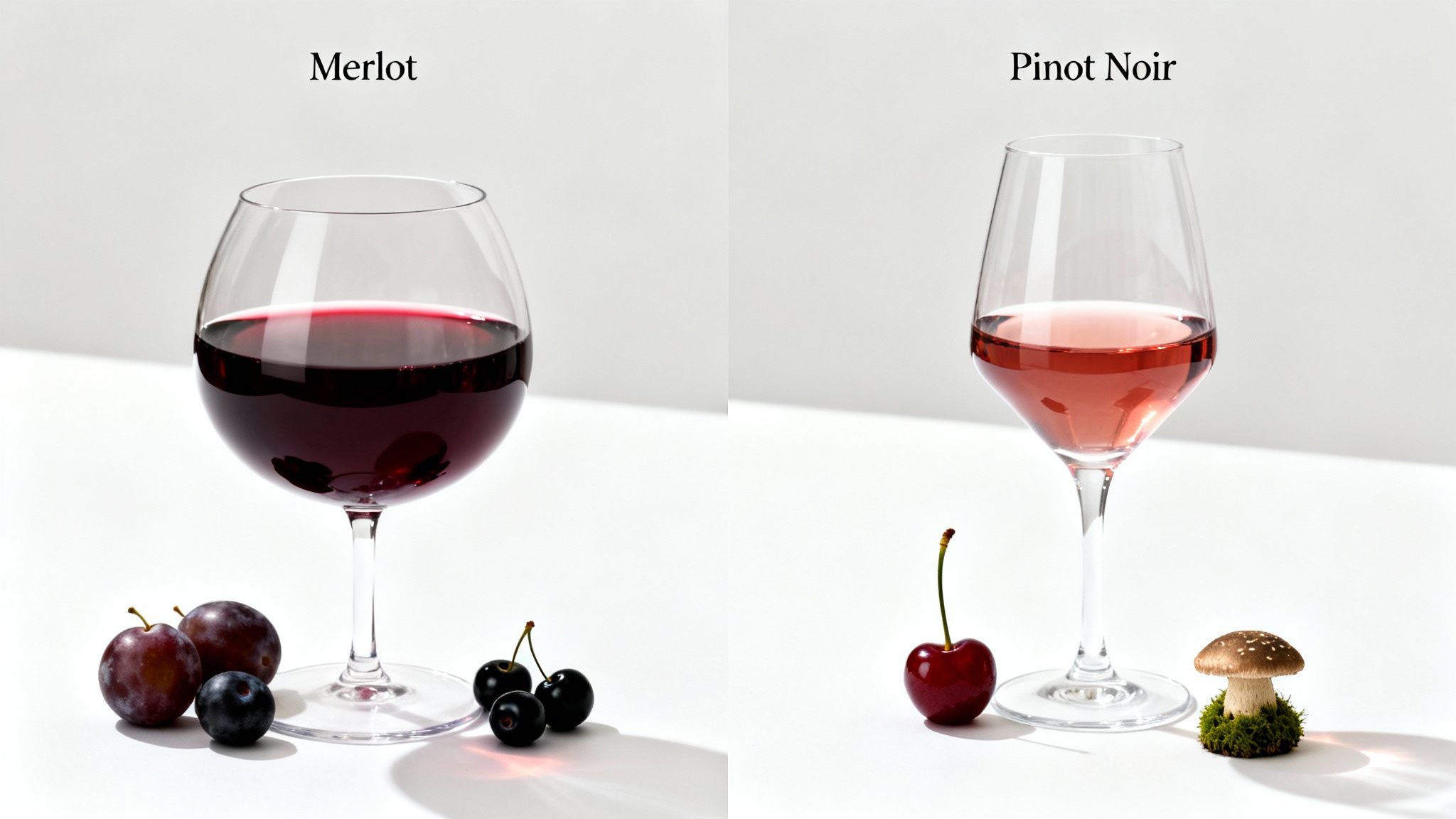
| Color in the glass | Deep ruby, opaque at the center | Pale garnet, you can see through it |
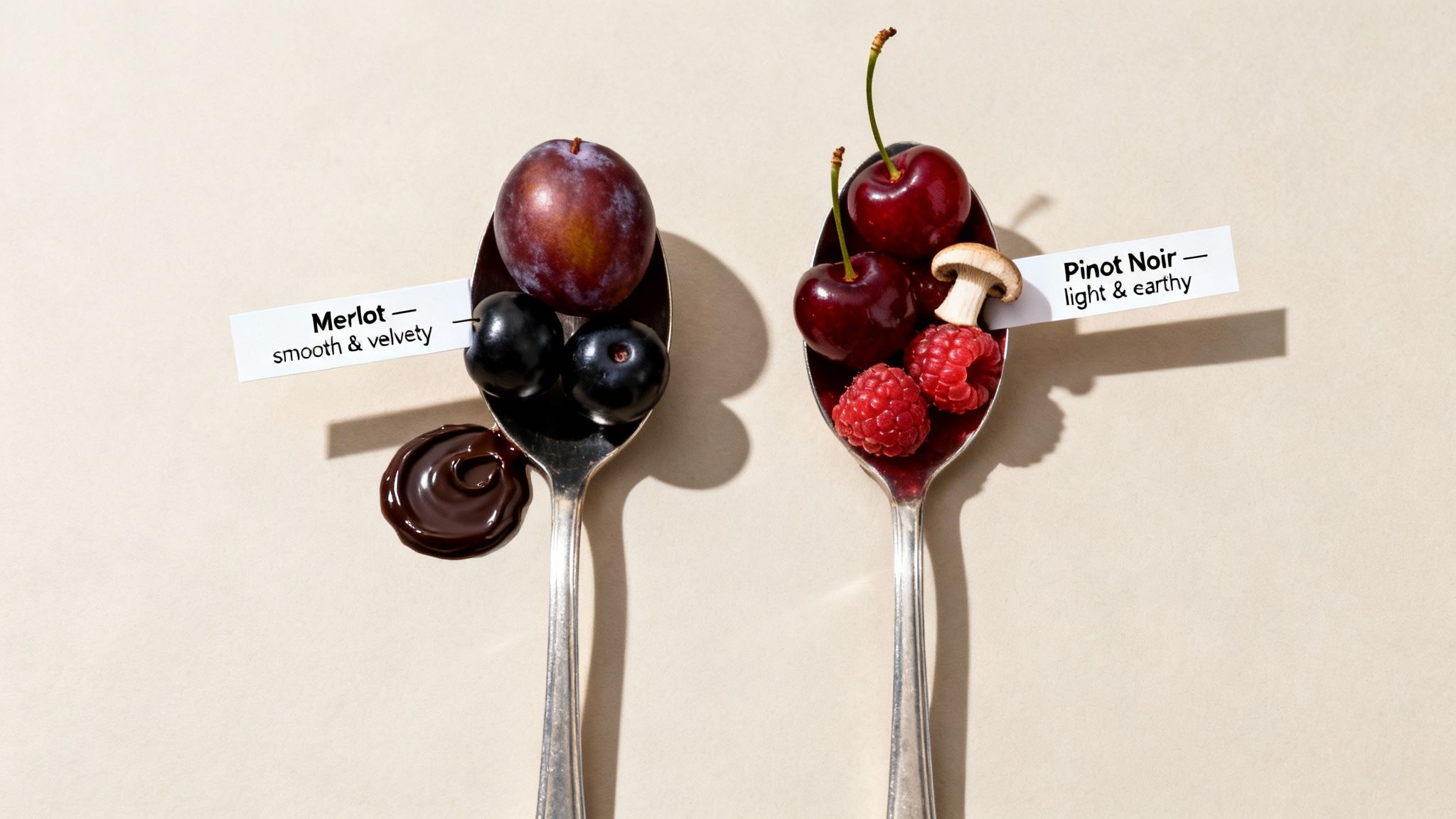
| Main flavors | Plum, black cherry, cocoa | Red cherry, cranberry, mushroom, forest floor |
| Body and texture | Medium to full, soft and rounded | Light, silky, higher acidity |
| Tannin | Moderate, smooth rather than grippy | Low, barely noticeable |
| Serve it at | 60 to 65F | 55 to 60F, a slight chill suits it |
| Where the good value sits | Reliable from about $12 upward | Gets interesting from about $25 upward |
Is Merlot or Pinot Noir sweeter?
Almost every Merlot and almost every Pinot Noir you can buy is a dry wine, meaning the yeast converted the grape sugar into alcohol and very little sugar survived. If one of them tastes sweeter to you, that is usually your palate reading ripe fruit flavor as sweetness rather than reading actual sugar, and Merlot's plummy, cocoa-edged fruit does trigger that impression more often than Pinot Noir's tarter red cherry does.
There is one honest exception, and it lives at the bottom of the price range. Inexpensive supermarket reds from either grape are sometimes finished with a few grams of residual sugar because a touch of sweetness makes a thin wine taste rounder and sells better in a blind sip. You will rarely see it declared on the front label, so the practical tell is the taste itself. If a $9 red leaves a faintly sticky impression on your lips, that is sugar covering for fruit that never fully ripened. Our guide to dry versus sweet wine goes through how to read that on a label before you buy.
Why did people stop drinking Merlot?
The blame lands on a single film, and for once the folklore survives contact with the evidence. Sideways arrived in American cinemas on October 22, 2004, its lead character spent the story praising Pinot Noir and refusing point blank to drink Merlot, and the wine trade has cited it for Merlot's fall from fashion ever since. What makes this case unusual is that somebody actually went and measured the effect rather than repeating the anecdote.
Steven Cuellar, Dan Karnowsky and Frederick Acosta pulled American retail scan data covering 1999 to 2008 and tested for a statistical break in the trend, using Cabernet Sauvignon and Syrah as a control group of reds the film never mentioned. Their paper, published in the Journal of Wine Economics in 2009, found the effect was real in both directions. Pinot Noir's price and case volume both rose significantly after the film, while Merlot's growth rate slowed and its price fell, and both changes held up against the control group.
The part that gets left out of the retelling is the size of it. The authors concluded that far from being devastating for Merlot, the boost the film gave Pinot Noir was larger than the damage it did to Merlot, and that the film lifted overall wine drinking in the process. Merlot never actually collapsed, it simply stopped growing, lost a little pricing power, and acquired a reputation problem that outlived the sales problem by roughly fifteen years.
Why price decides this more than your palate does
The most useful finding in that paper is the one nobody quotes. When the authors split the data into three price bands, under $10, $10 to $19.99 and $20 to $40, the effects landed in completely different places. Merlot's losses were confined mostly to bottles under $10, and its most expensive promoted tier actually grew despite the film. Pinot Noir gained across every price band, and gained most at $20 to $40.
Twenty years later that split is still visible on the shelf, and it flips the advice most articles give you. Cheap Merlot lost its casual buyers, so the producers who stayed in that category had to compete on something other than fashion, and a $12 to $15 Merlot today is one of the more dependable buys in the aisle. Cheap Pinot Noir got the opposite treatment. Demand ran ahead of the supply of fruit that could actually make good Pinot, and thin skins do not give you much to work with, so a lot of what sits under about $18 with Pinot Noir on the label is pale, hollow and sometimes quietly softened with sugar or blended out with other grapes to give it color.
So the practical rule is not that one grape is better. Under about $18 the odds favour Merlot, and if you love Pinot Noir it is worth saving up for a single $25 bottle instead of buying two at $12. Above $25 the question genuinely does come down to which style you prefer, and both grapes deliver at that price.
Which red wine is smoother, Merlot or Pinot Noir?
Both of them are, and the confusion comes from people using one word for two different sensations. Merlot is smooth in the sense of being soft and round and easy to swallow, with tannins that feel polished rather than drying, which is why it gets recommended to anyone who found Cabernet Sauvignon too astringent. If that texture is what you are after, our comparison of Cabernet Sauvignon and Merlot covers where the line between them sits.
Pinot Noir is smooth in the sense of being light and silky, with so little tannin that there is almost nothing to grip your palate at all. What it does have is acidity, and a bright, mouth-watering finish can read as sharp rather than smooth if you were expecting something plush. Tannin is the word doing most of the work in these descriptions, and if it has never quite made sense to you, our explainer on what tannins actually are is a better starting point than any tasting note.
People who like Pinot Noir for its lightness often end up enjoying Gamay for the same reasons at a friendlier price, which we get into in our look at Pinot Noir and Gamay as chilled reds. People who like Merlot for its plush fruit usually get on well with the softer end of Spain and Argentina, and our roundup of reds similar to Merlot covers where to go next.
How to tell them apart in the glass
You can usually call these two before you smell anything, because the color gives it away. Tip the glass away from you over something white and look at the rim where the wine thins out. Merlot holds its color almost to the edge and you will struggle to read print through the middle of it, while Pinot Noir fades to a watery orange-pink rim and stays see-through even in a full glass. That difference is the thin skins showing up in the finished wine rather than anything to do with quality, and a pale Pinot Noir is behaving exactly as it should.
The smell is the second tell. Merlot arrives as dark fruit with a slightly sweet, baked edge, plum and blackberry and sometimes cocoa or vanilla from the oak. Pinot Noir smells red rather than black, with cranberry and sour cherry sitting over something earthy that people describe as mushroom, damp leaves or the smell of a forest after rain. If you sniff a glass and the savory note arrives before the fruit does, you are almost certainly holding Pinot Noir.
What to eat with each one
Merlot has enough body and dark fruit to sit alongside food with real weight to it, so roasted and grilled meat, burgers, lamb, lasagna and anything in a rich tomato or mushroom sauce all work without much thought. Its tannin is moderate rather than aggressive, which means it handles cheese and charcuterie better than a big Cabernet does, and it will not fight a dish that has some sweetness in the sauce.

Pinot Noir works the other way round, brightening a dish instead of matching its weight. The acidity cuts through fat the way a squeeze of lemon does, which is why it is the standard red for salmon and tuna, and its earthy, savory side lines up naturally with mushrooms, duck, roast chicken and anything involving beetroot or lentils. It is also the most reliable red on a table where everyone is eating something different, since it rarely overwhelms anything. If you want the reasoning behind pairings like these rather than a list to memorise, our guide to pairing wine with food lays out the logic.
How to choose one in the aisle or off a wine list
In a shop, let the price decide first and the style decide second. If your budget is around $12 to $15, reach for the Merlot, and look for one from Bordeaux, Chile or Washington State rather than the biggest brand on the end cap. If you can stretch to $25 or so and you want something lighter and more perfumed, that is where Pinot Noir starts repaying the money, with Oregon, Chile and the cooler corners of California all offering honest bottles at that level.
In a restaurant the calculation changes, because the markup magnifies everything. A by-the-glass Pinot Noir on a mid-range list is often the cheapest Pinot the venue could find, whereas the Merlot in the same slot is more likely to be a decent wine that nobody orders. That is one of the few places where ordering the less fashionable grape genuinely gets you a better glass. Standing in front of a specific bottle and wondering whether it suits you is exactly the moment Sommy's Fit Check is built for, since it reads the actual wine in front of you against your Taste Profile rather than against the average drinker.
Neither grape is the safe answer or the sophisticated one. Merlot is the better bet cheap, Pinot Noir is the better bet once you spend a bit, and the only opinion that settles it is yours.
Common questions about Merlot and Pinot Noir
Which is healthier, Merlot or Pinot Noir?
There is no meaningful health difference between them, and we would not recommend choosing a wine on that basis. Pinot Noir from a cool region often carries a little less alcohol than a ripe Merlot does, so the same size glass can be a slightly smaller drink, and the label will tell you which is which before you pour.
Which one is better for someone new to red wine?
Merlot, mostly because it is more forgiving of a low budget. A beginner buying a $13 Merlot will usually get something soft and pleasant, while a beginner buying a $13 Pinot Noir has a decent chance of getting something thin and being put off the grape for years by a bottle that was never representative of it.
Why is Pinot Noir usually more expensive?
It is a genuinely difficult grape to farm. The thin skins that make the wine so delicate also make the fruit vulnerable to rot and sunburn, the vines crop lightly, and the grape only ripens well in cool regions where land is limited. Lower yields and higher risk both end up in the price.
Does Merlot age well?
The everyday bottles are made to drink now and will not improve with time in a cupboard. Serious Merlot from the right bank of Bordeaux ages for decades, but that is a different category of wine at a different price, and nothing you buy for a Tuesday needs keeping.