

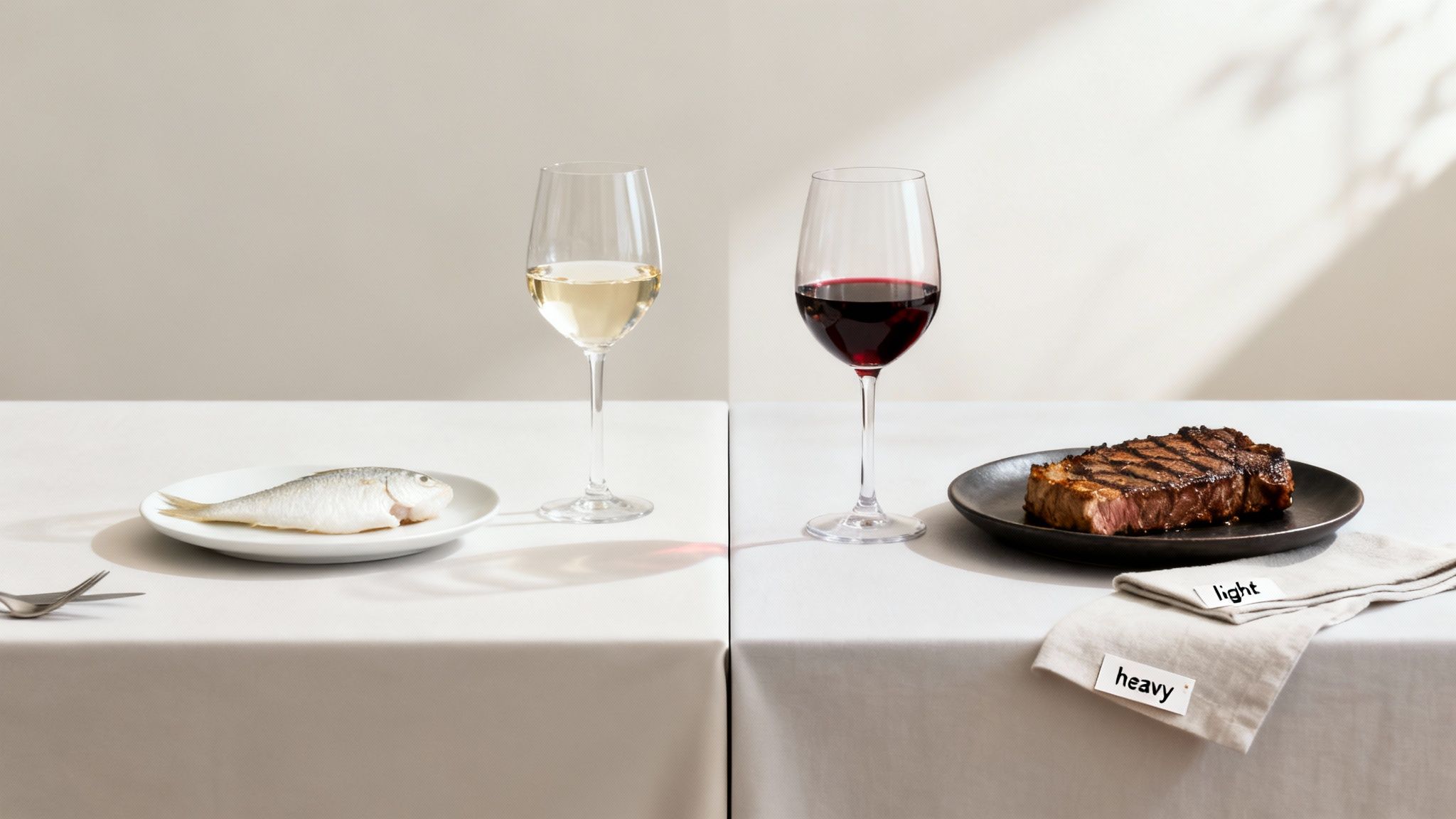
To pair wine with food, match the weight of the dish to the weight of the wine, then decide whether you want the wine to echo the dish or cut against it. A light, fresh meal wants a light, crisp wine, and a rich, heavy meal wants a bold, full-bodied one. Those two decisions cover almost every pairing you'll ever make, and neither of them requires you to memorize a single grape variety.
Most pairing advice either explains the theory and leaves you stranded at the shop, or hands you a list of matches without telling you why any of them work. This guide does both, and it also covers the part nobody writes about: what to do when the pairing you chose isn't working and dinner is already on the table.
What's the one rule that makes pairing easy?
Match the intensity of the wine to the intensity of the food. Ask yourself whether the dish is light and delicate or rich and hearty, and reach for a wine of roughly the same size. A powerful wine will flatten a delicate dish, and a light wine will vanish next to a heavy one, so matching weight keeps either from bullying the other off the table.
Light food, light wine
Light dishes taste fresh and clean, and they're usually cooked quickly: salads, grilled fish, sushi, steamed vegetables, or chicken with lemon and herbs. Look for wines described as crisp, bright, or zesty, which in practice means something like Sauvignon Blanc, Pinot Grigio, or a dry rosé.
Heavy food, heavy wine
Heavy dishes are rich and satisfying, and they tend to involve slow cooking, red meat, or a cream sauce. Braised short ribs, lasagna, steak, and creamy pasta all need a wine with enough presence to stand next to them, so look for the words bold, rich, or full-bodied, and think Cabernet Sauvignon, Malbec, or an oaked Chardonnay.
| If Your Food Is... | Look For a Wine That Is... | Quick Examples |
|---|---|---|
| Light and delicate (salads, fish) | Light-bodied (crisp, refreshing) | Sauvignon Blanc, Pinot Grigio, rosé |
| Medium intensity (chicken, pork) | Medium-bodied (smooth, balanced) | Chardonnay, Pinot Noir, Chianti |
| Rich and heavy (steak, stews) | Full-bodied (bold, powerful) | Cabernet Sauvignon, Malbec, Syrah |
What are congruent and complementary pairings?
A congruent pairing puts a shared flavor on both sides of the table, and a complementary pairing uses the wine to balance something the dish has too much of. Every pairing you've ever enjoyed was doing one of those two jobs, and knowing which one you're aiming for turns a guess into a decision.
Think about a creamy baked pasta for a moment. If you pour an oaked Chardonnay, the wine's own creamy, buttery texture runs alongside the sauce and the whole plate feels richer and rounder, which is a congruent pairing. If you pour a sharp Pinot Grigio instead, the acidity slices straight through that richness and resets your mouth between bites, which is a complementary pairing. The same dish, two completely different but equally good evenings, and the only thing you changed was which job you gave the wine.
Neither approach is more correct than the other. Congruent pairings feel warm and indulgent, so they suit a slow winter dinner, while complementary pairings feel refreshing and keep a heavy plate from wearing you out. Deciding which mood you're after is often faster than deciding which grape you want, and it narrows a wine list far more quickly.
Which tastes actually decide a pairing?
Six taste elements do the real work: salt, acid, sweetness, bitterness, fat, and spicy heat. Food can carry all six, but wine really only brings three of them to the table, since wine expresses acidity, sweetness, and bitterness (which arrives as tannin in reds) and almost never brings saltiness, fat, or chili heat of its own.
That imbalance is exactly why pairing works. You're using the three things wine has to answer the six things your dinner has, and each pairing below is just one of those answers.
| Your Dish Is Strong In... | What the Wine Should Bring | Why It Works |
|---|---|---|
| Fat (steak, cheese, cream) | Tannin or high acidity | Both scrub the richness off your palate so the next bite tastes like the first |
| Salt (cured meat, olives, fries) | Acidity or bubbles | Salt softens tannin and makes a crisp wine taste fruitier |
| Acid (tomato, vinaigrette, citrus) | Even more acidity | A wine less tart than the food will taste flat and watery beside it |
| Sweetness (glazes, desserts) | More sweetness than the plate | A dry wine next to a sweet dish tastes sour and thin |
| Spicy heat (chili, curry) | A little sweetness, low alcohol, low tannin | Sweetness cools the burn while alcohol and tannin amplify it |
| Bitterness (char, greens, radicchio) | Fruit and softness, not tannin | Two bitter elements stack up and turn harsh together |
Two of those lines are worth committing to memory, because they explain most pairings that go wrong. Your wine should be more acidic than your food, and it should be sweeter than your food. Break either rule and the wine tastes thin and sour, which is why a dry sparkling wine collapses next to wedding cake and a lovely Chardonnay turns to water beside a lemony salad.
Why pair to the sauce instead of the protein?
Because the sauce is usually where the strongest flavors live, and the wine responds to whatever is strongest. A plain roasted chicken breast is close to a blank canvas, so pairing to the chicken tells you almost nothing useful about which bottle to open.
Put that same chicken under a creamy mushroom sauce and it's now a rich, earthy, fatty dish that wants a lightly oaked Chardonnay or an earthy Pinot Noir. Brush it with a sweet, spicy barbecue glaze instead and it becomes a sweet-and-hot dish that wants a fruity red with soft tannin, or an off-dry rosé. The bird never changed, but the right wine did, twice.
So read your plate for its loudest element rather than its headline ingredient. If you're standing over a recipe and can't tell which flavor is going to dominate, this is the moment Sommy's Pairing feature is genuinely useful, because you can point your camera at the recipe or the finished dish and get a recommendation built around the sauce rather than the protein.
How do you choose wine in a restaurant or a store?
Decide what you're eating first, name the single loudest flavor in it, then scan for wine described in words that answer that flavor. The theory above only pays off if it survives contact with a four-page wine list or a shop with three hundred bottles, and the trick in both places is narrowing fast rather than knowing more.
Reading a restaurant wine list
Order your food first, because the meal leads the decision and choosing the wine first just makes the pairing harder. Once you know what's coming, look through the menu description for the dominant element, whether that's a cream sauce, a sharp vinaigrette, or a smoky spice rub.
Then take that one word to the list. Many lists include short descriptions like crisp, bold, fruity, or smooth, and those are worth more to you than the grape names beside them. The wines by the glass are a good place to start, since they're a curated set the restaurant is confident about and pair well with plenty of the menu. Asking is the fastest route of all, and a sentence like "I'm having the salmon with lemon dill sauce, and I'd like something crisp around $50" gives your server everything they need while sounding clear rather than uncertain.
Working a crowded wine aisle
A shop gives you no server and endless options, so the job is elimination. Fix your meal and your budget before you walk in, since those two limits alone remove most of the shelf, then read the shelf talkers and back labels for the same descriptive words you'd look for on a menu. Something labeled rich and jammy is pointed at your barbecue, and something bright and zesty is pointed at your shrimp scampi.
Staying inside one price band also helps more than people expect, because most of the fatigue in a wine shop comes from weighing bottles you were never going to buy. Our guide on how to choose wine confidently goes further into these real-world moments, and if the label itself is the obstacle, Sommy's Vision label scan reads the bottle in front of you and tells you whether it fits your Taste Profile, the living picture of your palate that sharpens every time you rate something.
Which classic pairings work, and why?
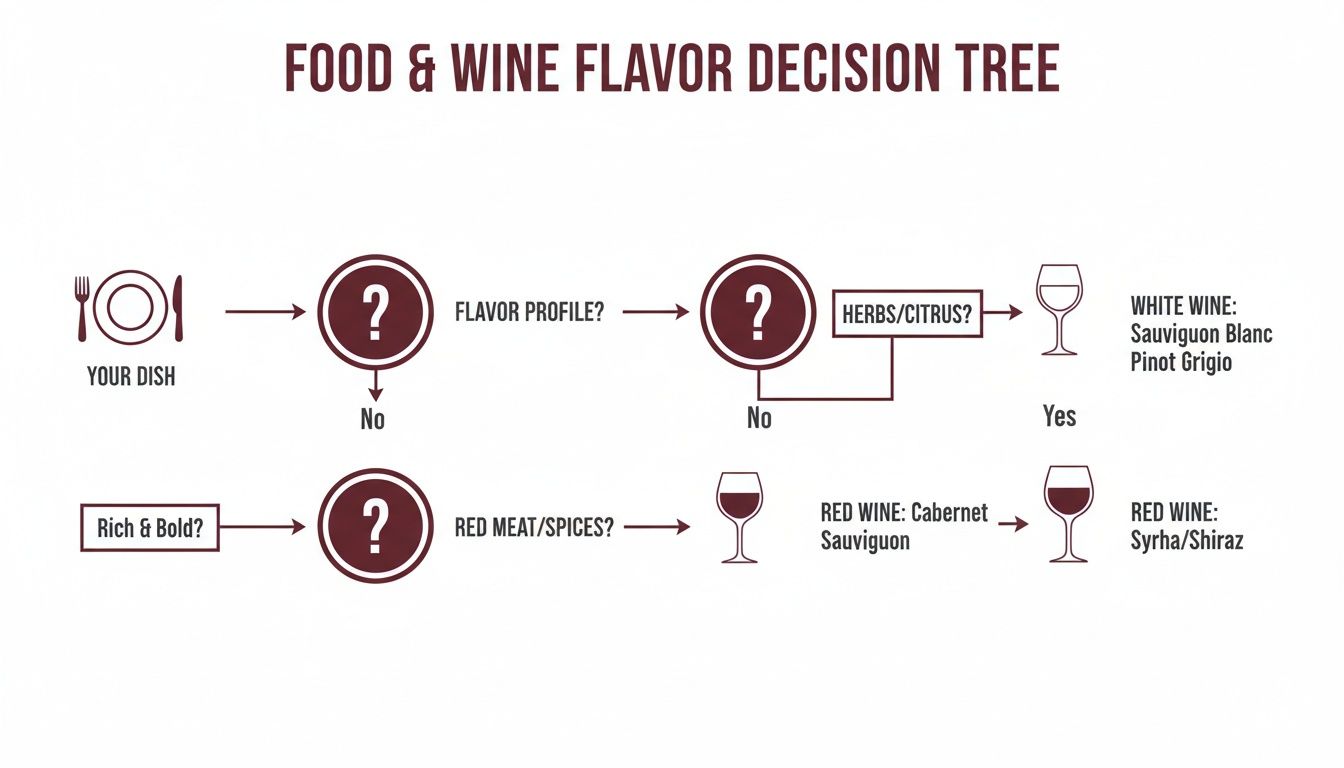
The famous pairings are famous because each one solves a specific taste problem, and reading them as solutions rather than as rules lets you apply the same logic to a meal nobody has written about. A rich steak works with Cabernet Sauvignon because the wine's tannin has enough grip to cut the fat, and delicate grilled fish works with Sauvignon Blanc because the wine's acidity does what a squeeze of lemon does.
Spicy takeout is the one that trips people up, since a big tannic red will make the chili burn hotter rather than calmer, while an off-dry Riesling or Gewürztraminer cools the heat with a touch of sweetness. A cheese board is the easiest of the lot, because a dry rosé has the acidity to handle soft creamy cheeses and just enough red fruit for the aged, harder ones.
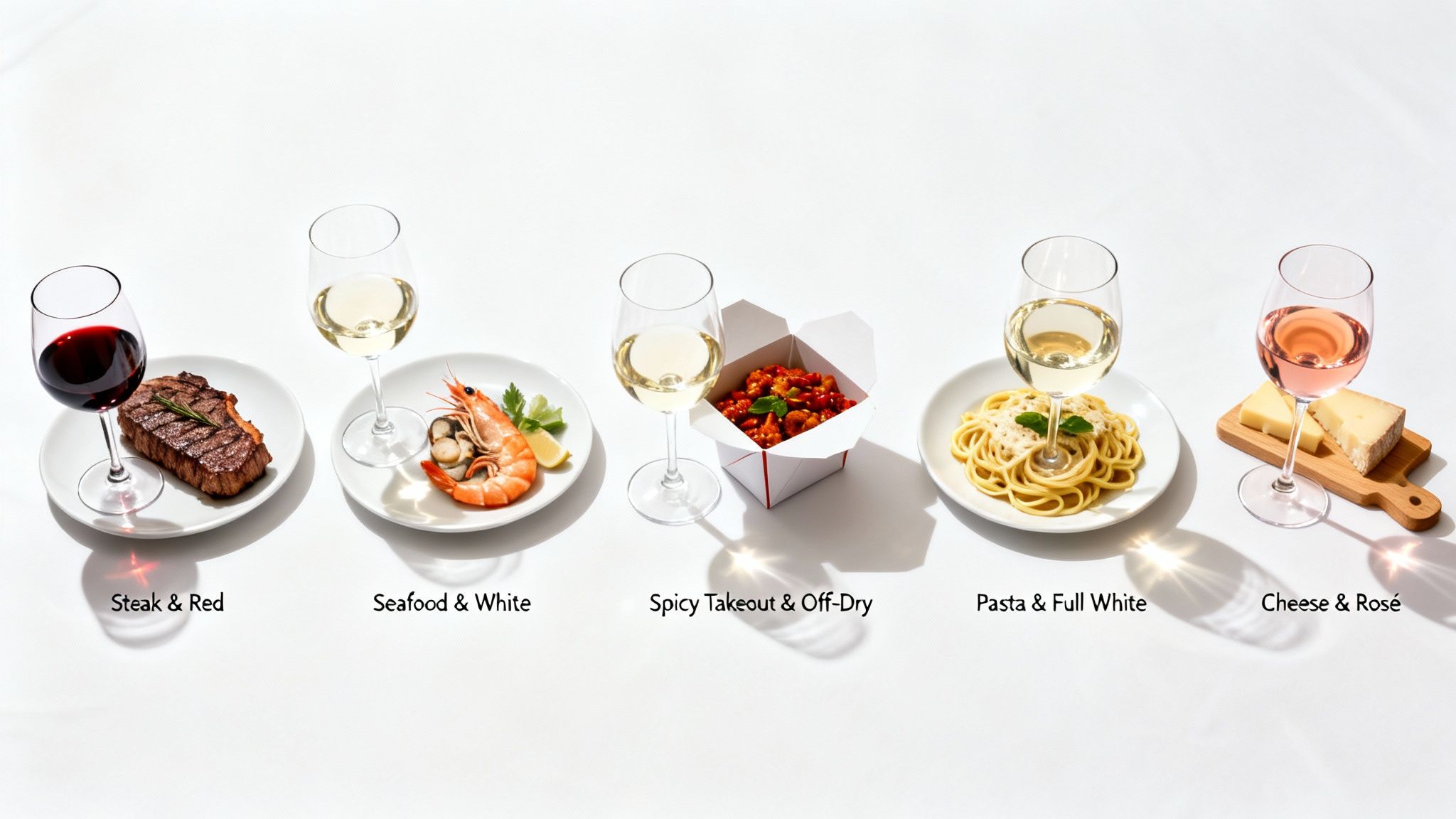
| The Dish | The Wine | The Taste Problem It Solves |
|---|---|---|
| Rich steak | Bold red (Cabernet Sauvignon) | Tannin cuts fat, and the weights match |
| Delicate fish | Crisp white (Sauvignon Blanc) | Acidity works like a squeeze of lemon |
| Spicy curry | Off-dry white (Riesling) | Sweetness cools chili heat |
| Creamy pasta | Oaked Chardonnay or Pinot Grigio | Echo the cream, or cut through it |
| Cheese board | Dry rosé | Acid for soft cheese, fruit for hard cheese |
What do you do when a pairing isn't working?
Adjust the plate rather than opening another bottle, because a small change to the food fixes most mismatches in about thirty seconds. This happens to everyone, and a pairing that doesn't click is information about your own taste rather than a mistake you made.
If the wine is steamrolling the food, put something neutral between them, since a bite of plain bread or a cracker resets your palate and gives the dish room to be tasted again. If the food is steamrolling the wine, which is what usually happens with spicy takeout, add fat: a spoonful of sour cream on a taco or a drizzle of olive oil over fiery pasta coats your mouth, dulls the burn, and lets the wine's flavors come back into focus.
A few foods are genuinely difficult and worth knowing in advance. Asparagus and artichokes contain compounds that can make many wines taste metallic, and a crisp unoaked white such as Sauvignon Blanc is the reliable escape. Vinegar-heavy dressings flatten most wines, so the answer there is to fight acid with acid and pour something even sharper than the salad.
Common wine pairing questions
Do I have to follow the red wine with meat rule?
No, and it's the rule most worth dropping. Match weight instead of color, because a light-bodied red like Pinot Noir is excellent with salmon, and a full-bodied white will happily stand up to pork chops.
What's a safe wine to bring to a dinner party?
A dry rosé is the most flexible bottle you can carry, since it has white-wine acidity and light red fruit, so it bridges almost any menu. A crisp Sauvignon Blanc or a light Pinot Noir will do the same job if rosé isn't your thing.
How much does the sauce really matter?
More than the protein, nine times out of ten. Target the loudest flavor on the plate, and on most plates that's the sauce or the seasoning rather than the meat underneath it.
Should the wine be sweeter than the dessert?
Yes, and it's one of the few pairing rules worth treating as absolute. A dry wine beside a sweet dish tastes sour and hollow, which is why a brut sparkling wine fights with wedding cake while a sweeter sparkling wine sits beside it comfortably.
Does an expensive bottle make a better pairing?
Not really, because pairing rewards the right structure rather than the higher price. A $15 off-dry Riesling will beat a $90 Cabernet Sauvignon next to a hot green curry every single time.
What if I only like one kind of wine?
Then start from the wine and choose food that suits it, which is a perfectly good way around the problem. If you drink mostly Cabernet Sauvignon, lean toward richer, fattier dishes that give the tannin something to work against.
Making your next choice easier
Pairing well comes down to matching weight, deciding whether you want the wine to echo the dish or cut through it, and answering the loudest taste on the plate. Everything else is detail you can pick up over time, and the best pairing is still the one you actually enjoy drinking.
If you'd rather not run that calculation in the middle of a restaurant, that's what Sommy is built for. You can ask Sommy Chat what to drink with tonight's dinner, scan a bottle or a wine list with Vision, and get a recommendation shaped by your own Taste Profile rather than a generic chart. For a wider set of dish-by-dish matches, our wine pairing guide covers a lot more ground, and if you're still working out what you like in the first place, the guide to building a personal wine profile is the place to start.