
A wine scanner app is a mobile app that uses your phone's camera to recognize a wine from its label, then pulls up tasting notes, ratings, food pairings, and local prices in a few seconds. Think of it as a pocket sommelier: point it at a bottle, and the guesswork turns into a confident choice.
What a Wine Scanner App Does for You
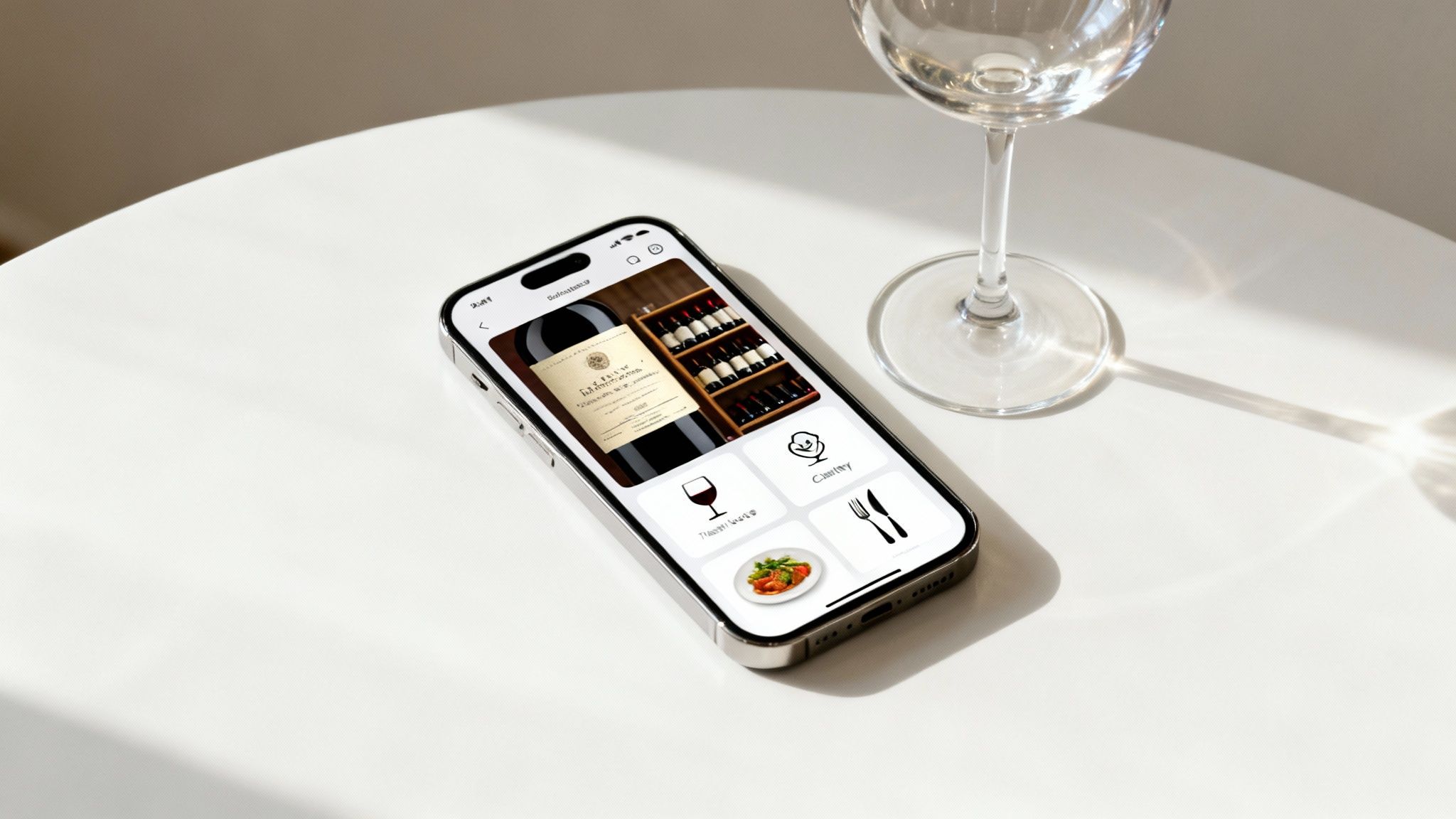
You're standing in the wine aisle, staring at a wall of bottles. Or you're at dinner with a long list of names you've never heard of. A wine scanner app cuts through that noise. One quick scan gives you information that used to be reserved for experts:
- Instant knowledge: the grape, the region, and what the wine is meant to taste like.
- Community ratings: aggregated scores and reviews from other drinkers, so you get a feel for a bottle before you commit.
- Price checks: what a bottle sells for nearby and online, so you don't overpay.
- Food pairings: ideas for what to serve, which helps when you need to decode a restaurant wine list.
The best apps go one step further: instead of only showing you what is popular, they learn what you like and point you to bottles that fit your own taste.
How a Wine Scanner App Works
The few seconds between snapping a photo and getting a screen full of details come down to a simple three-part flow: see, match, then think.
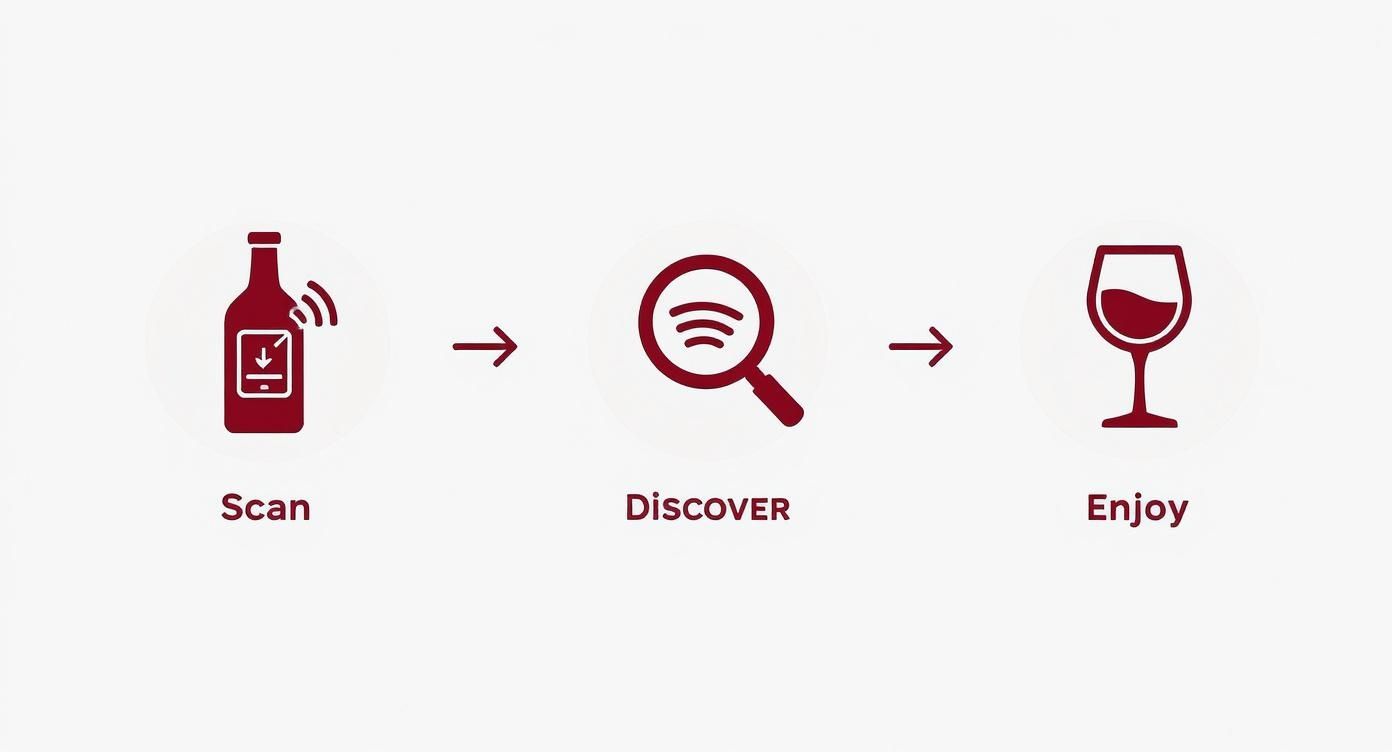
Step 1: Image recognition
First, the app uses image recognition to read the label. Its algorithm looks for unique features: the winery name, the vintage, the logo, even the fonts and artwork. Trained on millions of labels, it can pick out the key details even in dim restaurant lighting or at an awkward angle.
Step 2: Data matching
Once the app has a solid read, it checks that visual information against a database of millions of wines and finds the match in a fraction of a second. That is where it pulls the grape, the region, professional reviews, tasting notes from other drinkers, and average prices.
Step 3: AI and personalization
This is where a great app stands apart. Every time you scan, save, or rate a wine, a smart app notes your preferences and builds a personal taste profile, a lot like the way a streaming service learns which shows you prefer. Instead of only telling you what is popular, it can suggest a new bottle you are likely to love based on your past choices. Sommy is built around this idea.
Features to Look For in a Great Wine App
Instant label recognition is just the price of entry. The features below are what separate a basic scanner from a tool you actually keep using, and our roundup of the best wine apps sorted by what you need groups the whole category the same way.
| Feature | What It Does | Why It Matters |
|---|---|---|
| Label recognition | Identifies a wine from a photo of the label. | The basic starting point. Accuracy is everything. |
| Wine database | Provides region, grape, and producer details. | Gives you the facts about the bottle in your hand. |
| Community ratings | Shows average scores and reviews from users. | A quick sense of a wine's popularity and style. |
| Personal notes | Lets you save your own rating and notes. | Helps you remember what you liked for next time. |
| Price comparison | Checks prices at local and online retailers. | Helps you shop smart and avoid overpaying. |
| Personalized recommendations | AI learns your taste and suggests new wines. | Turns a lookup tool into a real discovery engine. |
| Food pairing | Suggests pairings based on the wine's profile. | Takes the guesswork out of matching wine and food. |
| Cellar management | Tracks your collection, quantity, and location. | Useful if you buy more wine than you drink in a week. |
The Main Wine Scanner Apps Compared
Most "wine scanner app" searches really mean one question: which one should I download? Here is an honest look at the main options and what each does best.
- Vivino: the most popular option and the biggest crowd-sourced database. Scan a label or a restaurant menu, see a community rating, and buy through its marketplace. The best all-rounder for a fast second opinion, though its rating is the crowd's average, not yours.
- Wine-Searcher: the one to reach for on price. Scan a bottle and it shows what that wine costs across retailers and where to buy it near you. Less about taste guidance, more about not overpaying.
- Delectable: favored by enthusiasts and industry pros, with strong tasting notes and a following-people social layer. Great if you like seeing what sommeliers are drinking.
- Hello Vino: simple and beginner-friendly, built around quick recommendations and food pairings rather than a deep database.
- Sommy: instead of showing the crowd average, Sommy learns your Taste Profile from every wine you rate and tells you whether a specific bottle actually fits you with a Fit Check. Scan a label, a shelf, or a restaurant list and get a pick matched to your palate, not everyone else's.
| App | Best For | Cost | Standout |
|---|---|---|---|
| Vivino | A fast second opinion | Free, with a marketplace | Biggest crowd-sourced database |
| Wine-Searcher | Checking price and availability | Free, paid Pro tier | Price data across retailers |
| Delectable | Enthusiasts and pros | Free | Tasting notes and a social feed |
| Hello Vino | Beginners | Free | Simple pairings and picks |
| Sommy | Recommendations for your taste | Free | Taste Profile and Fit Check |
The short version: use Vivino for a quick crowd rating, Wine-Searcher for price, Delectable for the enthusiast community, and an AI app like Sommy when you want a recommendation built around your own taste. For a wider look at the category, see our guide to the best wine app for iPhone.
How to Get the Most Accurate Scans
Recognition is good, but a few habits make it near-instant and cut down on misses:
- Fill the frame with the label. Get close enough that the front label fills most of the screen, and hold steady for a beat so the photo is sharp.
- Scan the front, not the back. The front label has the winery name, vintage, and artwork the app is trained on. Back labels and barcodes are far less reliable.
- Find better light. Restaurant candlelight is the usual culprit behind a failed scan. Angle the bottle toward any light source, or use your phone's flashlight in a pinch.
- Type it in when a scan fails. For a rare or very new bottle that isn't in the database yet, searching the producer and wine name by hand usually finds it.
- Scan the whole list. Many apps can read a restaurant wine list or a store shelf, not just one bottle, and surface the best matches for you at once.
How to Choose the Right Wine Scanner App
Start with one question: what problem am I trying to solve? Your answer cuts the list in half.
- The casual explorer: you want to make sense of the wine aisle and get a good pick for dinner. Prioritize a clean interface and strong food pairing.
- The social drinker: wine is about sharing finds. Look for social features like shareable wish lists and the ability to follow friends.
- The serious collector: you are building a cellar, so inventory tracking (purchase price, location, drinking windows) matters most.
Whichever camp you fall into, three fundamentals separate a keeper from a delete:
- Recognition accuracy and speed: a good app identifies a bottle almost instantly, even in moody restaurant lighting. If it keeps failing, you end up typing everything by hand, which defeats the point.
- Database depth: a large library means the app finds not just big names but the interesting small-producer bottle you stumbled on. Check that it covers the wines you actually drink.
- Recommendation quality: this is the real difference maker. An app that learns your palate becomes a trusted advisor instead of a search box.
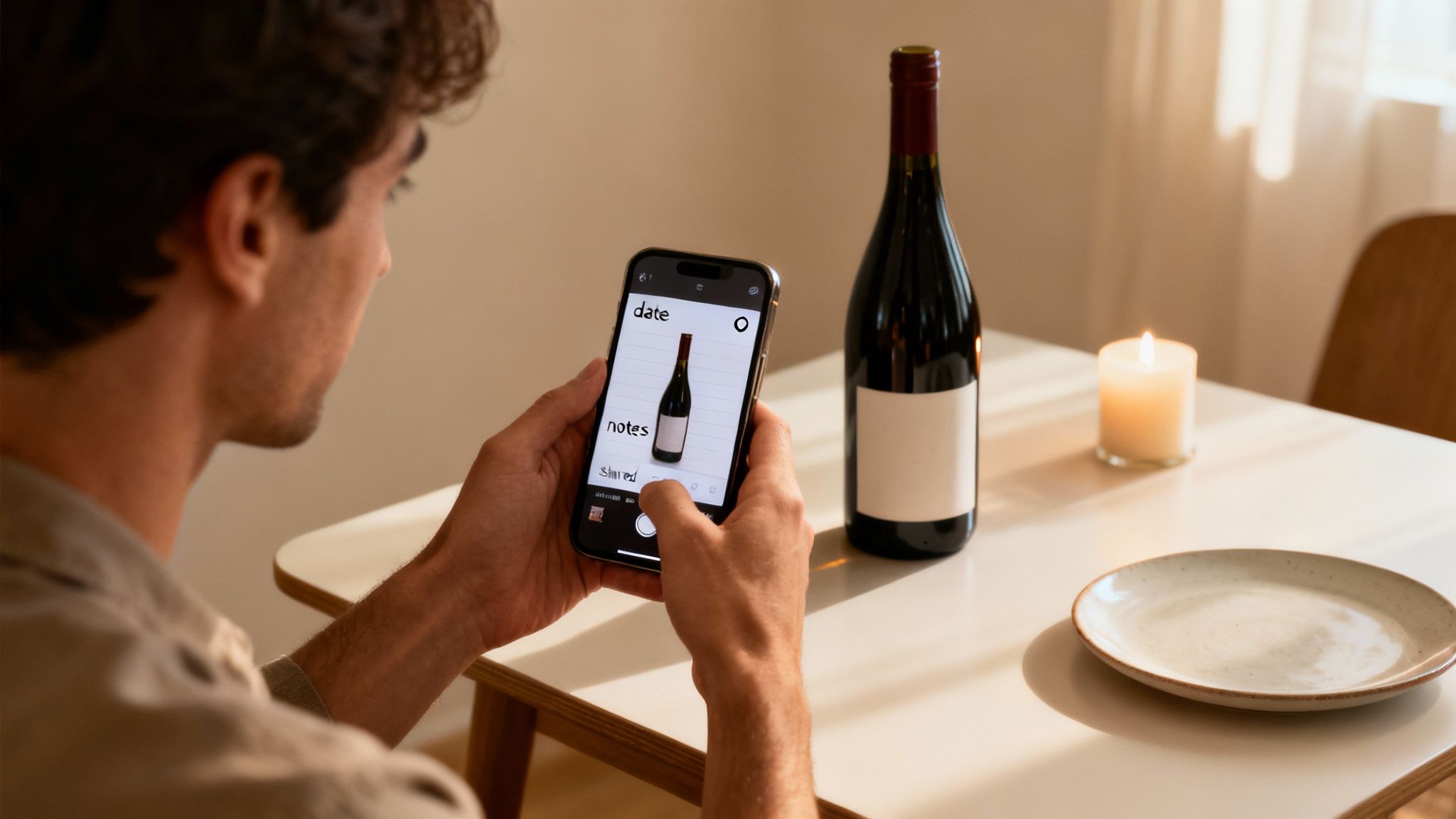
That last point is where an AI app like Sommy separates from a crowd-rating tool. It builds a personal taste profile and learns your preferences for specific grapes, regions, and styles, so its recommendations feel like they came from someone who knows you, not from the general public.
Where Wine Scanner Apps Fall Short
These apps are genuinely useful, but it helps to know their limits before you lean on them too hard:
- A crowd rating is not your rating. A wine averaging 3.8 stars can still be wrong for you if it is a bold, oaky style and you like things crisp and light. Popularity and personal fit are different things.
- The database has gaps. Small producers, brand-new releases, and private-label store bottles are the ones most likely to come back as "not found."
- Scores can be gamed or thin. A wine with only a handful of ratings, or one tied to a marketplace that wants to sell it, deserves a little skepticism.
- No app can taste for you. Scanning tells you what a bottle is and what others think, but building real confidence still comes from tasting and tracking what you personally enjoy.
The fix for most of these is an app that learns your own palate over time, so its picks improve the more you use it instead of always handing you the crowd average.
Common Questions About Wine Scanner Apps
How accurate are wine scanner apps?
For the everyday bottles you meet in a shop or on a wine list, the leading apps are very accurate and identify most common labels instantly, using image recognition tied to large, constantly updated databases. Accuracy drops with poor lighting, a torn label, or a rare vintage that isn't in the system yet, but those are the exceptions.
Can an app really recommend wines I will enjoy?
Yes, if it uses AI to learn your taste. Basic scanners lean on generic crowd-sourced ratings, while an app like Sommy builds a personal taste profile from every wine you scan and rate. Over time its picks get genuinely personal, guiding you toward wines that fit your palate rather than what is popular with everyone.
Are wine scanner apps free?
Most are free to download and scan, and make money through a marketplace, retailer links, or an optional paid tier with extra features. You can get real value without paying, so it is worth trying a couple before you settle on one.
Can I scan a wine list or menu, not just a bottle?
Yes. Most modern apps can read a restaurant wine list or a store shelf and highlight the best options, not just identify a single bottle. It is one of the most useful moments for a scanner app, since it turns a page of unfamiliar names into a short list worth ordering from.
What is the best free wine scanner app?
Vivino is the most popular free option thanks to its huge database, and Wine-Searcher is the free go-to for price. If you want picks matched to your own taste rather than the crowd average, Sommy is free to use and gets more personal the more you rate.
Do wine scanner apps work offline?
Not really. Matching a label against a database of millions of wines happens in the cloud, so you need a connection to scan and get results. A weak signal in a restaurant basement is a common reason a scan stalls. If that happens, note the bottle and scan it later, or type the name in once you are back online.
Is my personal data safe with a wine app?
Reputable developers take privacy seriously. Pick an app with a clear privacy policy that spells out what it collects, usually your scan history and ratings, and how it is used, which is mainly to improve your recommendations. You can find the policy on the app's store page before you download.
Ready for recommendations that actually fit your taste? Scan a label, a shelf, or a wine list with Sommy and get a pick matched to your palate, plus a running memory of every bottle you have loved. Try Sommy today.