A wine identifier app uses your phone camera to read a wine label and tell you what the bottle is, almost always with a community rating attached. That solves half of the problem. It names the wine, but a stranger's average score can't tell you whether the bottle suits your palate, which is the reason you pulled out your phone in the shop in the first place. The apps worth keeping are the ones that go from "what is this" to "will I actually like it", and that second step is where Sommy's 'Fit Check' does the work the rest leave undone.
So this article covers both halves honestly. We'll walk through what a wine identifier app really does, how the label reading works in plain words, what the popular ones get right and where they stop short, and how Sommy reads a scanned label against your own taste instead of the crowd's. You'll leave knowing which app to reach for in the aisle, and why naming the bottle was never the part that actually stumped you.
What is a wine identifier app?
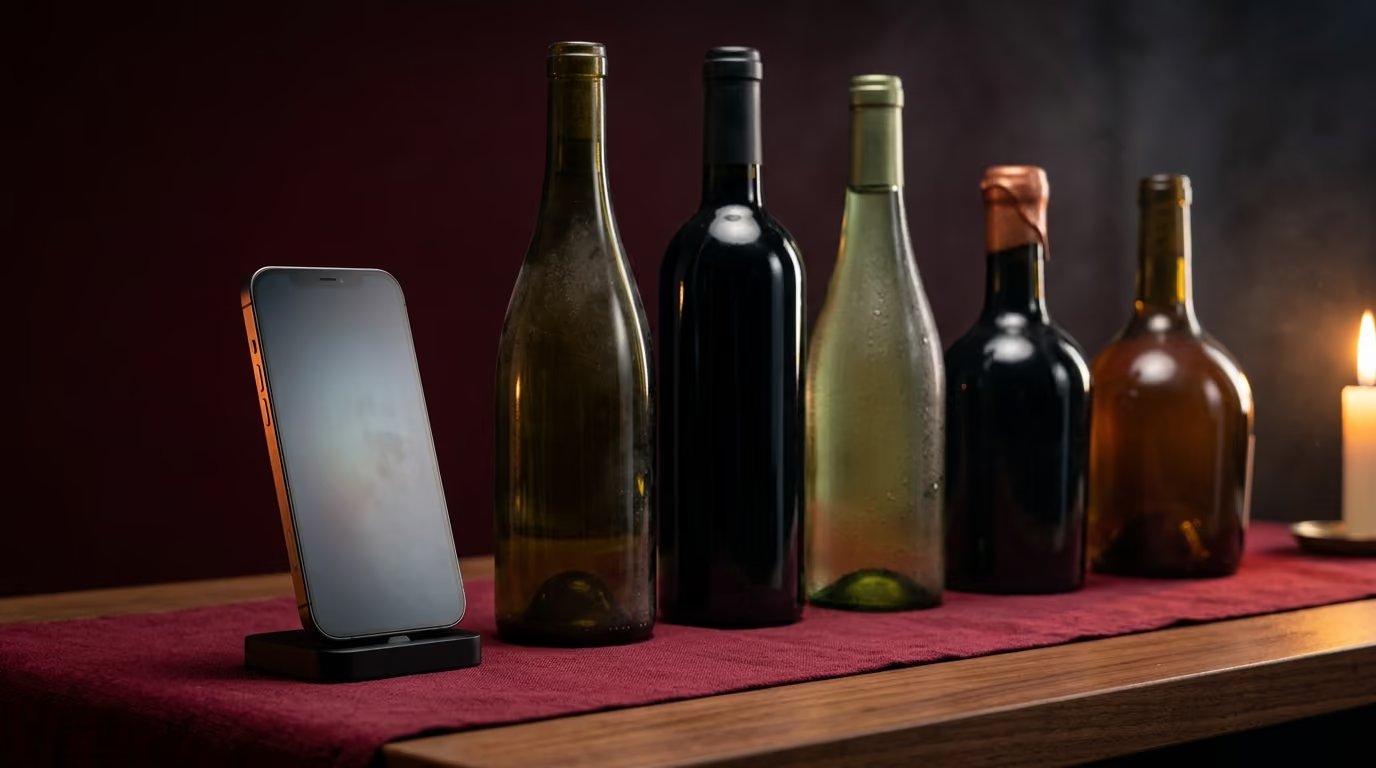
A wine identifier app is a phone tool that recognizes a specific wine from its label or bottle and pulls up information about it, usually including community ratings, tasting notes, price ranges, and where to buy. You point your camera at the front label, the app matches it against a database of millions of wines, and a card comes back with the producer, the vintage, the region, and what other drinkers thought.
That last part is the selling point for most of them, and it's also the catch. A rating built from thousands of strangers is a popularity number, not a personal one. A bold, tannic Napa Cabernet can carry a high community average and still taste like sandpaper to someone who loves soft, fruity reds. The app did its job when it named the bottle. Whether you'll enjoy pouring it is a separate question that a shared score was never designed to answer. Keep that split in mind, because it's the difference between an app that identifies a wine and an app that helps you choose one.
Most people first reach for a wine identifier app in one of three moments. You're standing in a crowded shop staring at a wall of labels you don't recognize. You're at a friend's place and want to remember the bottle you're drinking so you can find it again. Or you're holding something a relative gave you and have no idea if it's worth opening tonight. In each case, naming the wine is step one, and knowing whether it's for you is the step you actually care about.
How does a wine identifier app read a label?
A wine identifier app reads a label by combining two techniques: optical character recognition (OCR), which pulls the printed words off the label, and image matching, which compares the whole label picture against a reference library. The app takes what it reads, the producer name, the wine name, the vintage year, and matches that text and image to an entry in its catalog, then serves you everything it knows about that entry.
The two screen shots below show what it looks like in Sommy.
First tap into the Scan page, then select "Label" from the scan-mode picker, center the wine label in the yellow square, then tap the yellow shutter button:
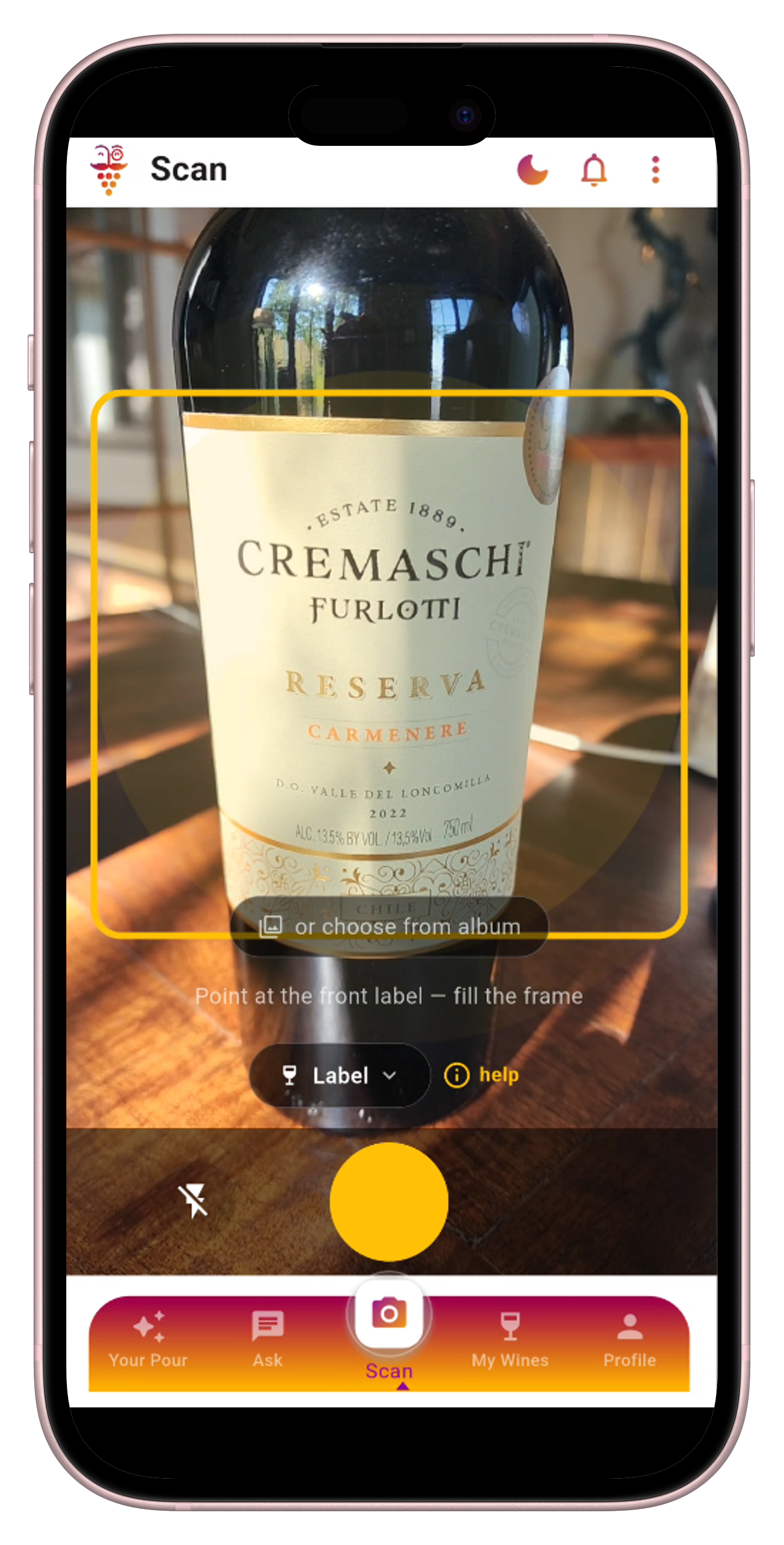
In a second or two, Sommy will identify what it saw, and will render some general information about tasting notes and food pairings:
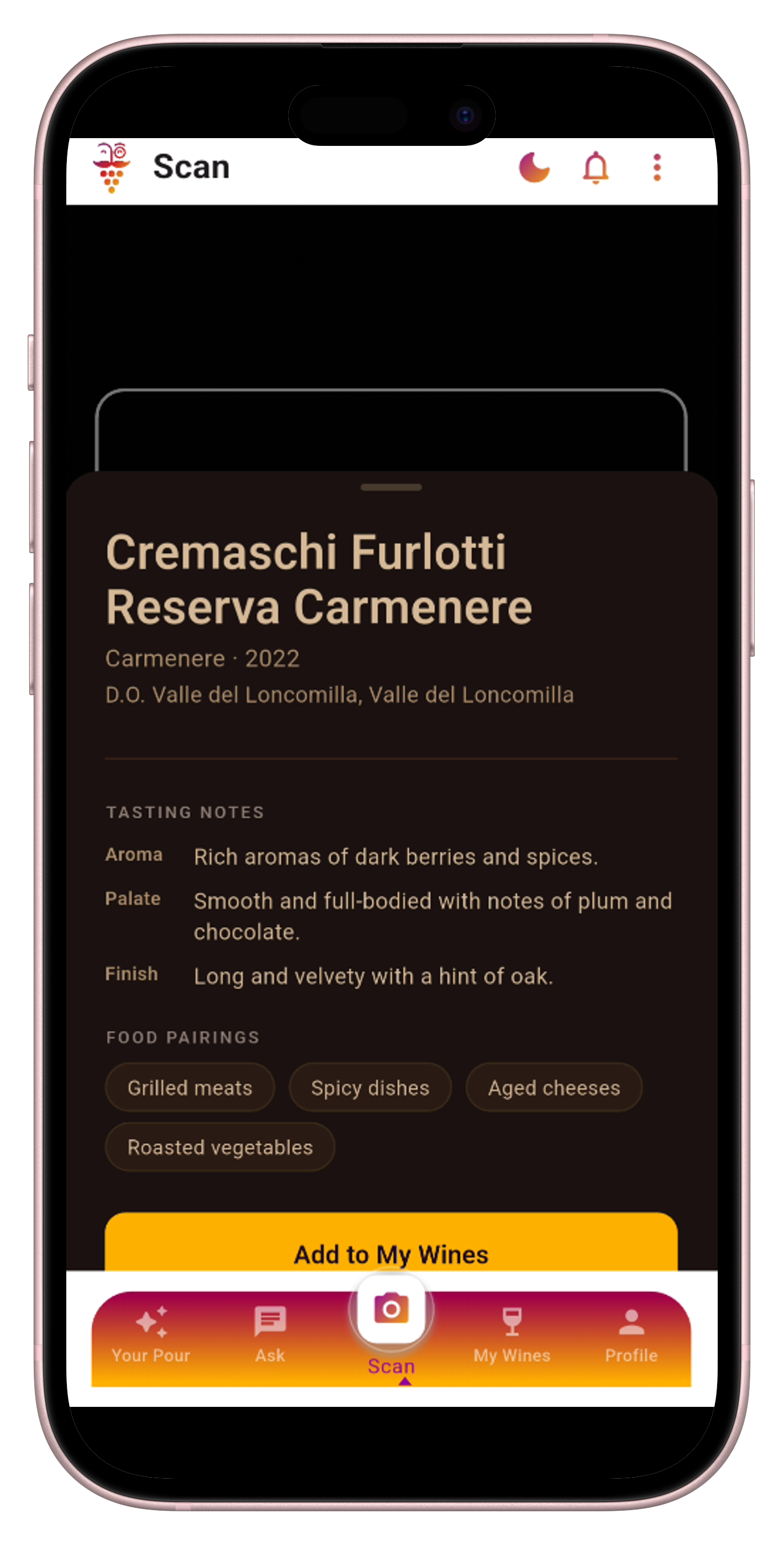
In good light with a clean, front-facing label, this works well and takes a second or two. Where some apps get shaky is the real world of wine shopping. Labels curve around the bottle, so the text distorts at the edges. Older bottles have faded or stained labels. Small producers and imported wines sometimes aren't in the database at all, so you get a near-match or nothing. And a label photographed at an angle under dim restaurant lighting is a genuine challenge for any of these tools.
The better apps, like Sommy, handle glare and partial labels gracefully and ask you to try again rather than guessing wrong. Sommy will sometimes ask you to also scan the back label if it thinks some information is missing, and it can be captured there.
Sommy's Vision handles this scanning, and it reads more than a single front label. You can point the camera at a shop shelf full of bottles, a printed restaurant wine list, tonight's recipe, or even the meal on your plate, and it reads the whole scene. Label Scan is the piece aimed squarely at one bottle: you point the camera at a wine label and Sommy reads it. The reading is only the opening move, though.
What Sommy does with the wine once it's identified is where it splits from a plain database lookup, separates itself from most wine apps, and that's the next section.
It found the wine, but will you like it?
Most wine identifier apps can't tell you whether you'll like the wine, and that's the honest gap in the whole category. Knowing what the bottle is doesn't answer whether you'll personally enjoy it. A community rating tells you what the average drinker thought. It can't tell you whether this particular wine fits the way your own palate leans, toward crisp or rich, dry or a touch sweet, light and juicy or dark and structured.
Sommy's 'Fit Check' is built for exactly this moment.
You type a wine name, or say it out loud, or, similar to what we discussed above, easily scan the label, and Sommy gives you a clear read on whether the bottle is your style, measured against your own Taste Profile rather than a crowd. There's no numeric score to argue with. Instead you get a plain description of how the wine matches your taste: whether it leans the way you tend to like, where it might surprise you, and why. It's the difference between "this wine averages well" and "this wine is likely for you".
Here's how it works:
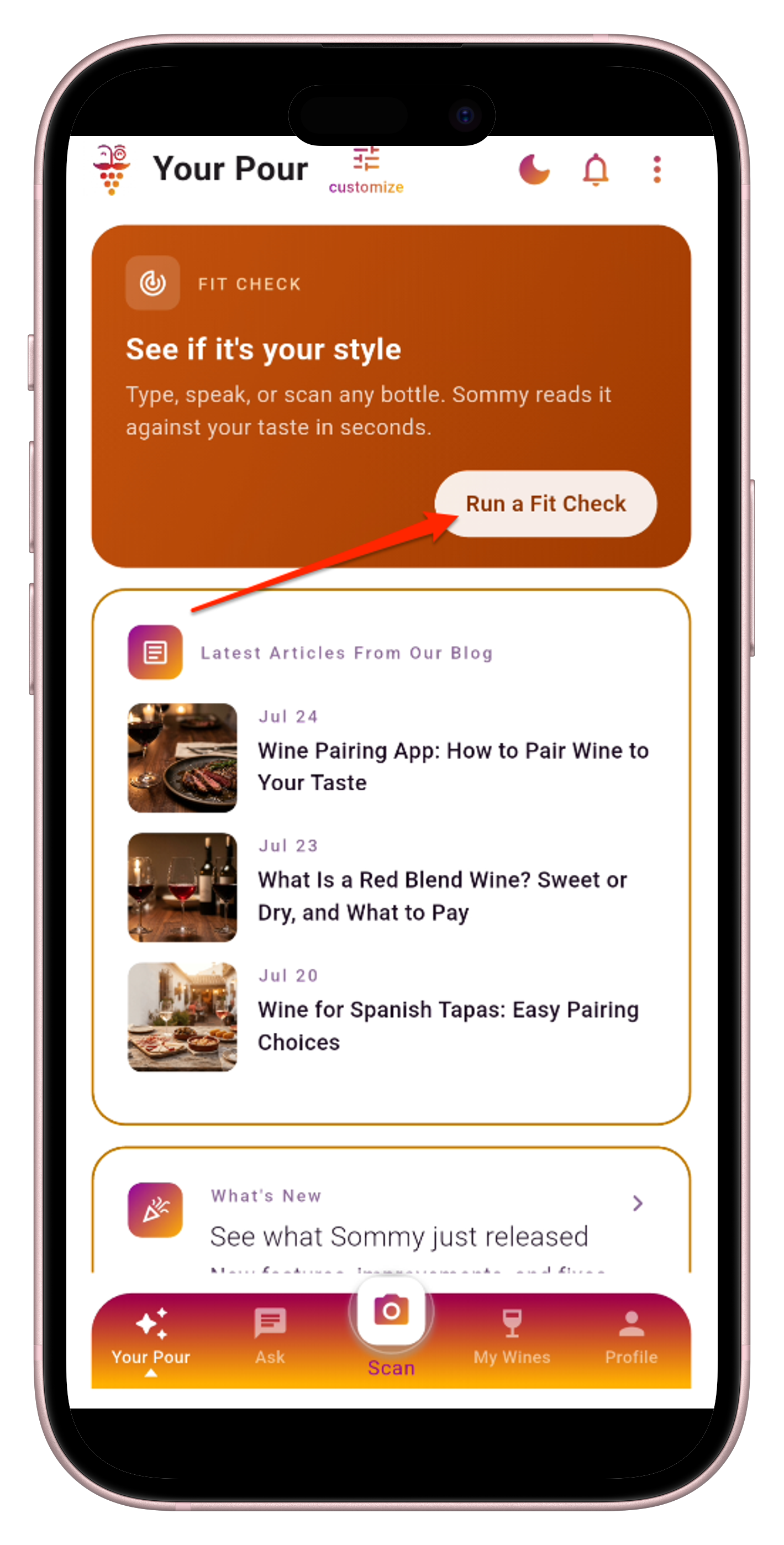
On the Your Pour page, tap into the 'Fit Check' card:
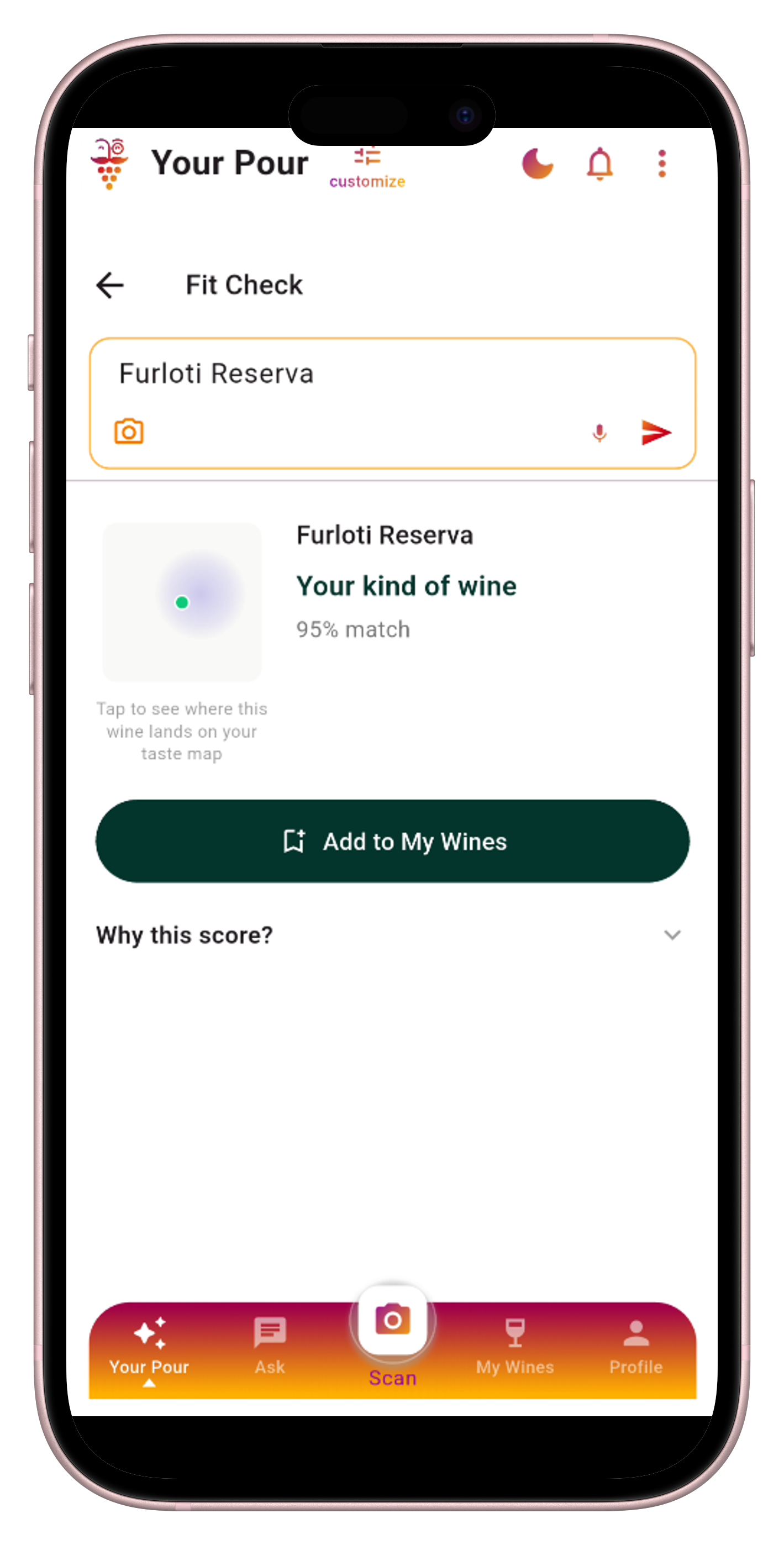
Then snap a picture of the label on the next screen and Sommy will think for a moment and render how well the wine aligns with your Taste Profile:
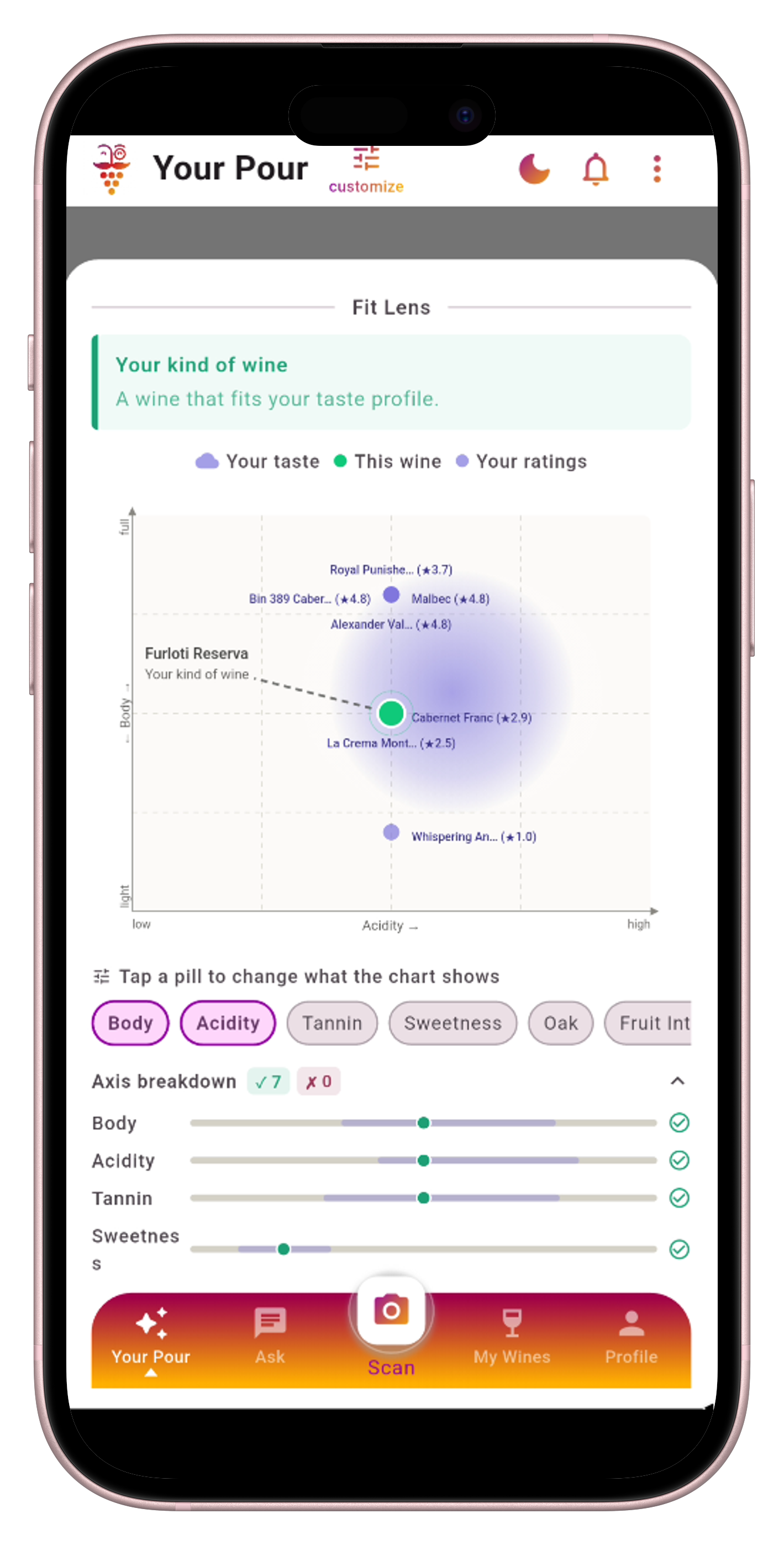
Tap into the results, and Sommy will give you even more insights about whether or not the wine fits your Taste Profile using its unique 'Fit Lens':
The read is only as good as what Sommy knows about you, and that's the role of your Taste Profile. It's a living model of your palate that Sommy builds and refines every time you rate a bottle, save one, or skip one. The more you use Sommy, the sharper Fit Check gets.
If you're switching over from another app, Sommy's 'Vivino Import' feature brings your existing ratings across so Sommy immediately understands your taste from day one instead of starting cold.
So the loop is simple: identify the bottle, then get an honest answer about whether it's yours before you spend the money. For the deeper version of how that personal model comes together, our guide to using an AI wine assistant walks through building your taste profile step by step.
What do the popular wine identifier apps actually do?
The wine identifier apps most people think of fall into a few clear jobs, and knowing which does what saves you from downloading five of them. Vivino is the giant most shoppers reach for first, built around scanning a label and showing a community rating and reviews. Wine-Searcher points at a different need, finding where a wine is sold and comparing prices across retailers. Delectable leans toward tasting notes and following what other drinkers and sommeliers are pouring. Each is genuinely good at its core job, and each stops at the same place: telling you about the wine, not about your fit with it.
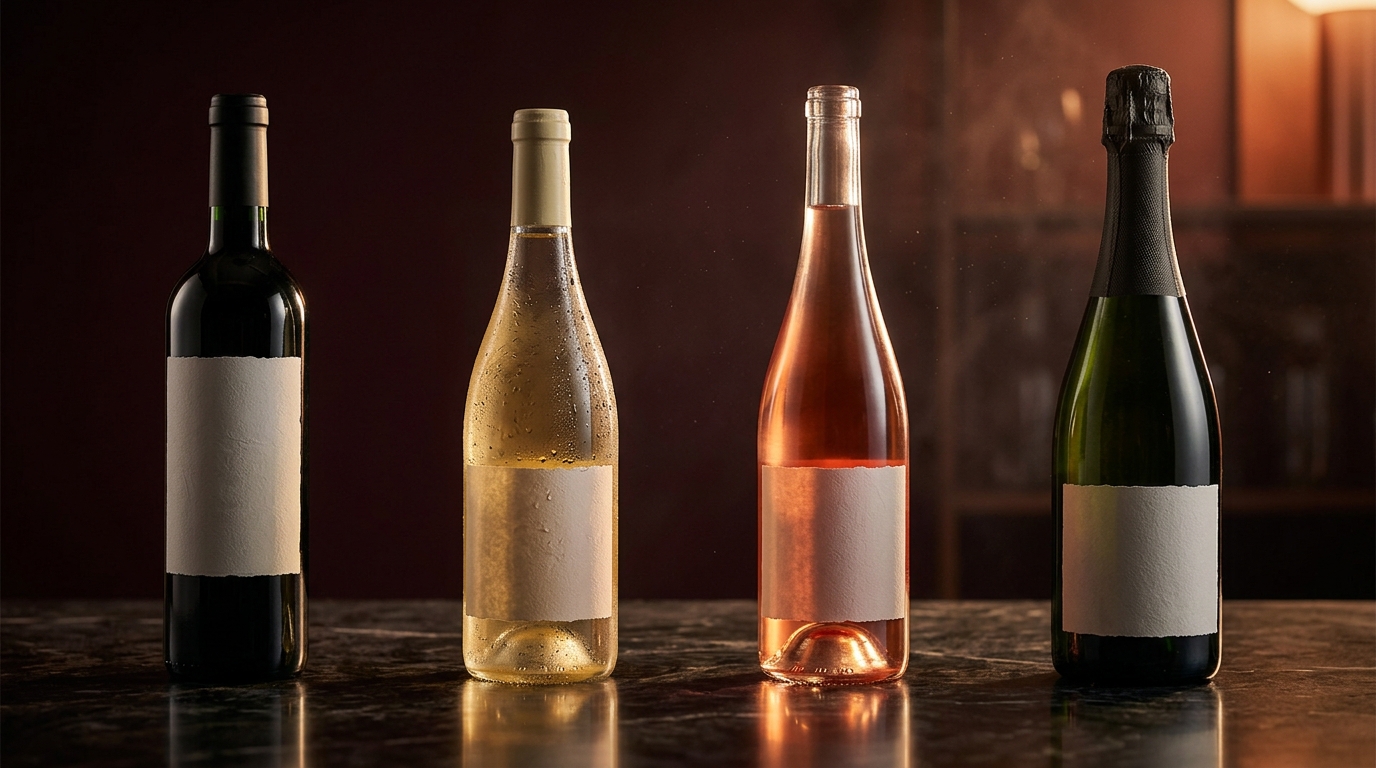
Matching the tool to the moment gets simple once you see what each is really for. A community scanner like Vivino is best when you want to name a bottle fast and glance at what the crowd thought, though that rating stays an average rather than a read on your taste. A price finder like Wine-Searcher earns its place when you've already settled on a wine and want the best deal, telling you the cost but nothing about the fit. A tasting-note app like Delectable is a pleasure for reading how other drinkers and sommeliers described a bottle, which is still their palate and not yours. Sommy sits in the gap the others leave, focused on whether the bottle suits you personally, with a younger catalog than the oldest giants but the one answer they skip.
None of this makes the big scanners bad. If all you want is to name a bottle and glance at what the crowd thinks, a community scanner does that in seconds and it's free.
The point is to be clear about what you're getting. A high average on a label you scan is a signal that plenty of people liked it, and nothing more. If you've ever bought a highly rated wine and quietly disliked it, you've already met the limit of the crowd-rating model. That gap is the whole reason a personal read exists.
When does a wine identifier app help, and when does it fall short?
A wine identifier app helps most when you already know your own taste and just need the bottle's name and a rough sense of quality. If you know you love juicy Argentine Malbec and you're checking whether the one in your hand is well regarded, a quick scan and a community rating is plenty. It's also genuinely useful for memory: scan a bottle you enjoyed at dinner so you can find it again later, which beats squinting at a blurry photo weeks after the fact.
It falls short in the exact situation where you need help most, when you don't yet know what you like and you're facing an unfamiliar bottle. A crowd rating gives a confident-looking number that has nothing to do with your palate, and that false confidence is how people keep buying wines that let them down. It also struggles with obscure and small-production bottles that aren't well represented in any database, and with the messy conditions of real shopping: curved labels, low light, and bottles photographed at an angle. And no scanner can read a bottle that isn't in front of you, so planning a purchase or decoding a restaurant list before you arrive sits outside what a pure identifier does.
This is where reading the physical label yourself still matters, because the bottle tells you plenty before any app weighs in. If you want to get faster at that, our walkthrough on how to read a wine label covers the terms that actually predict taste. Pair that habit with a tool that knows your palate, and you cover both the crowded aisle and the quiet moment of deciding what to open. For the broader picture of picking a bottle with less second-guessing, how to choose wine with confidence is a good companion read.
Beyond identifying: what to do once you know the wine
Identifying a wine is the start of a chain, not the finish. Once you know the bottle and whether it fits you, the useful next moves are finding more like it, pairing it with dinner, and remembering it so the next choice is easier. A good wine identifier app should carry you through that whole chain instead of dropping you at a rating.
Say Sommy's 'Fit Check' tells you a wine is your style. The natural next thought is "what else like this should I try", and that's what Sommy's 'Find Similar' is for: it surfaces bottles that match one you already love, by grape, region, or overall character, so a single good bottle becomes a short list worth exploring. If you liked a soft, plummy red, for instance, you can chase down wines similar to Merlot without guessing in the aisle. When dinner's the occasion rather than the bottle, Pairing works the other direction: tell Sommy what you're cooking, by recipe or by a photo of the plate, and it pulls a wine that fits both the food and your taste.
The last piece is memory, and it's the one plain scanners handle worst. Every bottle you rate, save, or pour teaches Sommy more about you, so your Cellar and your history aren't just a list, they're what makes the next Fit Check sharper. This is the quiet advantage of a personal system over a database: the crowd's average never changes because of you, but your own model gets better every single time you use it.
Wine identifier app questions, answered
What is the best free wine identifier app?
For simply naming a bottle and seeing a community rating, Vivino is the most widely used free option and it does that job well. If your goal is knowing whether a wine fits your own taste rather than the crowd's, Sommy's 'Fit Check' answers that question directly, reading a scanned label against your personal Taste Profile instead of a shared average. The best choice depends on whether you want the wine's name or a real answer about your fit with it.
Can a wine identifier app tell me if I'll like the wine?
Most can't, and that's the honest gap in the category. A typical wine identifier app shows you a community rating, which reflects the average drinker's opinion and not your palate. Sommy is built around closing that gap: Fit Check gives you a plain read on whether a specific bottle suits your taste, based on the wines you've already rated, so you get a personal answer rather than a popularity number.
How accurate is label scanning?
Label scanning is quite accurate for common, widely sold wines photographed clearly in good light, and it usually returns a match in a second or two. Accuracy drops with faded or curved labels, dim lighting, angled photos, and small-production or imported bottles that may not be in the database. Reading the label yourself as a backup, and using an app that admits when it isn't sure, both help you avoid a confident wrong match.
Do I need to create a profile to use a wine identifier app?
You can name a bottle with most scanners without much setup, but the useful part of a personal app depends on it knowing your taste. Sommy's Taste Profile takes about a minute to start and sharpens every time you rate or save a wine. If you're coming from another app, Vivino Import brings your ratings across immediately so Sommy understands your palate from the first scan rather than learning from scratch.
Is a wine identifier app worth it for a beginner?
Yes, and arguably more so than for an expert, as long as you pick the right kind. A beginner benefits least from a raw community rating, since you don't yet know whether your taste matches the crowd's. An app that learns your palate and tells you whether a bottle fits you gives a new drinker real footing, and it turns every scan into a small lesson about what you actually enjoy.
Turning a scanned label into a bottle you'll love
A wine identifier app earns its place on your phone when it does more than read a label. Naming the bottle is the easy part, and the free scanners nailed that years ago. The quiet decision in the aisle is the one that still stings: not "what is this wine", but "will this one be good for me". A crowd rating has never answered that, and buying by average is how a lot of us ended up with bottles we didn't finish.
Sommy is built to close that loop. Scan or say a wine, get a Fit Check against your own Taste Profile with no score to argue over, then let Find Similar, Pairing, and your growing history make every next choice easier. Ask Sommy about any bottle you're eyeing, or download the app and give it a minute to learn your taste.
Once the app knows what you like, the label was always just the beginning.