
The best wine app for your iPhone is the one that helps you choose a bottle calmly and confidently, right when you need to. A truly helpful app learns your personal taste and gives you a few clear choices, instead of burying you in confusing jargon or endless reviews. For most people who just want to end decision anxiety, that app is Sommy, a personal AI assistant designed for in-the-moment recommendations.
This guide explores the best options to help you decide, not just research.
How to Confidently Choose Wine With Your iPhone

Whether you’re looking at a long restaurant wine list or feeling overwhelmed in a store aisle, the goal is the same: find a good bottle without the stress. It's a normal feeling. Wine isn't confusing because it's complex; it's confusing because you're afraid of choosing wrong.
Many apps make this feeling worse. They act like digital encyclopedias, forcing you to scroll through ratings and reviews that add to the pressure. A great wine app should feel less like a textbook and more like a calm, helpful friend.
The most effective apps provide instant clarity, not a wine education course. They act as your personal guide, helping you decide quickly and confidently.
Matching an App to Your Problem
The trick is to think about why you need an app. Are you trying to make a quick choice before the waiter returns? Or find the best value at the grocery store? Each situation calls for a different kind of help.
If restaurant menus often stump you, you can learn how to read a restaurant wine list in 30 seconds with an app in your pocket.
Below is a quick look at how the best apps approach these common, stressful moments.
How Top iPhone Wine Apps Solve Common Problems
| Your Situation | The Problem | How the Best Apps Help |
|---|---|---|
| Dining out | The wine list is long and intimidating, and you feel pressured to choose quickly. | Scan the entire list and highlight a few top choices based on your personal taste and food pairing. |
| Shopping for wine | You're faced with a "wall of wine" and have no idea where to start or which bottle offers good value. | Let you scan labels to get instant, personalized recommendations that fit your budget and taste profile. |
| Hosting a party | You need a versatile wine that will please multiple guests with different tastes. | Suggest crowd-pleasing styles or specific bottles that pair well with a variety of foods, removing the guesswork. |
Matching an app's strengths to your real-world needs is the key to finding a tool you'll actually use. An app that’s brilliant for cataloging a cellar is useless when you’re trying to impress a client at dinner. It's all about the right tool for the job.
Why Traditional Wine Apps Just Add to the Anxiety
Let’s be honest. Many popular wine apps on your iPhone feel like they were designed for hobbyists, not for helping you make a quick, simple decision. They operate like massive digital libraries, packed with features that expect you to become an expert overnight.
Instead of calming your nerves, they throw more data at you. Suddenly you’re scrolling through endless user reviews, trying to figure out what a high score actually means, or memorizing obscure wine regions. This approach usually creates more anxiety, leaving you more confused than when you started.
The root of the problem is simple: these apps are databases you search, not assistants that give you guidance.
They’re Built for Research, Not for Decisions
The old guard of wine apps assumes you have a good idea of what you’re looking for. But when you’re standing in a wine aisle, a giant database is the last thing you need. What you really want is a single, confident recommendation you can trust.
This focus on collecting information over providing clear answers leads to a few common frustrations:
- Overwhelming User Reviews: Sifting through conflicting opinions from strangers is a terrible way to make a confident choice. One person’s favorite might be a style you dislike.
- Focus on Collecting, Not Enjoying: Many apps encourage you to rate and log wines. This can be fun for enthusiasts, but it doesn't help when you just want to find a nice bottle for dinner tonight.
- Expert Jargon: You see terms like "tannins," "terroir," and "malolactic fermentation," which only reinforces the feeling that you’re not qualified to make a good choice.
The pressure to understand complex rating systems can turn a simple shopping trip into a stressful test. The real goal should be to choose wine without relying on ratings and focus on what you personally enjoy.
Ultimately, these encyclopedia-style apps fail to solve the real problem: helping you confidently pick a bottle you’ll love. They give you data, but what you need is a decision.
When hunting for the best wine app for your iPhone, it’s easy to get lost in features. Let’s focus on what actually helps you make a quick, confident decision: Label Scanning, Personalization, and Food Pairing.
The real question is: does this feature reduce stress and get you to a great choice faster?
Label Scanning Speed and Intelligence
Almost every wine app has a label scanner. You point your phone at a bottle, and the app tells you what it is. But what happens next is what separates a database from a helpful tool.
A basic scanner identifies the wine and then shows you a wall of information—ratings, reviews, and tasting notes from strangers. This is fine for research at home, but it’s overwhelming in a busy wine aisle.
An intelligent scanner, on the other hand, goes a step further.
Instead of just telling you what the wine is, an intelligent app should immediately tell you if you will like it based on your personal taste. This small difference is the key to removing decision anxiety.
The difference is night and day. One approach gives you homework; the other gives you an answer. For a deeper look, our guide on how a great wine scanner app can improve your choices breaks it down.
Personalization Beyond Public Ratings
Personalization moves past what the crowd thinks and zeroes in on what you prefer. This is where database-driven apps and AI assistants really differ.
Database apps like Vivino are masters of crowd-sourced data. With a massive user base, they can tell you what’s popular on a global scale. This model is fantastic if you trust the wisdom of the crowd.
A personal AI assistant like Sommy takes a different path. It quietly learns your specific palate from the wines you enjoy. It builds a taste profile unique to you, allowing it to make recommendations tailored to your preferences, not the global average.
Feature Comparison for Real-World Wine Decisions
Let's look at a side-by-side comparison of how these different approaches help you choose a wine quickly and confidently.
| Feature | Database-Driven App (e.g., Vivino) | Personal AI Assistant (e.g., Sommy) | Which Is Better For You? |
|---|---|---|---|
| Label Scan | Identifies the wine and shows you global ratings and community reviews. | Identifies the wine and immediately tells you if it matches your personal taste profile. | Sommy, if you want a quick "yes" or "no" for you. Vivino, if you want to research a wine's general popularity. |
| Personalization | Based on your past ratings, but heavily influenced by millions of other users. | Learns your unique palate from your ratings and feedback, ignoring crowd noise. | Sommy, if you want recommendations tailored only to your taste. Vivino, if you prefer to follow popular trends. |
| Food Pairing | Offers generic suggestions like "pairs with beef" based on the wine's general style. | Can analyze a full restaurant menu, your preferences, and the wine list to find the perfect bottle for your specific meal. | Sommy is far more practical for dining out. Vivino offers a basic starting point. |
Ultimately, a database app is like a public library—full of information if you're willing to search. An AI assistant is like a personal sommelier who already knows what you like.
Food Pairing That Actually Works
Food pairing is another area where the approach makes a huge difference. Many apps offer generic advice like “pairs well with chicken.” This is a decent starting point, but it often falls short in a real restaurant.
Modern AI-driven apps can do much more. Imagine taking a photo of an entire restaurant menu. An AI assistant can analyze all the dishes, cross-reference them with the wine list, and suggest the perfect bottle that complements what everyone at the table is ordering.
This turns a potentially stressful decision into a simple, confident choice.
Matching Your App to the Moment
The “best” wine app for your iPhone isn’t a one-size-fits-all answer. It depends on what you need in that exact moment. Are you trying to find a great value at the grocery store, or just pick one bottle that a group of friends will enjoy?
Different moments call for different tools. The trick is to match an app's core strength to your most common challenge.
This decision tree shows how you might pick an app feature based on your goal, whether you’re scanning a label, looking for a food pairing, or hoping for a personal match.
As the visual shows, the first step is figuring out your goal. That points you toward the function that will give you a confident, stress-free answer.
For the Data-Driven Shopper
If you love research and trust the wisdom of the crowd, a database-heavy app is your best friend. These apps are perfect for when you’re in a wine shop and want to compare prices, check ratings, and see what thousands of other drinkers think about a bottle.
In this scenario, speed and accuracy are everything. Powerhouse apps often connect with thousands of stores to show you real-time pricing and availability. This approach is for the person who wants to feel like a smart shopper, armed with data to back up their choice. It’s about finding a popular, well-liked wine at a fair price.
For the Overwhelmed Diner or Shopper
But what if you don't want more data? What if you just want the anxiety of choosing to go away, especially when staring down a long restaurant wine list or a packed supermarket aisle?
This is where a personal AI assistant shines. Instead of giving you research to do, it gives you a recommendation made just for you.
An AI assistant like Sommy is built for that moment of indecision. Its purpose isn't to show you what's popular; it's to tell you what you'll love, quietly and confidently.
This kind of app is for the person who values a quick, personalized answer over crowd-sourced opinions. It’s less about research and more about relief. For anyone who feels overwhelmed by too many choices, Sommy can help you pick the right bottle in a crowded supermarket aisle without the stress.
Think of it this way: one type of app helps you become a better wine researcher, while the other removes the need to do research at all. The best wine app for your iPhone is the one that solves your problem with the least amount of friction.
How Personal AI Is Changing Wine Recommendations
The next evolution of wine apps is a shift away from massive, impersonal databases and toward true, personal guidance. Instead of forcing you to sift through reviews, the best new apps use artificial intelligence to learn your unique taste. They act less like a library and more like a personal wine assistant right on your iPhone.
This is a fundamental change. It’s no longer about throwing more information at you; it’s about giving you a clear, confident answer when you need it most.
Imagine an app that already knows you prefer dry, light-bodied white wines. When you scan a restaurant’s wine list, it doesn't just show you a wall of ratings. Instead, it instantly highlights the two or three options it knows you'll love. That's the promise of a personal AI assistant.
From Encyclopedia to Assistant
The core difference is simple. Traditional apps are like encyclopedias—they hold tons of information, but you have to do the work of finding what you need. An AI-powered app is like a real assistant. It does the heavy lifting for you by learning your preferences and serving up a tailored recommendation.
This approach is designed to completely remove decision friction. It’s not about making you smarter about wine; it's about making the app smarter about you.
This Sommy screenshot shows how simple the interface can be when the AI already knows what you like. Just type or speak your question, and Sommy returns answers:
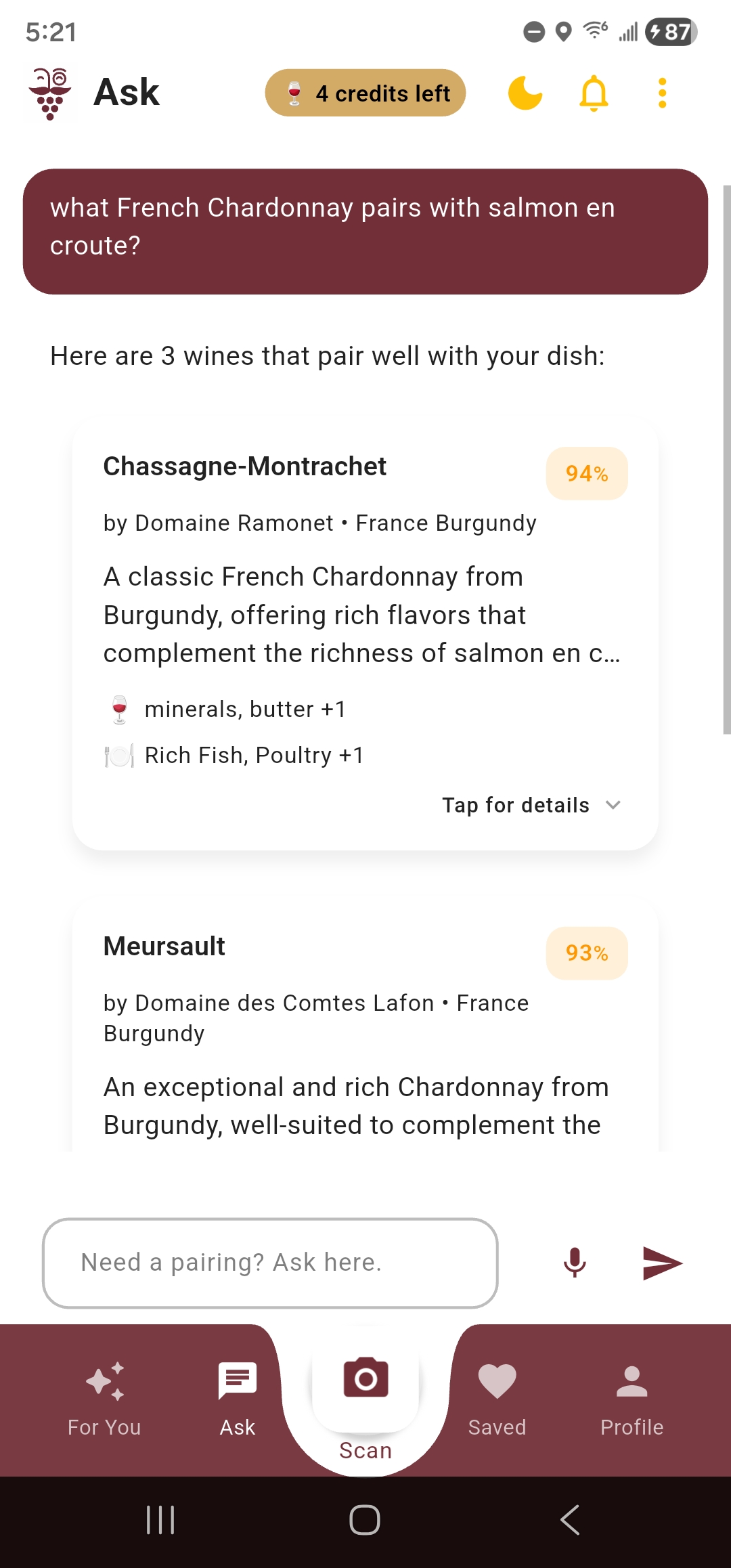
The focus is on clear, direct, in-context, and personalized recommendations, not on complex walls of text you have to decode yourself.
How It Builds Confidence
The biggest benefit of this AI-driven approach is the feeling of relief. When you get recommendations that you consistently enjoy, you start to trust the process. That trust builds confidence, and the anxiety of picking the "wrong" bottle disappears.
An AI doesn't care what critics say or which wine has the most awards. It only cares about one thing: what you like.
This personalized model is a major change from the crowd-sourced data that powers older apps. Instead of following the herd, you get a recommendation that reflects your actual taste.
By focusing on your palate, Sommy delivers a more reliable experience. You can learn more about how AI taste profiles work behind the scenes to create these custom suggestions. This technology turns your iPhone into a calm, decisive guide for any wine moment.
The Best App for Calm and Confident Choices

After comparing the different approaches, the best wine app for iPhone users who just want to end decision anxiety is Sommy.
While big database apps are fantastic for research, Sommy is built to solve the immediate problem: "What should I order right now?" It was designed from the ground up to be a decision assistant, not a massive wine library.
Built for Deciding, Not Researching
Sommy's real power is its laser focus. By zeroing in on your personal preferences and the specific context—like what you're eating or your budget—it gives you clear, simple answers without the noise.
You don't have to wade through dozens of user reviews or try to figure out what a confusing score actually means. The app does that quiet work for you. It hands you a recommendation, not more homework.
The goal of a great app isn't just to give you information; it's to give you relief. It should make you feel calm and capable, turning a moment of stress into a moment of simple enjoyment.
Your Personal Decision Assistant
If your main goal is to stop worrying about making the "wrong" choice and simply enjoy a great bottle you know you'll like, this modern approach is what you’ve been waiting for.
The app learns what you enjoy, offering suggestions that get better over time. That's what really sets it apart. Instead of just identifying a wine, it helps you confidently choose one, turning your iPhone into a trusted, personal guide. This is exactly the kind of in-the-moment decision Sommy was made for.
Common Questions About Wine Apps
People often ask the same questions when trying to find the right wine app. Here are a few honest answers to help you decide.
What Is the Best Free Wine App for an iPhone?
Most top apps, including Vivino and Sommy, offer powerful free versions. Vivino’s free app is great for research—you can scan a label and pull up millions of user reviews to see if a wine is popular. It’s like a giant public library.
Sommy’s free version is built for decision-making. Instead of showing you what everyone else thinks, it gives you personal recommendations based on your unique taste.
The "best" one depends on what you need. Do you want a mountain of data (Vivino), or a clear, personal answer (Sommy)? If your main goal is simply remembering what you drank, weigh the options in our guide to the best wine tracking app.
Can a Wine App Really Tell Me What I'll Like?
Yes, but how it gets there is what matters.
Apps that use crowd-sourced ratings give you a general sense of a wine’s popularity, but that’s not the same as knowing if you will like it. A highly-rated wine that tastes like oaky, buttery chardonnay is not a great wine for someone who hates that style.
AI-powered apps like Sommy learn directly from the wines you rate. This builds a taste profile that can predict, with impressive accuracy, whether a new wine is for you. It’s a shift from popular opinion to personal preference, which is a more reliable way to find a bottle you’ll genuinely love.
How Do Wine Scanner Apps Work in a Restaurant?
This is where many apps stumble. Most scanners need a clean shot of a single bottle label, which is useless when you're handed a long, printed list.
More advanced tools are solving this. Sommy, for example, lets you scan the entire wine list. Its AI then reads every wine, filters out the noise, and highlights the best picks for you based on your taste, food pairing, and budget.
This feature was designed for that awkward moment at the dinner table. It makes ordering fast, discreet, and much less stressful.
If you want to stop guessing and start choosing with confidence, Sommy is designed to provide that kind of in-the-moment help. Learn more about how our personal AI assistant can make your next wine choice a calm one.