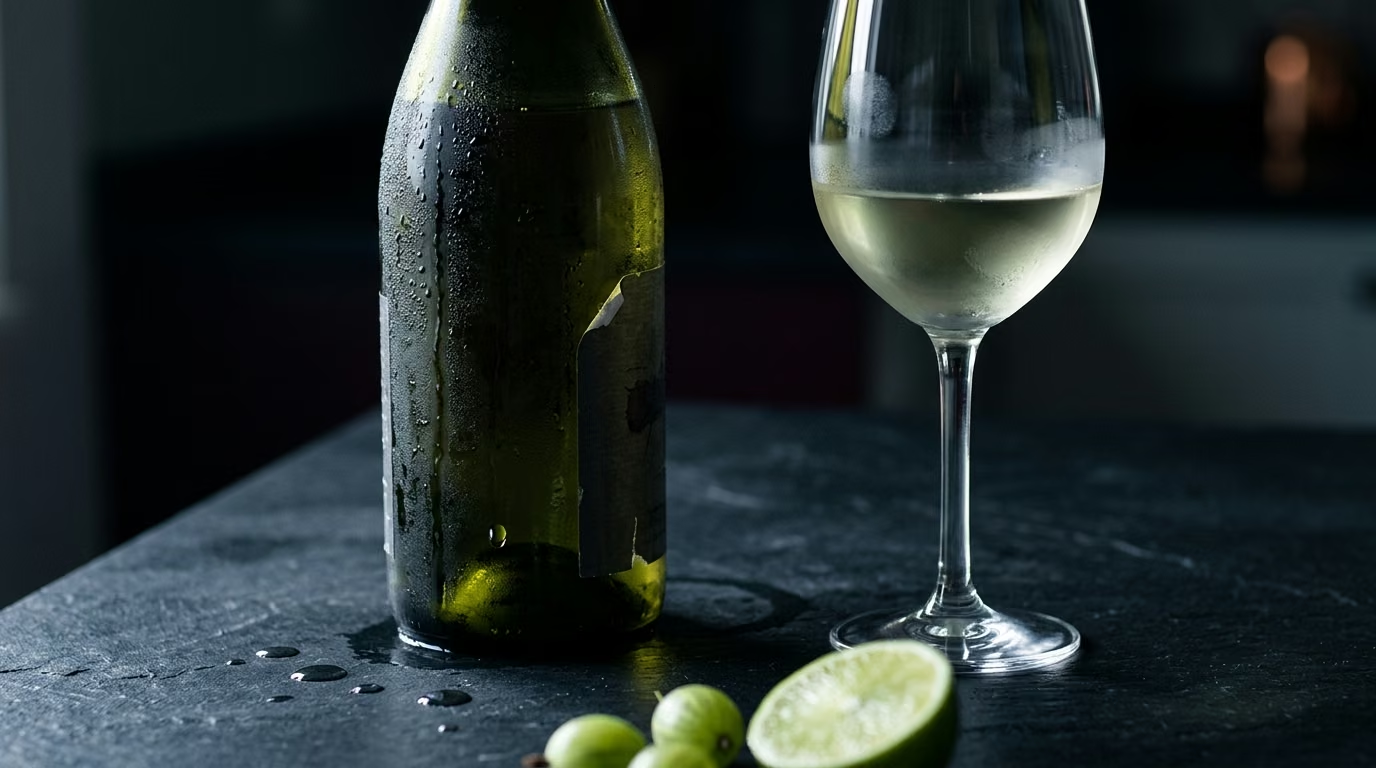
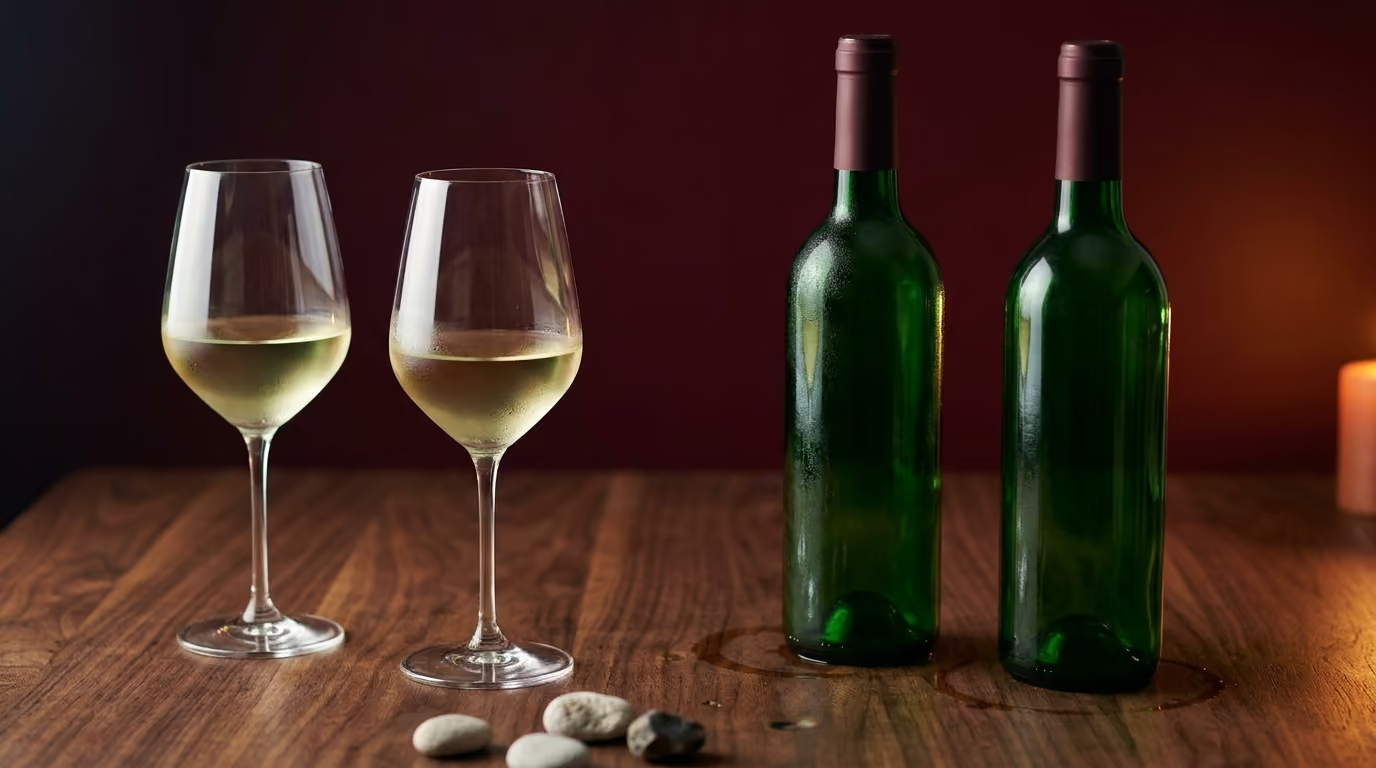

Sancerre and Sauvignon Blanc aren't two different wines. Sancerre is a small appellation in the eastern Loire Valley in France, and every white wine it makes is 100% Sauvignon Blanc, so the label prints the place and never prints the grape. What you're really choosing between is Sauvignon Blanc from 3,053 hectares of French limestone at around $36 to $40 a bottle, and Sauvignon Blanc from somewhere larger and cheaper. The taste gap is real, and so is the price gap, and there are four neighbouring French appellations that split the difference for $10 to $15 less.
What is the difference between Sancerre and Sauvignon Blanc?
Sancerre is a place and Sauvignon Blanc is a grape, so all Sancerre is Sauvignon Blanc but almost no Sauvignon Blanc is Sancerre. The appellation sits on the left bank of the Loire river east of Bourges, and the Bureau Interprofessionnel des Vins du Centre-Loire puts it at 3,053 hectares farmed by about 300 growers, producing 163,504 hectolitres a year on a five-year average. The white wines have been an appellation since 1936. There's also a little red and rosé Sancerre made from Pinot Noir, which won its own appellation status in 1959, so a bottle marked Sancerre isn't automatically white.
The reason this confuses people is a labelling convention rather than anything in the glass. French appellation law asks the bottle to name the region, and the grape is treated as something you're expected to know already, which is why you can turn a bottle of Sancerre all the way around and never see the words Sauvignon Blanc. A New Zealand or Californian producer does the opposite, printing the grape in large letters because the grape is what their customer is shopping for.
If you're wondering how to ask for it out loud, Sancerre comes out roughly as sahn-SAIR, with the stress on the second half and the final consonant soft.
So the honest comparison isn't Sancerre against Sauvignon Blanc. It's Sancerre against every other Sauvignon Blanc on the shelf, and that's a comparison about climate, soil, yields and how many bottles the region can make.
What does Sancerre taste like next to a New Zealand Sauvignon Blanc?
Sancerre tastes drier, tighter and more savoury than a Marlborough Sauvignon Blanc, which leads with passion fruit and fresh-cut grass. Both are unmistakably the same grape underneath, with the same high acidity and the same citrus core, but the French version keeps the fruit quieter and pushes a chalky, faintly smoky note forward instead.
Two things drive that, and the first is ripeness, because Sancerre sits far enough north that grapes hang into late September and October and the fruit arrives at the winery lean rather than tropical. The second is what the winemaker chooses not to do. The technical sheet for Patient Cottat's Anciennes Vignes Sancerre records no malolactic fermentation, which is the step that softens sharp malic acid into rounder lactic acid, and most Sancerre skips it deliberately. Didier Raimbault's 2024 Sancerre Blanc ferments and ages entirely in stainless steel, with no oak anywhere in the process.
Inside Sancerre itself there's a second layer of variation that the appellation name hides. Growers talk about their wines in terms of which soil the fruit came off, and Didier Raimbault's sheet describes its 2024 as balancing the weight of terres blanches against the airy lift of caillottes, which is the standard shorthand. Clay-limestone gives you a broader, rounder Sancerre with more body, and the stony caillottes sites give you the sharper, higher-toned version. Two bottles from the same village and the same vintage can sit noticeably apart on that axis, which is one reason a single bad experience with Sancerre isn't a verdict on the appellation.
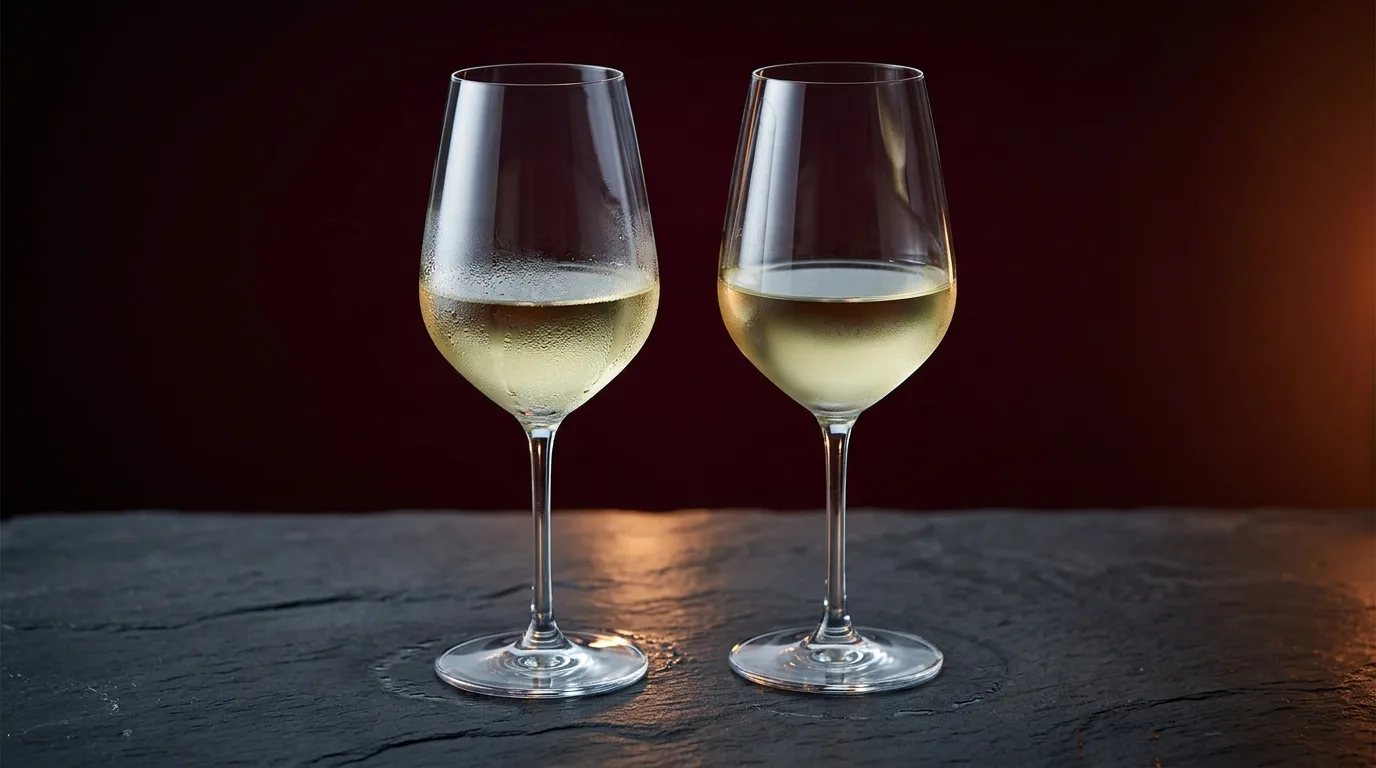
Pour the two side by side and the colour tells you almost nothing, because both land on the same pale lemon with a green edge. The difference shows up on the second sip, where the New Zealand bottle keeps offering fruit and the Sancerre gets narrower and more mineral. Neither one is better than the other, and if you like the loud aromatic style, paying more for a wine built to be quieter is a strange way to spend your money, and our Sauvignon Blanc taste guide walks through which camp you probably sit in. The same question comes up in reverse in Chenin Blanc vs Sauvignon Blanc, where the confusion is about sweetness rather than origin.
Is Sancerre dry or sweet?
Sancerre is dry, and the numbers are not close. Didier Raimbault's 2024 Sancerre Blanc carries 0.39 grams per litre of residual sugar at 12.5% alcohol, and Patient Cottat's Anciennes Vignes lists less than 2 grams per litre at 12% alcohol. Both figures sit far under the point where a white wine starts to read as even faintly off-dry, so a Sancerre is bone dry on any scale you want to use.
What catches people out is that dry and sour aren't the same thing. The Raimbault sheet also shows 4.14 grams per litre of total acidity, and high acid on a wine with no sugar to balance it reads as sharp, lean or even sour to a palate trained on softer whites. That's the sensation, not the sugar. If you've ever called a wine dry because it made your mouth water, our breakdown of dry versus sweet wine explains which of the two you were actually tasting.
Why is Sancerre more expensive than other Sauvignon Blanc?
Sancerre costs more because there's very little of it and most of it leaves France. The appellation covers 3,053 hectares, while New Zealand's entire national vineyard runs to 42,000 hectares according to New Zealand Winegrowers' 2025 annual report, and roughly 90% of that country's wine is exported. One region is about fourteen times smaller than one country, and both are chasing the same American shopper.
Demand does the rest of the work here, because the Centre-Loire trade body reports that 71% of Sancerre's sales go abroad, against 46% for neighbouring Pouilly-Fume and 16% for Menetou-Salon, and its figures sheet for the 2024 to 2025 campaign shows the USA taking 43.3% of every exported bottle the Centre-Loire ships. A small region selling most of its production into the largest and hungriest export market is a recipe for a firm price, whatever's in the glass.
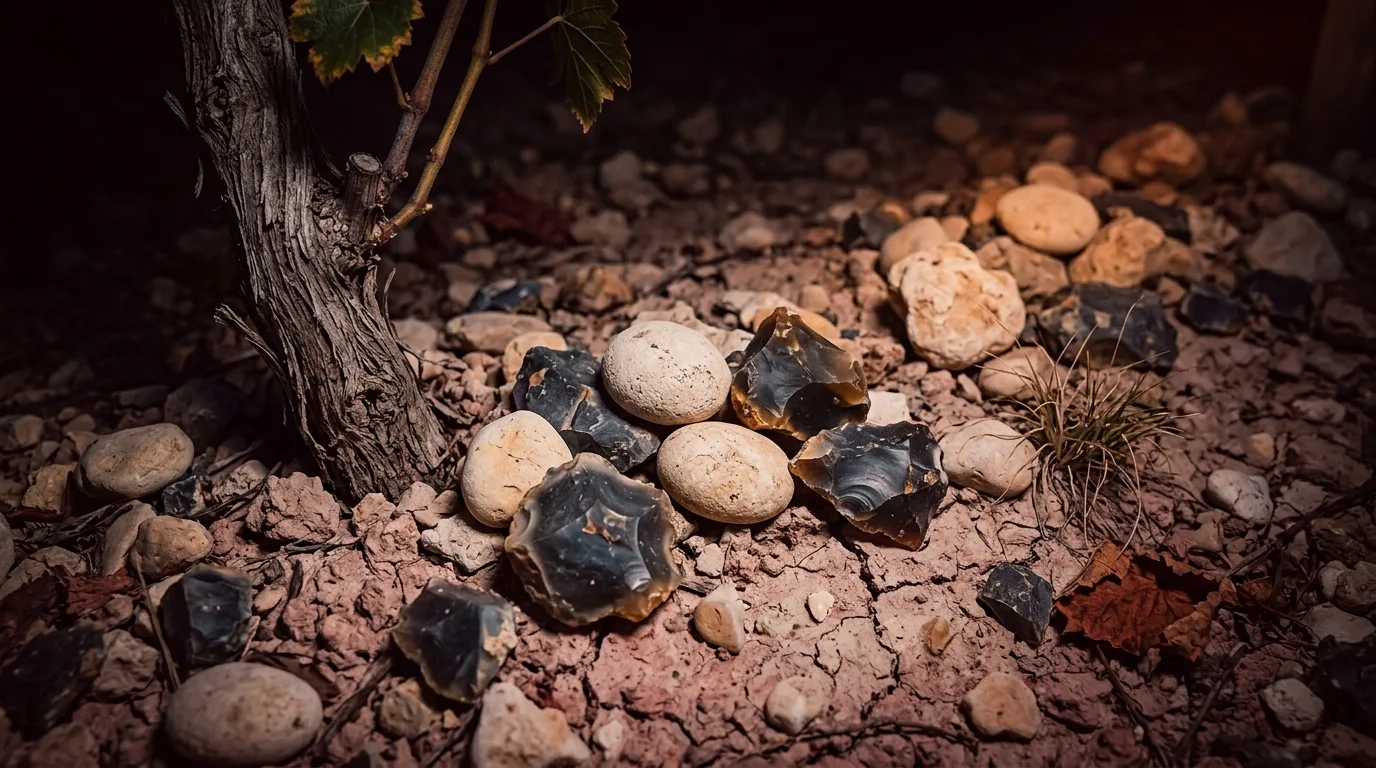
The soil argument is real too, and it's the part producers talk about most. Sancerre sits on three distinct soil types: clay-limestone hills the growers call terres blanches, pebbly limestone known as caillottes, and flinty clay to the east, all described on the appellation's own page. The land is steep, and Didier Raimbault's sheet describes vineyard slopes running from 200 to 400 metres with inclines reaching 40 percent. One thing the premium isn't paying for is hand picking, because the same trade body notes that most of the crop goes through mechanical harvesters and hand work is mainly kept for the red grapes. So the money buys scarcity and a specific set of hills. It doesn't buy a guarantee that your own palate prefers the result.
What does a bottle of Sancerre actually cost?
A mainstream Sancerre in the US runs around $36 to $40, and the famous names climb steeply from there. Checking Wine-Searcher's Sancerre region listing on September 30, 2026, Henri Bourgeois Sancerre averaged $36, Château de Sancerre and Pascal Jolivet Sancerre Blanc both averaged $40, Joseph Mellot La Châtellenie $44, Domaine Delaporte $46 and Domaine Vacheron $54. At the top of the same list, Edmond Vatan's Clos la Néore averaged $399, which tells you the ceiling is set by collector demand for a handful of growers rather than by the appellation itself.
Price is doing two separate jobs on that list. Up to about $55 you're paying for a region with limited land and heavy export demand, and most well-made bottles in that band taste broadly similar. Above roughly $80 you've moved into single vineyards and a handful of names that a small collector market bids on directly, and that part of the curve has very little to do with whether a wine suits your dinner.
Those averages are the number worth holding on to, because they're what makes the rest of this decision arithmetic rather than opinion. A dinner-party white at $38 is a different purchase from a Tuesday white at $15, and the shelf gives you no help at all in working out whether the extra $23 lands anywhere you'd notice. That's genuinely the moment Sancerre becomes a gamble, and it's also the moment the cheaper neighbours start to look interesting.
Which white wine is closest to Sancerre for less money?
Menetou-Salon and Quincy are the closest swaps, and both average roughly $12 to $15 less a bottle than Sancerre. They sit a few miles away in the same corner of the Loire, they're planted to the same Sauvignon Blanc, and Menetou-Salon grows on Kimmeridgian limestone from the Upper Jurassic, which is the same family of sediment that runs through the Sancerre hills.
The scale and export figures below are the five-year averages published by the Bureau Interprofessionnel des Vins du Centre-Loire for each appellation. Read the export column as a proxy for how much of the world is bidding for the wine.
| Appellation | Size | Growers | Sold abroad | US average, Sept 30 2026 |
|---|---|---|---|---|
| Sancerre | 3,053 ha | 300 | 71% | $36 to $54 |
| Pouilly-Fumé | 1,424 ha | 131 | 46% | not checked |
| Menetou-Salon | 647 ha | 96 | 16% | $20 to $32 |
| Quincy | 354 ha | 50 | 6% | $22 to $30 |
| Reuilly | 300 ha | 54 | 12% | not checked |
| Coteaux du Giennois | 233 ha | 46 | 38% | not checked |
On Wine-Searcher's Menetou-Salon listing, checked the same day, Cherrier Père et Fils averaged $20, Henri Bourgeois Le Prieuré des Aublats and Jean-Max Roger Morogues Le Petit Clos both $22, and Domaine Henry Pellé Les Bornes $26. On the Quincy listing, Philippe Portier and Domaine de Villalin both averaged $22, Domaine Mardon $25 and Domaine de Trotereau $29. Quincy is worth knowing for a second reason: the trade body records it as the first appellation in the Centre-Loire, granted in August 1936, a few months ahead of Sancerre.
Pouilly-Fumé is the other name people reach for, sitting directly across the river at 1,424 hectares and known for a gunflint smoky aroma. We didn't price it on the same day, so treat it as an unknown on cost, though its 46% export share is nearly triple Menetou-Salon's and that's usually the sign of a wine the world has already found. If your goal is the Sancerre experience at a lower price, go west to Menetou-Salon or Quincy rather than across the water. If you want more swaps outside France entirely, our list of wines similar to Sauvignon Blanc covers the grape's other homes.
What about red and rosé Sancerre?
Red and rosé Sancerre are Pinot Noir, not Sauvignon Blanc, and they're the reason a Sancerre label can surprise you. Both colours won appellation status in 1959, more than twenty years after the whites, and the Centre-Loire trade body describes the reds as firm and full with cherry and morello cherry fruit, and the rosés as a blend of fruit and freshness that works beyond summer drinking.
Pinot Noir is actually the older story here. The same source records that Sancerre was famous for its Pinot Noir long before Sauvignon Blanc arrived in quantity, exporting it down the Loire in the Middle Ages, and that phylloxera wiped out those predominantly Pinot Noir vineyards at the end of the 19th century. Sauvignon Blanc took over on the replant because it suited the local climate, and the whites carried the region to fame from there.
The coloured bottles are a small minority before export even gets a say, since the trade body's regional figures put reds at 10 percent and rosés at 4 percent of Centre-Loire production. If you do find a red Sancerre on a list, treat it as a light, cool-climate Pinot Noir rather than anything like the white, and expect it to want the same food a Burgundy village wine would.
How do you know what you're buying from the label?
Look for the appellation name in the largest type, then the producer, then the village, because a Sancerre label ranks that information in exactly that order and never names the grape. A line reading Sancerre with no colour mentioned is usually white, since the trade body's figures for the region put whites at 86 percent of Centre-Loire production against 10 percent red and 4 percent rosé, but Blanc, Rouge and Rosé do appear on bottles that need the clarification.
Village and vineyard names are the other signal. Bué, Verdigny and Ménétréol are among the villages the appellation covers, Chavignol turns up on labels too, and a grower who prints one of those names is telling you the fruit came from a smaller patch than the appellation as a whole. That smaller patch usually costs more, and a named single vineyard moves you into a different market altogether: on Wine-Searcher, François Cotat's Les Monts Damnés averaged $99 and his La Grande Côte $103 on September 30, 2026.
This is also the exact moment a phone earns its keep, since the front label is answering a question about geography while you're asking a question about taste. Sommy's Label Scan reads the bottle in your hand and matches it against what you've already told it you like, which is a more useful answer than the appellation name on its own. Our guide to reading wine labels covers the same territory for the rest of the French shelf.
What food goes with a bottle of Sancerre?
Goat cheese is the classic match, and the classic goat cheese is Crottin de Chavignol, made in the same hills as the wine. The Syndicat du Crottin de Chavignol records the cheese as an AOC since 1976 and an AOP since 1996, and its producers age it for a minimum of 10 days, selling it in stages from mild and fresh through to hard and nutty. The young, chalky version is the one we'd put next to a young Sancerre, because both have the same tightness and neither is trying to overpower the other.
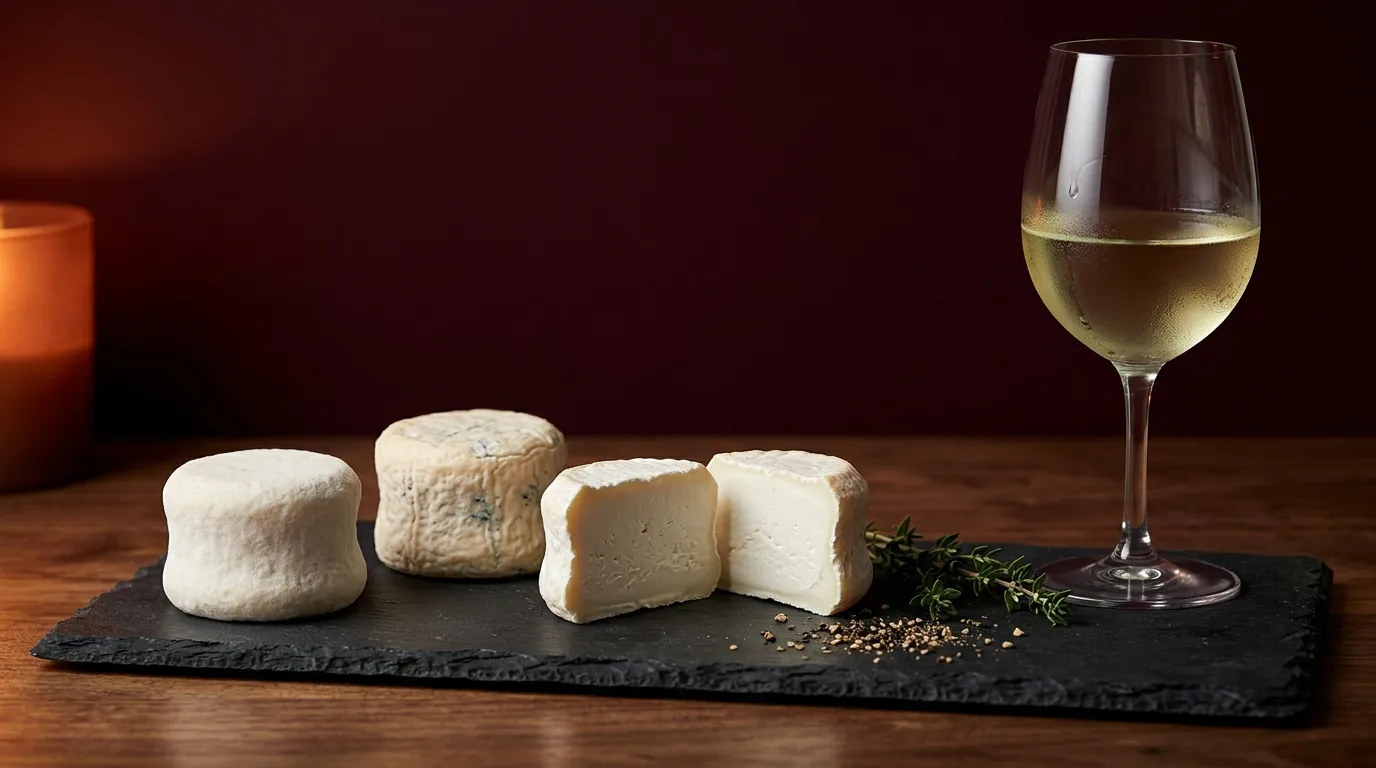
Beyond cheese, the high acidity does the same job lemon does. Didier Raimbault's own tasting sheet suggests oysters, seared scallops with lemon butter, grilled trout and fish tacos, and every one of those works for the same reason: a wine with 4 grams per litre of acid and no residual sugar cuts through fat and salt rather than sitting on top of them. Serve it properly cold, somewhere between 46 and 50°F, which is colder than most fridges manage on the door shelf. Our wine and cheese pairing guide and our notes on food pairings with Sauvignon Blanc go wider if the cheese board is the whole meal.
Frequently asked questions
Is Sancerre always Sauvignon Blanc?
Every white Sancerre is 100% Sauvignon Blanc. The appellation also makes red and rosé from Pinot Noir, which have carried appellation status since 1959, so the grape depends on the colour in the bottle.
What white wine is closest to Sancerre?
Menetou-Salon is the closest, since it's the same grape on Kimmeridgian limestone a few miles southwest of Sancerre and averages roughly $20 to $32 in the US. Quincy is the next one, averaging $22 to $30, and Pouilly-Fumé is the other neighbour worth trying, though its reputation sits closer to Sancerre's than Quincy's does.
Why is Sancerre more expensive than Sauvignon Blanc from elsewhere?
Sancerre has 3,053 hectares to sell and exports 71% of it, while New Zealand alone farms 42,000 hectares. Small supply meeting large export demand sets the price well before anyone tastes anything.
Is Sancerre dry or sweet?
Sancerre is dry by any measure, and published technical sheets put residual sugar at 0.39 grams per litre on one 2024 bottling and under 2 grams per litre on another, both far below the level where sweetness becomes noticeable.
Is Sancerre the same as Pouilly-Fumé?
No, though they're neighbours making the same grape on opposite banks of the Loire. Pouilly-Fumé covers 1,424 hectares and is known for a flinty, smoky character, while Sancerre is the larger and more widely exported of the two.
How do you pronounce Sancerre?
It's roughly sahn-SAIR, with the emphasis falling on the second syllable and the final R soft rather than rolled.
Does Sancerre age?
Most of it is built for early drinking, and we'd open a bottle within two or three years of the vintage. Didier Raimbault's 2024 ferments and then spends a year in stainless steel with no oak at any stage, so there's very little in the winemaking designed to develop in bottle.
Which bottle should you open tonight?
Buy the Sancerre when the wine is the point of the evening and you want the lean, mineral version of Sauvignon Blanc that only these hills make. Buy Menetou-Salon or Quincy when you want that character on a weeknight, since $22 buys something recognisably from the same family and leaves you $15 that the Sancerre label would have taken.
Buy the New Zealand bottle when you actually prefer it, which plenty of people genuinely do. A wine costing more doesn't make it the wine you'll enjoy more, and the only test that settles it is opening both and paying attention to which glass empties first. That's the part no appellation map can decide for you.