
Pour a dry, high-acid white with enough texture to sit beside melted butter without going flat. Sancerre, Chablis, Albarino and a good dry Vouvray all do this well, because their acidity answers the lemon while their weight keeps up with the fat. Skip heavily oaked Chardonnay, which turns waxy against citrus, and skip anything sweet, which makes the browned scallops taste oddly candied. If you only remember one thing, remember that you're pairing the sauce and not the shellfish.
What wine goes best with scallops in butter and lemon sauce?
A crisp, unoaked or lightly oaked white with real acidity is the safest and most enjoyable answer. The dish pulls in two directions at once, since butter coats your palate and lemon strips it clean, so the wine has to do both jobs too. That means acidity high enough to keep pace with the citrus, and enough body that it doesn't vanish under the butter.
Sancerre is the classic for a reason, with its cutting grapefruit acidity and a faint chalky grip that echoes the sear on the scallop. Chablis gives you a similar shape from Chardonnay rather than Sauvignon Blanc, so it feels a little rounder and a little more savoury, which suits a sauce that leans buttery rather than sharp. Albarino from Rias Baixas brings a saline, almost sea-spray quality that flatters shellfish generally. Dry Vouvray made from Chenin Blanc is the sleeper pick, because it carries a waxy, quince-like texture that mirrors the butter while its acidity stays bright underneath.
Decanter's sommelier panel lands in the same territory, recommending Vouvray, white Rioja and Lugana for seared scallops and noting that the cooking method and the sauce matter more than the shellfish itself. That's the whole principle in one line, and it's why a page about scallops has to be a page about what you put on them.
Why does the sauce decide the wine and not the scallops?
Scallops on their own are mild, faintly sweet and low in fat, so almost any clean white would flatter them. What actually sits on your palate is the butter, the lemon and whatever else went into the pan. A plain seared scallop and a scallop swimming in beurre blanc are two different pairing problems even though the protein is identical.
Butter is the tricky half of the equation, because fat softens acidity and mutes aromatics, so a wine that tasted lively on its own can read as dull and slightly flabby once the sauce is involved. Wines with genuinely high natural acidity survive this, which is why the Loire and Chablis keep coming up. The lemon then does the opposite, sharpening everything and making any wine with residual sugar taste sweeter than it did in the glass.
That combination rules out more bottles than most pairing advice admits. A big buttery California Chardonnay sounds like a natural match on paper, since butter and butter ought to agree, but the oak and the lemon fight and the result tastes faintly of vanilla and metal. If you love that style, our guide to spotting buttery Chardonnay on a wine list will help you tell the oaky bottles from the fresh ones before you commit.
Which specific bottles should you look for?
Buy on style rather than on a single producer, since the shelves change constantly and the style is what does the work. The table below sorts the reliable options by what your sauce is actually doing, which is the question you can answer while standing in the kitchen.
| If your sauce is | Look for | Why it works |
|---|---|---|
| Heavy on lemon and light on butter | Sancerre, Muscadet, Assyrtiko | High acid meets the citrus head on and keeps the finish clean |
| Balanced beurre blanc | Chablis, dry Vouvray, white Rioja | Texture matches the fat while the acidity stays lifted |
| Butter plus garlic and herbs | Albarino, Vermentino, Gruner Veltliner | Herbal and saline notes pick up the aromatics in the pan |
| Butter plus a little cream | Lightly oaked Chardonnay, Lugana | Rounder body keeps up without adding sweetness |
| Scallops wrapped in bacon | Rose from Provence, sparkling wine | Cuts the smoke and salt without overwhelming the shellfish |
Muscadet deserves a specific mention, because it's usually one of the cheapest genuinely good whites in any shop and it was more or less designed for shellfish. Look for the words "sur lie" on the label, which means the wine rested on its spent yeast and picked up a slightly creamier texture along the way. That extra texture is exactly what a butter sauce asks for.
Assyrtiko from Santorini is the pick if your version leans hard on lemon. It has a piercing, almost lime-like acidity and a smoky mineral edge that stands up to citrus better than almost anything else at the price. Vermentino from Sardinia or coastal Tuscany does something gentler, with a bitter almond note on the finish that sits nicely against browned butter.
How does the cooking method change the pairing?
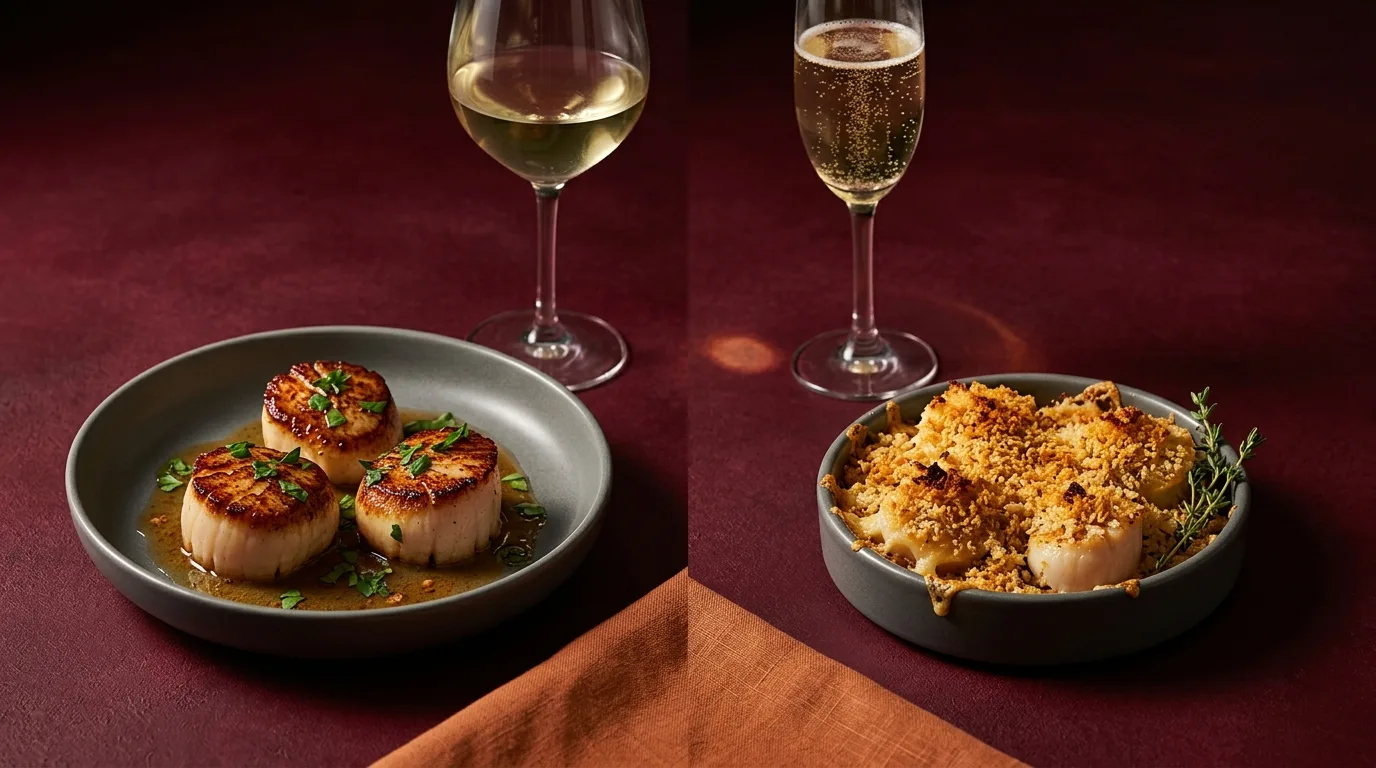
Searing, baking and serving them raw each ask for a different wine, even before the sauce enters the conversation. A hard sear caramelises the natural sugars in the scallop and adds a toasty, almost nutty layer, which is why a wine with a bit of texture behaves better than something razor sharp. Baked scallops usually arrive under breadcrumbs or cheese, adding fat and salt that sparkling wine handles more gracefully than a still white.
Raw scallops, whether sliced as crudo or dressed as ceviche, are the most delicate version of the dish and the most easily bulldozed. Very dry Riesling is the standard answer there, and Decanter's panel makes the same call, adding that an off-dry Mosel Kabinett works when the dish carries a lot of citrus. That is one of the few moments where a touch of sweetness helps rather than hurts, because the acid in a ceviche marinade is doing something quite different from a spoonful of pan lemon.
Bay scallops and sea scallops behave differently too. Bay scallops are small and sweeter, so they usually turn up in chowders, casseroles and pasta, where whatever they're swimming in sets the pairing. Sea scallops are big enough to be the centre of the plate, which is when the butter and lemon question we started with actually decides your bottle.
What glass and temperature actually change the pairing?
Serve the white cold but not freezing, since an over-chilled wine loses the aromatics that make the pairing work in the first place. Straight from a fridge is generally a few degrees too cold, so pulling the bottle out fifteen minutes before you sit down usually lands it in a better place. As the wine warms in the glass, the texture that stands up to the butter starts to show.
Use a normal white wine glass rather than a small tumbler, because the extra room lets a Vouvray or a Chablis open up. This matters more than it sounds with a rich sauce, since a wine that reads as simple and hard when it's ice cold in a narrow glass will read as generous and layered a few minutes later. Our page on wine serving temperatures has the ranges by style if you want to be precise about it.
Can you drink red wine with scallops?
Yes, though you need to choose carefully and the butter sauce narrows your options further. Tannin is the problem, since it clashes with delicate shellfish and can leave a metallic taste, so the answer is a red with very little of it. Decanter's panel names Trousseau, Zweigelt and German Pinot Noir, all of which are pale, high-acid reds that behave more like heavy whites.
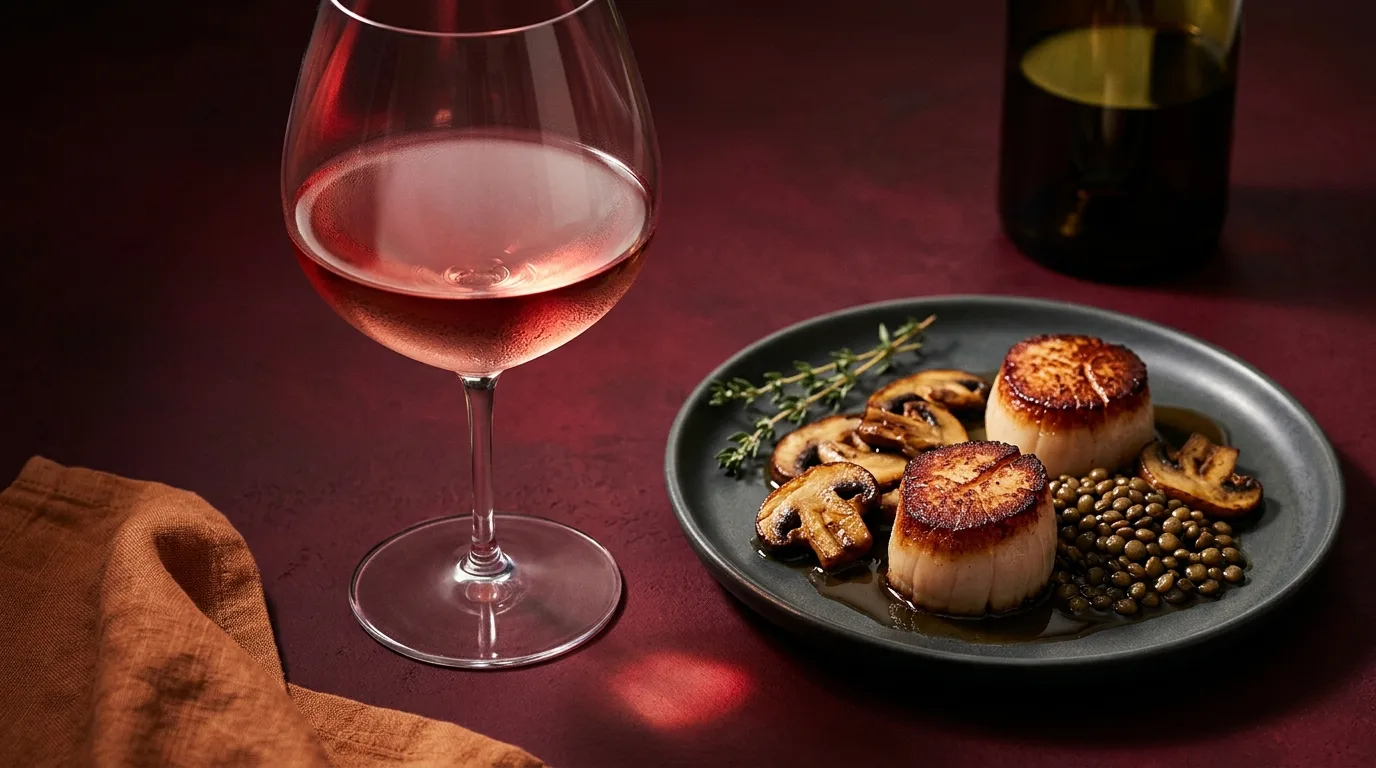
Serve any of them properly chilled, closer to how you'd treat a white than a room-temperature red. The difference here is not subtle, since a warm light red next to buttery scallops tastes soupy and thin, while thirty minutes in the fridge makes the same bottle taste crunchy and fresh.
Honestly, most weeknights the white is the better call. Reach for the red when the scallops share the plate with mushrooms, lentils, black pudding or anything else earthy, because at that point the sauce is no longer the loudest thing on the plate.
What should you avoid pouring?
Heavily oaked Chardonnay is the most common mistake, for the reasons above. Sweet or off-dry wines are the second, since lemon amplifies sweetness and a Riesling that read as barely off-dry on its own can taste like dessert beside the sauce. Dry Riesling is welcome, and the distinction matters enough to check the back label rather than guessing from the bottle shape.
Big tannic reds are the third to skip, so leave the Cabernet Sauvignon, Malbec and Nebbiolo for another night. High-alcohol whites above roughly fourteen percent can also overwhelm the dish, since alcohol reads as weight and heat, and neither helps a plate this delicate. The same logic applies across a lot of shellfish cooking, which our broader guide to choosing wine for shellfish by dish works through in more detail.
How do you pick a bottle in the shop in two minutes?
Start at the Loire Valley section if the shop has one, since Sancerre, Muscadet and Vouvray all live there and any of the three will work. If the shop is organised by grape instead, go to Sauvignon Blanc and look for a French bottle rather than a New Zealand one, because the Loire style is leaner and less tropical, which suits butter better.

Failing both of those, Albarino is now stocked almost everywhere and it's very hard to get wrong with seafood. Check the alcohol on the back label as your final filter, since anything from twelve to thirteen percent is usually in the zone you want, and a number well above that suggests a riper, weightier style than this dish needs.
If you'd rather not stand there translating labels, snapping a photo of the finished dish and letting Pairing read the sauce is faster than working through the shelf. It's the same reasoning as above, applied to your plate rather than a general rule, which matters when your beurre blanc is heavier or sharper than the average.
Frequently asked questions
What is the best wine pairing with scallops for a dinner party?
Chablis is the most reliable crowd choice, because it flatters the dish without being a wine anyone needs explained to them. If you want something less expected, a dry Vouvray gives people something to talk about while still doing the job the butter sauce requires.
Does Chardonnay go with scallops?
Unoaked or lightly oaked Chardonnay works beautifully, and Chablis is the benchmark example. Heavily oaked Chardonnay is the version to avoid with a lemon sauce, since the vanilla and toast notes turn harsh against citrus.
Should the wine be the same one I cook with?
It doesn't have to be, though it's a genuinely useful shortcut. Cooking with a dry, acidic white and drinking something from the same family keeps the flavours in the sauce and the flavours in the glass pointing the same direction.
What wine goes with scallops in a cream sauce rather than butter?
Add a little more body, since cream is heavier and rounder than butter. A lightly oaked Chardonnay, a Lugana from northern Italy or a white Rioja with some age all carry the extra weight while keeping enough acidity to stop the dish feeling rich.
Is sparkling wine a good match for scallops?
It's excellent, particularly with baked or bacon-wrapped scallops, where the bubbles and the acidity scrub the fat away between bites. A dry Champagne, a Cremant de Loire or a good Cava all work, and the drier the better with a lemon sauce.
What wine goes with seared scallops and pasta?
Follow whatever the pasta sauce is doing, since it usually outweighs the scallops. A lemon and butter pasta wants the same Sancerre or Muscadet as the plated version, while a tomato-based sauce pushes you toward something with more acidity and a touch of red fruit.
Pouring it tonight
The short version is that you're matching butter and lemon, so you want acidity plus a little texture, and you want to skip the oak and the sugar. Sancerre and Chablis are the two bottles that almost never disappoint here, Muscadet is the value pick, and dry Vouvray is the one that will make someone at the table ask what you poured.
Beyond that, trust the sauce in front of you rather than the rule. A version heavy on garlic and parsley points toward Albarino, a version that's mostly lemon points toward Assyrtiko, and a version enriched with cream points toward something rounder. The scallops themselves are the easy part of this pairing, and they always were.