
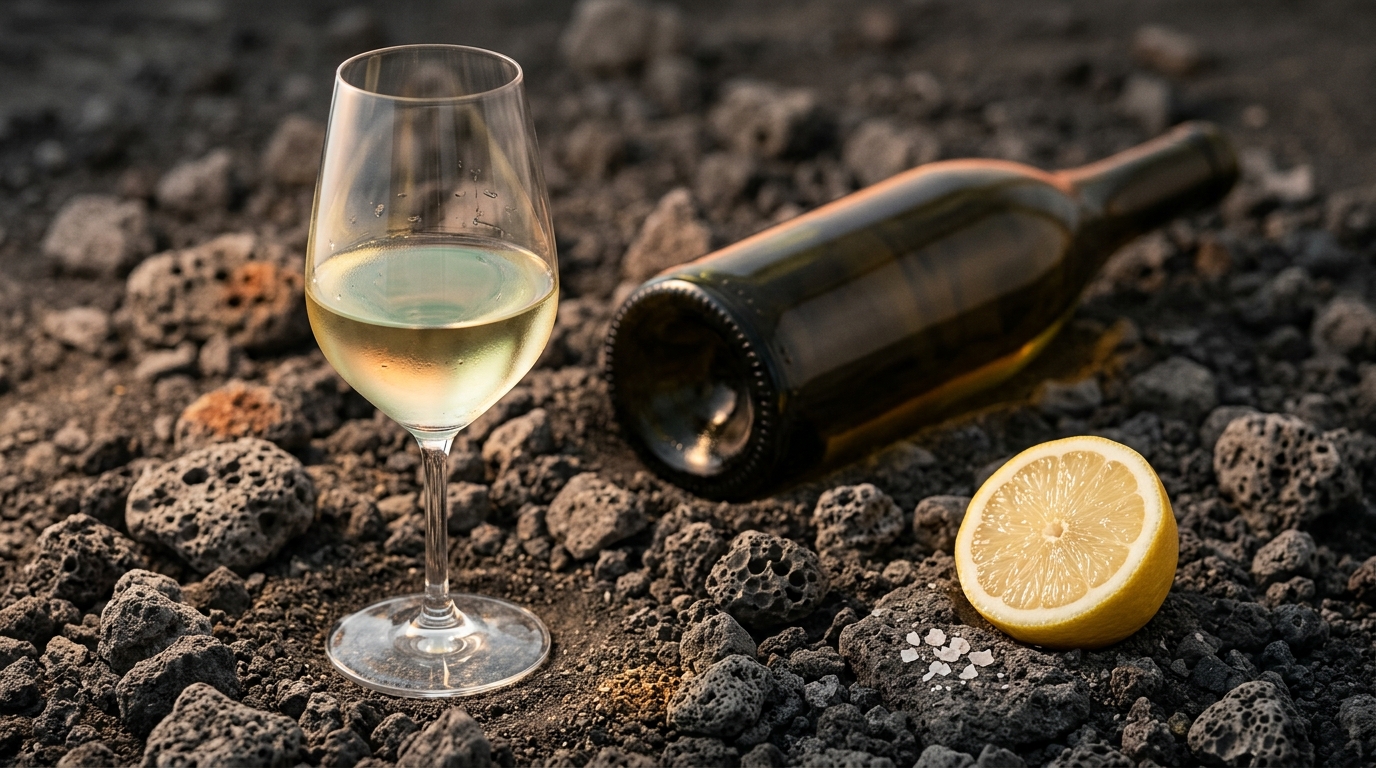

Assyrtiko is a bone-dry white from the Greek island of Santorini, and it tastes of lemon pith and grapefruit with a salty, smoky finish that keeps pulling you back. It carries more acid than almost any other white you can buy, and more alcohol than its pale color suggests. Santo Wines lists its 2024 Santorini Assyrtiko at 13.4% alcohol with a pH of 3.08, which puts it in the same strength bracket as a California Chardonnay while tasting sharper than a Loire Sauvignon Blanc. Order it if you like your whites genuinely bracing. Skip it if tart wine makes you flinch.
Three words on the label decide which Assyrtiko you get, and one of them will land a dessert wine on your table next to the fish. That's the part most guides leave out, so we'll start with taste and get to the label before you order.
What does Assyrtiko wine taste like?
Assyrtiko tastes of lemon pith, grapefruit and green apple, finished by a savoury, briny edge that reads as salt or wet stone rather than fruit. Wine Folly's profile of the grape names lime, passion fruit, beeswax, flint and saline as its primary flavours, which is a fair spread of what you'll meet across different producers. The first impression is almost always citrus, and the last impression is almost always salt.
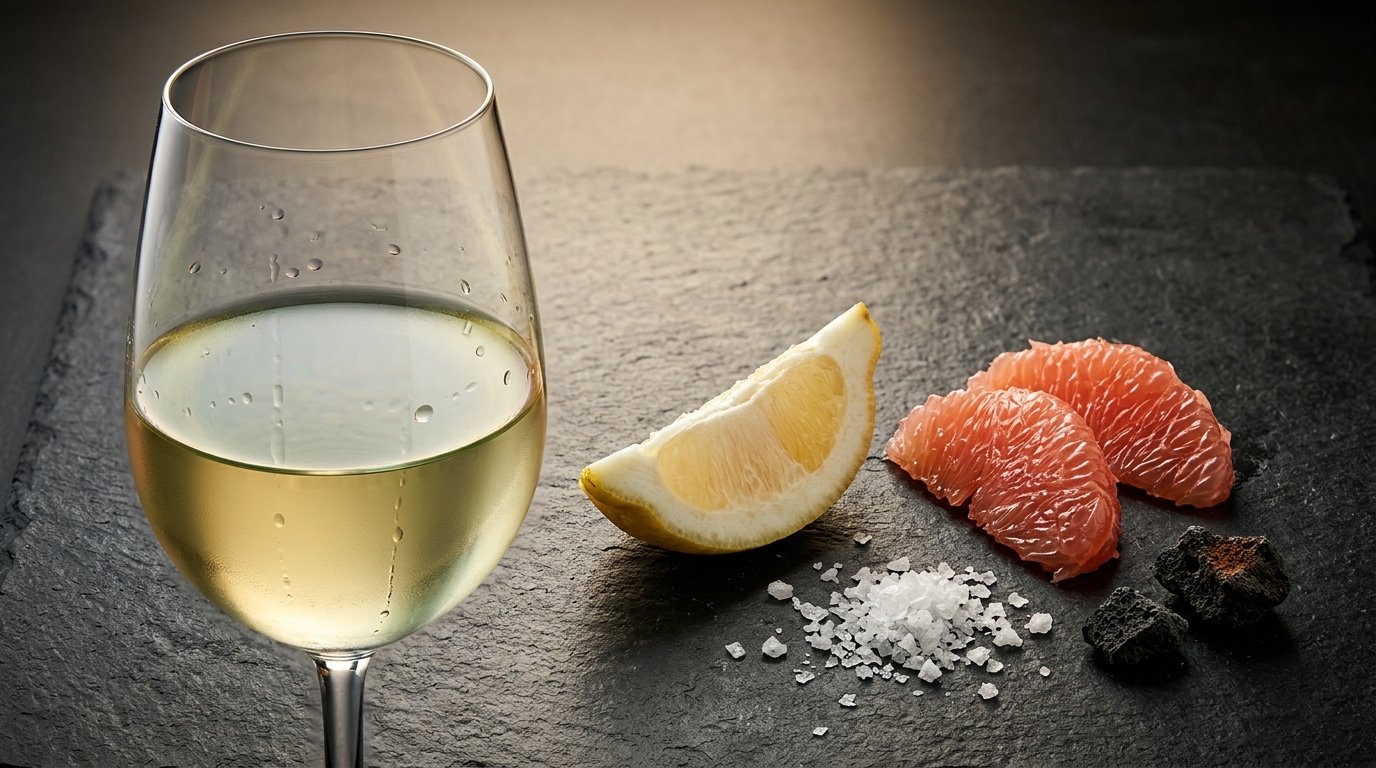
What makes the grape unusual is that it holds onto its acidity even when the fruit ripens fully. Most white grapes grown somewhere as hot and dry as Santorini would turn soft and dull by harvest, all sugar and no spine. Assyrtiko ripens and stays sharp, which is why the Oxford Companion to Wine, quoted in Wikipedia's entry on the grape, records it as keeping high acidity even in ripe years. Decanter describes the result as a pronounced savoury profile with stony minerality and citrus freshness.
That savoury finish is the thing people struggle to describe. A tasting note may call it stony, flinty or mineral, and none of those words tells you much while you're holding the glass. In plain terms, once the lemon fades you're left with a faint salted-edge impression and a mouth that feels rinsed rather than coated. The useful question isn't whether you can name the rock. It's whether you want another bite of dinner immediately, because that's what the finish actually does.
Will Assyrtiko taste too sharp to you?
Probably not, if you already enjoy dry Riesling or a lean Sauvignon Blanc. Almost certainly yes, if your usual white is a soft Pinot Grigio or a buttery Chardonnay. This is the one question worth settling before you spend money, and unlike most tasting-note vocabulary, there are real numbers behind it.
Santo Wines publishes the full analysis for its Santorini Assyrtiko: total acidity of 6.5 grams per litre of tartaric acid, residual sugar of 2 grams per litre, and a pH of 3.08. The residual sugar figure means the wine is genuinely dry, with no sweetness left to soften anything. The pH is the number that matters most, because lower means sharper, and 3.08 is very low for a still white. A typical Sauvignon Blanc sits nearer 3.2, and a warm-climate Chardonnay can run past 3.5. So Assyrtiko isn't merely described as high-acid. It's measurably at the sharp end of what the wine world bottles.
If you're not sure how you feel about acidity in general, our explainer on what acidity in wine actually does is a better starting point than a tasting note, and we've also written about enjoying wine when you dislike tart flavours. Both will tell you more about your own reaction than any description of Santorini will.
The practical move in a restaurant is to order a glass rather than a bottle for your first encounter. A small pour costs a few dollars and settles the question permanently, and it's the same approach we'd suggest for dry Riesling, the closest familiar reference point for this kind of sharpness.
Why does a crisp white run 13.4% alcohol?
Because Santorini is hot and dry, the grapes ripen fully, and full ripeness means sugar that ferments into alcohol. Assyrtiko simply keeps its acid while that happens, so you get a wine that tastes lean and weighs more than it tastes. Wine Folly lists the grape's usual range as 13.5% to 15% alcohol by volume, and the Santo Wines bottling above comes in at 13.4%.
This is the single most misleading thing about the grape, and it's why some people find their first bottle surprising rather than refreshing. The color is pale, the aroma is citrus, and everything about the first sip says light wine. Then the weight arrives on the finish. Wine Folly files Assyrtiko under light body, which is accurate about its texture, but a 14% wine is not a light drink no matter how it feels in the mouth. Plan a glass or two with dinner rather than an afternoon of it.
The upside of that ripeness is that the wine can stand up to real food instead of disappearing beside it. A 12% Pinot Grigio gets flattened by garlic and olive oil. Assyrtiko doesn't, which is the whole reason it ended up as the house white of a cuisine built on lemon, herbs and grilled fish.
Santorini, Nykteri or Vinsanto: which word on the label decides the style?
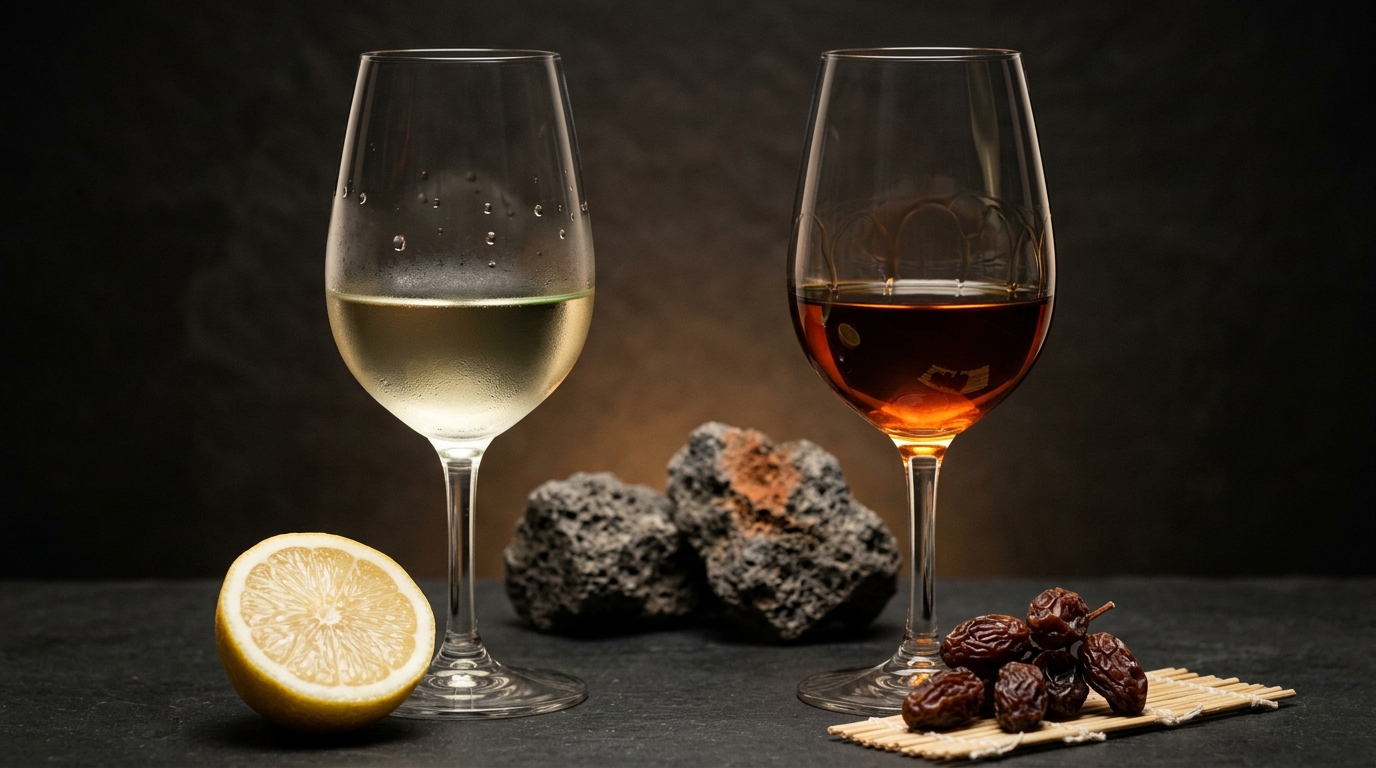
Look for the word Santorini for a classic dry white, Nykteri for a richer barrel-aged version, and Vinsanto for a sweet dessert wine. The grape name alone tells you nothing about which of the three you're holding, and confusing the last one for the first is the mistake worth avoiding.
| Label word | What you get | Sweetness | Oak | When to open it |
|---|---|---|---|---|
| Santorini (or just Assyrtiko) | Bone-dry, citrus, saline finish | Dry | Usually none | With dinner, especially seafood |
| Nykteri | Fuller, rounder, more texture | Dry | Barrel-aged | With richer dishes and cream sauces |
| Vinsanto | Dried apricot, honey, orange peel | Sweet | Years in barrel | After dinner, with dessert |
Nykteri gets its name from the old practice of picking at night to beat the Aegean heat, and it spends time in barrel, which gives it more weight and a rounder texture than the standard bottling. It's still dry, so it isn't a sweet wine by mistake. But if buttery or toasty flavours bother you, ask about oak before you commit, because this is where you'll find it.
Vinsanto is a different drink entirely. The grapes are sun-dried on straw mats until they shrivel and concentrate, then the wine ages in oak for years, sometimes more than a decade. It comes out tasting of dried apricot, coffee and orange peel, with enough acidity still running through it to stop the sweetness turning cloying. It's a genuinely great wine and completely wrong next to grilled fish, which is why the word is worth knowing on sight. If sweet wines interest you, our piece on dry versus sweet wine and the numbers that separate them covers how to read sweetness off a label more generally.
You may also see Aidani or Athiri named on a Santorini blend. Both are local white grapes, with Aidani adding floral aromatics and Athiri adding flesh and roundness, and a small percentage of either softens Assyrtiko's edges slightly without changing what the wine is.
What does a bottle of Assyrtiko cost?
More than most people expect from an unfamiliar grape. Santo Wines sells its own Santorini Assyrtiko for $41.99 through its United States shop, and while you'll find bottles for less, this is not a bargain-bin alternative to Pinot Grigio. Santorini is a small island with tiny yields, and the price reflects that rather than any fashion premium.
That matters for how you approach your first bottle. If you want to try the grape without spending $40, look for Assyrtiko from mainland Greece rather than Santorini, where the same variety grows at lower cost. You'll get a genuine picture of what the grape does, usually with softer fruit and a little less of the saline intensity that the island is known for.
What food goes with Assyrtiko?
Grilled fish with lemon, oysters, shellfish, and a Greek tomato and feta salad. Wine Folly names shellfish and Greece's classic tomato-feta salad as the natural partners, and the logic behind both is the same: the wine's acid does the job a squeeze of lemon would do, cutting salt and richness and resetting your palate between bites.
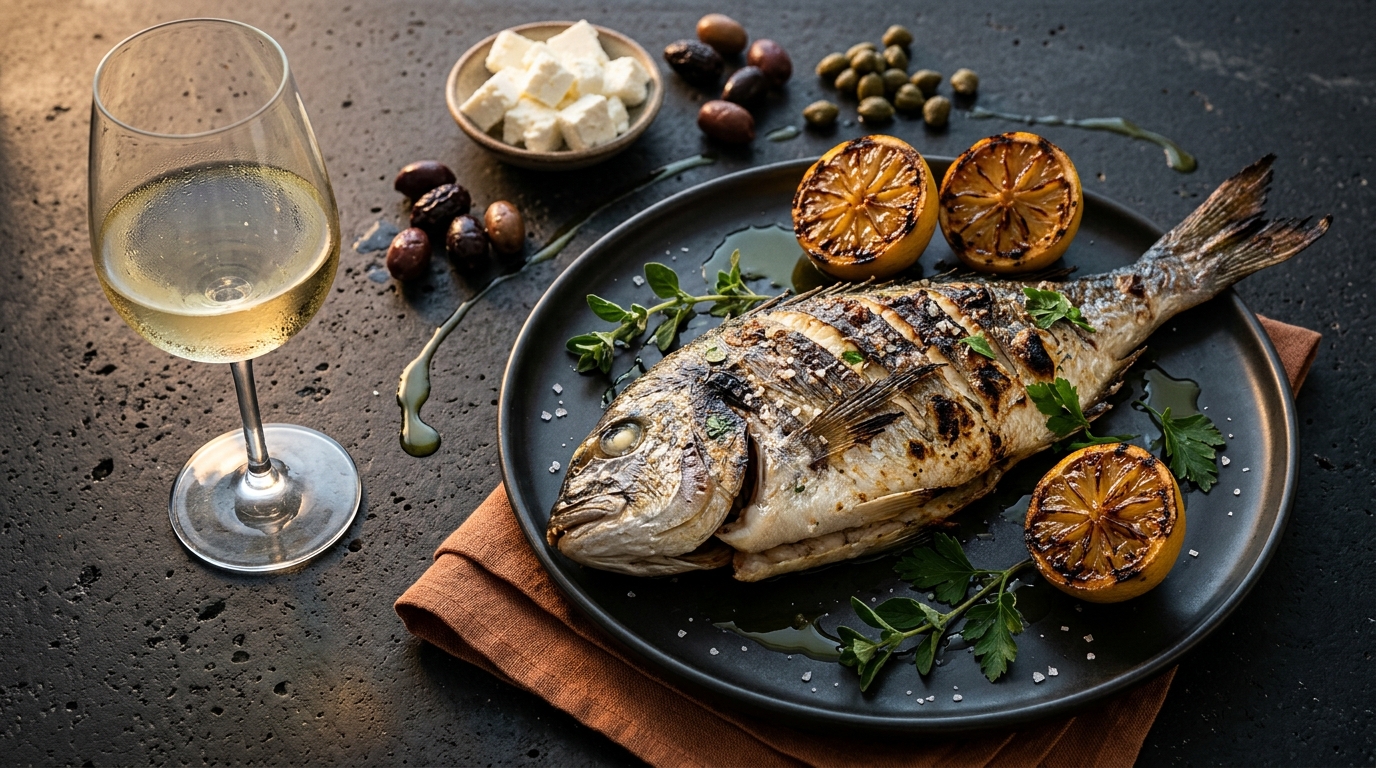
Salty and briny food is where the grape is genuinely hard to beat. Feta, olives, anchovies, capers and grilled octopus all have enough salt to make a softer white taste flat, and Assyrtiko meets them instead of folding. We've written more about this shape of pairing in our guides to wine for oysters, wine with shellfish and what to pour with Greek gyros and souvlaki.
Two situations call for a change of plan. If your dish is under a thick cream sauce, reach for a Nykteri rather than the leanest bottle you can find, because the extra weight gives the wine something to push against. And if the meal leads with chilli heat, a very high-acid wine can sharpen the burn rather than cool it, so something softer will treat you better.
Is Assyrtiko from outside Greece worth trying?
Yes, and the plantings are more established than you'd guess. Jim Barry Wines grows Assyrtiko in Clare Valley, South Australia. In California, Paicines Ranch Vineyard in the San Benito AVA supplies fruit that Margins Wine bottles, and the Abbey of New Clairvaux has grown it since 2011. Kefi Winery in Monroe, North Carolina grows it too. The original American cuttings arrived in 1948, imported by the grape breeder Harold Olmo at the University of California, Davis, and sat in the university's collection until New Clairvaux took an interest in the early 2000s.
Expect these to taste like the grape without tasting like the island. The high acid travels, because that's genetic. The saline, smoky quality that people associate with Santorini owes a lot to the island's specific conditions, so a Clare Valley bottling will usually give you more fruit and less of that mineral austerity. Neither version is better than the other, because they're answers to different questions, and if you already know you like a particular style of white, our approach to finding the next bottle from one you liked applies here as much as anywhere.
Santorini's own vineyards are unusual enough to explain the difference. The soil is volcanic ash, pumice and lava with almost no clay and no organic matter, which is so inhospitable that phylloxera cannot survive in it, so many of the island's vines grow on their own ungrafted roots the way European vines did before the blight. The vines are trained low into coiled baskets called kouloura, which shelter the fruit from the wind and sun, and a comparative study cited in Wikipedia's entry found that kouloura vines held a less-stressed water status through heatwaves than conventionally trellised ones.
How should you serve Assyrtiko, and can you age it?
Serve it cold but not frozen, somewhere between 38°F and 45°F, which is Wine Folly's recommended range, in a standard white wine glass. There's no need to decant it at any age. If the bottle comes out of the fridge so cold that you can't smell anything, let the glass sit for five minutes and the citrus will arrive.
On aging, a good Santorini Assyrtiko will keep and develop. Wine Folly puts the window at five to ten years, and plenty of writers rate the island's best bottlings as serious cellar candidates. That said, the grape name on its own is not a promise about a specific bottle, and most Assyrtiko sold in the United States is made to drink young and fresh. If you're buying something to put away for a decade, ask the shop about that particular wine and that particular producer. Otherwise open it with dinner this week, which is what it was made for.
Ordering it in a restaurant is where the name causes the most hesitation, and a wine list is exactly the moment when knowing the grape doesn't help you as much as knowing yourself. Sommy's Current Venue filters an actual restaurant's list against what you've liked before, so an unfamiliar Greek white either comes back as a good fit for you or doesn't. If you'd rather handle it out loud, the script is short: say you're having fish, you want something dry and bright without oak, and name your price limit before the server suggests anything. Our guide to ordering wine at a restaurant covers the rest.
Assyrtiko questions people ask before ordering
Is Assyrtiko like Sauvignon Blanc?
They share dryness and high acidity, and that's where the similarity stops. Sauvignon Blanc leans grassy, herbal or tropical depending on where it's grown, while Assyrtiko leans lemon pith and salt with a smoky edge. Assyrtiko is also usually the stronger wine, at 13.4% to 15% against the 12% to 13% typical of a Loire or New Zealand Sauvignon Blanc. If you love Sauvignon Blanc's snap but find its green notes tiring, Assyrtiko is a very good next step.
Is all Assyrtiko wine dry?
Almost all of it is dry, and reliably so. Dry Santorini and Nykteri bottlings both come in dry, with the Santo Wines example carrying just 2 grams per litre of residual sugar. The exception is Vinsanto, a genuinely sweet dessert wine made from sun-dried grapes, and the word Vinsanto on the label is your warning. The grape also turns up blended into Retsina, where it's often paired with the lower-acid Savatiano.
What does Assyrtiko smell and taste of on the finish?
Lemon and grapefruit up front, then a savoury, salty, faintly smoky impression that lingers after you swallow. Tasting notes call this minerality or salinity. It isn't sweet fruit and it isn't oak, and it's the quality that makes the wine feel refreshing rather than merely sour.
How cold should Assyrtiko be served?
Between 38°F and 45°F, colder than a red and about the same as any other crisp white. Over-chilling mutes the aromatics, so if you can't smell the citrus, give the glass a few minutes in your hand.
Is Assyrtiko expensive compared with other white wines?
Santorini bottlings tend to be, with Santo Wines listing its own at $41.99 in the United States. Assyrtiko grown on mainland Greece or in California and Australia generally costs less, which makes it the sensible way to meet the grape before deciding whether the island version is worth it to you.
Ordering your first Assyrtiko with confidence
Assyrtiko is a good call when you want a white that's genuinely dry, seriously sharp and built for salty food, and a poor call if soft and rounded is what you actually enjoy. The wine's own numbers say so plainly: 6.5 grams per litre of acid, 2 grams of sugar and a pH of 3.08 leave nowhere for softness to hide.
So make the decision on two things rather than on Santorini's reputation. Check the label for the word that sets the style, and be honest about how you feel about sharp wine. Ask for a dry Santorini Assyrtiko with your fish, name your price range, and order it by the glass the first time. That's enough to find out whether this becomes your house white, and you don't need to learn a word of Greek to do it.
