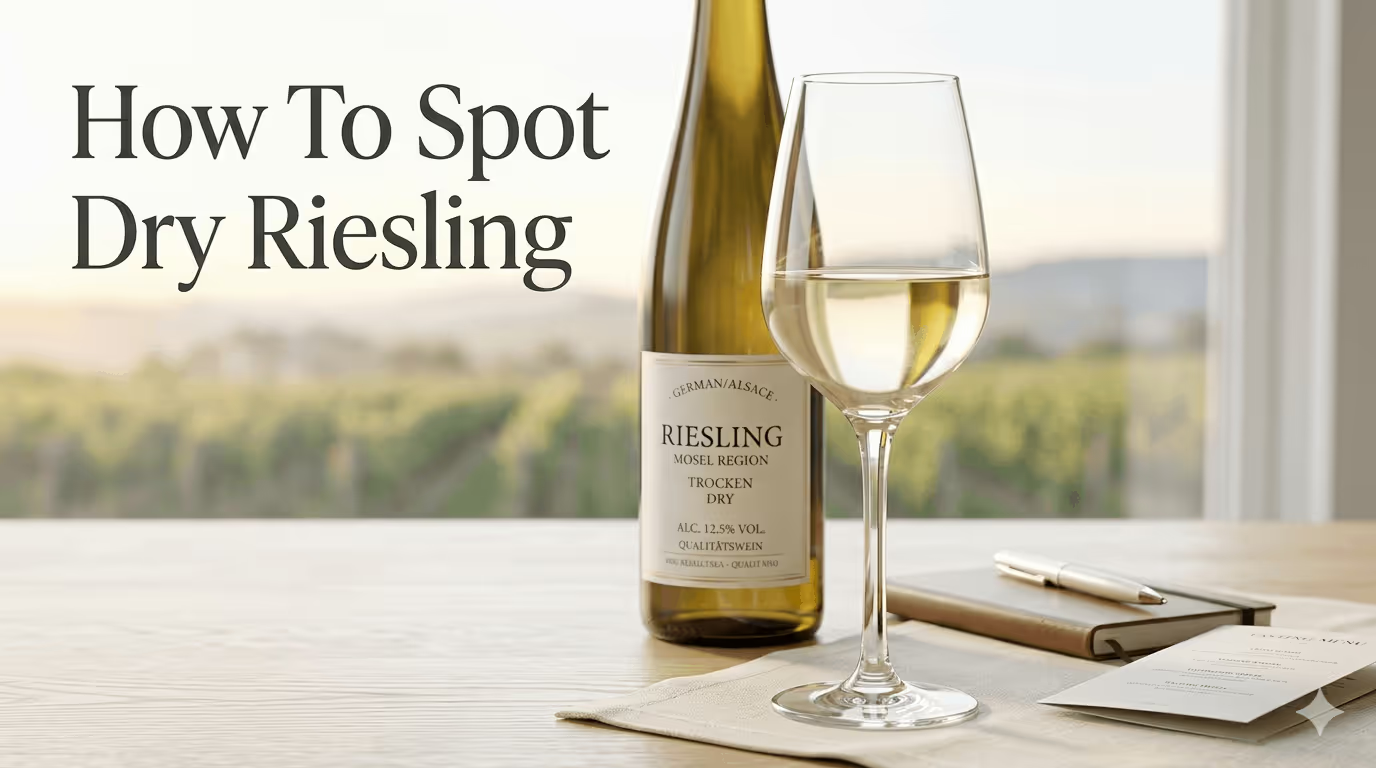

A dry Riesling is one where nearly all the grape sugar has fermented into alcohol, so the wine finishes crisp rather than sweet. The fastest way to find one is to read the style word rather than the grape name: trocken on a German label is a legal term meaning the wine holds no more than 9 grams of residual sugar per liter, and Grosses Gewächs guarantees the same thing at the top of the quality ladder. Outside Germany, Riesling from Alsace, from Australia's Clare Valley and Eden Valley, and from Austria is dry by tradition rather than by declaration, which is why those bottles rarely bother to say so.
If you've bought a Riesling expecting crisp and got syrup instead, that isn't a failure of taste. Riesling is the one white grape that makes both styles brilliantly, and the American shelf mixes them together with almost no signposting.
What is a dry Riesling?
A dry Riesling is a Riesling fermented until the yeast has eaten nearly all the sugar, leaving acidity rather than sweetness as the wine's main structure. Germany, which grows more Riesling than anywhere else, actually writes the number into law. According to the Deutsches Weininstitut, a wine can be sold as trocken with up to 4 grams of residual sugar per liter, and up to 9 grams if the total acidity is no more than 2 grams per liter below the sugar figure. That second clause is the interesting one, because it treats dryness as a balance between sugar and acid rather than a sugar reading on its own.
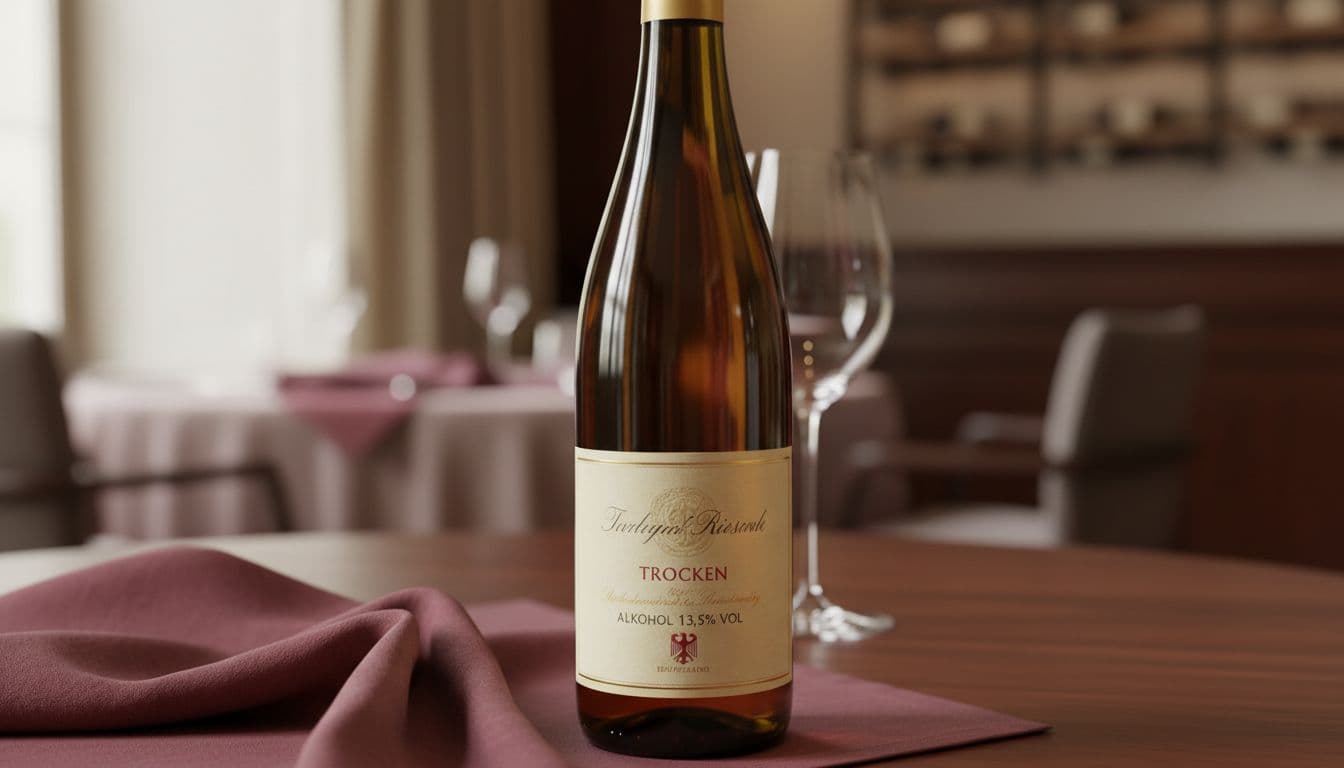
That balance rule explains something people find confusing in the glass. A Riesling carrying 8 grams of sugar can taste bone dry if the acidity is high enough to cover it, while the same 8 grams in a soft, low-acid white would read as noticeably sweet. Riesling naturally runs high in acid, so it hides sugar better than almost any other grape, and your palate is not being fooled so much as correctly reading a genuine tension between the two.
Dry is also far more common than the grape's reputation suggests. The German wine trade body reports that half of all German quality and Prädikat wines were sold in the dry style in 2022, so the sweet stereotype describes an export habit more than it describes German production.
Why is dry Riesling so hard to find?
Dry Riesling is hard to find because the sweet versions travelled better, and the labels that would tell you the difference are written in German. For decades the bottles that reached American supermarkets were the soft, cheap, blue-bottle style, and those set the expectation for a whole generation of drinkers. Importers responded to what sold, which meant the dry bottles that Germans were actually drinking at home mostly stayed at home.
The label system made things worse before it made them better. The VDP, the association of Germany's top estates, describes the problem in its own history of the classification: under the older rules the sugar content of the grape juice alone determined a wine's quality grade, and traditional terms such as Spätlese ended up attached to wines of very different sweetness levels. So a word that once told you something useful stopped being a reliable signal, and growers who wanted to make serious dry wine had no agreed way to say so.
The fix arrived from the producers rather than the lawmakers. The VDP introduced Grosses Gewächs as its designation for a dry wine from a top vineyard site, and from the 2006 vintage those wines have been dry to the legal standard of no more than nine grams of residual sugar. In 2012 the association adopted the four-tier structure it uses now, running from VDP.Gutswein through VDP.Ortswein and VDP.Erste Lage up to VDP.Grosse Lage, deliberately modelled on the Burgundian ladder of village, premier cru and grand cru. Grosses Gewächs bottles are embossed with a GG logo, which makes them one of the few wines you can identify by running a thumb over the glass.
How do I know if my Riesling is dry or sweet?
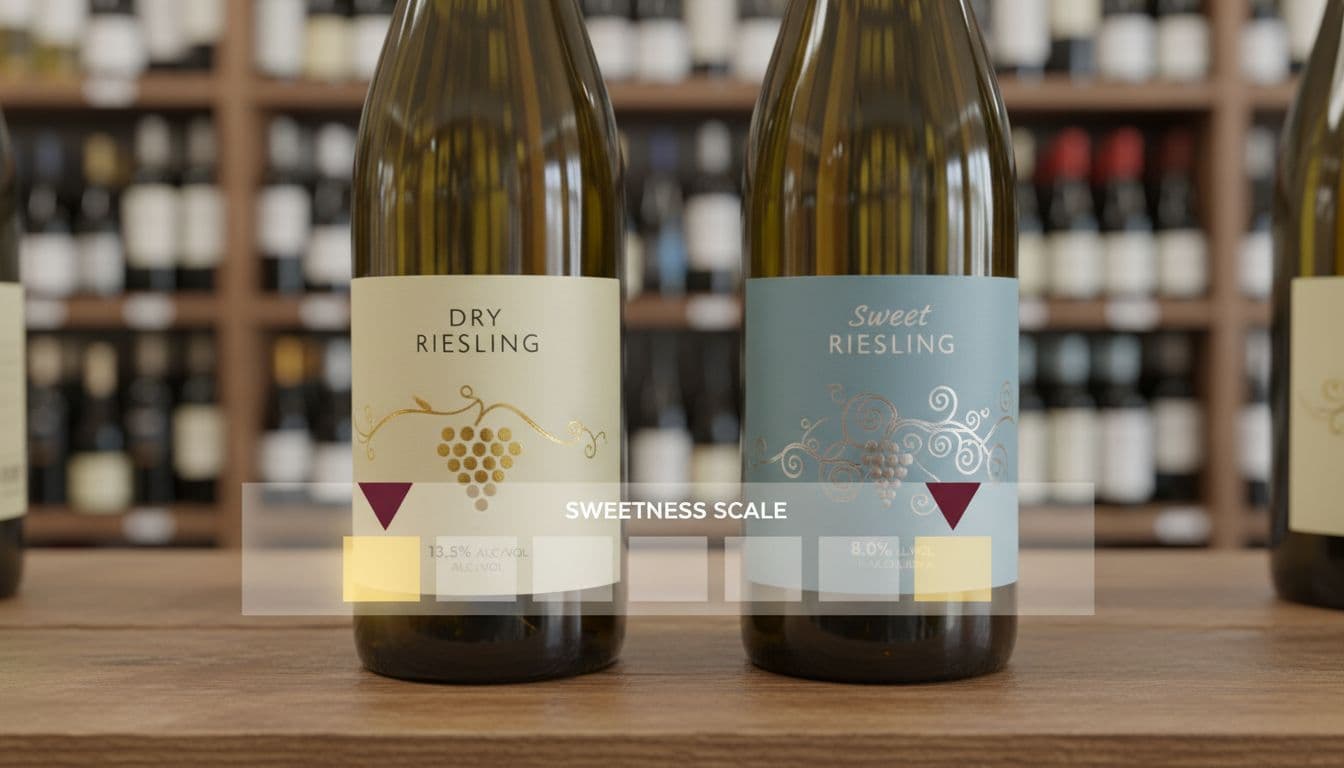
Read the style word first, and only then look at anything else on the label. One word usually settles it, and the useful ones cluster on German bottles because Germany is the only major producer that regulates the vocabulary. Here is what each term actually commits the producer to:
| Label term | Legally means | How it drinks |
|---|---|---|
| Trocken | Up to 9 g/L residual sugar, subject to the acid balance rule | Dry, the safest word on the shelf |
| Grosses Gewächs (GG) | Dry to the legal standard, from a classified VDP site | Dry and serious, the top of the dry range |
| Halbtrocken | Up to 12 g/L, or up to 18 g/L under the acid rule | Off-dry, a clear impression of sweetness |
| Feinherb | Nothing, the term is not defined in wine law | Usually between halbtrocken and sweet |
| No style word at all | Nothing is being promised either way | Check the origin and the alcohol instead |
Feinherb deserves the warning it gets here. The Deutsches Weininstitut calls it an unofficial fifth taste category that isn't clearly defined and isn't regulated by wine law, yet it appears on plenty of good bottles because growers like its softer sound. Treat it as off-dry and you'll rarely be surprised.
The other trap is the Prädikat ladder. Kabinett, Spätlese and Auslese describe how ripe the grapes were at harvest, not how sweet the finished wine is, which is why a bottle can perfectly reasonably say Spätlese trocken. Read those two words together rather than stopping at the first one, and a whole shelf of German Riesling stops being intimidating. Our guide to reading a wine label without guessing covers the same logic across other countries.
Does the alcohol percentage tell you if a Riesling is dry?
Alcohol is a decent second opinion and a poor first one. The logic behind the shortcut is sound, since sugar that ferments becomes alcohol, so a wine that finishes at 12 or 13 percent has converted more of its sugar than one that stops at 8 or 9 percent. A German Riesling at 7.5 percent has almost certainly been stopped mid-fermentation and left sweet, and one at 12.5 percent has almost certainly been fermented out.
The middle of that range is where the shortcut breaks down. Plenty of dry Rieslings from cooler sites land at 11 percent because the grapes never got ripe enough to go higher, and plenty of lightly off-dry wines sit at 11.5 percent with a few grams of sugar left behind on purpose. If the bottle carries a style word, trust the word over the number every time. Use alcohol only when the label tells you nothing else, and treat anything under about 10 percent as a strong hint toward sweetness.
Where do the reliably dry Rieslings come from?
Four regions make dry Riesling as their default, which means you can buy on origin alone when the label gives you nothing else to work with, and Australia is the clearest case of the four. Wine Australia states plainly that the tradition there has been to ferment Riesling to complete dryness, and the country sits second only to Germany in total Riesling plantings, with 3,157 hectares recorded in 2020 and the first vines going in near Penrith, New South Wales, in 1838.
Within Australia the two names to look for are Clare Valley and Eden Valley, which between them account for a third of all Australian Riesling production. Clare grows on slate and limestone with cold nights, giving light-bodied wines with vivid lime fruit and enough structure to age for decades. Eden Valley sits higher up in the Barossa zone and gives a similar shape with a steelier, more mineral finish. Almost every Australian Riesling arrives under a screwcap, which the industry credits with preserving exactly the purity the style depends on.
Alsace is the second safe bet, and the region's own trade body files Riesling under its "fresh and dry" grouping, describing the wine as very linear with a lively intensity that carries from the first taste through the finish. Austria is the third, where Riesling from the Wachau, Kremstal and Kamptal is made dry as a matter of course and tends to be fuller and riper than its German equivalent. The fourth is the Finger Lakes in New York, where dry Riesling has become the region's calling card and where American labels usually say "dry" in plain English, which removes the guesswork entirely.
Germany remains the deepest source of great dry Riesling, but it's the one place where you have to read rather than assume. That's the whole reason the trocken and GG vocabulary exists.
What does a dry Riesling actually taste like?
A dry Riesling tastes of lime, green apple, white peach and wet stone, with an acidity that makes your mouth water rather than coating it. The aromatic side is where people get misled, because Riesling smells fruity and floral whatever its sugar level, and a bone-dry bottle can still lift out of the glass smelling of apricot and honeysuckle. Aroma and sweetness are separate things, and Riesling separates them further than most grapes do.
The finish is the honest test. A dry Riesling leaves your palate feeling rinsed and slightly tingly, the way a squeeze of lemon does, while an off-dry one leaves a soft roundness that lingers on the middle of your tongue. Older bottles develop a distinctive petrol or kerosene note that sounds alarming written down and reads as complexity in the glass, and it shows up in dry examples more often than sweet ones. If you want the broader version of this distinction across other grapes, our guide to dry versus sweet wine works through the residual sugar numbers style by style, and Riesling compared with Moscato is useful if sweetness is the axis you care about most.
Standing in front of a German shelf with five unfamiliar terms on every label is exactly the moment Sommy's Label Scan was built for, since pointing your camera at the bottle gets you the style and whether it suits your taste before you've worked out what Grosses Gewächs means.
What should you eat with a dry Riesling?
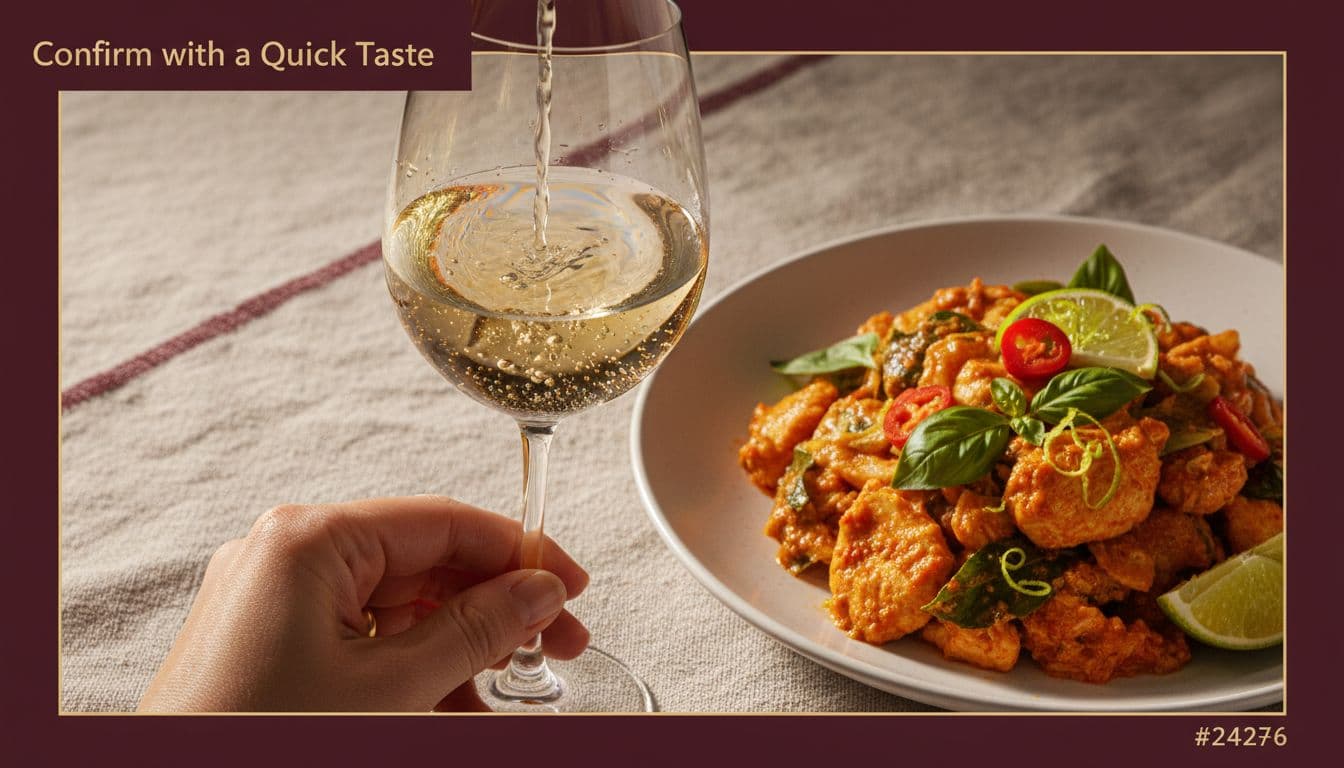
Dry Riesling handles the two things that defeat most white wines, which are chili heat and salt. Its acidity resets your palate between bites and its slight sweetness of fruit, even in a dry bottle, takes the edge off capsaicin in a way that an oaked Chardonnay never manages. Thai curry, Sichuan cooking, Korean fried chicken and anything arriving with a chili crisp on the side all work better with dry Riesling than with almost anything else on a wine list, and our guide to wine for spicy takeout nights goes further into why.
Salt is the other natural partner, which puts oysters, sushi, cured pork and salty hard cheese squarely in range. The high-acid, low-alcohol shape of a German trocken Riesling is especially good with raw fish, and our white wine for sushi guide makes the case in detail. Roast pork with apple, trout, and simple roast chicken all sit comfortably here too, and our fuller Riesling pairing guide covers the sweeter styles as well.
Frequently asked questions about dry Riesling
What are the three types of Riesling?
Riesling is usually sorted into dry, off-dry and sweet, though the German system that most bottles follow actually recognizes more gradations than three. Dry covers trocken and Grosses Gewächs, off-dry covers halbtrocken and the unofficial feinherb, and the sweet end runs from lieblich at up to 45 grams of residual sugar per liter through the dessert wines above that. The tidy grouping of three is a convenience rather than a rule.
What's the best dry Riesling?
There's no single best dry Riesling, and the honest answer is that the right one depends on whether you want the lean, citrusy version or the riper, rounder one. For lean and mineral, look to German trocken from the Mosel or an Australian bottle from Clare Valley. For something with more weight behind it, Alsace and Austria both give you a fuller shape at the same dryness, and a German Grosses Gewächs sits at the top of that group. We don't rank wines by score, because the bottle that suits your palate is a different question from the bottle a critic liked.
Is dry Riesling the same as regular Riesling?
No, because there's no such thing as regular Riesling. The grape covers the full sweetness range, from wines with almost no sugar to dessert wines that pour like syrup, and the word Riesling on its own commits the producer to nothing about style. That's exactly why the style word matters more than the grape name on this particular shelf.
Can you cook with dry Riesling?
Dry Riesling is a good cooking white, particularly for pork, mussels, and cream sauces that want acidity to cut through them. Use a genuinely dry bottle rather than an off-dry one, since sugar concentrates as a sauce reduces and a halbtrocken wine can leave a dish tasting oddly sweet. The classic Alsatian preparations of choucroute and coq au Riesling both assume the dry version.
Is there good dry Riesling at everyday prices?
Yes, and Riesling is one of the better-value white grapes precisely because its reputation for sweetness has kept demand modest. German trocken at the basic quality tier, Australian Clare and Eden Valley bottles, and entry-level Alsace all deliver real character well below what an equivalent Chardonnay or Sancerre would cost. We're not quoting figures here because retail prices move constantly and vary by state, but the value sits in those three places.
Buying your next bottle
Finding a dry Riesling comes down to one habit, which is reading the line below the grape name instead of stopping at it. Trocken and Grosses Gewächs are promises backed by law, Clare Valley and Alsace and Austria are promises backed by tradition, and feinherb is a word that promises nothing at all. Everything else on the label is detail you can learn later.
If you'd rather not memorize a vocabulary list before your next dinner, that's a fair position to take, and it's the reason Sommy exists as a second opinion in the aisle rather than a textbook to study first.