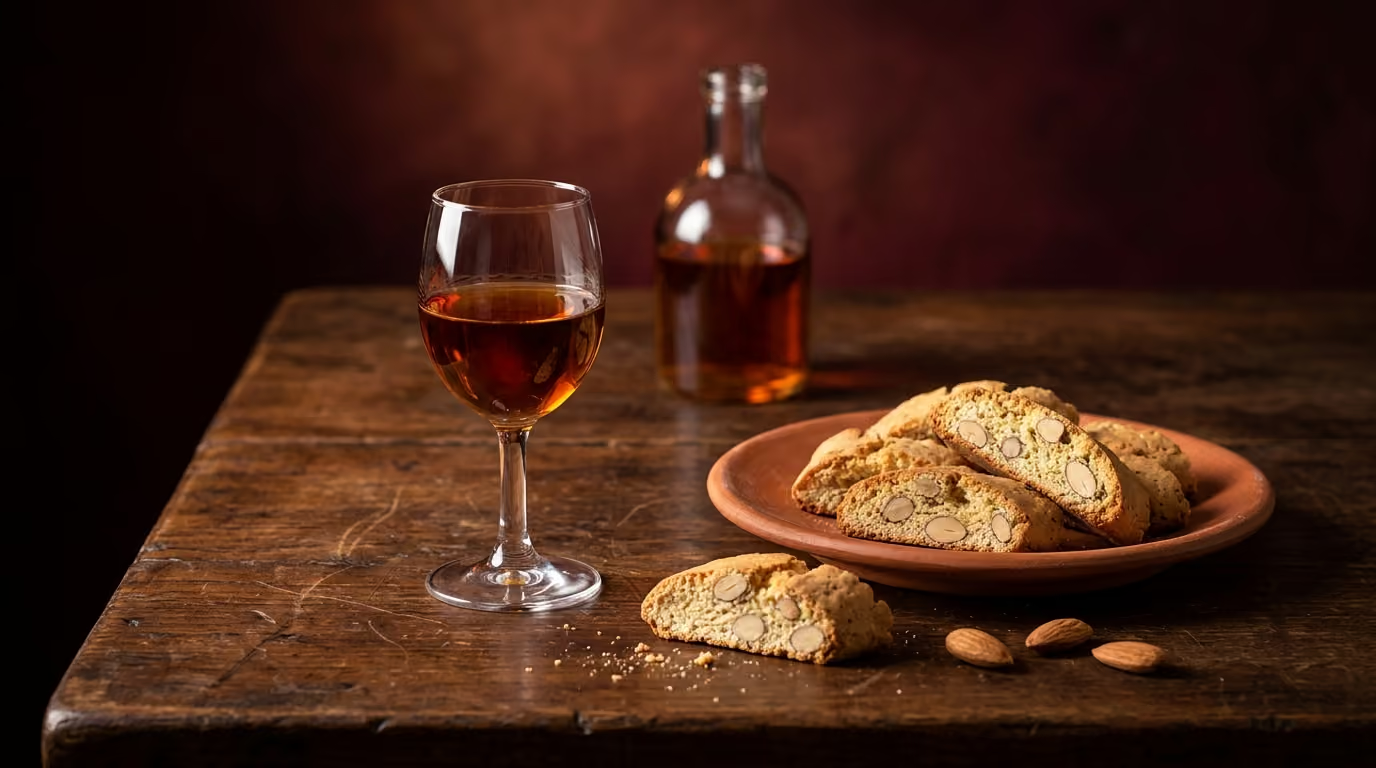

Vin Santo is an Italian wine made from grapes that have been dried indoors for months before pressing, and it's best known as Tuscany's amber after-dinner wine served with cantucci, the hard almond biscuits locals dip into the glass. Most bottles you'll meet are sweet, tasting of dried apricot, honey, hazelnut and caramel, but the style runs all the way to bone dry, so the one thing worth asking before you order is how sweet that particular bottle is. If you want the easy first taste, ask for a small pour of a sweet Vin Santo del Chianti Classico with the biscotti and you'll be in the right place.
The name means "holy wine", the process takes years, and the price surprises people who expect dessert wine to be cheap. Below we cover the taste, why two bottles differ so much, what the label tells you, how it differs from Santorini's Vinsanto, and how to serve and pair it at home.
What does Vin Santo taste like?
Vin Santo tastes of dried apricot, golden raisin, honey, toasted hazelnut and caramel, with a sweet version feeling thick and glossy in the mouth and a dry one tasting closer to a nutty, old-style Sherry. Wine Folly's write-up describes it as full-bodied and typically very sweet, with "aromas of hazelnut, caramel, honey, tropical fruit, perfume and dried apricot" (Wine Folly), which matches what most people notice on a first sip.

The color is your first clue to how it was made. Vin Santo ranges from pale gold to deep auburn brown, and the darker, browner end usually means more time in small barrels with a little air getting in. That slow contact with oxygen is what brings the walnut, orange peel and coffee-like notes that people describe in older bottles, and it's the same family of flavors you'd find in an aged tawny Port or a sweet Oloroso Sherry.
What surprises most first-timers is that a good sweet Vin Santo doesn't feel syrupy, because the grapes' natural acidity cuts through the sugar and keeps the finish clean. A poor one does feel heavy, and that gap between producers is far bigger here than with most everyday wines.
Is Vin Santo sweet or dry?
Vin Santo can be either, and the label usually won't tell you which, so it's a wine where you genuinely have to ask. Wine Folly notes that some bottles are nearly dry with alcohol around 18 to 19%, while others are extremely sweet at around 220 grams of sugar per liter with about 14% alcohol (Wine Folly). For a sense of scale, our page on dry vs sweet wine explains what those sugar numbers feel like in the glass.
The reason for the spread is the way the wine ferments. The Chianti producers' consortium explains that each small barrel ferments on its own schedule, so when the casks are finally opened "some barrels will have a dry or semi-dry taste if the yeasts have completed their long work of digesting the sugars; other barrels may have a sweet or semi-sweet taste if this process has not yet been completed" (Consorzio Vino Chianti). The producer then blends those barrels into a house style, which is why one estate's Vin Santo can be reliably sweet and its neighbor's reliably dry.
So the practical move is simple. In a shop, look for a sweetness word on the back label, such as "dolce" (sweet), "amabile" (medium sweet) or "secco" (dry), and if there isn't one, check the producer's own description online before you buy. In a restaurant, just ask the server whether the Vin Santo on the list is sweet or dry, which is a normal question that any decent server can answer in a sentence.
How is Vin Santo made?
Vin Santo is made by drying freshly picked white grapes, usually Trebbiano Toscano and Malvasia, indoors for three to six months, then pressing the shriveled bunches and fermenting and aging the sticky juice for years in small wooden casks. In Tuscany that drying happens in a "vinsantaia", a ventilated loft or attic room, with the bunches either laid on woven cane mats or hung from racks so air can move around them (Consorzio Vino Chianti).

Drying grapes like this is called the passito method, and it's the same idea behind Amarone and a dozen other Italian sweet wines. As water evaporates, sugar, acid and flavor concentrate in what's left. The consortium puts the yield bluntly: the juice that comes out of the press is roughly a third to a quarter of the weight of the grapes that went in, and it's "very syrupy and concentrated in terms of sugar".
That juice goes into caratelli, small barrels of 50 to 100 liters (rarely 200) that are often very old and made from chestnut, cherry, acacia, mulberry or oak. They're filled with a little air left at the top and sealed, then kept in the same unheated loft, so the wine ferments slowly through cold winters and wakes up again in warm summers. Wine Folly says this stop-and-start fermentation can take up to four years to finish, and that many barrels develop their own yeast culture, called the "madre" or mother, which carries over from one batch to the next.
Wine Folly also lists versions from Veneto made with Garganega, the grape behind Soave, and a rare Trentino one made with the aromatic Nosiola grape, though most bottles in a US shop come from Tuscany.
Why is Vin Santo so expensive?
Vin Santo costs more than most table wines because it takes far more grapes and far more time to make. Losing two thirds or more of the juice to drying means a producer needs several times the fruit for the same volume, and the Chianti rules require at least three years of aging in those small barrels, or four years for a Riserva, before the wine can be sold (Consorzio Vino Chianti). Some barrels spoil or evaporate along the way, which the consortium mentions too.

Here's what that looks like in US prices. Wine-Searcher's averages, which it converts to a standard 750 ml bottle, put Barone Ricasoli Castello di Brolio Vin Santo del Chianti Classico at about $72, Marchesi Antinori's at about $77 and Isole e Olena's at about $144 (Wine-Searcher). Vin Santo usually comes in smaller bottles, often the 375 ml half bottle, so the price on the shelf will typically be closer to half of those figures. Wine Spectator's Dr. Vinny once put the range for a half bottle at "about $15 upward to around $250", adding that you should expect to pay at least $30 or so for the good stuff (Wine Spectator); that answer dates from 2009, so treat the floor as older than the ceiling.
A half bottle goes further than you'd think. At a small dessert pour of about 3 ounces (75 ml), a 375 ml bottle gives you five glasses, which is enough for a dinner party, and an opened bottle keeps well in the fridge with the cork pushed back in, since it's already spent years slowly meeting oxygen in the barrel.
What do the names on a Vin Santo label mean?
The words after "Vin Santo" on a label tell you where it was made and roughly what went into it, not how sweet it tastes. Vin Santo del Chianti has had its DOC, Italy's protected-origin status, since 1996, and the rules say Trebbiano Toscano and Malvasia Bianca Lunga must make up at least 70% of the blend, with Sangiovese allowed up to 30% in the classic white style (Consorzio Vino Chianti). Here are the terms you're most likely to see in a US shop or on an Italian restaurant list:
| Label term | What it means | What to expect |
|---|---|---|
| Vin Santo del Chianti | Made in the wider Chianti area, at least 3 years in small barrels | The most common and often the easiest on the wallet |
| Vin Santo del Chianti Classico | From the Chianti Classico heartland between Florence and Siena | The style most US shops stock, from estates like Antinori and Castello di Brolio |
| Riserva | At least 4 years of barrel aging under the Chianti rules | Darker, nuttier and more expensive |
| Occhio di Pernice | "Partridge's eye", at least 50% Sangiovese | A rare red-grape version with a deeper color and cherry-like fruit |
| Liquoroso | A fortified style with grape spirit added | Wine Folly warns most are low quality, so skip it for a first bottle |
| Vinsanto (Santorini) | A separate Greek wine with protected rights to the name | Sun-dried Assyrtiko, sweet with bright acidity |
The Occhio di Pernice rule comes from the same consortium page, and the warning about the fortified Liquoroso style is Wine Folly's, which says "while a few producers make quality wines, most Liquoroso are low quality" (Wine Folly). If you enjoy a red Tuscan wine and want to know how the region's everyday reds compare, our page on what Chianti wine tastes like is the place to start.
Is Vin Santo the same as Santorini Vinsanto?
No, Tuscan Vin Santo and Greek Vinsanto from the island of Santorini are two different wines from two different countries, and since 2002 the EU has given Santorini exclusive use of the single-word spelling "Vinsanto" on its sweet wines, while Italy keeps "Vin Santo" or "Vino Santo" (Wikipedia)). Both are made from dried grapes, which is why the names overlap, but the grapes, the drying and the taste all differ.
Santorini's version must be at least 51% Assyrtiko, the island's signature white grape, with Athiri and Aidani making up the rest. The grapes are dried outdoors in the sun for 12 to 14 days rather than for months in a loft, then the wine is aged for at least 24 months in oak (Wikipedia)). It tends to taste of dried apricot, golden raisin and sweet spice with a streak of acidity and minerality that keeps it lively, which comes straight from Assyrtiko. If you've only tried that grape as a dry white with grilled fish, our page on Assyrtiko wine shows how different the everyday version is.
The two even share a possible origin story. A legend recorded by the Chianti consortium says that at the Council of Florence in 1439, the Greek bishop Bessarion tasted a Tuscan passito wine and called it "xanthos", meaning golden or naming the wine of Santorini, and the Italians heard "santo", meaning holy.
How should you serve Vin Santo?
Serve Vin Santo lightly chilled, in a small pour of about 3 ounces (75 ml), in an ordinary white wine glass. Because it's so concentrated, Wine Folly says "just a 3 oz (75 ml) pour is enough" (Wine Folly), and you don't need a dessert-wine glass or a decanter, since in Tuscany it's just as often poured into a short tumbler.
A short spell in the fridge before dinner is enough to take the edge off the alcohol and keep a sweet bottle from feeling heavy, but don't serve it ice cold, because cold mutes exactly the honey and nut aromas you're paying for. If the bottle has been in the fridge for a while, let the glass sit on the table for a few minutes before you drink it.
It's an after-dinner wine first, with dessert or in place of it, but it also works mid-afternoon with a biscuit and coffee. If you're planning a full Italian meal around it, our wine for Italian food page covers the bottles for the courses that come before.
What food goes with Vin Santo?
Cantucci, the dry Tuscan almond biscotti, are the classic match, and the pairing even has its own name, "cantucci e Vin Santo". Wine Spectator's Dr. Vinny describes the tradition of softening the rock-hard biscotti in the wine, which "really brought out the nutty, dried fruit flavors in the wine" (Wine Spectator). Dipping is optional; eating the biscuit alongside the glass works just as well and is a bit tidier at a dinner party.
Almond tart, panforte, roasted pears and anything with dried apricots, figs or toasted nuts all echo flavors the wine already has. Aged Pecorino Toscano or Parmigiano Reggiano works well with a sweet bottle, and blue cheese with a drizzle of honey suits a richer, darker one.
The one rule that matters is to keep the wine at least as sweet as the food. A very sugary dessert, like a frosted cake or milk chocolate, makes even a sweet Vin Santo taste thin and sour, and it will destroy a dry one. Dark chocolate is hit and miss, so if chocolate is the plan, a Port-style wine from our guide to Portuguese dessert wines is usually the safer pick. For a holiday cookie spread with several sweets on the table, our page on wine for a holiday dessert night helps you match the bottle to the plate.
How do you pick your first bottle or glass of Vin Santo?
Pick a sweet Vin Santo del Chianti Classico in a half bottle from a well-known estate, because that's the style the tradition is built around and the one you're most likely to find in a US wine shop. Castello di Brolio and Antinori are both widely distributed and sit at the more affordable end of Wine-Searcher's averages, so they're a sensible first purchase before you try a pricier Riserva.
At a shop, the tricky part is that two bottles with nearly identical labels can be sweet and dry, so it's worth checking the back label for "dolce" or "amabile" or looking up the producer's note on your phone. That's also the moment where Fit Check helps, since you can type or scan the bottle in front of you and get a straight answer on whether it suits your taste before you spend $40 on a half bottle.
At a restaurant, one plain sentence does the job: "I'd like a small glass of the Vin Santo, and could you tell me if it's sweet or dry?" A server will usually offer cantucci with it if they're on the menu. You don't need to know the producer, the vintage or the DOC, and our page on ordering wine at a restaurant uses the same approach for longer lists.
If you end up loving the nutty, oxidative side of Vin Santo rather than its sweetness, try a sweet Oloroso or Pedro Ximénez next, which our Sherry wine page covers in detail.
Frequently asked questions about Vin Santo
Is Vin Santo fortified like Port?
Traditional Vin Santo isn't fortified, because its alcohol comes entirely from slow fermentation of very sugary juice. There is a fortified style called Vin Santo Liquoroso, made by adding grape spirit, but Wine Folly cautions that most of it is low quality, so a standard Vin Santo is the better first choice.
Is Vin Santo a dessert wine?
Vin Santo is usually treated as a dessert wine and most bottles sold in the US are sweet, but dry versions exist with alcohol around 18 to 19%. Those dry styles drink more like an aperitif or a nutty Sherry, so check the label or ask before you pour one with dessert.
Why is Vin Santo called holy wine?
Nobody knows for sure why Vin Santo is called holy wine. The leading explanations are its historic use at Mass, a legend from the 1439 Council of Florence in which a Greek bishop's word "xanthos" was misheard as "santo", and a production calendar that tied pressing and bottling to religious holidays.
How long does Vin Santo last once opened?
An opened bottle of Vin Santo lasts much longer than an ordinary table wine, because it has already aged for years in barrels that let a little air in. Push the cork back in, keep it in the fridge, and taste it before pouring for guests; if it smells flat or vinegary, it's time to finish it or let it go.
Is Vin Santo worth trying?
Vin Santo is worth trying if you like dessert wines with more nuttiness than fruit, and a half bottle of sweet Vin Santo del Chianti Classico with a bag of cantucci is the cheapest way to find out. Grapes that dry for months and juice that ferments for years in tiny barrels are what give it a honey, apricot and toasted-nut character that a sweet wine made the quick way doesn't have.
Just remember the one question that matters before you buy or order: is this particular bottle sweet or dry? Ask that, keep the pour small, and serve it with something that's a little less sweet than the wine, and your first taste of Tuscany's holy wine should be a good one.