If you want wines like Meiomi, start with Böen Tri-Appellation Pinot Noir and Vennstone Pinot Noir, both made by Joe Wagner, the winemaker who created Meiomi and then sold it in 2015. Those two land closest because Meiomi competes on sweetness and texture rather than on grape variety. Ontario's liquor board lists the current bottling at 22 grams of sugar per liter, while a typical dry Pinot Noir carries almost none, and that one gap explains why a well meaning recommendation for a "similar Pinot Noir" so often tastes thin and sharp next to the bottle you actually like. Match the sugar and the soft texture first, then worry about what the label says.
What type of wine is Meiomi, and why does it taste so smooth?
Meiomi is a California Pinot Noir blended from grapes grown in three separate counties, and its smoothness comes from ripe fruit, oak, and a level of leftover sugar that most dry reds never come close to.
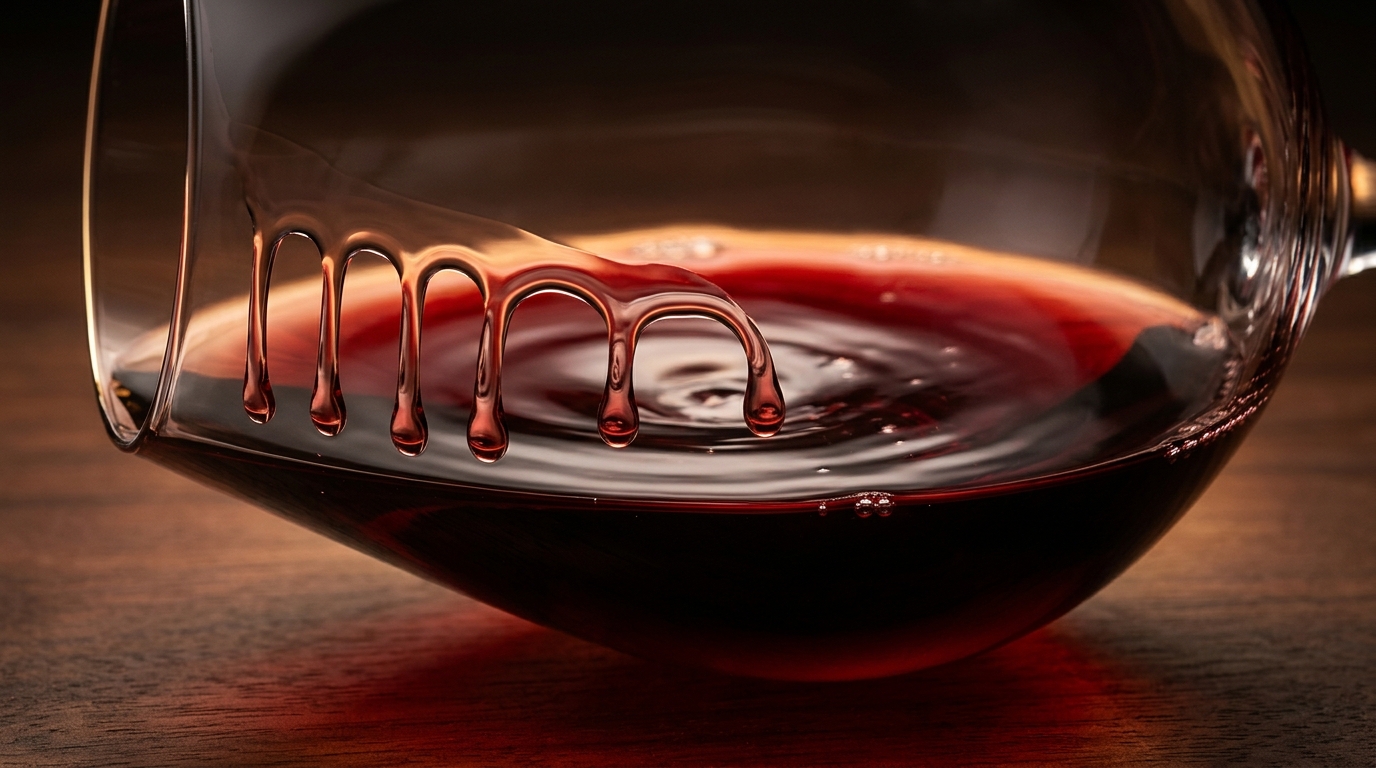
The blend is the first unusual thing about it. Ontario's liquor board lists the appellation as Monterey, Santa Barbara, and Sonoma counties, which means the wine is assembled from three growing regions hundreds of miles apart rather than expressing a single place. Monterey fruit brings the dark, broad texture. Sonoma adds brighter cherry and strawberry notes, and Santa Barbara contributes spice and a silky finish. Blending across that much geography is what lets the wine taste the same every single year, and that consistency is a large part of why people become loyal to it.
The second unusual thing is the sugar. The same official listing puts the current bottling at 13.5 percent alcohol and 22 grams of residual sugar per liter, with the style described as full bodied and smooth. Our own breakdown of dry versus sweet wine puts the practical dividing line for dryness at around 10 grams per liter, so Meiomi sits at roughly double that line. It isn't a sweet wine by dessert standards, but it carries far more sugar than the category it's shelved in would suggest.
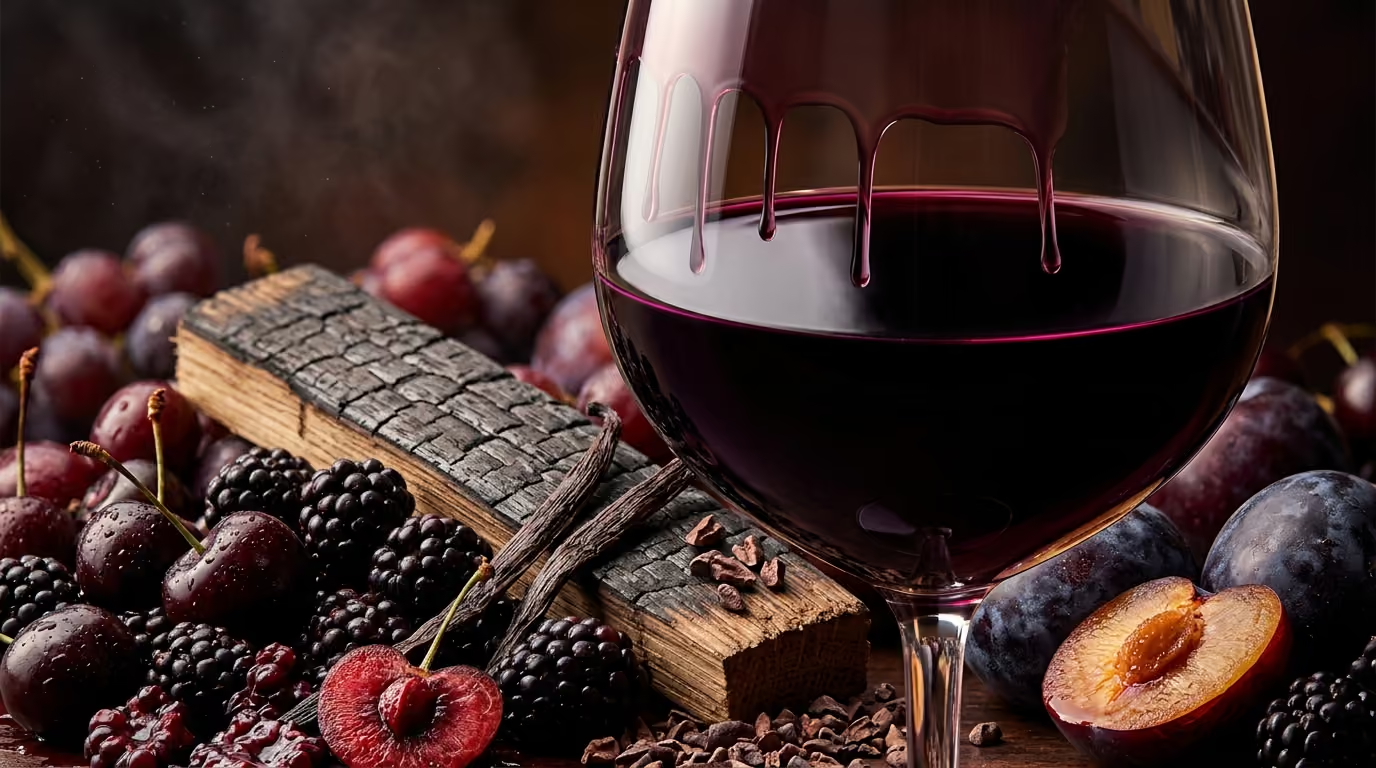
That sugar does real work on your palate. It rounds off the edges, softens the grip of the tannins, and makes the fruit read as jammy rather than tart. Combined with oak aging, which layers in vanilla and a faint smokiness, you get a red wine that never fights back. For anyone who has been burned by a dry, savory, high acid bottle, that reliability feels like a relief, and there's nothing wrong with liking it.
Why do most Pinot Noir recommendations disappoint Meiomi fans?
Most Pinot Noir recommendations fail Meiomi drinkers because the person making them matches the grape variety while ignoring the sugar, and the sugar is what you actually taste.
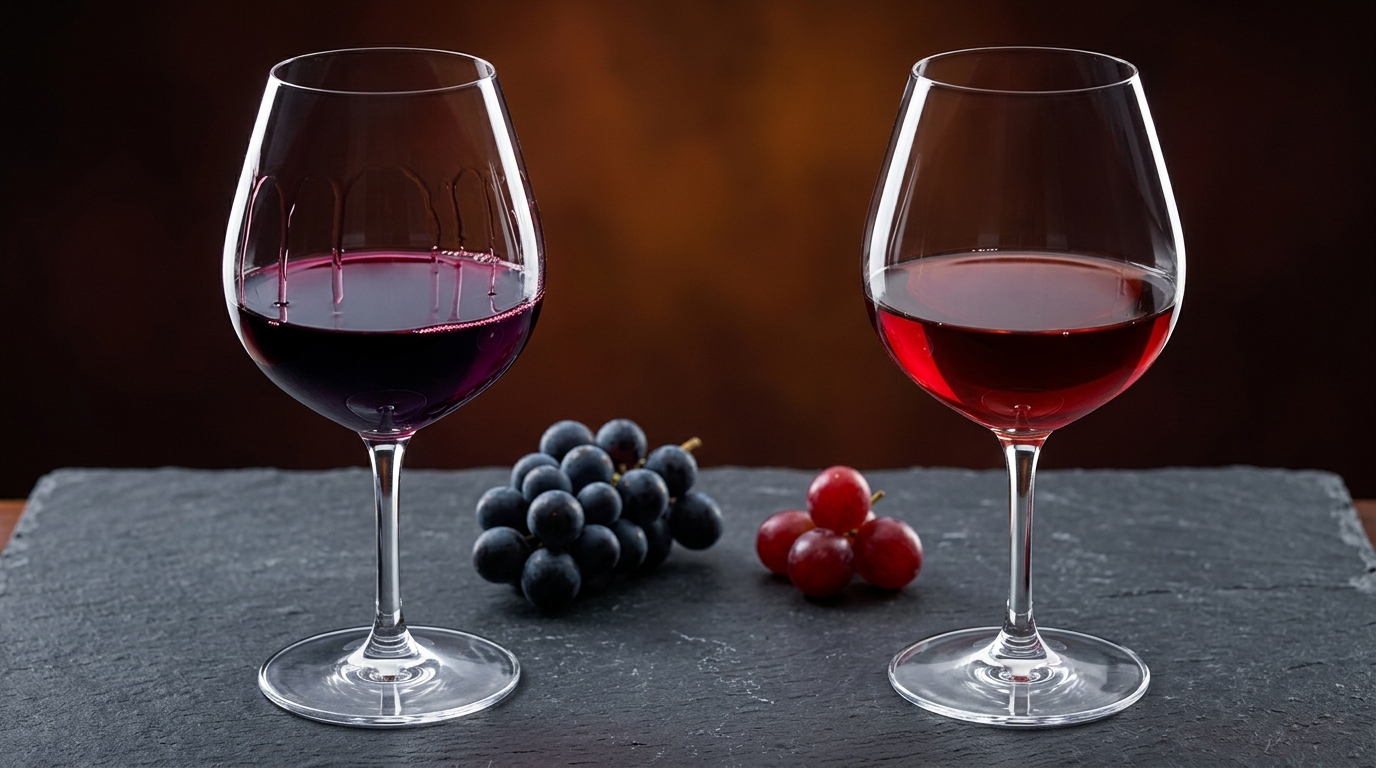
The size of that gap became public in an unusually direct way. Sonoma winemaker Adam Lee sent a bottle of Meiomi to ETS Laboratories, an accredited wine lab in Healdsburg, and published the result: 19.4 grams of sugar per liter, against 0.6 grams in his own Dial Tone Pinot Noir. Constellation Brands, which owns Meiomi, responded with a letter demanding he substantiate the claim, and the dispute was covered by the San Francisco Chronicle and by Meininger's International. The exact figure moves a little between vintages and sources, but every number in that story sits in the same territory, and Ontario's current listing of 22 grams per liter is an official disclosure rather than a partisan one.
Think about what that means in a glass. A classic dry Pinot Noir from Burgundy or the Sonoma Coast might carry less than a single gram of sugar per liter, while Meiomi carries somewhere around twenty. When a shop employee hands you a beautifully made, genuinely dry Pinot Noir because you said you like Pinot Noir, they've matched one word on the label and missed the entire reason you enjoy the wine. It will taste lean, tart, and faintly bitter to you, and you'll walk away assuming you picked a bad bottle.
So the useful question isn't which wines share Meiomi's grape. It's which wines share its ripeness, its softness, and its sweetness. Once you reframe the search that way, the field of good answers gets much wider, and it stops being limited to Pinot Noir at all. Our Pinot Noir taste guide covers what the grape does when it's made in the traditional style, which is useful mostly as a description of what to avoid if Meiomi is your benchmark.
Which wines come from the person who created Meiomi?
Three of the closest alternatives to Meiomi come from Joe Wagner himself, because he kept making wine in that style after selling the brand.
Wagner is a fifth generation Napa winemaker and the son of Chuck Wagner, who founded Caymus. He started Meiomi in 2006 and grew it into one of the fastest selling Pinot Noir brands in the country, then sold it to Constellation Brands for $315 million in a deal Decanter and Wine Spectator both covered in 2015. He stayed on as a consulting winemaker for two years, and after that he had no hand in the bottle sitting on the shelf today.
What he did next is the useful part for you. In 2019 he launched Böen, described at the time as a return to the signature style that brought California Pinot Noir to a mass audience, which is a polite way of saying he set out to make Meiomi again. He also produces Vennstone, a Pinot Noir drawn from Sonoma, Monterey, and Santa Barbara counties, the exact same three county structure Meiomi uses. The name comes from the Venn diagram of those three regions overlapping. Belle Glos, the richer and pricier label he started as a teenager, sits in the same family of wines and turns the volume up considerably.
None of this means a Wagner bottle will taste identical, and blending decisions and sugar levels still vary between labels. It does mean that when you reach for Böen or Vennstone, you're buying from the person who designed the flavor you're chasing, rather than hoping a stranger's Pinot Noir happens to land nearby. If you like the Wagner house style generally, our roundup of Caymus Cabernet alternatives covers the same territory on his father's side of the family.
What are the best wines like Meiomi to try next?
The strongest matches are Böen and Vennstone for closeness, Belle Glos for a richer version of the same idea, and Decoy Merlot or Apothic Red if you're willing to leave Pinot Noir behind.
Prices below are average US retail figures from Wine-Searcher, which tracks what bottles actually sell for across thousands of shops. Meiomi itself averages about $21, so most of these sit in the same range or below.
| Bottle | Why it works for Meiomi drinkers | Average price |
|---|---|---|
| Böen Tri-Appellation Pinot Noir | Joe Wagner's deliberate return to the Meiomi style, same three county blending idea | $19 |
| Vennstone Pinot Noir | Wagner again, blended from the identical Sonoma, Monterey and Santa Barbara trio | $23 |
| La Crema Monterey Pinot Noir | Ripe black cherry, polished and soft, the safest non Wagner swap | $19 |
| Belle Glos Las Alturas Pinot Noir | Darker, fuller and more concentrated, a special occasion version of the same mood | $47 |
| Decoy Merlot | Plush plum and cocoa with gentle tannins, smoother than most Cabernet | $20 |
| Apothic Red | The sweetest and cheapest option here, openly built for easy drinking | $12 |
Böen is where almost everyone should start, since it costs slightly less than Meiomi and comes from the same hands. Vennstone is the other obvious first move, and the fact that it draws on the same three counties makes it the closest thing to a structural copy that exists. La Crema Monterey is the best answer if you want to step outside the Wagner orbit while keeping the ripe, rounded profile, though it runs drier than Meiomi and some people notice that immediately.
Belle Glos deserves a word of warning alongside the recommendation. It's genuinely delicious and genuinely richer, but at more than twice the price it's a different kind of purchase, and plenty of Meiomi drinkers find it heavier than they wanted on a Tuesday night. Treat it as the celebration bottle rather than the replacement.
Decoy Merlot and Apothic Red both abandon the grape and chase the texture instead, which is the right instinct. Merlot naturally gives you plum, cocoa, and a soft finish without the tannic bite that pushes people away from Cabernet, and our comparison of Merlot and Pinot Noir explains where the two overlap. Apothic Red is the sweetest thing on this list and makes no apology for it, and if you've enjoyed it before, our guide to wines like Apothic Red carries that thread further.
How do you find a bottle like this in a shop or a restaurant?
Read for texture and ripeness words rather than grape names, and stay with warm climate California bottlings when you're not sure.
Back labels are written by marketing departments, which turns out to be useful here, because they telegraph style honestly even when they're being florid about it. Words like smooth, velvety, plush, round, ripe, jammy, and rich all point toward the Meiomi lane. Words like earthy, savory, mineral, lean, bright, structured, and food friendly point firmly away from it. That vocabulary is more reliable than the grape, the vintage, or the price.
Region gives you a second filter. Warmer California growing areas produce the riper, denser style you're after, so Monterey, Santa Barbara, and the warmer pockets of Sonoma are good bets, while cool climate labels from Oregon, Burgundy, or New Zealand will usually taste too tart by comparison. Anything blended across multiple counties, the way Meiomi and Vennstone are, tends toward that same consistent, crowd pleasing profile by design.
Restaurants are harder, because someone is standing there waiting while you decide. The sentence that works is simple and specific: "I like Pinot Noir that tastes ripe and jammy rather than earthy, something smooth with soft tannins." Any decent server can act on that, and it beats asking for a recommendation with no information attached. If wine lists generally throw you, our walkthrough of how to read a wine list breaks down what the categories are actually telling you.
This is the exact moment Sommy's Find Similar feature was built for. You name a bottle you already like, Meiomi in this case, and it surfaces wines that share its character by grape, region, and style rather than matching the word on the label. Standing in an aisle with forty Pinot Noirs in front of you, that's a faster route to the right bottle than reading forty back labels one at a time.
What food goes with a smooth, fruit forward red?
Ripe, softly sweet reds pair best with food that carries a little sweetness, char, or fat, which covers most of what people actually cook on a weeknight.
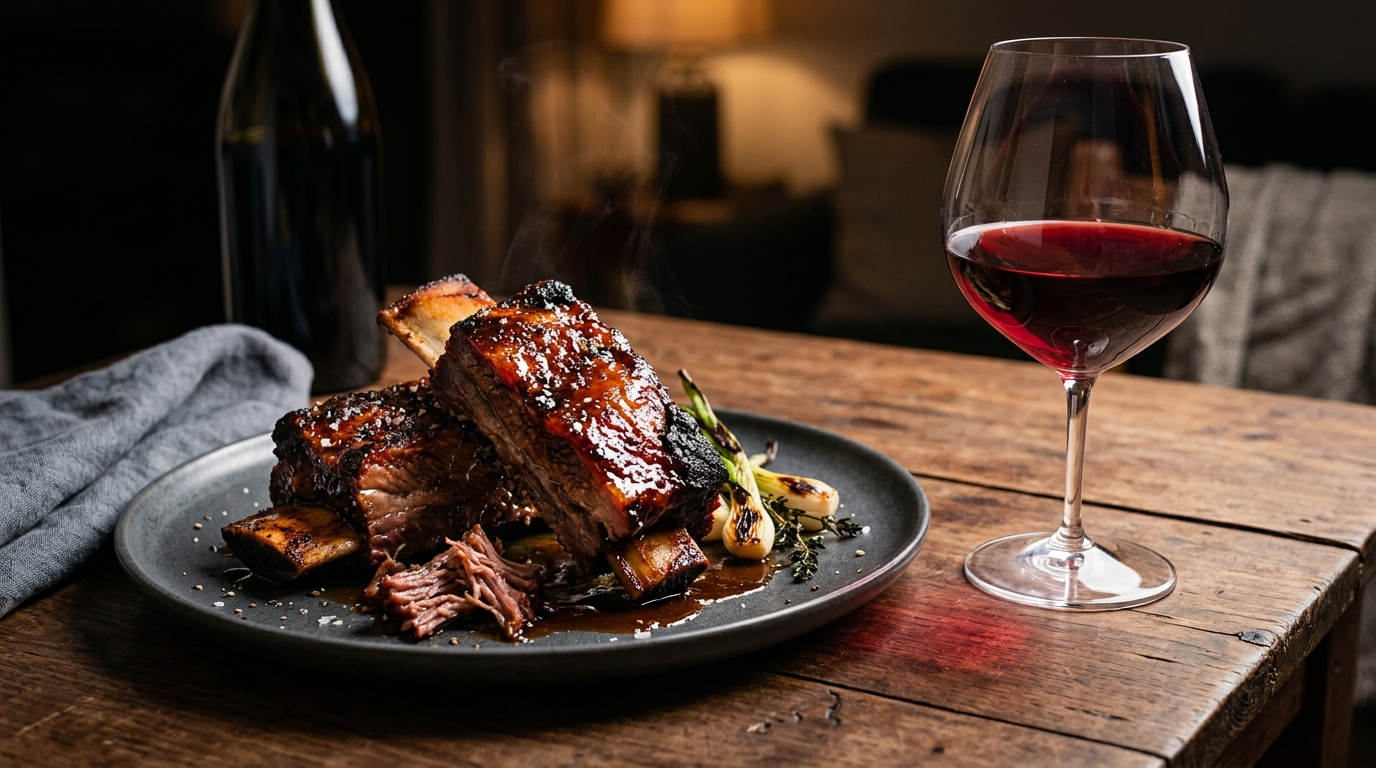
Barbecue is the standout match, because sweet and smoky sauces meet a wine that already leans that direction, and the two amplify each other instead of clashing. Burgers, pizza, and anything involving caramelized onions or roasted tomatoes work for similar reasons. Roast chicken and salmon are both reliable, since the wine stays soft enough not to overwhelm them, and mushroom pasta gives you an earthy counterweight that makes the fruit taste even riper.
The pairings that go wrong are worth knowing too. Very delicate white fish tends to vanish underneath a full bodied red, and heavily spiced food can make the alcohol feel hot and the sweetness feel cloying. Sharp vinaigrettes and briny dishes also sit awkwardly against residual sugar. Outside those cases, wines in this style are forgiving, and matching the weight of the food to the weight of the wine will get you most of the way there. Our guide to pairing food with red wine starts from tannin levels, which is the other lever worth pulling.
Frequently asked questions
Is Meiomi considered a good wine?
Meiomi is a well made, consistent wine that many people genuinely enjoy, though wine critics often criticize it for its sweetness and for tasting more like a designed product than a specific place. Both positions can be true at once. If you like ripe, smooth, faintly sweet red wine, it delivers that reliably every year, and your own preference is the only verdict that matters.
What's better than Meiomi Pinot Noir?
For a closer match at a similar price, Böen Tri-Appellation Pinot Noir at around $19 and Vennstone Pinot Noir at around $23 are the strongest options, both made by Meiomi's original winemaker. If you want a genuine step up in richness, Belle Glos Las Alturas at around $47 offers more concentration from the same producer. Better depends on what you want more of, so decide whether you're chasing value, closeness, or intensity.
What type of wine is Meiomi?
Meiomi is a California red wine, most commonly the Pinot Noir, blended from grapes grown in Monterey, Santa Barbara, and Sonoma counties. It's full bodied, oak aged, and noticeably riper and sweeter than a traditional dry Pinot Noir, with Ontario's liquor board listing the current bottling at 22 grams of sugar per liter. The brand also produces a Cabernet Sauvignon, a Chardonnay, and a red blend.
Is Meiomi actually sweet?
Meiomi is technically off dry rather than sweet, sitting well above the roughly 10 grams per liter mark where dryness ends but far below dessert wine levels. At around 22 grams per liter it carries more sugar than most people expect from a wine sold as a dry red, which is precisely why it tastes so smooth and why drier alternatives often disappoint.
Are all Pinot Noirs similar to Meiomi?
Most Pinot Noir tastes nothing like Meiomi, and that catches people out constantly. Traditional Pinot Noir from Burgundy, Oregon, or the cooler parts of California runs lighter, tarter, earthier, and almost completely dry. Look specifically for warm climate California Pinot Noir described as ripe, jammy, or full bodied if you want the Meiomi experience.
Do I have to stick with Pinot Noir at all?
No, and limiting yourself to one grape is the most common mistake in this search. Since what you're responding to is ripeness, softness, and sweetness rather than the grape itself, a plush Merlot or a commercial red blend can land closer than a dry Pinot Noir will. Decoy Merlot and Apothic Red are both worth trying for exactly that reason.
Where to start tonight
Buy the Böen first, because it costs a dollar or two less than Meiomi, it comes from the winemaker who invented the style you're trying to replace, and if it doesn't work for you, very little is lost. Vennstone is the natural second attempt, and between those two you'll quickly learn whether you're attached to the specific Meiomi blend or simply to the broader profile of ripe, soft, faintly sweet California red.
Beyond that, the habit worth building is reading for style rather than for grape. Meiomi taught a lot of people that they like Pinot Noir, when what they really like is ripe fruit, gentle tannins, and a touch of sugar, and those qualities show up across plenty of grapes and price points. Once you're reading back labels for texture words, the wine aisle stops being a wall of identical bottles and starts being a set of choices you can actually make.