
The best wine with chocolate is one that's sweeter than the chocolate, which in practice means Ruby Port or Pedro Ximénez sherry with dark chocolate, Tawny Port or Brachetto d'Acqui with milk chocolate, and Pinot Noir or Moscato d'Asti with white chocolate. The quickest way to choose is the cacao percentage printed on the wrapper, because the higher that number climbs, the less sugar is in the bar and the sweeter and stronger the wine needs to be. A dry Cabernet next to a 70% bar is the pairing most people try first, and it's also the one most likely to taste bitter.
That last point surprises a lot of people, so we'll start with why it happens and then work through each kind of chocolate, plus the candy and desserts that are actually in the house in October.
Why does dry red wine taste bitter with chocolate?
Dry red wine tastes bitter with chocolate because both carry bitter, drying compounds, and the sugar in the chocolate makes the wine seem sourer and harsher by contrast. Madeline Puckette of Wine Folly describes a dry red next to dark chocolate as a wine that "will start to taste bitter and sour", and she puts it down to the flavanols in both, which are different types of tannin that end up clashing on your tongue (Wine Folly).
The sugar does the rest of the damage. Wine Spectator's Dr Vinny points out that the sweetness of chocolate lingers in your mouth and can make almost anything you sip afterwards seem bitter, and that young, tannic reds suffer most because their tannin already reads as bitter to some people before the chocolate arrives. His fix is the one every dessert pairing comes back to, which is keeping the wine sweeter than the dessert so the wine doesn't seem bitter or sour (Wine Spectator).
If tannin is a fuzzy idea, it's the drying, grippy feeling a strong black tea leaves on your gums, and our explainer on what wine tannins are and how they feel goes into it properly. The same sweeter-wine rule runs through every sweet course, not just chocolate, and we cover it for cakes, tarts and custards in our guide to dessert pairing with wine.
How does the cacao percentage change the wine you should pick?
The cacao percentage tells you how much of the bar comes from the cocoa bean itself, so a higher number means more bitterness, less room for sugar, and a wine that has to be sweeter and more intense to keep up. It's the most useful number on the wrapper, and almost none of the pairing guides ranking for this question mention it.
The legal definitions show why the color of the wrapper is a poor guide. Under the US standards for cacao products, milk chocolate only needs 10 percent chocolate liquor, which is the ground paste of the cocoa bean, plus at least 12 percent milk solids. Semisweet and bittersweet chocolate need at least 35 percent chocolate liquor, and white chocolate is made from cacao fat, dairy and sweetener with no chocolate liquor at all, with at least 20 percent cacao fat and no more than 55 percent sweetener allowed (eCFR, 21 CFR Part 163). "Dark chocolate" isn't one of the defined standards, so two bars that both say dark on the front can be wildly different, and the percentage is the only honest signal you get.

A 70% bar leaves at most 30 percent of its weight for sugar, milk and everything else, and an 85% bar leaves at most 15, so each step up the scale takes sugar away from the chocolate and asks the wine to supply it. Here's how we'd match the number on the wrapper to a bottle.
| What the wrapper says | How it tastes | What to pour |
|---|---|---|
| White chocolate (no cocoa solids) | Sweet, creamy, vanilla, no bitterness | Pinot Noir, Moscato d'Asti, ice wine |
| Milk chocolate | Sweet, milky, caramel, very little bitterness | Tawny Port, Brachetto d'Acqui, sweet Lambrusco |
| Up to about 60% cacao | Some bitterness, red fruit, still fairly sweet | Ruby Port, Banyuls, a ripe Zinfandel served cool |
| About 60% to 75% cacao | Clearly bitter, roasted, less sugar | Ruby Port, Late Bottled Vintage Port, Banyuls |
| Over 75% cacao | Very bitter, dry, almost savory | Pedro Ximénez sherry, poured small |
Treat the bands as starting points, since dried fruit or sea salt in a bar lets it take a drier wine than its number suggests.
What wine goes with dark chocolate?
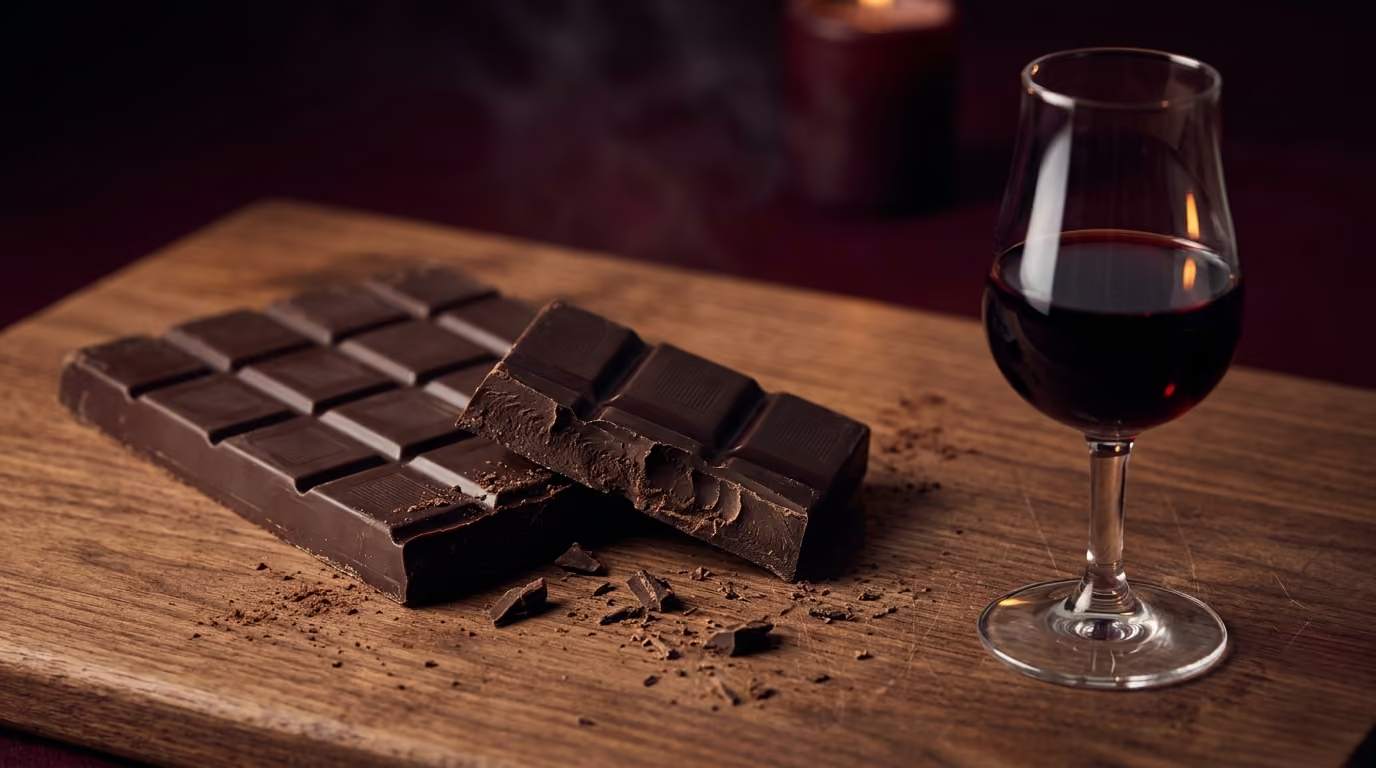
Pedro Ximénez sherry and Ruby Port are the two best wines with dark chocolate, with Banyuls from the south of France close behind, because all three carry enough sugar and dark-fruit flavor to stand up to a bitter bar instead of being flattened by it.
Pedro Ximénez, usually shortened to PX, is the heavyweight. It's made from grapes dried in the sun to concentrate their sugar, and the result is a thick, nearly black wine that tastes of raisins and molasses (Wikipedia, Pedro Ximénez). The sherry sweetness classification puts PX at 212 grams of sugar per liter or more, the highest of any sherry style (Wikipedia, Sherry), which is exactly why it can face an 80% bar and win. Pour it in small sips, because a little goes a long way, and our page on what sherry is and how its styles differ explains the rest of the family.
Ruby Port is the easier everyday choice and the one we'd reach for with most bars between 60% and 75%. Port is a fortified wine from the Douro Valley in Portugal, usually sweet and red, at 19 to 22 percent alcohol, and Ruby is the younger style, aged only a few years at most, so it keeps its bright, rich fruit (Wikipedia, Port wine). That fruit is what makes it work, because it fills in the sweetness and berry flavor the dark chocolate has given up. A Late Bottled Vintage Port is a step richer for the same job, and our guide to Portuguese dessert wines like Port and Madeira covers which bottle to order.
Banyuls is the French answer, a fortified red from the Roussillon coast near the Spanish border. It's a vin doux naturel, a style where the fermentation is stopped by adding alcohol so that the grape's natural sugar stays in the wine (Wikipedia, Banyuls AOC). Julien Moreno, head sommelier at Benoit New York, picks Banyuls for dark chocolate ganache and creamy dark desserts like lava cake in his pairing list for Coravin (Coravin). Wine Folly describes it as funkier and earthier than Port, which suits bars in the 60s.
Wine Folly also suggests port-style reds made outside Portugal, from grapes such as Zinfandel, Malbec and Petite Sirah (Wine Folly), and we'd save those for the gentler bars around 50% to 60%, where their extra spice has room to show.
What wine goes with milk chocolate?
Tawny Port and Brachetto d'Acqui are the best wines with milk chocolate, because milk chocolate is sweet, creamy and low in bitterness, so it wants either caramel and nut flavors or bright red-berry sweetness rather than a heavy, tannic red.
Wine Folly calls milk chocolate one of the easiest "true" chocolates to pair, since the extra fat from the cream makes it far more forgiving than a dark bar (Wine Folly).
Brachetto d'Acqui is our favorite pick for plain milk chocolate and anything with berries in it. It's made in Piedmont from the Brachetto grape, which gives light-bodied, highly aromatic wines with a distinct strawberry note, and the Brachetto d'Acqui version is a slightly sweet sparkling red often called the red equivalent of Moscato d'Asti (Wikipedia, Brachetto). The best-known bottle in the US is Banfi's Rosa Regale, which the producer lists at 7 percent alcohol and 102 grams of residual sugar per liter, with raspberry and strawberry on the nose, and chocolate named among its pairings (Banfi). The low alcohol and the bubbles keep it from feeling heavy after a few squares.
Tawny Port is the better match when the milk chocolate leans toward caramel, toffee or nuts. Tawny spends much longer aging in barrel than Ruby (Wikipedia, Port wine), which trades fresh fruit for flavors of caramel, dried fig and toasted nuts, and Wine Folly recommends older Tawny, 20 years and up, for caramel chocolates (Wine Folly).
Sweet Lambrusco is the casual, cheaper cousin of Brachetto, a fizzy red from Emilia-Romagna that comes in dry and sweet versions. Look for "amabile" or "dolce" on the label, and our guide to telling dry Lambrusco from sweet shows where to find those words. If you already love fizzy, sweet reds in general, our page on sweet sparkling red wine has more bottles in the same style.
What wine goes with white chocolate?
Pinot Noir is the surprising best match for white chocolate, along with Moscato d'Asti and ice wine, because white chocolate contains no cocoa solids and therefore none of the bitterness that turns a dry red sour next to a dark bar.
That comes straight from the legal definition we saw earlier, which builds white chocolate from cacao fat, dairy and sweetener with no chocolate liquor (eCFR, 21 CFR Part 163). With nothing bitter in the chocolate, the dry red has nothing to fight. Wine Folly calls Pinot Noir with white chocolate "a shockingly good pairing, especially for chocolate and wine pairing disbelievers", with the white chocolate's fat carrying the wine's cherry, strawberry and raspberry flavors, and suggests Beaujolais as a similar light red alternative (Wine Folly).

If you'd rather stay sweet, Moscato d'Asti brings peach and floral notes that suit the vanilla in white chocolate, and ice wine, usually made from Riesling or Vidal Blanc, adds pineapple and candied citrus flavors (Wine Folly). Moreno's pick for Coravin is a Mosel Riesling from JJ Prüm, chosen because the wine's acidity cuts through the richness of the chocolate (Coravin).
What wine goes with Halloween candy?
Tawny Port is the most forgiving single bottle for a bowl of Halloween candy, because its nutty, caramel flavors suit peanut butter cups, caramel bars and plain milk chocolate alike, while Brachetto d'Acqui is the lighter, fizzier choice when you're pouring for a crowd.
Peanut butter cups need sweetness and a nutty note in the wine. Wine Folly suggests Madeira and Marsala for them (Wine Folly), and Moreno pairs milk chocolate with peanut butter with an older vintage Port for the same reason (Coravin). Wine Folly's list also names Amontillado and Oloroso sherry, but be careful there, because both are normally dry, at 0 to 5 grams of sugar per liter in the sherry classification, while a Cream sherry runs 115 to 140 (Wikipedia, Sherry). With a sweet peanut butter cup, we'd take the Cream.

Caramel and nougat bars, the Snickers and Milky Way side of the bowl, belong with Tawny Port or a sweet Madeira. Moreno's choice for chocolate with caramel or salt is a Bual Madeira, which he describes as having a dry, almost sherry-like profile that suits the savory side of salted caramel (Coravin). Crispy wafer bars like Kit Kat are mostly milk chocolate and air, so they're happiest with something light such as Brachetto or a sweet Lambrusco, and a big fortified wine will simply bury them.
Mint chocolates are the awkward ones. Dr Vinny warns that mint and spicy chocolates can complicate a pairing (Wine Spectator), and Wine Folly's workaround is a Syrah or a port-style wine made from Touriga Nacional or Petite Sirah (Wine Folly). Candy with no chocolate in it at all, like gummies or candy corn, is pure sugar, and only a properly sweet wine such as Moscato d'Asti will survive it.
What wine goes with chocolate cake, brownies and chocolate-covered strawberries?
Chocolate cake and brownies pair best with Ruby Port or a ripe Zinfandel, and chocolate-covered strawberries pair best with Brachetto d'Acqui or sweet Lambrusco, because baking adds flour, butter and eggs that soften the chocolate while strawberries bring tart fruit that a red sparkling wine picks up.
Baked desserts are where a dry red stands its best chance. Wine Folly notes that when dark chocolate is inside a cake or cheesecake, the fat and starch can be enough to counteract the bitterness in both the chocolate and the wine (Wine Folly). A fudgy brownie is still very sweet, so we'd keep a Ruby Port for that, but a less sugary flourless chocolate cake or a chocolate tart can take a jammy Zinfandel or Grenache, especially if the dessert comes with berries on the side.
Chocolate-covered strawberries are the classic Valentine's tray, and Wine Folly's picks there are Brachetto d'Acqui and Lambrusco Amabile, the sweet style of Lambrusco (Wine Folly). Both have their own strawberry and raspberry flavors, so the wine and the fruit meet in the middle. Wine Folly also says Brachetto is an excellent pair with chocolate mousse, which works for the same reason, since mousse is light, airy and creamy.
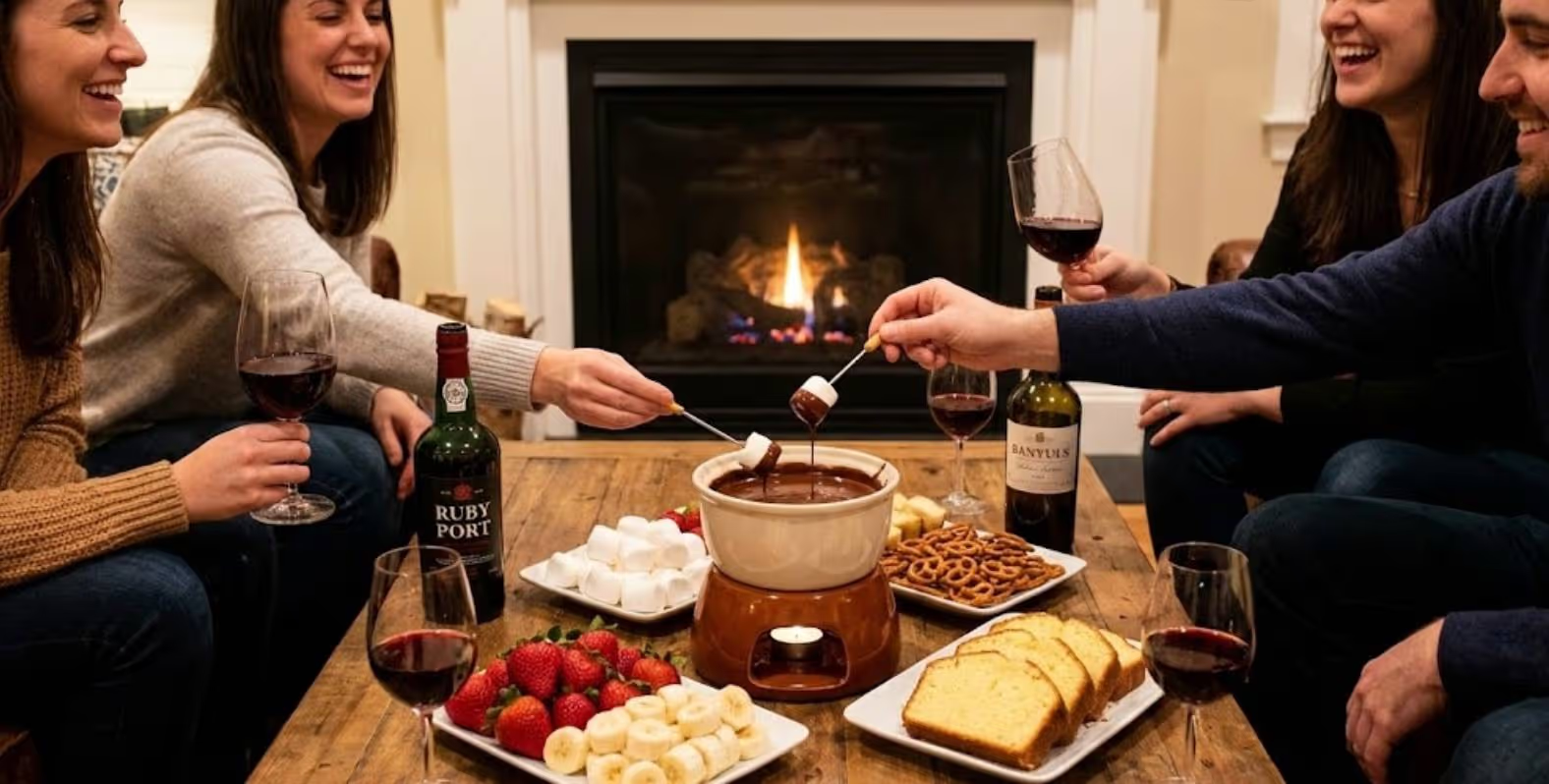
Chocolate chip cookies are mostly butter and brown sugar, so treat them like caramel and pour a Tawny Port or a Cream sherry. If you're melting the chocolate down instead, we wrote a separate guide to the best wine for chocolate fondue that also covers what the dippers do to the wine.
Can you drink Cabernet Sauvignon with chocolate?
You can drink Cabernet Sauvignon with chocolate if the chocolate is milky, salted or baked into a dessert, or if the Cabernet is a ripe, fruit-forward bottle with a touch of sweetness, but a young, dry Cabernet next to a 70% bar is the textbook clash.
The two big sources on this disagree a little, and both are right about different bars. Wine Folly says Cabernet with dark chocolate "usually makes the wine taste gross", with exceptions for reds carrying some residual sugar, noting that many value reds show anywhere from about 10 to 60 grams per liter of it, and naming value Shiraz, Malbec, Zinfandel and red blends like Ménage à Trois (Wine Folly). Dr Vinny is warmer, saying intense reds with riper fruit, like Zinfandel, Cabernet Sauvignon and Grenache, can bring out the fruit and vanilla notes in chocolate, especially oak-aged ones, and that it's more likely to work when the chocolate isn't terribly sugary and the wine is served with a slight chill (Wine Spectator).
So the red that works is ripe, juicy and slightly sweet rather than firm and dry, the same smooth style we cover in our list of wines like Apothic Red, and those bottles are a better bet with a chocolate bar than a serious Napa Cabernet.
Three small tricks help when the dry red is the only bottle open. Sprinkle a few flakes of sea salt on the chocolate, since Dr Vinny notes salt amplifies the flavors of both the chocolate and the wine. Put the bottle in the fridge for about 15 minutes, because a slightly cool red tastes less bitter and less boozy. And pick a chocolate with dried fruit in it, which he also says makes chocolate more wine-friendly (Wine Spectator).
How should you serve wine with chocolate?
Serve wine with chocolate in small pours, slightly cool, and taste from the lightest chocolate to the darkest, so each bar doesn't flatten the one after it.
Port runs 19 to 22 percent alcohol (Wikipedia, Port wine), so two or three ounces is plenty for a few squares. A slight chill keeps that alcohol from sticking out, which is advice Dr Vinny gives for Port and sweet wines alike (Wine Spectator), and our chart of wine serving temperatures gives the numbers for each style.
If you're setting up a tasting for friends, go white chocolate first, then milk, then dark from the lowest percentage to the highest, and line up the wines in the same direction, from Moscato d'Asti or Brachetto through Tawny and Ruby Port to PX. Let each square melt on your tongue for a few seconds before you sip, which lets the cocoa butter coat your mouth and softens the wine. Our guide to setting up a home wine flight walks through the glasses, pours and order if you want to turn it into a proper evening.
Leftovers are less of a worry than with ordinary wine, because the sugar in sweet sherries such as PX and Cream acts as a preservative and an opened bottle can last weeks or even months (Wikipedia, Sherry).
Frequently asked questions
What's the best wine with chocolate?
The best wine with chocolate depends on the bar, but Port is the safest all-rounder, with Ruby Port for dark chocolate and Tawny Port for milk chocolate and caramel. For white chocolate, try a light Pinot Noir or Moscato d'Asti, and for very dark bars over 75% cacao, a small glass of Pedro Ximénez sherry.
Does red wine with chocolate ever work?
Sweet red wines like Ruby Port, Banyuls and Brachetto d'Acqui go very well with chocolate, and a light Pinot Noir works with white chocolate. Dry, tannic reds like a young Cabernet Sauvignon usually taste bitter with dark chocolate, because both carry bitter compounds and the chocolate's sugar makes the wine seem sourer.
What wine goes with dark chocolate?
Pedro Ximénez sherry, Ruby Port and Banyuls are the best wines with dark chocolate, because they're sweet enough and fruity enough to balance its bitterness. Check the cacao percentage on the wrapper and go sweeter and heavier as the number climbs.
Should the wine be sweeter than the chocolate?
Yes, keep the wine at least as sweet as the chocolate, or the wine will taste thin, sour and bitter next to it. Wine Spectator gives exactly this advice for chocolate and every other dessert.
What wine goes with chocolate cake?
Ruby Port is the easy choice for a rich chocolate cake or brownies, and a ripe Zinfandel can work with a less sugary flourless cake or tart, since the butter and flour in a baked dessert soften the chocolate's bitterness.
Which bottle should you open with your chocolate tonight?
If you're buying one bottle for whatever chocolate turns up, make it a Tawny Port, which handles milk chocolate, caramel bars, peanut butter cups and cookies without fuss and is still decent with a medium-dark bar. If the chocolate is seriously dark, buy a Ruby Port or a half bottle of PX instead, and if it's white chocolate or strawberries, open the Pinot Noir or a Brachetto you'd be happy drinking anyway.
Then try it the way that actually teaches you something. Taste the same square with two different wines, notice which pairing makes you reach for a second piece, and remember the cacao percentage on the wrapper, because that number will tell you more next time than any chart.