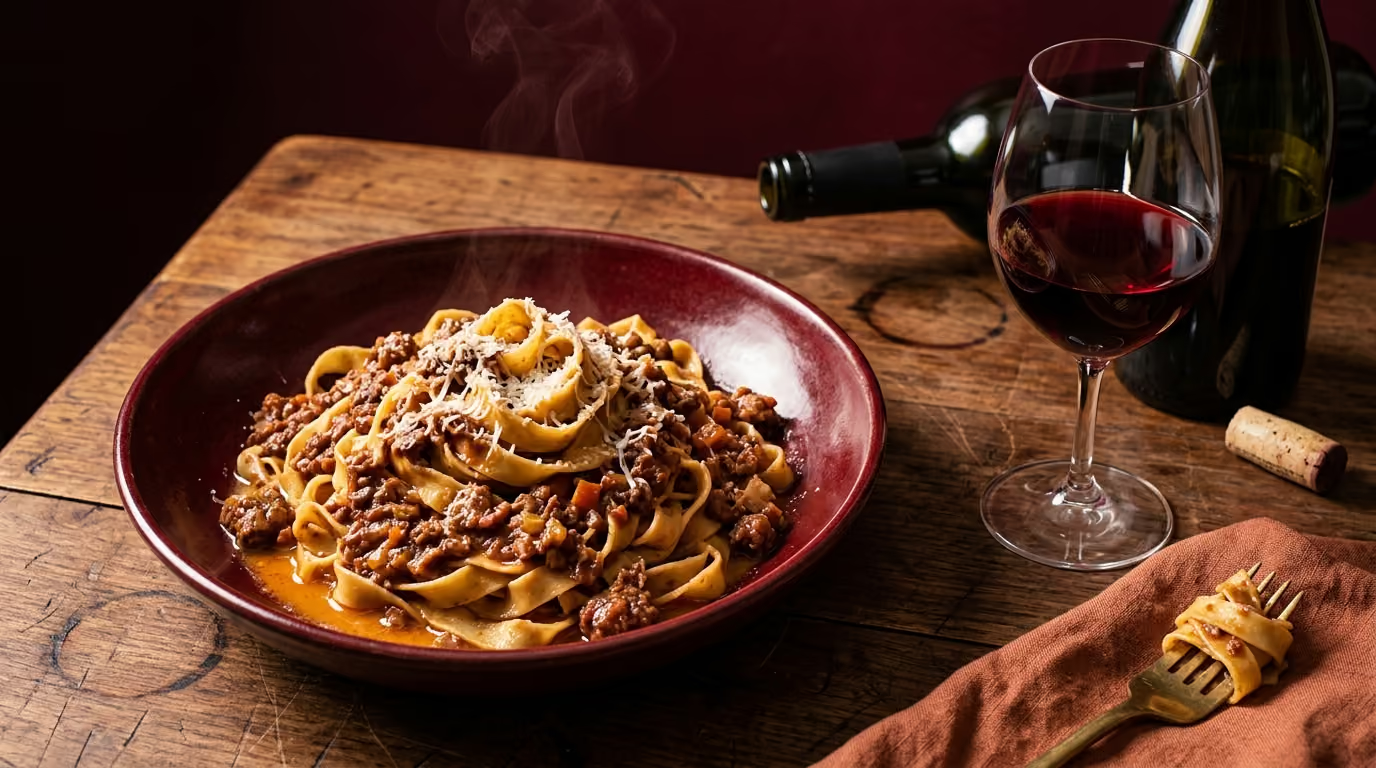
The best wine for bolognese is a medium-bodied Italian red with real acidity, and Sangiovese is the reliable answer for both jobs. Drink Chianti Classico, Sangiovese di Romagna or Barbera alongside it, and cook with whatever dry red or white you have open, since the official Bologna recipe permits either one.
Most pages answering this question quietly pick one meaning of the query and ignore the other. Half the people asking want to know what goes in the pan, and the other half want to know what goes in the glass. Both answers are below, along with the reason the two are not quite the same question.
What makes bolognese different from other pasta sauces?
Real ragù alla bolognese has far less tomato in it than almost anyone outside Italy expects, which changes the pairing completely. The updated recipe the Italian Academy of Cuisine deposited with the Bologna Chamber of Commerce on 20 April 2023 calls for 1 lb of coarsely ground beef and 6 oz of pancetta against just 7 oz of strained tomatoes and a single tablespoon of tomato paste, plus an optional half cup of whole milk stirred in halfway through the simmer. You can read the full deposited recipe on the Academy's own site.

That ratio matters more than any grape recommendation. A sauce built on meat, pork fat and milk is savory and rich rather than sharp, so the wine's main job is cutting through fat and salt. A sauce built on canned tomatoes is acidic in its own right, so the wine's main job becomes matching that acidity rather than getting flattened by it. Most weeknight meat sauce in American kitchens sits closer to the second description, which is why the advice you find online can feel contradictory.
The other half of the puzzle is the meat itself. Long-simmered beef and pancetta produce a deep savory quality and a coating texture that clings to tagliatelle, so a thin, delicate wine simply disappears next to it. You need enough body to stand up and enough acidity to reset your palate between forkfuls, and finding both in the same bottle is what narrows the field to a handful of Italian reds.
The optional half cup of milk changes the pairing as well, because the proteins in dairy bind to tannin and take the hard edges off a red wine as you eat. A ragù finished with milk will make a moderately structured red taste smoother than it does on its own, which widens the range of bottles that work rather than narrowing it.
Tannin is where people go wrong. A big, structured Cabernet or a young Barolo brings plenty of grip, and that grip collides with the salt in the pancetta and the acid in the tomato to produce a hard, drying finish. Moderate tannin with high acidity beats high tannin every time here.
Which wine should you cook bolognese with?
Either red or white works, and the Academy's own recipe says so directly, listing half a cup of red or white wine as the ingredient. That single line settles an argument that runs across most of the search results for this dish, where you'll find people insisting the authentic version demands one or the other.
The choice does change the sauce, though not dramatically. Red wine deepens the color toward that rich maroon the recipe describes and adds a faint edge of dark fruit and tannin, which suits a beef-heavy ragù you plan to simmer for three hours. White wine keeps the sauce brighter and lets the pork and milk come forward, which many cooks in Bologna prefer for exactly that reason. Neither one is wrong, and both evaporate almost entirely, since the recipe has you cook the wine off completely before the tomato goes in.
What matters far more is that the bottle is dry and drinkable. Wine reduces in the pan, and reduction concentrates whatever was in it, so residual sugar turns into a slightly jammy sweetness that fights the savory meat. Skip anything labeled as cooking wine for the same reason we'd skip it in any pan sauce, because those bottles carry added salt on top of a sauce that already has pancetta and stock in it.
Pour from a bottle you'd actually drink, and half a cup is all you need. A basic Sangiovese, Barbera, Montepulciano d'Abruzzo or a dry Pinot Grigio all do the job perfectly well, and you get to drink the rest while it simmers for two hours.
Which wine should you drink with bolognese?
Sangiovese in some form is the answer more often than not, because its combination of tart cherry fruit, savory herbal edge and firm acidity is built for exactly this kind of plate. Chianti Classico is the version most wine lists carry, and Sangiovese di Romagna comes from the region next door to Bologna itself.
| Wine | Why it works | Best when |
|---|---|---|
| Chianti Classico | Tart cherry and high acidity cut the fat without adding weight | You want the safe, widely stocked answer |
| Sangiovese di Romagna | Same grape, softer and rounder, and it's the local pairing | The ragù is rich and low on tomato |
| Barbera d'Asti | High acidity with very little tannin, so nothing turns bitter | You find Chianti too grippy |
| Lambrusco Grasparossa | Dry, lightly sparkling, scrubs pork fat off the palate | You're eating it in a Bolognese trattoria, or want to |
| Montepulciano d'Abruzzo | Soft and dark-fruited, easy on a crowd | Feeding people with mixed tastes |
| Valpolicella Classico | Light, sour-cherry driven, low tannin | The sauce is on the lighter side |

Barbera deserves particular attention when the ragù is heavy on pancetta. It carries some of the highest natural acidity of any Italian red while staying low in tannin, so it cuts fat without ever turning astringent against the salt, and our notes on what Barbera actually tastes like go into where the good bottles come from. If you want the deeper background on the grape behind Chianti, our Sangiovese guide covers how much the style shifts between regions.
Serving temperature does more for these wines than most people realize. Italian reds with high acidity taste hot and slightly bitter when they've been sitting in a warm kitchen next to a pot that has simmered for two hours, and twenty minutes in the fridge before you pour brings the fruit back into focus. Our notes on wine serving temperatures cover where each style actually shows best, and bolognese night is the classic case for chilling a red slightly.
Choosing between two bottles on the shelf is where general advice runs out, since a Chianti that feels bracing to one person tastes austere to another. Sommy's Fit Check gives you a straight read on whether a specific bottle suits your taste before you buy it, which is more useful in the aisle than another list of grape names.
Why does Lambrusco work better than you would expect?
Because dry Lambrusco is the wine people in Emilia-Romagna actually drink with this food, and the bubbles do real work against pork fat. The sweet, soft version exported in the 1970s and 1980s gave the name a reputation it has spent forty years shaking off, but a Lambrusco Grasparossa di Castelvetro labeled secco is dry, dark, faintly tannic and genuinely good.
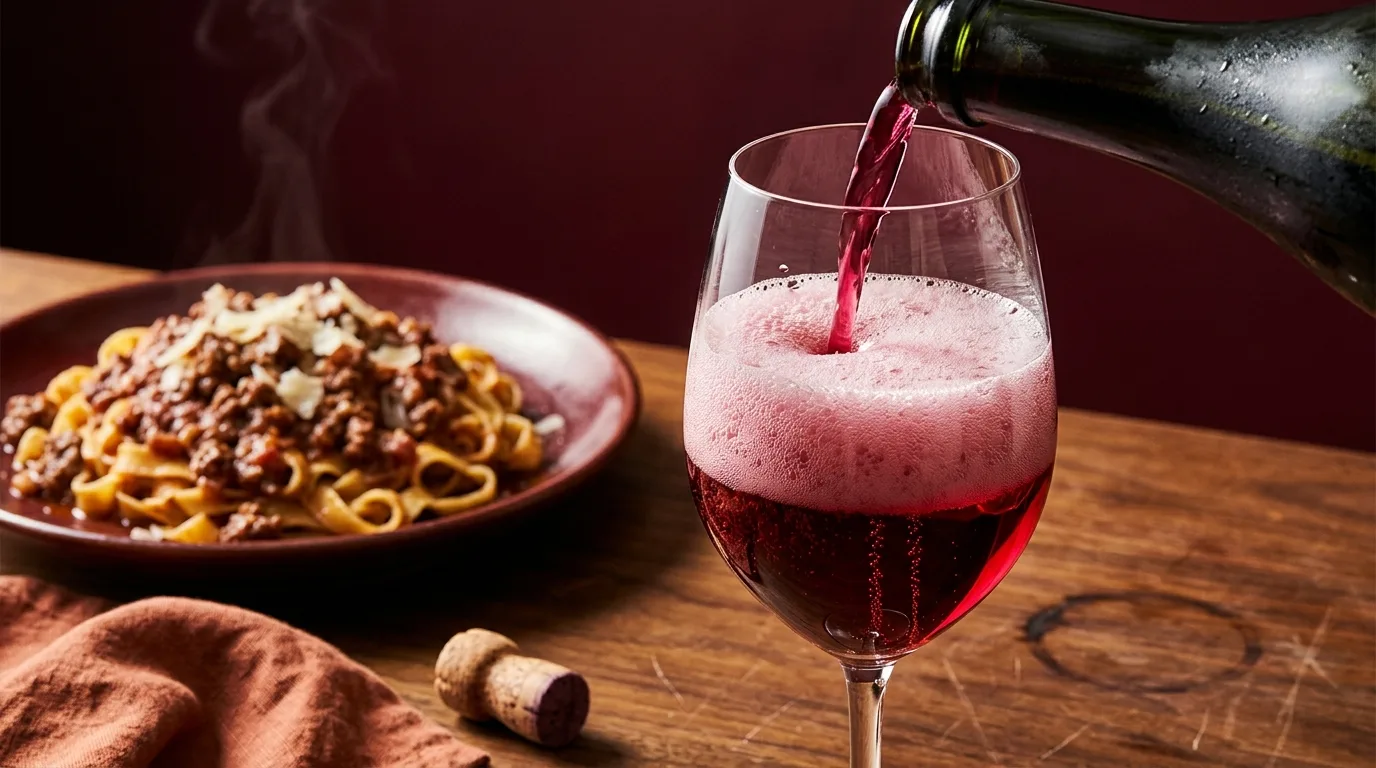
Carbonation lifts fat off your palate in a way still wine cannot, which is the same reason Champagne works with fried food. Bolognese carries a lot of rendered pork fat and a rich, coating texture, so the effect is more noticeable here than with a leaner tomato sauce. Serve it lightly chilled, around cellar temperature rather than fridge cold, and it stops reading as a novelty.
Look for the word secco on the label, and treat Grasparossa as the fuller of the common styles, with Sorbara sitting lighter and more floral. If a bottle says amabile or dolce, it has noticeable sweetness and belongs with dessert rather than with meat sauce.
The practical case for Lambrusco is that it survives a crowded table. Bolognese usually turns up on nights when several people are eating, often with bread and cheese on the table alongside it, and a dry sparkling red handles that spread better than a serious still red would. It also stays enjoyable across a long meal rather than demanding attention the way a serious still red does.
What if your meat sauce is the American tomato-heavy version?
Push harder toward acidity, because the tomato is now doing most of the talking. A sauce made with a full can of crushed tomatoes behaves differently from the Bologna original, and a soft, low-acid red will taste dull and slightly stewed beside it.
Chianti Classico remains the strongest single pick, and Sangiovese generally suits tomato better than any other widely available red because it shares that tart, savory profile. Barbera works for the same reason. Where the sauce is spicy, from chili flakes or hot sausage, a Zinfandel with ripe fruit takes the edge off the heat, though the trade-off is a wine that reads sweeter alongside the tomato.
The logic carries across other dishes in the same family. Our guides to spaghetti and meatballs in marinara and wine with lasagna follow the same rule, since baked pasta adds cheese and changes the balance again. For the broader picture across Italian cooking, our guide to wine for Italian food sorts dishes by what the sauce is doing rather than by region.
What to skip is consistent across every version of the sauce. Heavily oaked reds add vanilla and sweetness where you want savory freshness, big tannic Cabernet and Bordeaux blends turn drying against the salt, and anything with residual sugar reads as cloying next to tomato. Full-bodied is fine, but the bottle needs acidity underneath the weight to be worth opening.
Frequently asked questions
What is the best wine for bolognese sauce?
Chianti Classico is the most reliable answer, because Sangiovese brings tart cherry fruit and high acidity that cut through the fat without adding tannic grip. Sangiovese di Romagna, Barbera d'Asti and dry Lambrusco Grasparossa all work for the same reason.
Should I use red or white wine when making bolognese?
Both colors are permitted by the reference recipe. The Italian Academy of Cuisine's recipe deposited with the Bologna Chamber of Commerce in 2023 specifies half a cup of red or white wine, so use whichever is open, and make sure it's dry rather than sweet.
How much wine goes into a bolognese?
The official recipe calls for half a cup, described as one glass, for a sauce serving six people. You add it after browning the meat and cook it over medium heat until it has evaporated completely, before the tomato goes in.
Can you drink Cabernet Sauvignon with bolognese?
You can, but it isn't the best wine for bolognese, since firm tannin combines with salt from the pancetta and acid from the tomato to leave a drying, slightly metallic finish. A softer Merlot or an Italian red with moderate tannin will treat the dish better.
Is Lambrusco actually good with bolognese?
Dry Lambrusco is the traditional local pairing in Emilia-Romagna, and the carbonation clears rendered pork fat from your palate between bites. Look for Grasparossa di Castelvetro labeled secco, and serve it lightly chilled rather than fridge cold.
Does white wine ever work with bolognese at the table?
Rarely, since the sauce is savory and fatty enough to overwhelm most whites. A full-bodied, textural white with real acidity, such as an aged Soave Classico, can hold its own if you want to avoid red entirely, though a light Italian red will almost always suit it better.
What to open tonight
Buy a Chianti Classico if you want to stop thinking about it, and buy a Sangiovese di Romagna or a Barbera d'Asti if you want the version that fits a rich, low-tomato ragù even better. Open a dry Lambrusco Grasparossa when you feel like drinking what they actually pour in Bologna.
For the pan, use half a cup of whatever dry bottle is already open, red or white, because the Academy itself allows both and it evaporates completely either way. Pour a glass first, deglaze with the next splash, and let the sauce take the two hours it needs.