
A wine varietal is a wine named after the main grape it's made from, so a bottle labeled Merlot is a wine made mostly from Merlot grapes. The grape name is the single most useful clue on the front label, because it predicts the general flavor of what's inside better than the region, the vintage or the price does. In the United States a wine can carry a grape name only if at least 75 percent of it came from that grape, which is why "mostly" matters and why two bottles of the same varietal can taste noticeably different.
What is a wine varietal, exactly?
A varietal is the wine, and the variety is the grape. Cabernet Sauvignon is a grape variety; a bottle sold under the name Cabernet Sauvignon is a varietal wine. Most people use the two words interchangeably and nobody will correct you at dinner, but the distinction is the reason the label works the way it does.
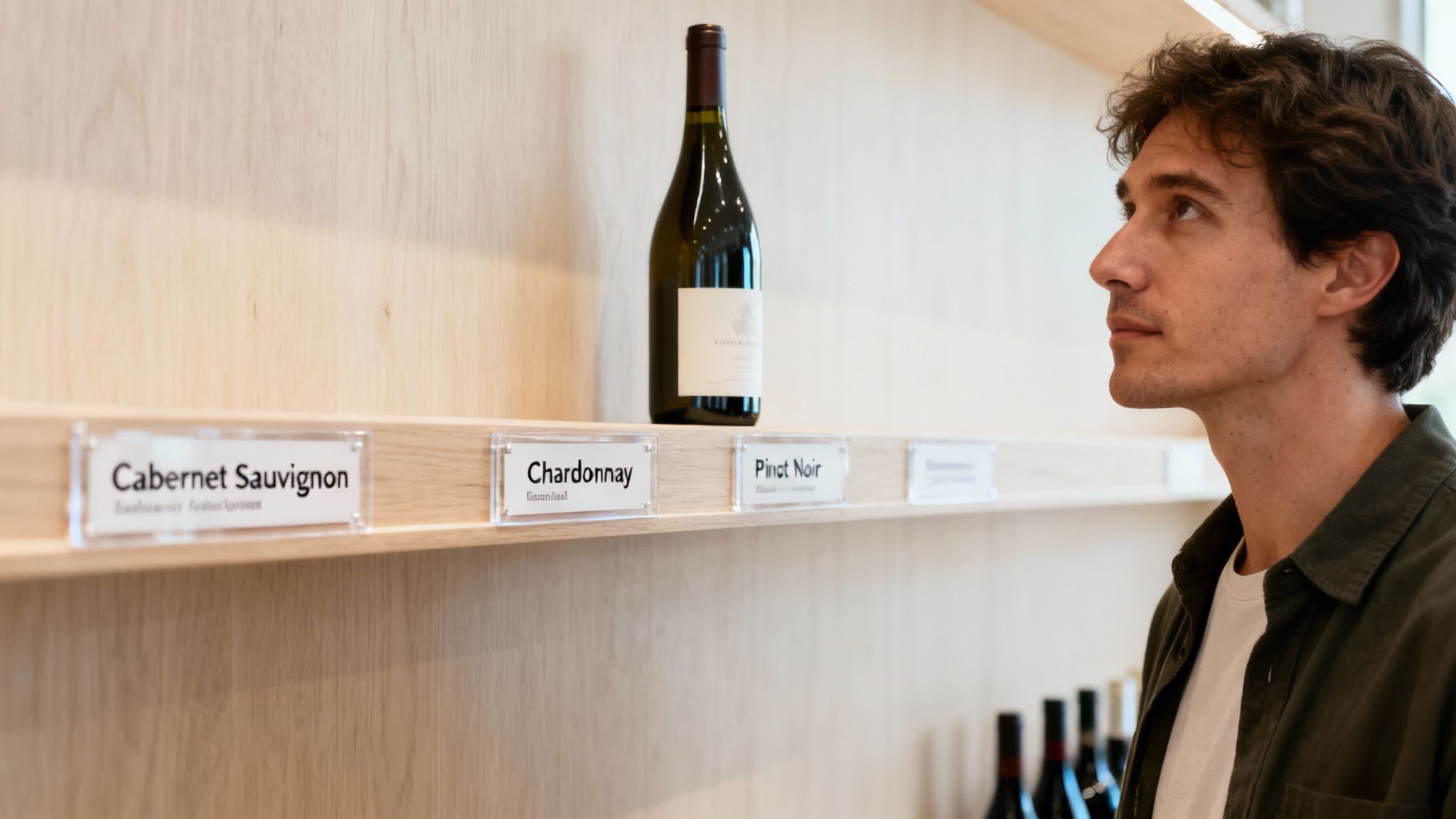
Think of grapes the way you already think of apples. You know a Granny Smith is tart and a Red Delicious is soft and sweet, and you make that call from the name alone without tasting either one. Grape names carry the same kind of information. Sauvignon Blanc is going to be zesty and citrusy almost anywhere it's grown, and Merlot is going to be soft and plummy, so the name narrows the field before you've opened anything.
That's really the whole trick, and you don't need to become an expert or memorize a list. You need three or four grape names attached to flavors you already know you like, and everything else is refinement.
Does a bottle labeled Merlot contain only Merlot?
Usually not, and the law says it doesn't have to. Under 27 CFR 4.23, the federal rule that governs American wine labels, a single grape name may be used as the type designation only if at least 75 percent of the wine came from that grape, and the whole qualifying 75 percent has to have been grown inside the appellation printed on the label. The remaining quarter can be anything the winemaker wants.
This is the most useful thing on this page, and almost nobody explains it. A California Merlot can legally be a quarter Cabernet Sauvignon, Petite Sirah or Syrah, which is exactly how two Merlots at the same price can taste like different wines. The blend is doing work you can taste, and the label doesn't have to tell you about it.
The percentage isn't the same everywhere, either, and the differences are bigger than most people expect.
| Where the wine is labeled | Minimum of the named grape | The catch |
|---|---|---|
| United States (federal) | 75 percent | All 75 percent must be grown in the labeled appellation |
| United States, Vitis labrusca grapes | 51 percent | The label has to say "contains not less than 51 percent" |
| Oregon | 90 percent | 18 named grapes are allowed at 75 percent instead |
| European Union | 85 percent | Applies to wine sold in the EU, wherever it was grown |
| Any region, two or more grapes named | 100 percent | Every grape must be listed, in descending order of how much was used |
Oregon is the strict one, and it's a genuine quality signal rather than trivia. Oregon Administrative Rule 845-010-0915 requires 90 percent of the named grape, with an exception list of eighteen varieties that may be labeled at 75 percent, including Cabernet Sauvignon, Merlot, Syrah, Grenache, Tempranillo, Sauvignon Blanc, Sangiovese and Zinfandel. Pinot Noir is not on that list, so an Oregon Pinot Noir really is at least nine parts in ten Pinot Noir, which is not something you can assume of a Pinot Noir from anywhere else in the country.
In Europe the number is 85 percent, set by Article 50 of Regulation (EU) 2019/33, and the same article requires 100 percent when two or more grapes are named, listed in descending order of how much of each went in. That last rule is why a label reading "Grenache Syrah Mourvèdre" tells you more than it looks like it does: there's nothing else in the bottle, and the grapes are printed heaviest first.
If reading the rest of the front label feels like guesswork too, our guide to how to read wine labels walks through the other words that actually predict taste.
What are the most planted wine varietals in the world?
Cabernet Sauvignon is the most planted wine grape on earth, covering roughly 341,000 hectares, or about 4 percent of all vineyard land. It's beaten overall only by Kyoho, a Japanese-bred table grape grown mainly in China that almost nobody outside Asia has ever eaten, let alone drunk. The figures below come from the OIV's Distribution of the World's Grapevine Varieties, which reports 2015 plantings and is still the most complete global count published.
| Variety | Color | Grown for | Area (hectares) |
|---|---|---|---|
| Kyoho | Black | Table grapes | 365,000 |
| Cabernet Sauvignon | Black | Wine | 341,000 |
| Sultanina | White | Table, drying and wine | 273,000 |
| Merlot | Black | Wine | 266,000 |
| Tempranillo | Black | Wine | 231,000 |
| Airén | White | Wine and brandy | 218,000 |
| Chardonnay | White | Wine | 210,000 |
| Syrah | Black | Wine | 190,000 |
| Grenache Noir (Garnacha Tinta) | Black | Wine | 163,000 |
| Red Globe | Black | Table grapes | 159,000 |
| Sauvignon Blanc | White | Wine | 123,000 |
| Pinot Noir | Black | Wine | 112,000 |
| Trebbiano Toscano (Ugni Blanc) | White | Wine and brandy | 111,000 |
Two entries there are worth a second look. Airén is a white Spanish grape with a larger footprint than Chardonnay, and you have almost certainly never seen it on a label, because most of it is distilled into brandy. Trebbiano Toscano goes the same way under its French name, Ugni Blanc, where it becomes Cognac. So a chunk of the world's most-planted wine grapes never reach a wine glass at all, which is a useful reminder that "widely planted" and "widely drunk" are different measurements.
The same report counts about 10,000 known grapevine varieties worldwide, of which just 13 cover more than a third of global vineyard area and 33 cover half of it. That concentration is why the same handful of names keeps reappearing on every wine list you read.
What do the popular varietals actually taste like?
Here's what to expect from the grape names you'll meet most often, with a dish that flatters each one. Treat it as a starting point rather than a promise, because the same grape grown in a cool place and a hot place gives you two different wines.
| Varietal | What it usually tastes like | Try it with |
|---|---|---|
| Cabernet Sauvignon | Bold and full-bodied, blackcurrant and dark cherry, drying on the finish | Steak, burgers, aged cheddar |
| Merlot | Softer and rounder, plum and black cherry, easy texture | Pasta in red sauce, roast pork |
| Pinot Noir | Light and smooth, red cherry and raspberry, low grip | Salmon, mushrooms, pizza |
| Syrah (Shiraz) | Dark and peppery, blackberry with a savory edge | Grilled lamb, barbecue, sausages |
| Malbec | Juicy and inky, blackberry and plum, softer than Cabernet | Steak frites, empanadas |
| Grenache | Warm and fruity, strawberry and dried herb, gentle tannin | Roast chicken, spiced stews |
| Chardonnay | Ranges from lean and citrusy to rich, buttery and vanilla-scented | Roast chicken, creamy pasta |
| Sauvignon Blanc | Zesty and sharp, grapefruit, lime and fresh-cut grass | Goat cheese, salads, fish tacos |
| Pinot Grigio (Pinot Gris) | Light and clean, green apple and pear, quiet by design | Light seafood, antipasti |
| Riesling | Bright and aromatic, lime and green apple, dry through to sweet | Spicy noodles, pork, Thai curry |
| Chenin Blanc | Apple and quince with real acidity, dry or off-dry | Roast pork, mustard sauces |
| Gewürztraminer | Perfumed and exotic, lychee and rose, low acid | Gochujang, curry, washed-rind cheese |
The drying sensation you get from a young Cabernet Sauvignon has a name, and it's the single most useful piece of wine vocabulary there is. If you want to understand why some reds grip your gums and others don't, our simple explainer on what tannin in wine actually is covers it in plain language. If you want to compare two of these head to head, Merlot versus Pinot Noir is the comparison people ask about most.
How do you pick a varietal you'll actually enjoy?
Start from a flavor you already love rather than from wine theory. Your everyday preferences in food and drink predict your wine preferences surprisingly well, and they cost nothing to consult.
If you like tart lemonade and grapefruit, you're probably a Sauvignon Blanc drinker. If you go for a creamy milkshake or a rich soup, oaked Chardonnay is built for you. If dark chocolate and strong coffee are your thing, Cabernet Sauvignon or Malbec will feel familiar rather than punishing. And if you reach for fresh berries and lighter flavors, Pinot Noir is the red that behaves like a white in terms of weight.
The reason this works is that the sensations transfer. Someone who likes sour candy is tolerant of acidity, and acidity is what makes a wine taste refreshing. Someone who takes their coffee black is tolerant of bitterness and tannin. You're not guessing about wine, you're reading preferences you already have.
Once you find a grape that lands, buy it twice more from different places before you move on. A Chilean Sauvignon Blanc, a New Zealand one and a French Sancerre are all the same grape, and tasting them next to each other teaches you more in one evening than a month of reading. Our beginner's guide to building a personal wine profile lays out how to keep track of what you learn.
Why do you see the same few varietals everywhere?
Because a small number of grapes are both easy to grow across many climates and easy for most people to enjoy, and that combination compounds. Out of roughly 10,000 known varieties, 33 account for half the world's vineyard area, so the wall of wine in your local shop is a much narrower selection than it looks.
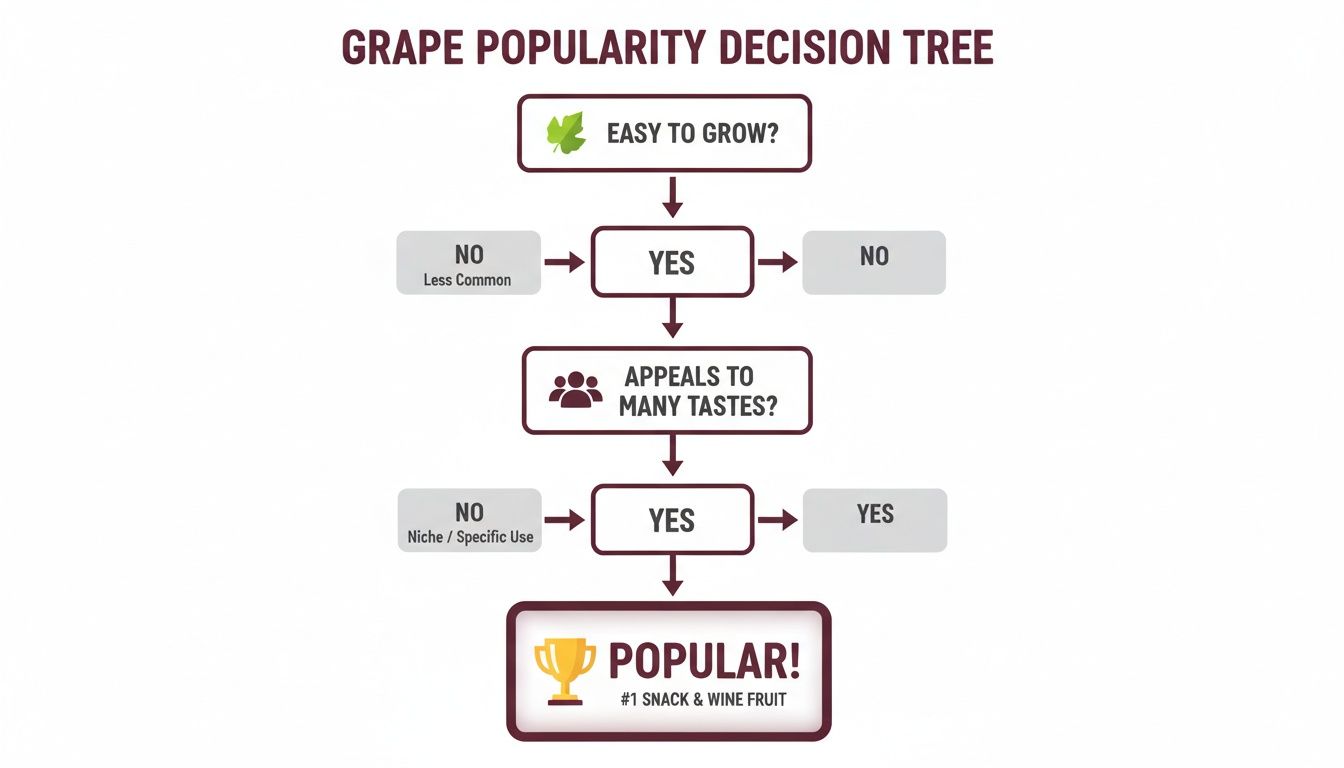
Cabernet Sauvignon is the clearest case. It's hardy, it ripens reliably, it tolerates hot and cool sites, and it produces a recognisable wine in China, France, Chile, the United States, Australia, Spain, Argentina, Italy and South Africa alike. A grape like that becomes a default for growers who need a crop that sells and for restaurants that need a bottle nobody sends back.
Pinot Noir sits at the other end. It's thin-skinned, fussy about climate and prone to disease, which is why it's planted on a third of Cabernet's area and usually costs more. The price gap between two reds on a list is often about how difficult the grape is to farm rather than how good the wine is.
The commercial pull is real too. In the American direct-to-consumer shipping channel, where wineries send bottles straight to customers, Cabernet Sauvignon led both volume at 16.5 percent and average bottle price at $85.96 in 2023, according to the Sovos ShipCompliant and WineBusiness Analytics report. That's one channel rather than all wine sold, but it shows where the money and the attention concentrate.
Seeing a familiar name on a menu isn't a trap or a sign of a boring list. It's usually there because it's dependable, and choosing it is a perfectly good decision.
What's the difference between a varietal wine and a blend?
A varietal wine leads with one grape and puts its name on the front; a blend combines several and usually gets a proprietary name or the words "red blend" instead. Neither is better, and the best-known wines in the world sit on both sides of that line.
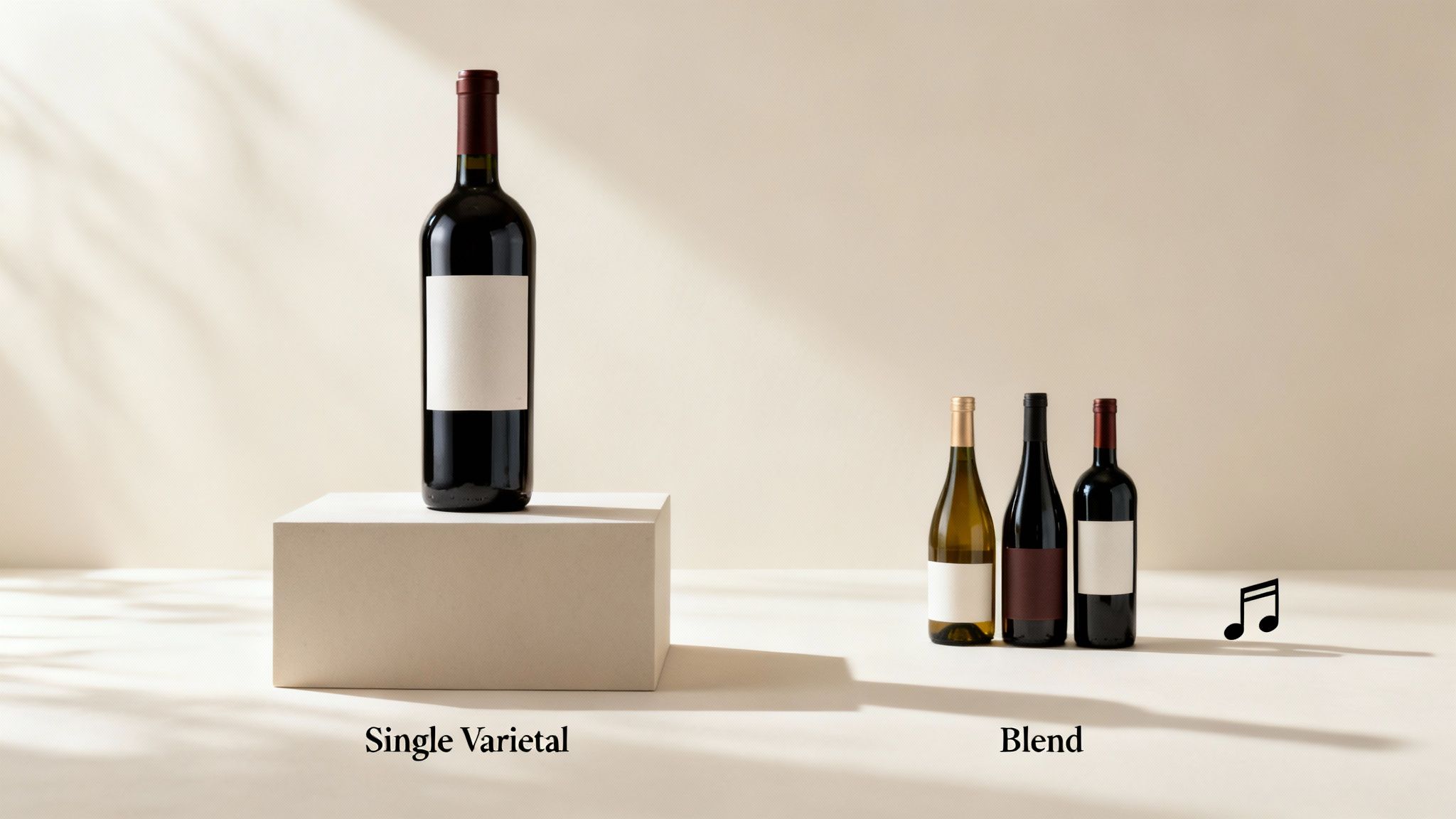
Bordeaux is a blend, Châteauneuf-du-Pape is a blend of up to thirteen permitted grapes, and Champagne is normally a blend of three. Nobody thinks of those as compromises. A winemaker blends to add something one grape can't supply on its own, whether that's structure from Cabernet Sauvignon, flesh from Merlot or perfume from Cabernet Franc.
The practical difference for you is predictability. A varietal label tells you roughly what you're getting before you open it, and a blend asks you to trust the producer instead. Blends are often the safer buy at the cheap end of the shelf, because blending lets a winemaker smooth over a weak component, and they're frequently the better value. Our guide to what a red blend actually is covers how sweet or dry they run and what to pay.
One quirk worth knowing: in the United States a wine can name two or more grapes on the label only if the wine is made entirely from those grapes and the percentages are printed, with a tolerance of plus or minus 2 percent, under paragraph (d) of the same federal rule. So "Cabernet Sauvignon Merlot" on a US label is a much more specific promise than "red blend", and it costs the winery nothing to make it except the loss of the freedom to add a fourth grape.
How do you choose a varietal from a restaurant wine list?
Decide red or white before you read a single name, because that halves the list in one move. Then let the food decide the rest: a big steak points at Cabernet Sauvignon or Malbec, a plate of fish points at Sauvignon Blanc or Pinot Grigio, and anything creamy points at Chardonnay or Chenin Blanc.
Then pick a grape you recognize. Restaurants stock the popular varietals precisely because they're reliable across a lot of dishes, so the familiar name is doing you a favor rather than exposing a lack of adventure. If you want to trade up, ask the server for something similar to a grape you already like, which is a far more useful question than asking what's good.
If you're stuck, one sentence solves it: say you'd like a smooth red that isn't too heavy, or a crisp dry white, and let them do the work. That gives a server everything they need, and it's what people who actually know wine tend to say anyway. When you're standing in a shop rather than sitting at a table, Sommy's Fit Check answers the same question against a specific bottle in your hand, which is the moment the grape name on its own stops being enough.
Frequently asked questions about wine varietals
Is a varietal the same as a grape variety?
They're close enough that nobody will stop you. The variety is the grape itself, such as Merlot or Chardonnay, and the varietal is a wine made and sold under that grape's name. In everyday use the two words have collapsed into one, and calling a wine a varietal is understood everywhere, so the distinction matters more to writers than to drinkers.
What are all the wine varietals?
There's no short answer, because the OIV counts roughly 10,000 known grapevine varieties worldwide. Only 13 of them cover more than 100,000 hectares each, and just 33 account for half of all vineyard land, so the working list you'll actually encounter in shops and restaurants is closer to twenty names than to ten thousand.
What are the 7 types of wine?
That phrase isn't an official classification, and different sources count differently, which is worth knowing before you memorize anyone's list. The grouping people usually mean is red, white, rosé, sparkling, dessert, fortified and orange, where orange means a white wine fermented on its skins. Those are styles rather than varietals, and any one of them can be made from many different grapes.
What are the top wine grape varieties by planted area?
By the OIV's global count, the largest wine grapes are Cabernet Sauvignon at 341,000 hectares, Merlot at 266,000, Tempranillo at 231,000, Airén at 218,000, Chardonnay at 210,000, Syrah at 190,000 and Grenache Noir at 163,000, followed by Sauvignon Blanc, Pinot Noir and Trebbiano Toscano. Kyoho and Red Globe appear high in the overall table, but both are table grapes rather than wine grapes.
Do I need to know a lot of varietals to choose good wine?
No, and trying to is the fastest way to make wine feel like homework. Most regular drinkers settle on two or three grapes they reliably enjoy and branch out from there, and a preference as simple as wanting a bold fruity red or a light crisp white gets you a good bottle far more often than a memorized list does.
What's the difference between Old World and New World varietals?
It's shorthand for where the wine was made rather than for anything in the bottle. Old World means Europe, mostly France, Italy, Spain, Germany and Portugal, and New World means everywhere else, including the United States, Australia, Chile, Argentina, New Zealand and South Africa. The same grape does taste different across that line, usually leaner and more savory in Europe and riper and more fruit-driven outside it, but the useful version of the rule is just that climate changes the wine more than the label ever admits.
Why does the same varietal taste different from bottle to bottle?
Three separate reasons stack up here. The wine only has to be 75 percent of the named grape in the United States, so the other quarter varies; the climate where it grew changes ripeness and acidity; and the winemaker's choices about oak, fermentation and sweetness change the finished wine again. A grape name sets the general direction, and everything after it is detail you learn by drinking.