
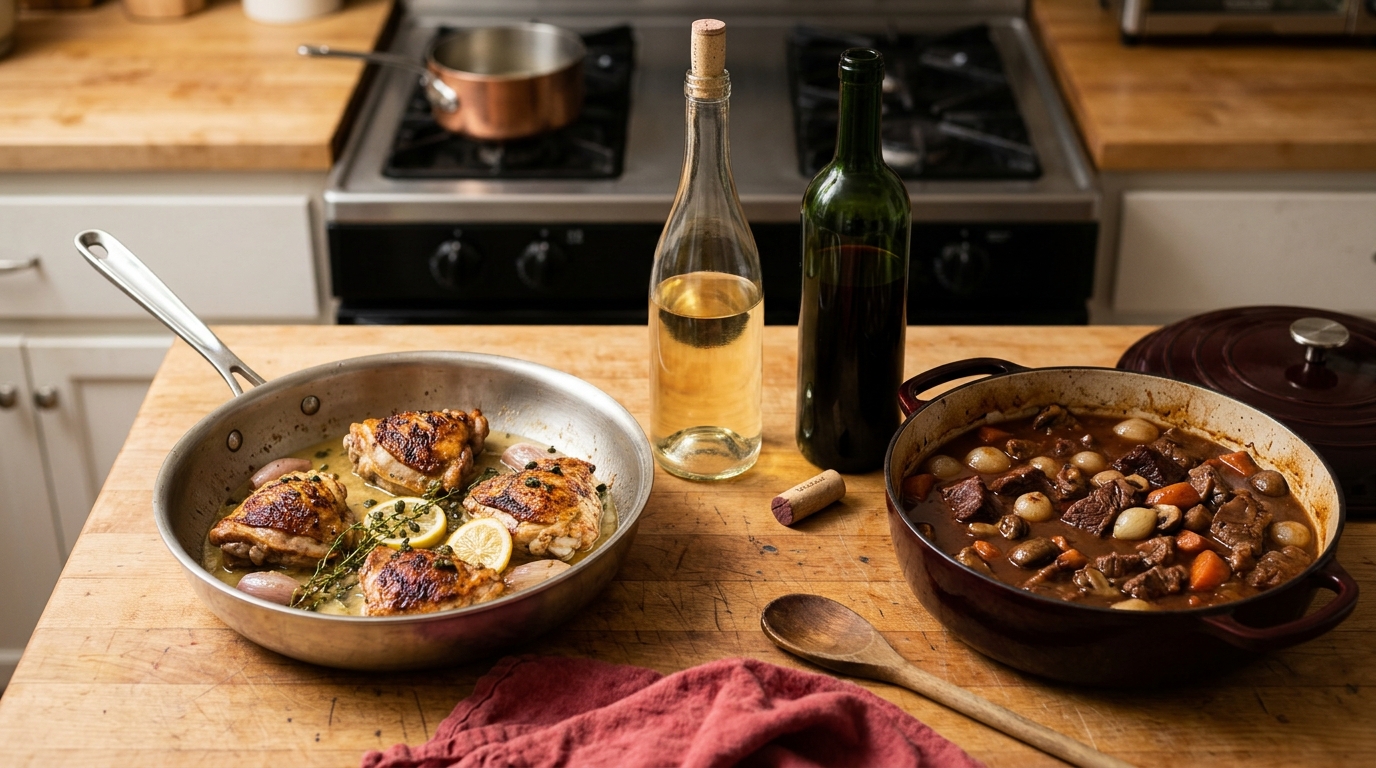

The best wine for cooking is an ordinary dry wine you'd happily drink, not the salted bottle from the vinegar aisle. For white, reach for Sauvignon Blanc, Pinot Grigio or an unoaked Chardonnay. For red, a soft, medium-bodied bottle like Merlot, Pinot Noir or a Côtes du Rhône does the job, and it doesn't need to cost more than about $10.
That's the whole answer for most weeknights, and the bottle you already have open is often the right one. The rest of this page covers the cases where it isn't: when a recipe needs a specific style, when the open bottle has gone off, and when you need a swap because there's no wine in the house at all.
What is the best dry white wine for cooking?
Sauvignon Blanc is the most dependable dry white wine for cooking, with Pinot Grigio, Chenin Blanc and Albariño close behind. All four are crisp, light on oak and not noticeably sweet, which is exactly what a pan sauce, a risotto or a pot of steamed shellfish wants from them.
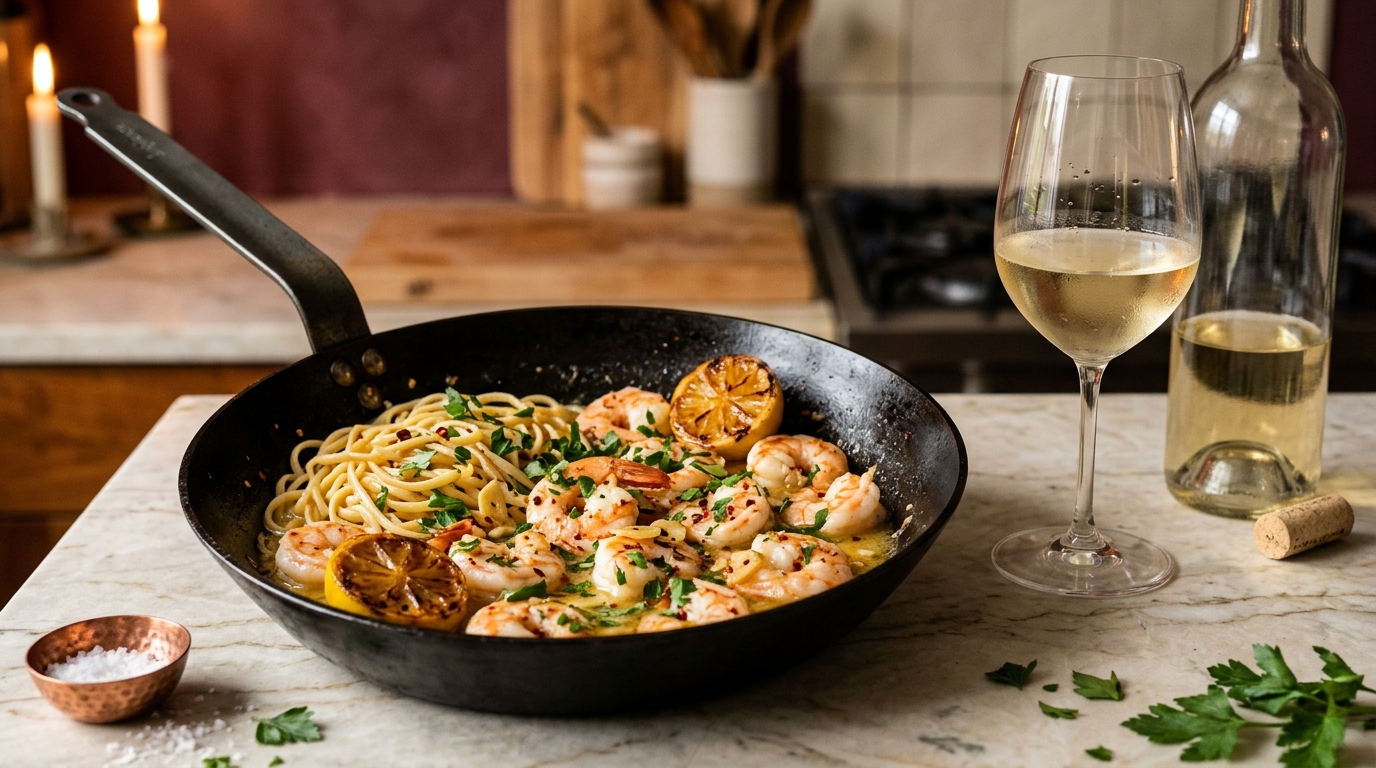
America's Test Kitchen put this to a proper test, making pan sauces plus beef and chicken stews with wines across a range of prices. In its write-up of the experiment, a $4 Sauvignon Blanc and a $4 Cabernet Sauvignon both made perfectly good stews and sauces, while a subtly sweet Riesling, an oaky California Chardonnay, a tannic Bordeaux and a sweet Lambrusco all put flavors into the food the testers didn't like. Their white-wine shortlist was Sauvignon Blanc or Chenin Blanc, Pinot Grigio, and Albariño.
The pattern behind that result is simple once you see it. Cooking concentrates whatever is loud in a wine. A little sweetness becomes a sticky, cloying sauce, and a buttery, toasty Chardonnay turns into something that tastes faintly of a lumber yard once it reduces. Bright acidity, on the other hand, is exactly what you want, because it does the same job a squeeze of lemon would.
That's why we'd steer you away from the big, rich California Chardonnay for cooking even if it's your favorite glass. Look for "unoaked" or "stainless steel" on the label instead, and our guide on how to spot unoaked Chardonnay shows the label words that give it away. A Chablis or a Mâcon from Burgundy is often unoaked too, which makes either one a safe pick.
Here's how the main whites line up in the kitchen:
- Sauvignon Blanc: the safest all-rounder, especially with garlic, herbs, lemon and seafood.
- Pinot Grigio: the most neutral of the group, so it never fights a delicate dish.
- Unoaked Chardonnay: a little rounder, which suits cream sauces and chicken.
- Albariño or Chenin Blanc: bright and fruity, lovely with shellfish and pork.
For a dish where the wine is the sauce, like mussels steamed in white wine, the choice matters a bit more. Our wine for mussels in white wine sauce post walks through that one, since the same bottle ends up in the pot and on the table.
What is the best red wine for cooking?
The best red wine for cooking is a soft, medium-bodied red such as Merlot, Pinot Noir, Grenache or a Côtes du Rhône blend. Those were America's Test Kitchen's red recommendations too, along with a plain, general table wine, and the reasoning is the same as for whites: you want fruit and acidity without anything extreme.
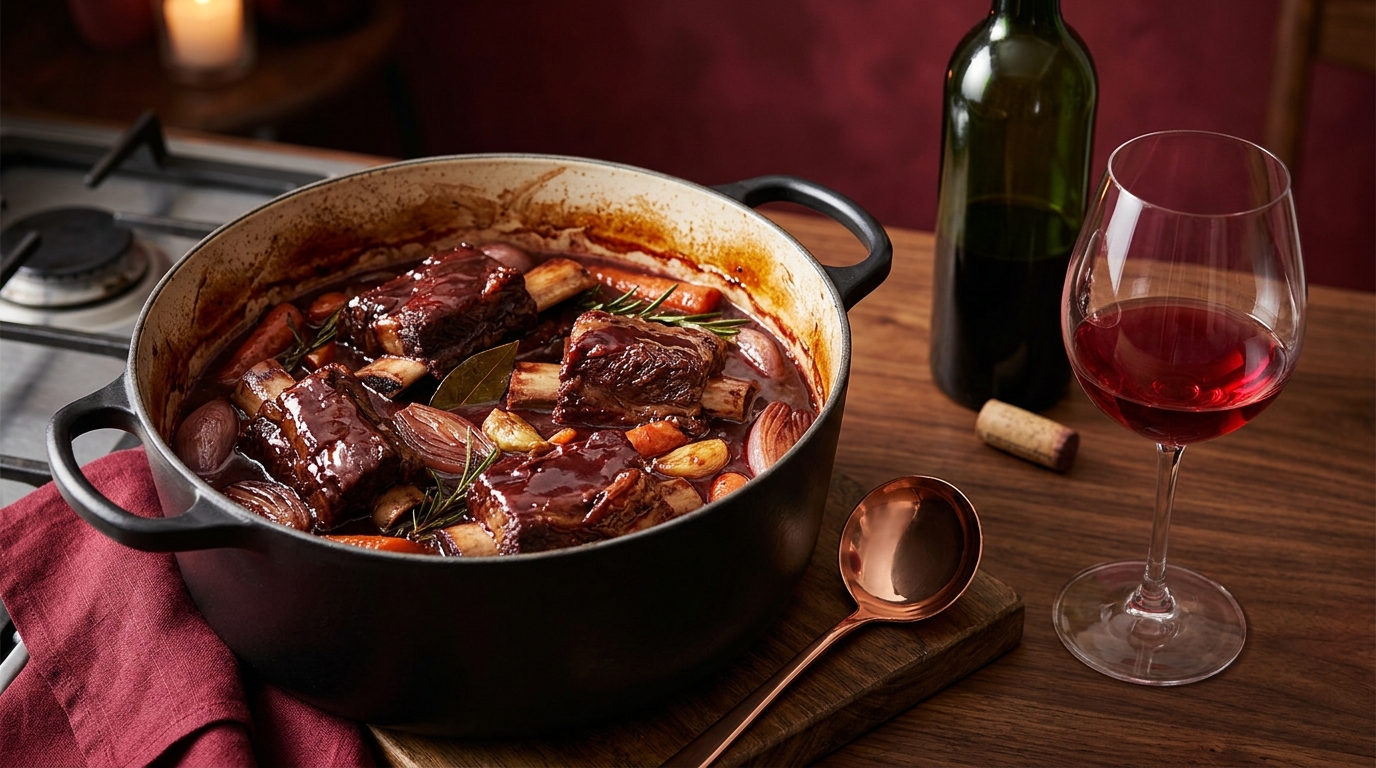
The thing to watch with red is tannin, the drying, grippy feeling a strong red leaves on your gums. Bon Appétit's senior food editor Chris Morocco explains that red turns bitter faster than white as it reduces, so he advises against reducing it by more than about half. The exception he gives is a long braise of a fatty cut, where gelatin from the meat smooths the bitterness back out.
That one detail explains a lot of red-wine cooking. A big, tannic Cabernet works in short ribs or a beef stew that simmers for hours, because the meat has time to soften it. The same bottle reduced hard into a quick pan sauce for a steak can taste harsh and bitter. If you're making something fast, choose the softer red.
Classic French braises are the place where people overthink this most. Our wine for beef bourguignon post covers the Burgundy question, and the honest answer is that a decent, inexpensive Pinot Noir does the job without the Burgundy price. For a meat sauce, the best wine for bolognese page explains why the official Bologna recipe lets you use red or white.
Is cooking wine the same as regular wine?
No, and the difference is salt. The "cooking wine" sold next to the vinegar is wine with salt and preservatives added, which keeps it shelf-stable for months after opening but makes it unpleasant to drink and hard to season with.
Brands like Holland House and Goya add salt plus preservatives such as potassium sorbate and potassium metabisulfite, according to this breakdown of how cooking wine is made shelf-stable. Sporked's editors reduced every supermarket cooking wine they could find and tasted the results off a spoon, and their verdict was that even the best of them was something to buy only if you absolutely insist. Goya's bottles were the saltiest they tasted.
The salt is the real problem. When wine reduces, the water evaporates and the salt stays in the pan, so a splash that seemed harmless can leave a sauce oversalted before you've seasoned anything. Chris Morocco's point in the Bon Appétit piece is blunter: cooking wine's additives work against the lightness and acidity that wine is supposed to bring, so there's little reason to buy it.
If salted cooking wine is genuinely all you have, use it, but cut back on any other salt in the recipe and taste before you season at the end. The one supermarket product Sporked rated well was Colombo Dry Marsala, which brings the savory, nutty Marsala character a dish like chicken Marsala depends on. Our page on chicken Marsala explains which Marsala to cook with and which to drink.
How much should you spend on wine for cooking?
Around $8 to $12 is plenty, and the cheapest drinkable bottle on the shelf will often do. The ATK test above found $4 wines worked fine in stews and sauces, and Chris Morocco told Bon Appétit that by the time a dish is done, you won't be able to tell a $50 bottle from a $10 one.
What you're paying for in an expensive wine is aroma and subtlety, and heat strips most of that away. What survives cooking is acidity, fruit, sweetness and tannin, and an inexpensive wine has all of those in abundance. So spend your money on the bottle you plan to drink with dinner, and cook with something modest.
There's a nice middle path here that we use a lot. Buy one moderately priced bottle that suits the dish, pour a cup into the pan, and drink the rest with the meal. It saves buying two bottles, and the wine in your glass echoes the flavor in the sauce, which is one of the easiest pairing wins there is.
Boxed wine is worth a mention for cooks. A dry boxed white or red stays fresh far longer than an opened bottle, because the bag inside collapses as you pour and keeps air away from the wine. That makes it a sensible kitchen staple if you cook with wine often but don't always finish a bottle.
Can you cook with wine that's been open for a few days?
Yes, as long as it still tastes like wine. An opened bottle that has lost some of its fruit and freshness is fine for cooking, but one that tastes sharply vinegary, musty or like wet cardboard should go down the sink, because heat will concentrate those flavors rather than burn them off.
The quick test is to pour a splash into a glass and taste it. If you'd shrug and say it's a bit flat, it's a cooking wine now, but if you wince, it isn't. Morocco's second firm rule in the Bon Appétit piece is the same: stay away from wine that's gone off, the same way you would if you were drinking it.
To get more days out of an open bottle, cork it and keep it in the fridge, reds included. Our guide on how to store open wine covers how long each style lasts and which stoppers actually help.
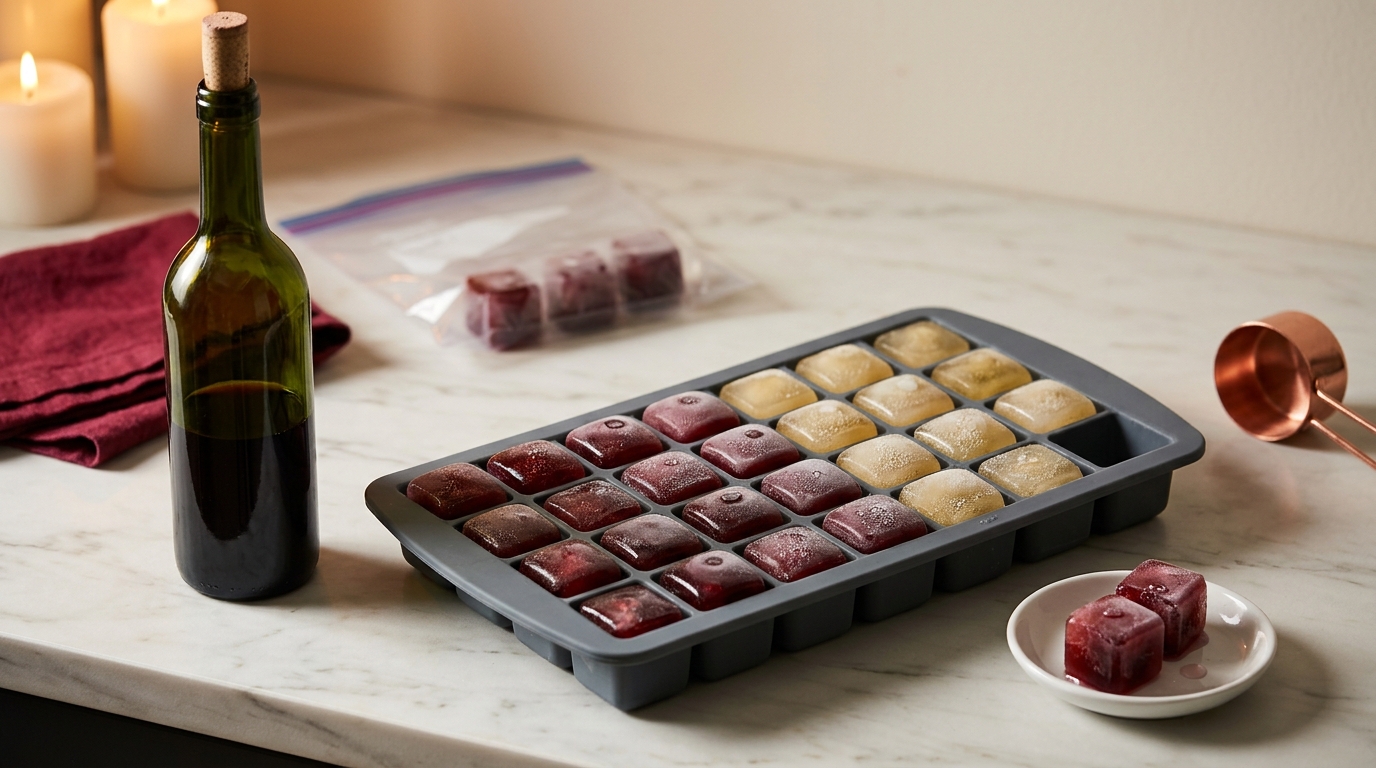
For leftovers you won't get to in time, freeze them. Pour the wine into an ice cube tray, freeze it, then tip the cubes into a labeled freezer bag with the style and date. A few cubes dropped into a pan sauce or a risotto work just as well as fresh wine, and it means the last third of a bottle never goes to waste. Keep reds and whites in separate bags so you're not guessing later.
Which wine should you use for each dish?
Match the wine to the sauce, not to the protein's color. A creamy chicken dish wants a rounder white, a tomato sauce can take either color, and a long beef braise is where a fuller red finally earns its place.
| Dish | Best wine to cook with | Why it works |
|---|---|---|
| Shrimp scampi, mussels, clams | Sauvignon Blanc or Pinot Grigio | Crisp acidity lifts garlic, butter and lemon |
| Chicken in a cream sauce | Unoaked Chardonnay | Rounder body suits cream without oak bitterness |
| Risotto | Pinot Grigio or Sauvignon Blanc | Neutral and bright, so the rice and stock lead |
| Pan sauce for steak | Merlot or Pinot Noir | Soft tannin stays smooth when reduced fast |
| Beef stew, short ribs | Côtes du Rhône, Grenache or Cabernet | Long braising tames the tannin |
| Bolognese or meat sauce | Dry red or dry white | Both work, as the official recipe allows |
| Chicken or veal Marsala | Dry Marsala | The dish depends on its nutty flavor |
Fortified and Asian rice wines are a separate case, since they bring a flavor you can't fake with table wine. A recipe that calls for dry sherry wants a dry fino, and our guide to sherry wine explains how to tell the dry styles from the sweet ones on a shelf. Avoid anything labeled "cooking sherry", which is the salted kind. For Chinese stir-fries, Shaoxing rice wine is the real thing, and dry sherry is the usual stand-in when you can't find it. Mirin is sweet by design, so swapping a dry wine in for it changes the dish.
Sparkling wine is worth knowing about as well. Leftover dry Prosecco or Cava cooks just like a still dry white, since the bubbles disappear in the pan anyway, so there's no need to pour away the end of a bottle from the weekend. Just check it's labeled Brut or Extra Brut, because a sweeter sparkling wine will make a savory sauce taste sugary.
What can you use instead of wine in cooking?
Unsalted stock with a little acid is the best general substitute, and dry vermouth is the best wine-based one. A splash of lemon juice or white wine vinegar in chicken or vegetable stock covers most of what white wine does in a pan sauce, and beef stock with a little red wine vinegar does the same for red.
| Recipe calls for | Good substitute | What changes |
|---|---|---|
| Dry white wine | Dry vermouth | Adds a light herbal note |
| Dry white wine | Chicken or vegetable stock plus lemon juice | Alcohol-free, less depth |
| Dry red wine | Beef stock plus red wine vinegar | Alcohol-free, less fruit |
| Shaoxing wine | Dry sherry | Different aroma, same savory role |
| Dry Marsala | Dry Madeira or dry Amontillado sherry | Keeps the nutty direction |
Dry vermouth deserves a special word, because it's the cook's secret weapon. It's wine fortified and flavored with botanicals, it keeps far longer than an open bottle of white once it's sealed and refrigerated, and it slots into almost any recipe that asks for dry white wine. The herbal note it adds is lovely with chicken and mushrooms, and you'd only notice it in the most delicate fish dish.
Don't use straight vinegar as a one-for-one swap. It's far more acidic than wine, so a full cup of it will overwhelm a dish that a full cup of wine would simply brighten. Start with a teaspoon or two in stock, taste, and add more only if the sauce still tastes flat.
Does cooking burn off all the alcohol?
No, and it takes far longer than most people think. The USDA's Table of Nutrient Retention Factors found that a dish still holds 40% of its alcohol after 15 minutes of baking or simmering, and 5% even after two and a half hours.
| Cooking method | Alcohol retained |
|---|---|
| Stirred into hot liquid, then removed from heat | 85% |
| Flamed | 75% |
| Baked or simmered 15 minutes | 40% |
| Baked or simmered 30 minutes | 35% |
| Baked or simmered 1 hour | 25% |
| Baked or simmered 2 hours | 10% |
| Baked or simmered 2.5 hours | 5% |
So a quick pan sauce finished with wine keeps most of its alcohol, and even a long stew keeps a trace. In practice the amount per serving is small, because a cup of wine spread across a pot that feeds six isn't much to start with. But if you're cooking for someone who avoids alcohol entirely, whether for health, pregnancy, recovery or religion, simmering is not a workaround. Use one of the stock-based substitutes above instead.
How do you get the most out of the wine in the pan?
Add it early enough to cook off the raw edge, and reduce it before the other liquid goes in. Wine that's poured in at the last minute tastes boozy and sharp, while wine that's simmered down for a few minutes turns rounded and savory.
The classic move is deglazing: after you've browned meat or onions, pour the wine into the hot pan and scrape up the brown bits stuck to the bottom with a wooden spoon. Those bits are concentrated flavor, and the wine lifts them into the sauce. Let it bubble until it's reduced by roughly half before adding stock or cream.
For red sauces, remember Morocco's rule from earlier and stop at about half. For white, you can go further, all the way down to a syrupy glaze for something like a beurre blanc, because white's lack of tannin means it doesn't turn bitter as it concentrates.
Once the dish is done and you're deciding what to pour alongside it, that's a slightly different question from what went in the pan. Sommy's Pairing feature takes the recipe itself, either a link or a photo of the cookbook page, and suggests a bottle for the glass based on the ingredients that actually drive the match.
Frequently asked questions
What is the best wine for cooking chicken?
The best wine for cooking chicken is a dry white like Sauvignon Blanc or Pinot Grigio for lemon, garlic and herb dishes, or an unoaked Chardonnay for creamy sauces. Coq au vin is the main exception, and it's traditionally made with a light red such as Pinot Noir.
Can I use red wine when a recipe calls for white?
Sometimes, in a hearty tomato sauce or a meat stew, but it'll change the color and add tannin that white doesn't have. In a cream sauce, a seafood dish or a pale risotto, use another dry white, dry vermouth or stock instead.
Is dry white wine for cooking the same as cooking wine?
Not at all, because dry white wine for cooking means any ordinary dry white you'd drink, like Sauvignon Blanc or Pinot Grigio, while "cooking wine" is a salted, preserved product sold near the vinegar. Recipes that say "dry white wine" mean the drinking kind.
Does the wine you cook with need to be good?
It needs to taste clean, not expensive. If it tastes fine in a glass, it'll be fine in the pan, and America's Test Kitchen found that $4 bottles worked perfectly well in stews and sauces. If it tastes off to drink, it'll taste off in the food.
How long does an open bottle of wine last for cooking?
Usually several days in the fridge with the cork back in, and often longer than you'd want to drink it, since cooking only needs the wine to be free of vinegary or musty notes. For anything longer, freeze it in an ice cube tray.
What's the best substitute for wine in cooking?
Unsalted stock with a splash of lemon juice or vinegar is the best alcohol-free substitute. If you just don't have the right wine, dry vermouth is the best stand-in for dry white wine in almost any savory recipe.
