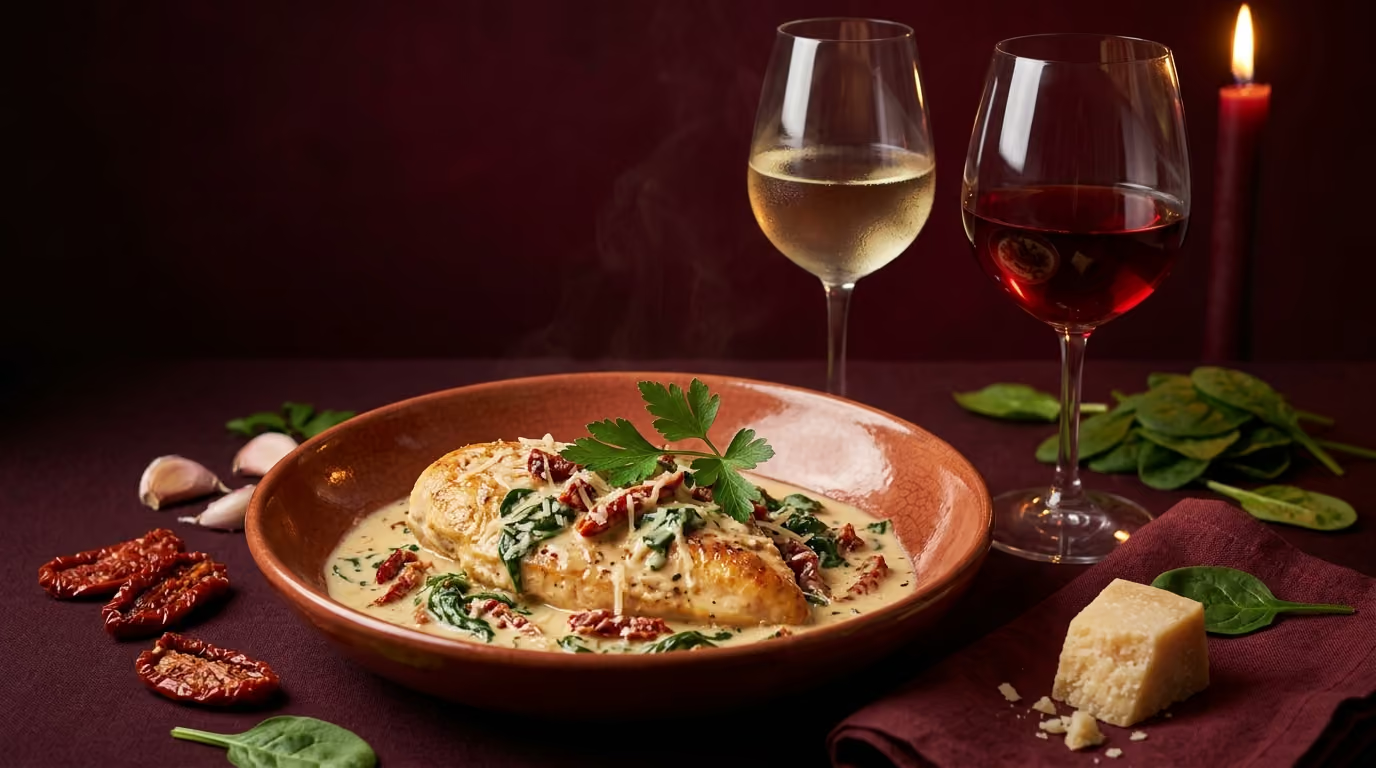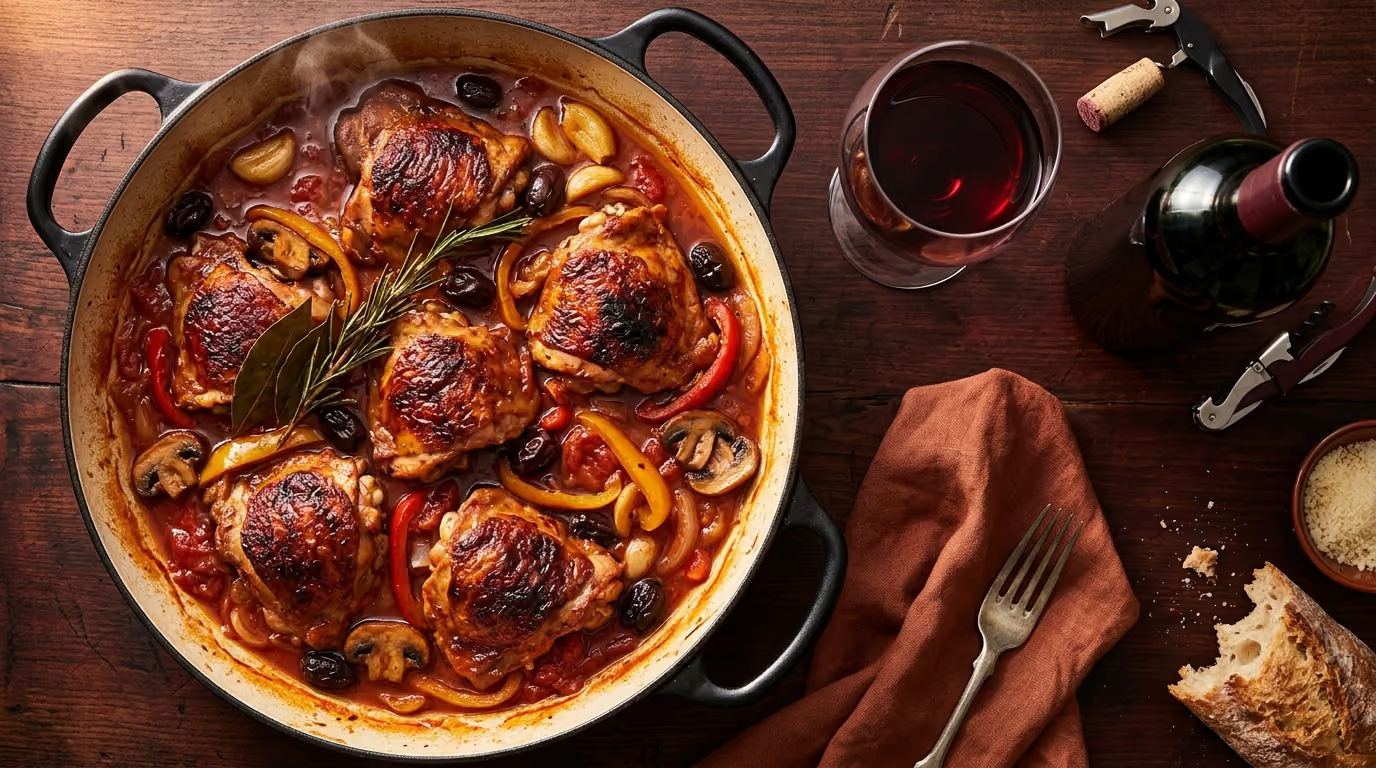


The best wine for chicken marsala is a light to medium-bodied red with fresh acidity, and Pinot Noir is the safest pick of all. Its bright cherry fruit and gentle earthiness echo the mushrooms while its acidity cuts through the buttery, slightly sweet marsala sauce, so neither the wine nor the dish overpowers the other. Italian reds like Barbera and Chianti work just as well, and if you lean white, a crisp Pinot Grigio or a lightly oaked Chardonnay is a genuinely good match too.
There are really two questions hiding inside "wine for chicken marsala," though, and most guides only answer one. The first is which Marsala to reduce into the pan, dry or sweet. The second is which bottle to pour alongside. This guide answers both, starting with the pan, because the Marsala you cook with is what decides the pairing that follows.
What is in chicken marsala, and what decides the pairing?
Pairing gets easy once you know what you are matching. Chicken marsala is chicken cutlets dredged in flour, browned in butter, then simmered in a pan sauce of shallots, mushrooms, and marsala wine. The flavors that decide the pairing are three: savory-earthy mushrooms, richness from the butter, and a sweet-nutty edge from the marsala itself.
Marsala is a fortified wine from the Sicilian town of the same name, granted its DOC in 1969. It is not a grape and it is not interchangeable with a red or white table wine, which is the single most common mistake home cooks make with this dish. How sweet it is, and how long it aged, are both printed on the label, and both change the sauce.
Should you cook chicken marsala with dry or sweet Marsala?
Use dry Marsala, labeled secco, for chicken marsala. It keeps the pan sauce savory and nutty, which is what you want under mushrooms and browned butter, and it lets you control the sweetness yourself rather than having the bottle decide for you.
Sweet Marsala, labeled dolce, is not wrong, and plenty of American restaurant versions lean that way on purpose for a glossy, caramelized sauce. It just pushes the dish toward dessert and reduces to something sticky if you are heavy handed. If sweet is all you can find, cut the amount by about a third and add a squeeze of lemon at the end.
These are legal categories with numbers behind them. Under the Marsala DOC rules, secco holds a maximum of 40 grams of residual sugar per liter, semisecco sits between 40 and 100, and dolce carries at least 100. That spread is wide enough to change a sauce completely, which is why "just use Marsala" is unhelpful advice.
How do you read a Marsala label?
Three things appear on every bottle. The color tells you which grapes it came from, the sweetness word tells you how it behaves in the pan, and the aging word tells you what it costs and whether it belongs in a glass instead.
| What is on the label | What it means | For chicken marsala |
|---|---|---|
| Oro or Ambra | Made from white grapes such as Grillo, Catarratto, Inzolia, Damaschino. Ambra gets its amber tint from cooked grape must | Either one is the standard choice |
| Rubino | At least 70 percent red grapes: Nero d'Avola, Nerello Mascalese, Perricone | Rarer and darker, fine but not traditional here |
| Secco | Maximum 40 g/L residual sugar | Buy this one |
| Semisecco | 40 to 100 g/L residual sugar | Workable, go lighter on the pour |
| Dolce | At least 100 g/L residual sugar | Sweet, and better suited to zabaglione |
| Fine | Aged at least 1 year, 8 months of it in barrel | The everyday cooking tier |
| Superiore | Aged at least 2 years, 20 months in barrel | Worth the small step up |
| Vergine or Soleras | Aged at least 5 years, with no sweetening additions permitted | Drink it, do not reduce it |
Two more numbers worth carrying: Marsala Fine must reach 17.5 percent alcohol and every other style 18 percent, so a little goes a long way in a pan.
What brand of Marsala is best for cooking?
Florio and Pellegrino are the two Sicilian houses you will actually find in American stores, and either is a sound buy. The thing to watch is not the name on the front, it is which bottling of that name you picked up.
Checking wine.com on August 30, 2026, the Florio bottling stocked most widely was Vecchioflorio Sweet Marsala Superiore at $19.97, not the dry one. That is the trap in a sentence: the easiest Marsala to find is often the sweet one, and the recipe in front of you almost certainly assumes dry. Read the word next to the name before you get to the register.
Above that everyday tier the wine stops being a cooking ingredient. Marco De Bartoli's Marsala d'Oro Vigna la Miccia was $57.99 for 500ml and Florio's Terre Arse Vergine Riserva was $86.99 the same day. Those belong in a glass with almonds and a hard cheese, not in a hot pan. For cooking, spend $15 to $25 on a dry Fine or Superiore and put the difference toward what you drink.
Is grocery store "cooking Marsala" the same thing?
No, and this is the difference that quietly ruins more chicken marsala than any pairing mistake. The bottles sold in the vinegar aisle rather than the wine aisle are usually not Marsala DOC at all.
Holland House Marsala Cooking Wine, the most widely stocked example, describes itself on its own label as a blend of American marsala style wine and distilled spirits, and its ingredient list runs wine, water, neutral spirits, invert sugar, salt, malic acid, and two preservatives. The label states 1.5 percent added salt, the nutrition panel shows 190 mg of sodium in a two-tablespoon serving, and the bottle carries the warning "not for sale or use as a beverage." Checked against the manufacturer's own product page on 2026-08-30.
The salt is the problem. Reduce that liquid by half and you concentrate the sodium with everything else, which is how a sauce ends up tasting flat and oddly salty however carefully you seasoned the chicken. If you already own a bottle, hold back the recipe's salt and season at the very end. Better still, buy real dry Marsala for a few dollars more. It keeps for months once opened, so it is not a single-use purchase.
What can you use instead of Marsala wine?
The closest substitutes are other oxidative fortified wines, because that nutty character is the flavor you are replacing, not just the alcohol.
- Dry Madeira is the best swap, near enough that most people would not catch it.
- Medium or dry Amontillado sherry is a close second, a touch more saline and a touch less caramel.
- Dry white vermouth works in a pinch and keeps the sauce savory, though you lose the nuttiness.
- No alcohol at all: chicken stock with a splash of white grape juice and a small spoon of balsamic vinegar gets you the sweet-savory shape, if not the depth.
What does not work is substituting a regular red or white table wine straight across. The sauce turns thin and acidic and stops tasting like marsala at all.
Which wine should you drink with chicken marsala?
One rule beats hunting for a single perfect bottle: match the weight of the wine to the weight of the sauce, and keep the acidity high either way. Acidity is what cleans the richness off your palate between bites, and it is what makes the meal feel fresh rather than heavy.
- Lighter, brothy sauce (thin and glossy, more broth than cream): Pinot Noir, or Pinot Grigio if you want white. Serve reds at 55 to 60°F, whites at 45 to 50°F.
- Classic, balanced sauce: Barbera or Chianti. Both bring the acidity to match the butter. Serve at 60 to 65°F.
- Rich, creamy, or deeply browned sauce: Chianti Classico, Valpolicella Ripasso, or a lightly oaked Chardonnay. Serve reds at 62 to 65°F.
- Something unexpected: a dry Lambrusco, chilled to 54 to 58°F.
- Best all-round bottle under $25: a good Barbera d'Asti, which flatters almost any version of the dish.
If you cooked with dry Marsala, the sauce is nuttier and savory, so a savory red suits it. If you cooked with sweet, the sauce is more caramelized and wants a wine with fruit of its own to keep up. Ordering out, assume a middle-of-the-road, lightly sweet sauce, because that is what most American kitchens serve.
Why is Pinot Noir the safest red?
When in doubt, order Pinot Noir. Its notes of cherry, raspberry, and forest-floor earthiness mirror the mushrooms, while its light body and soft tannins never bully the delicate chicken. The acidity does the rest, slicing through the butter with each sip. If mushrooms are the part of the dish you care most about, our guide to pairing wine with mushrooms goes deeper on why that earthy echo works.
A cooler-climate Pinot from Burgundy or Oregon leans savory and mushroomy, the more elegant match, while a warmer-climate bottle from California or New Zealand is juicier and friendlier. Expect to spend $18 to $30, and serve it slightly chilled around 55 to 60°F. If you like knowing how it compares to other soft reds, here is the difference between Merlot and Pinot Noir.
Which Italian reds work best?
For an authentic, food-first pairing, Barbera from Piedmont is hard to beat. Its calling card is naturally high acidity, which cuts the buttery sauce, paired with juicy dark cherry and plum fruit and famously low tannins. On the label, Barbera d'Asti is the brighter, zestier style, and Barbera d'Alba is a touch darker and richer for a mushroom-heavy sauce. Both are usually excellent value, often $15 to $25, and both are the smart order when you are staring at an Italian restaurant list and want a bottle that flatters the whole table.
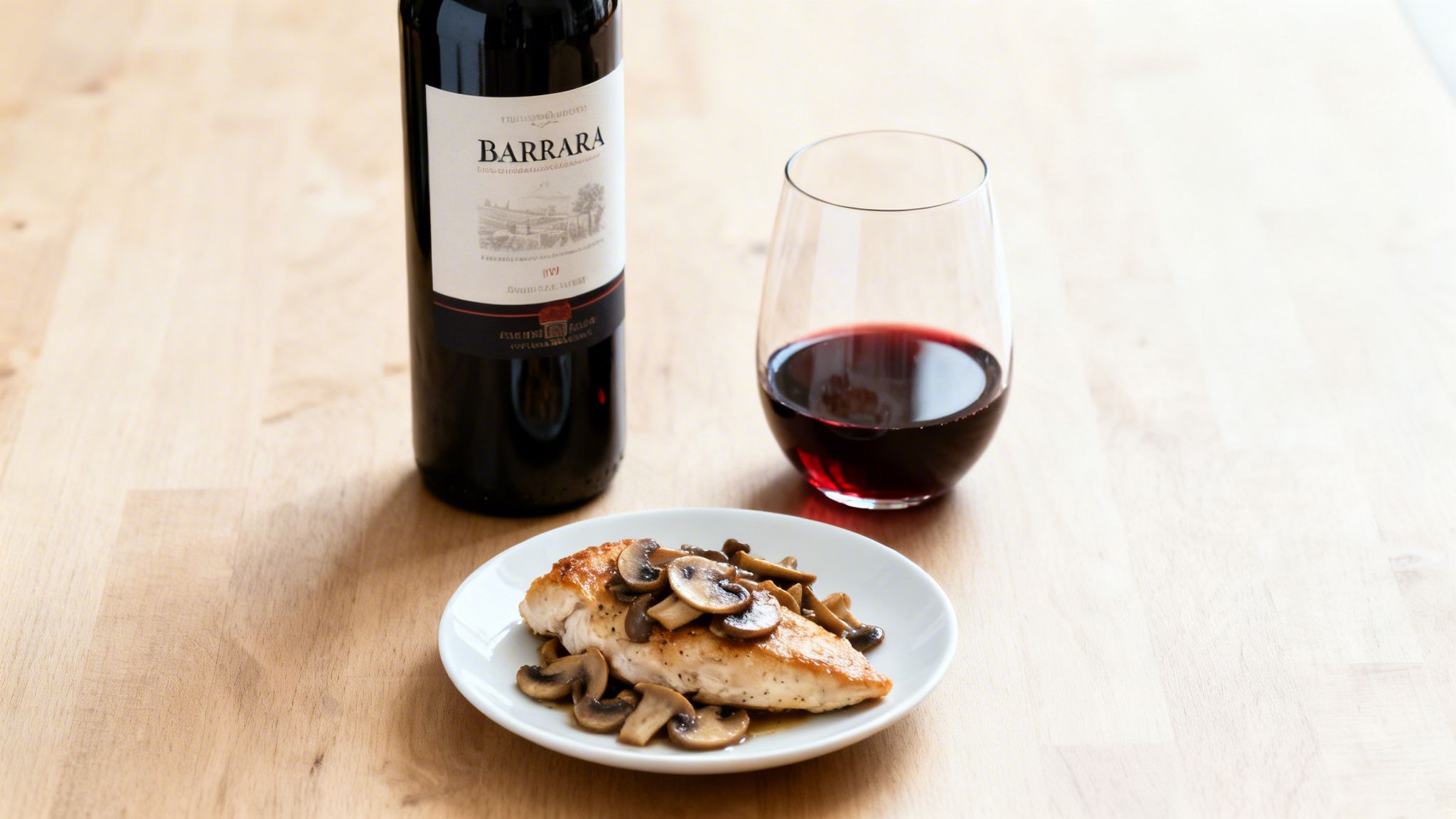
Chianti is the other classic. Its tart cherry and plum fruit, backed by savory notes of tomato leaf and earth, bridge straight to the mushrooms and herbs, while its lively acidity handles the butter with ease. Choose Chianti Classico, identifiable by the black rooster seal on the neck, for a clear step up. Serve at 60 to 65°F. For more along these lines, here is our guide to the best wine for Italian food, and if you are cooking your way through the chicken repertoire, the same acidity-first logic drives our picks for a Sunday roast chicken.
Three more hit the same brief at friendly prices: Cotes du Rhone for peppery ripe strawberry, Valpolicella for sour-cherry brightness (step up to Ripasso for a creamier sauce), and Garnacha from Campo de Borja for red fruit with a whisper of white pepper. Serve all three around 60 to 65°F.
Can you drink white wine with chicken marsala?
Yes, and sometimes it works better. Chicken is white meat, the sauce has butter and a nutty edge, and the right white can be a cleaner partner than any red, especially with a lighter version of the dish.

- Pinot Grigio is the easy answer, its crisp citrus refreshing the palate and letting the sauce lead. Reach for a good northern Italian bottle rather than the cheapest on the shelf.
- Chardonnay is the pick for a rich, butter-forward sauce. Lightly oaked or unoaked, think Macon or a cooler-climate California bottling, and skip the big oaky styles that fight the dish.
- Chenin Blanc is the sleeper, its orchard-fruit sweetness and firm acidity flattering the sauce's nutty side.
- Dry Riesling is the one to reach for if there is chili heat or extra garlic in the pan.
Serve whites at 45 to 50°F. Lighter sauce leans Pinot Grigio, creamier sauce leans Chardonnay.
What about dry Lambrusco?
A dry Lambrusco, the lightly sparkling red from Emilia-Romagna, is an inspired match. The gentle fizz scrubs the butter off your palate while its tart cherry fruit connects to the mushrooms, and it is light enough in body and alcohol that it never overwhelms the chicken.
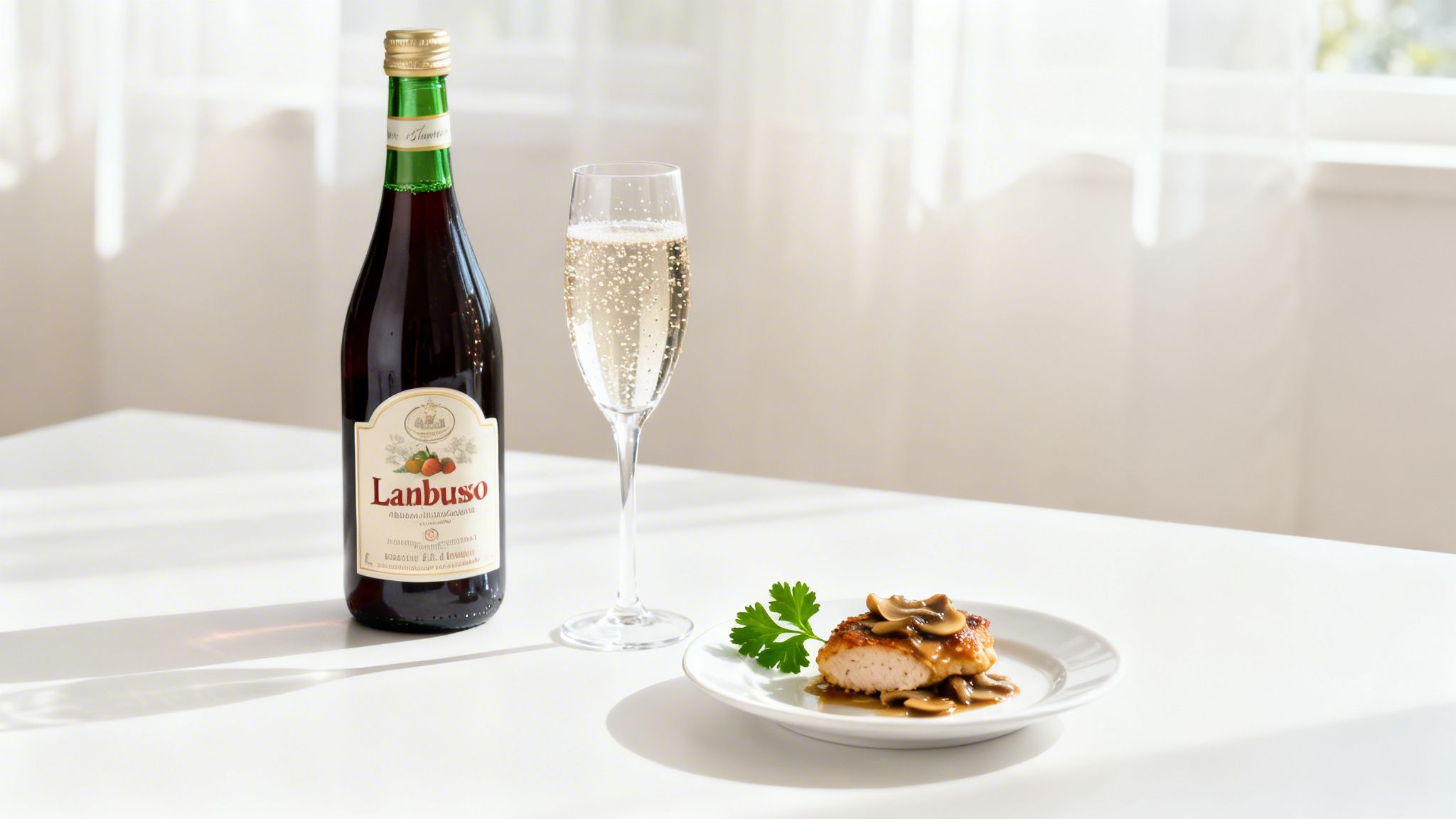
Look for "Secco" or "Brut" on the label for a dry style, or "Semisecco" for a whisper of fruit to balance a saltier sauce. Serve it well chilled, around 54 to 58°F, to keep the bubbles lively.
What changes when you order out instead of cooking at home?
At a restaurant, you rarely know how sweet the sauce is, so play the odds with a versatile, acidity-driven red. If the list has a Barbera, a Chianti, or a by-the-glass Pinot Noir, order it and stop worrying. Ask the server whether the marsala runs sweet or savory, and if the list is long and unfamiliar, photograph it and let Sommy filter it down to the bottles that fit both the dish and your taste.
At home, you hold all the information, because you chose the Marsala and controlled the butter. Reduced with dry Marsala and a light hand on the butter, pour Pinot Noir or Pinot Grigio. Built rich with cream and sweet Marsala, reach for Barbera, Chianti, or an oaked Chardonnay. Buy one bottle to cook with and a separate, better one to drink, because reducing a wine boils off the finesse you paid for.
The rest is three ideas: acidity is your ally, match earthy with earthy, and keep tannins tame, because big young Cabernet turns bitter against this sauce. If you would rather not think about it at all, snap a photo of your plate or the restaurant's list and Sommy's Pairing feature matches a bottle to your own Taste Profile.
Frequently asked questions
Is it better to use dry or sweet Marsala wine for chicken marsala?
Dry, labeled secco, which holds a maximum of 40 grams of residual sugar per liter under the Marsala DOC rules. It keeps the pan sauce savory and lets you control the sweetness. Sweet Marsala, labeled dolce, carries at least 100 grams per liter and pushes the dish toward caramel, so cut the quantity by about a third if it is all you have.
What brand of Marsala wine is best for cooking?
Florio and Pellegrino are the two Sicilian houses stocked most widely in the United States, and either works. Check which bottling you have picked up, because the easiest Florio to find is often the sweet Vecchioflorio Superiore rather than the dry one. Spend around $15 to $25 on a dry Fine or Superiore.
Is Marsala wine red or white?
Usually white. The Oro and Ambra styles are made from white Sicilian grapes such as Grillo, Catarratto, and Inzolia. Only the rarer Rubino style is red, requiring at least 70 percent Nero d'Avola, Nerello Mascalese, or Perricone. All of them are amber to brown in the glass because of oxidative aging, which is why Marsala rarely looks like either.
Can you use grocery store cooking Marsala?
You can, but it is a different product. Holland House Marsala Cooking Wine is labeled as a blend of American marsala style wine and distilled spirits with 1.5 percent added salt and 190 mg of sodium in a two-tablespoon serving, and it is marked not for use as a beverage. Reducing it concentrates that salt, so hold back the recipe's salt and season at the end.
What can you substitute for Marsala wine?
Dry Madeira is the closest, then a dry or medium Amontillado sherry, then dry white vermouth. Without alcohol, chicken stock with a splash of white grape juice and a little balsamic gets close to the sweet-savory shape. A regular red or white table wine does not work as a straight swap.
What wine goes best with chicken marsala?
A light to medium-bodied red with fresh acidity, and Pinot Noir most of all. It mirrors the mushrooms and cuts the buttery sauce without overpowering the chicken. Barbera and Chianti are excellent Italian alternatives.
What is traditionally served with chicken marsala?
Buttered egg noodles, mashed potatoes, or creamy polenta to catch the sauce, plus a green vegetable with some bite such as roasted asparagus, broccolini, or a lemon-dressed salad. That acidic green side is the reason a high-acid wine sits so comfortably next to the plate.
What should you avoid pairing with chicken marsala?
Skip big, tannic reds like young Cabernet Sauvignon or Syrah, and heavily oaked, high-alcohol whites. Both overpower the delicate chicken and clash with the sauce.
What temperature should you serve the wine?
Serve light reds slightly chilled at 55 to 60°F, medium reds at 60 to 65°F, whites at 45 to 50°F, and Lambrusco well chilled at 54 to 58°F. A red that is too warm tastes flat and heavy against the buttery sauce, so a short spell in the fridge helps.