
The best Argentine Malbec for you depends on where it was grown far more than on its price or its rating. A bottle from the Uco Valley will usually taste fresher and more floral, one from Luján de Cuyo will feel rounder and more savoury, and a bottle labelled only Mendoza sits somewhere in between. Read the region on the label first, decide which of those two directions you want, and the rest of the decision gets much smaller.

Why does choosing a Malbec feel harder than it should?
Because the labels all look alike while the wines behind them genuinely differ. Two bottles can both say Argentina, Mendoza and Malbec, cost within a few dollars of each other, and still deliver noticeably different experiences depending on the altitude and the sub-region the fruit came from. Nothing on the front of the bottle explains that to you.
Argentina’s scale makes it worse rather than better. Malbec arrived there with the French agronomist Michel Pouget in 1868 and has since become the country’s signature grape, with around 25,000 hectares planted in Mendoza alone, plus further plantings in La Rioja, Salta, San Juan, Catamarca and Buenos Aires. That’s an enormous amount of wine sharing one grape name.
The useful response isn’t to memorise producers. It’s to learn the two or three words on the label that actually predict the style, then stop reading the rest.
What do the regions on the label actually tell you?
They tell you the altitude, and altitude is what shapes the wine. Argentina’s most highly regarded Malbec comes from the high-altitude parts of Mendoza, specifically Luján de Cuyo and the Uco Valley, which sit in the Andean foothills between roughly 800 and 1,500 metres, or 2,800 to 5,000 feet.
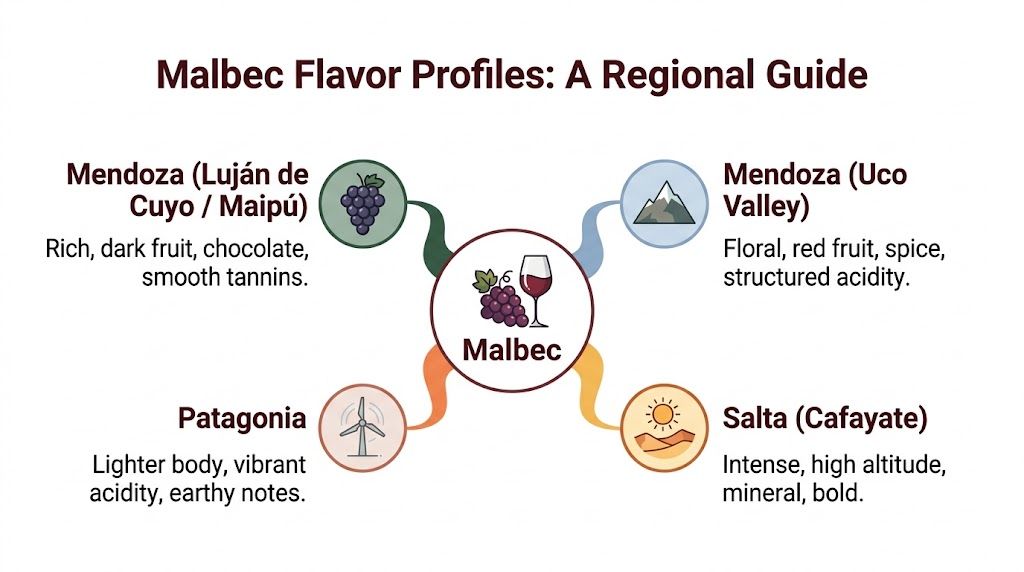
Vineyards that high get intense daytime sun and genuinely cold nights, and that daily swing is what lets the grapes ripen fully while keeping their acidity. A wine with acidity intact tastes lively and finishes clean, and one without it tastes heavy and slightly flat no matter how much fruit it has.
In practice, Uco Valley on a label points toward the fresher, more floral and more structured end of the range, since it’s the higher and cooler of the two. Luján de Cuyo points toward something rounder, softer and more savoury, with the velvety texture that made Argentine Malbec popular in the first place. A bottle labelled only Mendoza covers a much wider area and is the least predictable of the three, which is not the same as being worse.
Which words on the label are worth reading?
Region first, then alcohol, then any mention of oak. Those three tell you most of what you need, and everything else on a Malbec label is either marketing or legally meaningless.
| What the label says | What to expect | Best for |
|---|---|---|
| Uco Valley | Fresher, floral, firmer structure | Lighter red meat, herby dishes, drinking without food |
| Luján de Cuyo | Rounder, softer, more savoury | Steak, lamb, roasted and grilled food |
| Mendoza only | Broad middle ground, varies by producer | Everyday drinking and mixed tables |
| Aged in oak, 12 months or more | Vanilla and spice over the dark fruit | Rich, charred or barbecued food |
Alcohol is the number that tells you how the wine will feel. Most Argentine Malbec sits between 13.5 and 14.5 percent, and the higher end will taste warmer and fuller in the mouth. If you want something easier to drink on its own, look toward the lower end of that range.
The word Reserva carries no legal definition in Argentina the way it does in Spain, so it doesn’t promise anything by itself. It’s still mildly useful within a single producer’s range, where it usually marks a step up in sourcing or oak ageing from their entry-level bottling. Our guide to reading wine labels covers which other terms are regulated and which are decoration.
How much do you need to spend?
Less than most people assume, because Argentina remains one of the better value sources of serious red wine. The stretch between about fifteen and twenty-five dollars is where Argentine Malbec is genuinely strong, and it’s where a named sub-region starts appearing on labels rather than just the word Mendoza.

Below roughly twelve dollars you’re usually buying fruit from warmer, lower-altitude sites, blended for consistency rather than character. Those wines are perfectly drinkable and often good value for a party, but they tend to taste soft and simple, and they’re the reason some people think Malbec is one-dimensional. A few dollars more changes the experience considerably. If you want a specific, widely available example of the step up, we’ve written about Trivento Golden Reserve in detail.
Above about forty dollars you’re into single-vineyard bottlings where the differences get finer and more personal. They can be excellent, though the improvement per dollar slows sharply, and nobody should feel they need to go there to drink well. Spending twenty dollars on a bottle from a named sub-region beats spending fifty on a bottle you chose because the label looked expensive.
What food goes with Argentine Malbec?
Grilled and roasted meat is the classic answer and it holds up, but the more useful question is which style of Malbec suits the meal. A rounder Luján de Cuyo bottle handles a fatty ribeye or slow-roasted lamb, where its softer tannins and savoury depth meet the richness head on.
A fresher Uco Valley bottle works better with lighter preparations, including grilled chicken thighs, mushroom dishes, herby sausages or anything with a tomato-based sauce, because its acidity keeps up rather than getting buried. It’s also the better of the two to drink on its own before dinner. Our guide to the best wine for a steak dinner goes further into matching by cut and sauce if steak is the main event.
The pairings to avoid are the delicate ones. Malbec has enough colour, tannin and alcohol to flatten white fish, fresh goat cheese or a lemon-dressed salad, and there’s no version of the grape that solves that. Empanadas, hard cheeses, barbecue and anything with real char are all much safer ground.
How does Argentine Malbec differ from French Malbec?
The same grape makes a noticeably firmer wine in France. Malbec’s original home is Cahors in south-west France, where the appellation rules require a minimum of 70% Malbec in the blend and the wines are dark and tannic enough to have earned the name the black wines of Cahors.
Argentine versions are softer and plusher in texture by comparison, with riper fruit and less obvious grip, which is precisely why they travelled so well. Argentine Malbec has nonetheless shown ageing potential comparable to the French style, so the softness isn’t a sign of a simpler wine. If the old world against new world distinction is new to you, we unpack it in old world versus new world wine.
Worth knowing if you’ve tried one and disliked it: someone who found Cahors too austere will often get on well with a Luján de Cuyo bottle, and someone who found Argentine Malbec too soft and sweet-tasting should try either Cahors or a high-altitude Uco Valley wine before writing the grape off.
What about Malbec from outside Mendoza?
Mendoza dominates, but it isn’t the only source worth knowing. Argentine Malbec is also planted in La Rioja, Salta, San Juan, Catamarca and Buenos Aires, and Salta in the north is the one most likely to surprise you, since its vineyards sit higher still than Mendoza’s and the wines tend to come out intense and firmly structured.
These bottles turn up less often on shop shelves and can be harder to find, which is exactly why they’re interesting once you’ve worked out whether you prefer the fresh or the round style. If a shop has a Salta Malbec and you already know you like the Uco Valley end of the range, it’s worth trying, because it usually pushes further in the same direction.
A bottle that names any specific sub-region is generally telling you something real, since blending across a wider area is what produces a label that says Mendoza and nothing else. That isn’t a reason to avoid the broader labels, which include plenty of good everyday wine, but it does explain why two bottles at the same price can taste so different.
How should you serve it?
Slightly cool rather than at room temperature, which is the single change that improves most Malbec. Around 16 to 18 degrees Celsius, roughly 61 to 64 Fahrenheit, keeps the fruit defined and stops the alcohol dominating, and most kitchens run warmer than that.
Fifteen or twenty minutes in the fridge before dinner gets an over-warm bottle into range, and it makes a bigger difference to a fuller Luján de Cuyo wine than to a fresher Uco Valley one. Served too warm, a 14.5 percent Malbec tastes hot and slightly soupy, and people often blame the wine when the temperature was the problem.
Glass shape matters less than wine writing suggests, though a glass with enough room to swirl genuinely helps an aromatic style. Anything with a bowl you can get your nose into is fine, and there’s no need for Malbec-specific stemware.
How long will a bottle keep?
Most Argentine Malbec at everyday prices is made to drink within about three to five years of the vintage, and there’s no benefit in holding it longer. The fruit is the appeal, and that fades before anything more interesting develops in a wine built for early drinking.
Higher-end single-vineyard bottlings are a different matter, and Argentine Malbec has shown ageing potential comparable to the French style, so a serious bottle from a good site can develop over a decade. That’s a deliberate cellaring decision rather than something worth attempting with a twenty dollar wine.
Storage is straightforward in either case. Somewhere cool, dark and reasonably stable does the job, and a cupboard away from the oven beats a wine rack on a sunny kitchen counter by a wide margin. Heat and light are what actually spoil wine at home, not the absence of a cellar.
Read the region, then stop reading
Argentine Malbec is a large category with one genuinely useful shortcut running through it. Look for Uco Valley when you want freshness and structure, look for Luján de Cuyo when you want roundness and savoury depth, spend somewhere between fifteen and twenty-five dollars, and check the alcohol if you care how heavy the wine will feel. That’s enough to buy well without knowing a single producer by name.

What a guide can’t settle is which of those two directions you’ll personally prefer, and that only emerges from drinking a few and paying attention. Sommy keeps track of what you liked as you record it, so the next suggestion comes from your own history rather than from an average reader’s. Our broader guide to choosing wine with confidence applies the same thinking beyond Malbec.
Questions people ask about Argentine Malbec
What is the best region for Malbec in Argentina?
Luján de Cuyo and the Uco Valley, both within Mendoza, are the two most highly regarded. They sit between roughly 800 and 1,500 metres in the Andean foothills, and that altitude is what gives the wines their combination of ripe fruit and fresh acidity.
Is Argentine Malbec sweet?
Nearly all of it is dry, though ripe dark fruit and vanilla from oak can read as sweetness. If a Malbec has tasted sugary to you before, it was most likely a warm-climate, lower-altitude bottle, and a Uco Valley wine will taste noticeably drier and fresher.
How much should I spend on a good Argentine Malbec?
Between fifteen and twenty-five dollars covers most of the quality worth having. That range is where bottles start naming a specific sub-region rather than just Mendoza, and the jump in character from a ten dollar bottle is much larger than the jump from twenty-five to fifty.
What is the difference between Malbec from Argentina and Cahors?
Cahors in south-west France makes a darker, more tannic and more austere style, with appellation rules requiring at least 70% Malbec in the blend. Argentine Malbec is softer and plusher with riper fruit, which is why it became the more popular of the two internationally.
Does Reserva mean anything on an Argentine Malbec?
It has no legal definition in Argentina, unlike in Spain where the term is regulated. Within one producer’s own range it usually indicates better fruit or longer oak ageing than their standard bottling, so it’s a relative signal rather than a guarantee.
Should I decant Argentine Malbec?
A younger, fuller bottle benefits from twenty or thirty minutes of air, which softens the tannin and lets the fruit open up. It isn’t essential, and simply opening the bottle before you sit down achieves much of the same effect.