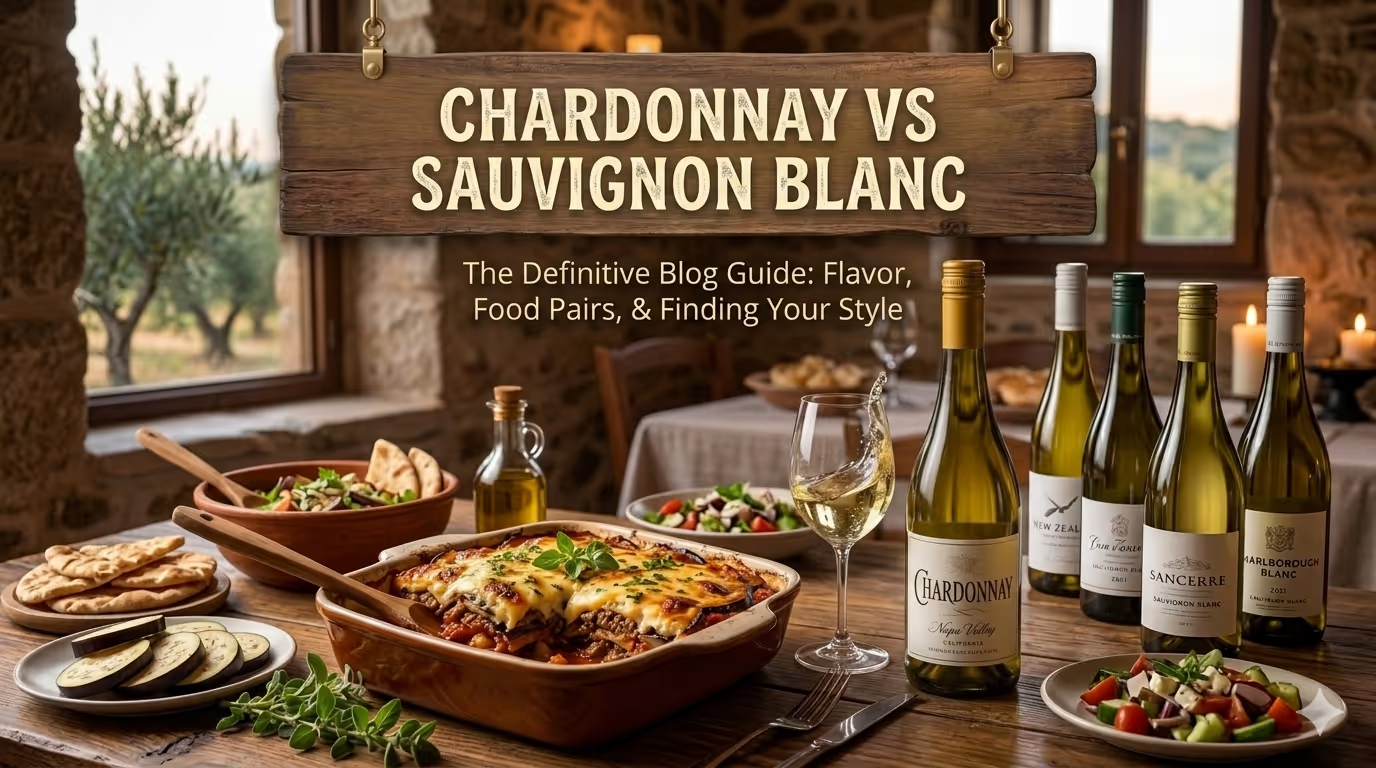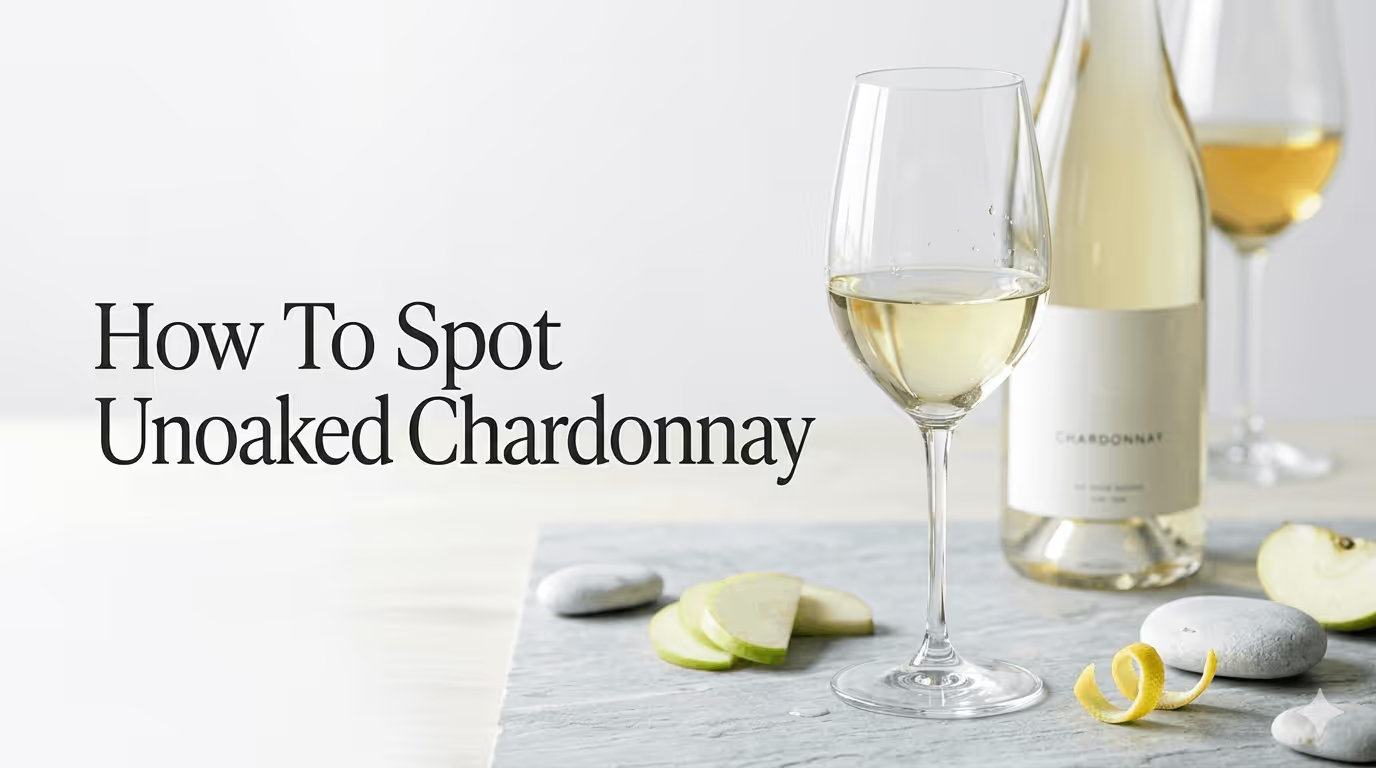


Decide whether you want a crisp white or a rich one, and the California shelf stops being overwhelming. That single choice does more work than price, producer or region, and it maps almost perfectly onto one label question: was the wine aged in oak or not. Unoaked whites taste of citrus and apple and stay out of the way of your food, while oaked whites taste of vanilla and baked fruit and feel rounder in the mouth. Pick the feel you want, then pick a grape that delivers it.

How much white wine does California actually make?
More than it makes red, though only barely. The USDA’s 2025 preliminary grape crush report for California puts the year’s total crush at 2,759,202 tons, of which white wine varieties accounted for 1,316,716 tons against 1,306,727 tons of red. That gap of about ten thousand tons is under one percent, so the two halves of the shelf really are close to evenly matched.
That’s worth knowing because the wall of bottles isn’t an illusion or a sign that you’re missing something obvious. California genuinely produces an enormous and varied amount of white wine, and no reasonable person walks in already knowing the producers. The job isn’t to recognise labels, it’s to narrow the field quickly enough that you can buy a bottle and get on with your evening.
The same report shows how concentrated the choice really is underneath all that variety. Chardonnay alone accounted for 17.8% of everything crushed in California in 2025, the largest share of any single variety, red or white. So the shelf looks endless while the reality is that one grape dominates it, which is why learning the two faces of California Chardonnay solves most of the problem.
What is the one question that decides a California white?
Ask whether the wine was oaked or unoaked, because that tells you how it will feel in your mouth better than anything else on the label. It matters most with Chardonnay, where the same grape produces two genuinely different drinking experiences depending on the choice the winemaker made.
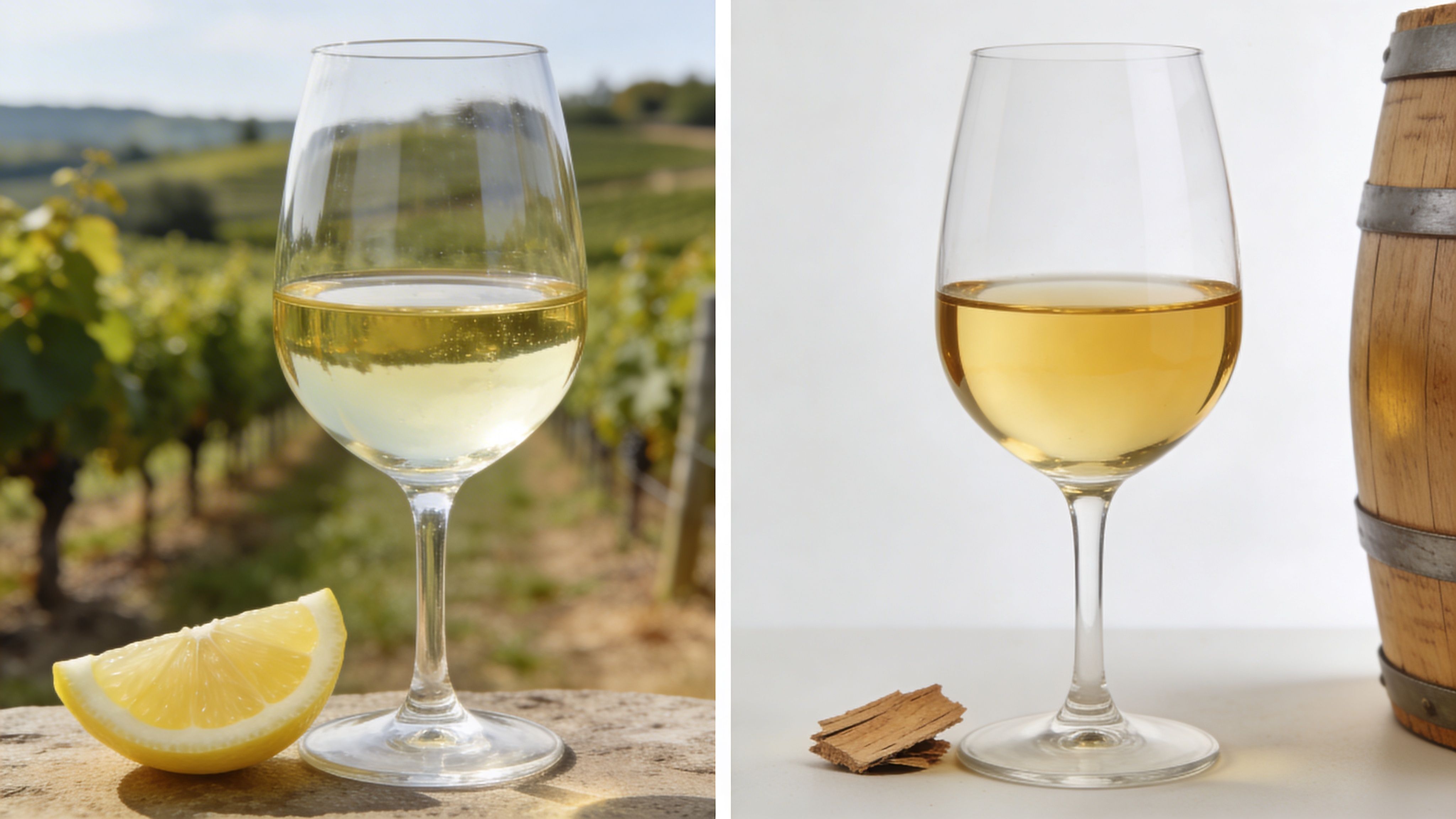
An unoaked white reflects the fruit directly, so you notice lemon, green apple, pear and a clean finish. It tastes bright and it tends to stay out of the way of whatever you’re eating. An oaked white adds another layer on top of that fruit, bringing vanilla, toast and a creamier texture, the quality people often call buttery. Neither is better, and a great many people who say they dislike Chardonnay have simply met the wrong one of the two.
The practical version is short enough to remember at a shelf. If you want the wine to refresh you, go unoaked. If you want it to comfort you, go oaked. Our guide to spotting an unoaked Chardonnay covers the label wording that gives it away, which is the part shops rarely make obvious.
Which style suits the food you’re eating?
Lighter food wants the crisper wine and richer food wants the rounder one, which is the whole rule in a sentence. This table covers the situations that come up most often.
| What you’re eating | Style to pick | Good California choices | What to say out loud |
|---|---|---|---|
| Sushi, oysters, salads, goat cheese | Crisp and unoaked | Sauvignon Blanc, unoaked Chardonnay | Something crisp, not buttery |
| Grilled fish, simple chicken, light pasta | Crisp to medium | Pinot Grigio, unoaked Chardonnay | A fresh white that won’t overpower the food |
| Creamy pasta, lobster, buttery sauces | Round and oaked | Oaked Chardonnay | A richer Chardonnay with some oak |
| Roast chicken, spiced dishes, richer poultry | Full but aromatic | Viognier | Something fuller, but not heavy or oaky |
Plenty of bottles sit between those two poles, and that’s perfectly fine. You don’t need to place a wine exactly on the scale, you only need to push in the right direction. Moving toward crisp or toward rich will get you a bottle you enjoy far more reliably than agonising over which specific producer to trust.
What does California Chardonnay taste like?
It depends almost entirely on where the grapes grew and what the winemaker did with them. Cooler coastal areas hold onto acidity and give leaner, citrus-driven wines, while warmer inland sites ripen the fruit further and push it toward pineapple and stone fruit. Oak barrels then add vanilla and a creamier texture on top, and stainless steel tanks leave the fruit alone.
An unoaked California Chardonnay gives you green apple, lemon and pear with a clean finish, and it’s the safer bottle when the table has ordered different things. An oaked one gives you baked apple, pineapple and vanilla with a broader feel, and it can sit beside rich food without disappearing. If you want to understand why French Chardonnay often tastes leaner than the California version, our comparison of Chablis and Chardonnay makes the difference concrete.
Labels help when they bother to. The words unoaked and stainless steel fermented both point toward the fresher style, while barrel fermented and aged in oak point toward the richer one. References to cool coastal areas tend to mean brighter wines, and warmer inland regions tend to mean riper ones. When the label says nothing useful, one plain question to a member of staff, asking whether a bottle is more crisp or more creamy, will settle it faster than reading every back label on the shelf.
What should you drink if you don’t want Chardonnay?
Three other California whites cover almost everything Chardonnay does, and each one has a clear job. You don’t need a mental list of ten grapes, you need three you can recall under pressure.
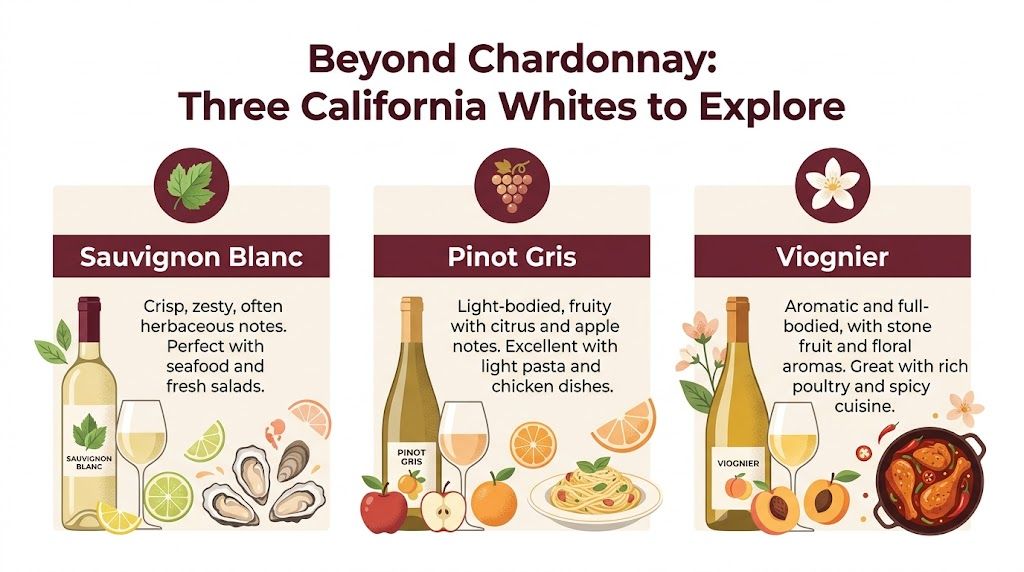
Sauvignon Blanc is the one to reach for when you want the wine to wake the meal up. It’s bright and citrusy, usually fermented in stainless steel to keep that energy, and it’s the easiest white to put next to seafood, goat cheese or a sharply dressed salad. Some California producers age it in oak and label it Fumé Blanc, which gives you a softer version of the same grape. Our guide to food pairings with Sauvignon Blanc is the one to read if you tend to decide by the meal rather than the bottle.
Pinot Grigio is the low-drama choice, landing in a light, easy zone that rarely offends anyone at the table. That sounds like faint praise and isn’t meant as any: a bottle that quietly suits a mixed group at a casual lunch is genuinely useful, and it’s the right answer more often than wine writing admits. Viognier is the opposite pick, more aromatic and fuller-bodied, and it works when you want presence without the obvious buttery signal of oaked Chardonnay. We compare that pair directly in Chardonnay versus Viognier.
How do you choose quickly in a shop?
Narrow by style before you look at a single label, because scanning bottles at random is what turns a two-minute errand into twenty. Decide first whether tonight calls for crisp or rich, then pick the grape that fits, then use the label only to confirm the choice you’ve already made.
The words worth hunting for are few. Unoaked and stainless steel signal the fresh style, barrel fermented and aged in oak signal the rich one, and Fumé Blanc tells you a Sauvignon Blanc has seen some oak. Price is a poor guide at this end of the market, since a well-made California white at fifteen dollars will please you more than a badly chosen one at thirty.
If you’re stuck between two bottles, ask staff a question about style rather than quality. Asking which of two wines is more crisp gets a useful answer, while asking which is better invites a guess about your taste that nobody can make on your behalf. Our broader guide to getting good wine recommendations covers how to frame that question in other situations too.
What should you say in a restaurant?
Describe the sensation you want and the food you’ve ordered, then let the server do the matching. Saying that you’re having fish and chicken and would like a white that’s fresh rather than buttery gives them everything they need, and it works on any list regardless of how it’s organised.
Avoid the questions that sound reasonable but lead nowhere. Asking for the best white invites the question of best for whom, asking what’s popular tells you about strangers rather than yourself, and asking for the smoothest means different things to different people. Preference words do the work instead, so crisp, light, richer, fresh and creamy will all get you somewhere useful.
It’s also fine to name a budget out loud, and servers generally appreciate it. Pointing at a price on the list and asking for something around there, in a crisp style, is a completely normal request that removes the awkward part of the conversation entirely.
How cold should you serve them?
Colder for the crisp styles and a little warmer for the rich ones, because temperature changes what you taste as much as the wine itself does. Sauvignon Blanc, Pinot Grigio and unoaked Chardonnay are at their best properly cold, straight from the fridge, where the chill sharpens the citrus and keeps them refreshing.
Oaked Chardonnay and Viognier both suffer from that treatment. Served ice cold they taste muted and slightly hollow, because the cold flattens exactly the vanilla, baked fruit and texture you paid for. Taking the bottle out of the fridge fifteen or twenty minutes before you pour lets that character come back, and it’s the single easiest way to improve a rich white without spending more on it.
The same logic applies over the course of an evening. A bottle left on a warm table drifts out of its best range within half an hour, so an ice bucket or a return trip to the fridge between glasses is worth the small amount of effort. If a white ever tastes flabby or vaguely alcoholic to you, temperature is a more likely culprit than the wine being poorly made.
Do California white wines improve with age?
Almost all of them are made to drink young, so buy them for this week rather than for a cupboard. Sauvignon Blanc and Pinot Grigio in particular are at their best within a year or two of the vintage, when the fresh citrus character is still intact, and holding them longer trades away the quality you bought them for.
Oaked Chardonnay is the exception worth knowing, since the better examples can gain a richer, nuttier character over several years. That said, it’s a genuine cellar decision rather than something that happens usefully in a kitchen cupboard, and most bottles at everyday prices won’t reward the wait. Keeping any white somewhere cool and dark matters far more than how long you keep it.
Pick the feel first, then the grape
California white wine only looks complicated because the shelf is genuinely enormous, with white varieties making up 1,316,716 of the 2,759,202 tons crushed in 2025 and Chardonnay alone taking 17.8% of the whole crush. Underneath that scale the decision stays small: work out whether you want crisp or rich, use oaked against unoaked as the shortcut, and keep Sauvignon Blanc, Pinot Grigio and Viognier in mind for the nights Chardonnay isn’t what you feel like.
What no guide can tell you is which of those two styles you personally prefer, and that’s the part worth actually learning. Sommy builds a picture of your taste as you record what you drink, so the next recommendation comes from your own history rather than from a general article, including when you’re standing in front of a shelf with no idea where to start. Our beginner wine chart is a good place to begin if you’d rather have something visual to work from.
Questions people ask about California white wines
What is the most popular white wine in California?
Chardonnay leads the state by a wide margin. The USDA’s 2025 preliminary crush report records it as 17.8% of all grapes crushed in the state, which is the largest share of any single variety of either colour.
Are California white wines sweet?
Most of them are dry, though a rich oaked Chardonnay can taste sweeter than it is because vanilla and ripe fruit read as sweetness. If you actively want a dry wine, unoaked styles and Sauvignon Blanc are the safest place to look.
What is the difference between oaked and unoaked California white wine?
Oaked wine spends time in wooden barrels, which adds vanilla, toast and a creamier texture, while unoaked wine is usually fermented in stainless steel and keeps a brighter, more citrus-driven character. It’s the single most useful distinction to learn, because it changes how the wine feels more than the grape name does.
Which California white wine is best for a group with different tastes?
An unoaked Chardonnay or a Pinot Grigio will please the widest range of people. Both stay light enough to suit varied food and neither has the strong buttery character that tends to divide a table.
Is California Sauvignon Blanc different from New Zealand Sauvignon Blanc?
California versions tend to be a little rounder and less sharply herbaceous than the classic New Zealand style, and some are aged in oak and sold as Fumé Blanc. If you like the intensity of New Zealand Sauvignon Blanc, look for a California bottle that mentions stainless steel fermentation.
How much should I spend on a California white wine?
Choosing the right style matters far more than spending more money. A well-matched bottle at around fifteen to twenty dollars will suit your dinner better than an expensive wine in a style you don’t enjoy, so put the effort into crisp against rich before you put it into price.