

You're in a wine shop or staring at a restaurant list, and one Pinot Noir says “organic.” Now you have to make a call. Is it just label language, or will it change what ends up in your glass?
Short answer: yes, organic Pinot Noir wine can be different, and the difference often matters most in taste, not image. The useful question isn't whether organic is “better” in some abstract way. It's whether that bottle sounds more like what you already enjoy.
Is Organic Pinot Noir Actually Different
You are standing in front of two bottles that cost about the same. One says organic. The other does not. If you want the simplest answer, here it is. Organic Pinot Noir can taste different, and that difference can matter in a useful, drink-in-the-glass way.
With Pinot Noir, small choices show up clearly. It is a grape that tends to reveal more of its site and winemaking style than heavier reds do. That is why the word organic can be more than a farming note. It can give you a clue about whether the wine will taste clean and bright, a little earthy, more savory, or less glossy than the version beside it.
What that means in plain English
Organic is not a guarantee of better wine. It is a clue about style and feel.
In practice, organic Pinot Noir often lands a bit closer to the fruit and the vineyard, and a bit farther from a heavily polished, same-every-year profile. Some bottles taste vivid and lifted, with tart cherry, cranberry, and herbs. Others show more earth, dried leaves, or a slight wildness. That can be a real plus if you want personality. It can be a drawback if you want something soft, plush, and predictable for a weeknight pour.
That trade-off is the part shoppers can use.
The question to ask yourself
Ask one simple question before you buy. Do you want a Pinot Noir that feels tidy and easy, or one that feels a little more distinctive?
If you usually enjoy smooth, crowd-pleasing reds, organic Pinot Noir can still work well. Just look for bottles described as fresh, juicy, silky, or fruit-driven. If the shelf tag or server mentions earthy, savory, mineral, or forest-floor notes, expect a wine with more edge and less softness.
A good organic Pinot Noir does not ask you to care about farming for its own sake. It gives you another signal about what the bottle may be like to drink, which lowers the guesswork.
If you want to notice those differences without making wine feel complicated, this simple guide on how to taste wine properly keeps the process easy.
What Organic Means for Your Wine
At the bottle level, organic usually matters in two places. First, how the grapes are grown. Second, how much intervention happens once those grapes reach the winery.
That's the practical version most shoppers need.
In the vineyard
Organic grape growing means the producer is avoiding synthetic pesticides, herbicides, and fertilizers. The focus is usually on soil health, living systems in the vineyard, and fruit that reflects the site more directly.
In the cellar
Organic winemaking often goes with a lighter hand in production. That can mean fewer additives and a more restrained approach overall, though the exact rules depend on certification and region.
A simple visual helps.

Why you're seeing it more often
That matters because more availability usually means less risk for you. You're more likely to find multiple options, not just one odd bottle with a premium price and no context.
Organic on a wine label doesn't automatically mean rare, difficult, or only for enthusiasts. It often just means you're looking at a bottle shaped by a different set of production choices.
If you've also seen “biodynamic” and don't want the two terms blending together, this plain-English comparison of organic vs biodynamic wine is a helpful reset.
How Organic Farming Changes the Taste
The simplest way to think about organic Pinot Noir wine is this. It can taste a little more like the place and a little less like a recipe.
That doesn't guarantee a dramatic difference every time. But it does change what many producers are aiming for.

Why the flavor can shift
Some organic producers use indigenous yeast from the grape skins instead of relying only on commercial yeast. A New Zealand producer explains that organically grown fruit often arrives with a natural “sheen or a bloom,” linked to healthy microbial life, and says that natural-yeast fermentation can lead to earthy and more mineral characters in the finished wine. That same explanation also notes these wines may feel less standardized than more controlled styles. You can read that producer perspective in this detailed piece on making organic Pinot Noir in Waipara.
A scientific paper adds the technical side. It examines how differences in organic production systems correlate with Pinot Noir fermentation outcomes, showing that farming method can influence the microbial ecology of fermentation and, in turn, aroma and style. That research appears in this scientific analysis of organic production systems and Pinot Noir fermentation.
What that means in the glass
It's similar to produce from a farmers market versus produce bred for total consistency. One isn't morally superior on your dinner plate. But they may deliver a different experience.
You might notice:
- More earthy notes like forest floor, dried herbs, or mushroom
- A more savory feel instead of straight sweet fruit
- Mineral or stony impressions that make the wine feel less soft and obvious
- More vintage variation from one year to the next
What works and what doesn't
Organic Pinot Noir wine often works well for people who want a red that feels alive, interesting, and a bit less manufactured.
It may not be the right pick if you want maximum predictability or a very ripe, fruit-led profile every single time.
Worth knowing: “Different” doesn't always mean “better.” It means the bottle may show more personality, and sometimes more rough edges too.
That trade-off is useful once you know what you like.
How to Choose an Organic Pinot Noir
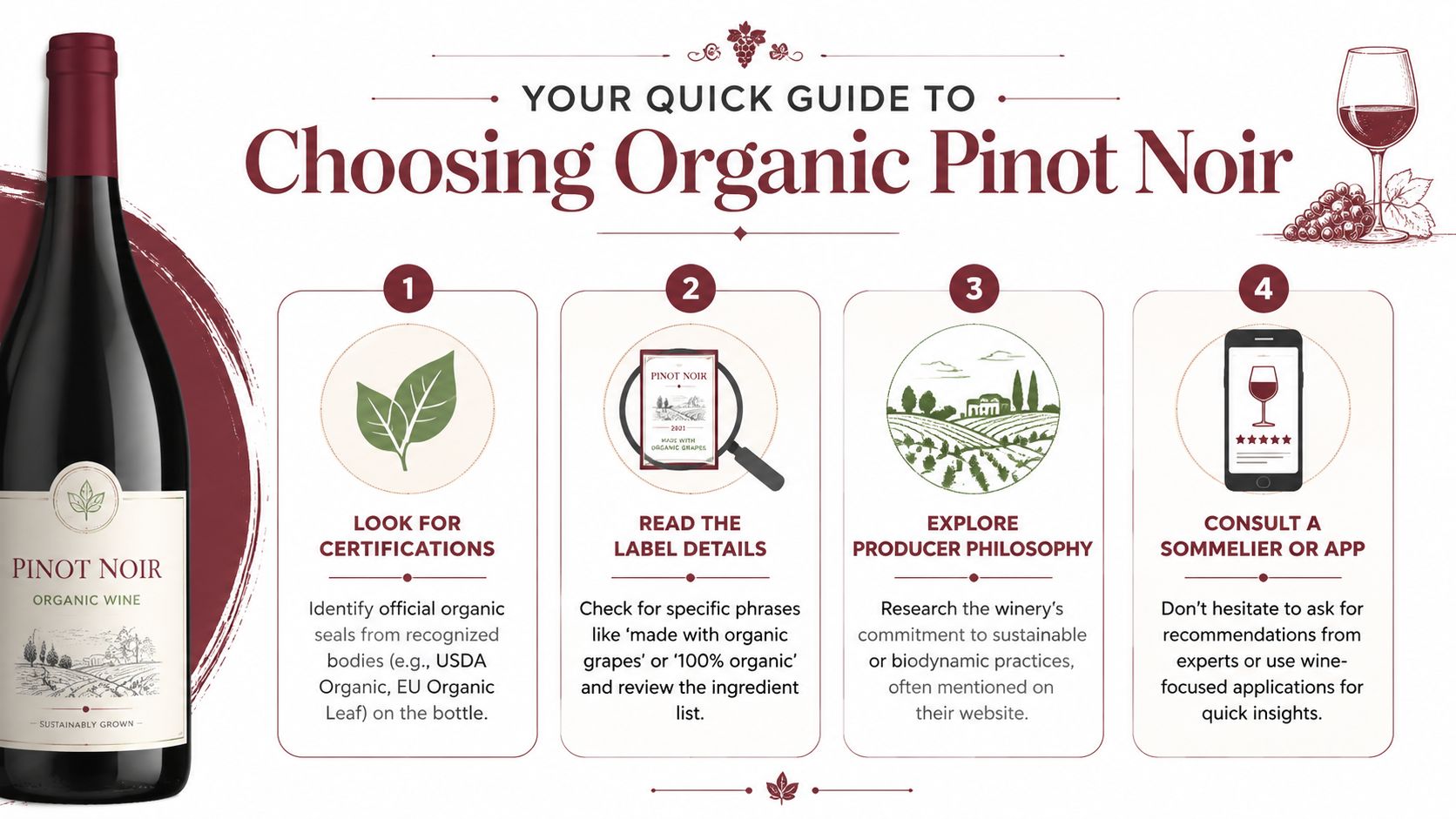
You are standing in front of a shelf with six Pinot Noirs that all look vaguely right, and the word organic is not helping much. The fastest way to choose well is to treat organic as one clue, then use the style cues on the bottle to figure out whether the wine will suit your taste.
A simple store checklist
- Confirm it is organic
Look for a recognized organic seal or clear wording on the label. That saves time and keeps you from guessing based on packaging that only looks natural or minimal. - Use tasting words as your shortcut
Words like cherry, raspberry, juicy, and soft usually point to an easier, more fruit-forward bottle. Words like earthy, savory, forest floor, herb, or mineral usually signal a more angular, less obvious style. Neither is better. The right one depends on whether you want comfort or character tonight. - Let region guide your risk level
Cooler regions often give Pinot Noir more tart red fruit, more lift, and sometimes more earthiness. Warmer regions often give you rounder fruit and a softer feel. You do not need to memorize a map. Just use place as a clue for whether the bottle is likely to feel brisk or plush. - Buy for the occasion, not the idea
An interesting bottle is not always the right bottle. For a casual weeknight, a silky, straightforward Pinot is often the smarter pick. For a slow dinner or a drinker who likes nuance, a more savory organic Pinot can be a great call.
Why these clues matter more with Pinot Noir
Pinot Noir tends to show small differences clearly. That matters in the aisle because organic on its own does not tell you whether the wine will taste bright and easy or earthy and more demanding.
What it can tell you is that the bottle may show a bit more vintage and site personality, with less of the polished sameness some shoppers expect. For the person drinking it, that means more chance of finding a bottle that feels distinctive, and more need to read past the word organic before you buy.
Fast decision table
| If you usually like | Look for words like | Better chance you'll enjoy |
|---|---|---|
| Fresh, light reds | bright cherry, red fruit, lively | A lighter organic Pinot Noir |
| Savory, earthy reds | forest floor, herbal, mineral | A more site-driven organic Pinot Noir |
| Smooth, easy dinner wines | soft, silky, balanced | A broadly crowd-pleasing bottle |
If you want a little more Pinot-specific buying help without getting dragged into wine theory, this practical guide to choosing Pinot Noir keeps the decision simple.
Simple Pairing and Serving Advice
Pinot Noir is one of the easier reds to bring to dinner because it usually plays nicely with food. Organic Pinot Noir wine follows the same rule. You do not need a perfect pairing to enjoy it.
You just need to avoid overwhelming it.
Easy pairings that rarely miss
- Roast chicken. Pinot Noir has enough freshness to cut through the richness without bullying the food.
- Salmon. The wine's gentle structure works with richer fish better than heavier reds do.
- Mushroom dishes. Earthy flavors in the food often make earthy notes in the wine feel more intentional and more delicious.
- Pork tenderloin. It's flavorful but not so heavy that it flattens the wine.
- Mild cheeses. Soft, creamy cheeses let the wine stay graceful.
A good pairing doesn't need to be fancy. It just needs to keep the wine and the food in the same weight class.
Serving without overthinking it
Serve Pinot Noir slightly cool, not warm like a living room in summer. If the bottle is warm from a shelf or countertop, a short chill helps the fruit feel clearer and the wine feel less flat.
A few practical moves help:
- If it tastes blurry, cool it down a little.
- If it smells closed, give it a few minutes in the glass.
- If the wine seems earthy, pair it with savory food instead of trying to drink it on its own first.
What usually doesn't work
Very spicy food can push Pinot Noir around. Huge steaks with heavy char can make it seem thin. Very sweet sauces can make it feel sharper than it is.
If dinner is simple, organic Pinot Noir wine often shines more.
For more calm, real-world pairing help, this food and wine matching guide is useful when you're choosing on the fly.
Get a Confident Recommendation in Seconds
You don't need to memorize any of this in a restaurant or store. You only need to know what kind of experience you want.
That's where a tool can help. Organic production can influence Pinot Noir fermentation and final style in measurable ways, so asking for a recommendation based on taste makes more sense than guessing from the word “organic” alone, as noted earlier in the scientific research.
When a quick answer is better than more reading
If you're holding two bottles and one says earthy while the other says bright cherry, a fast recommendation is often all you need.
Useful prompts are simple:
- “Help me pick an organic Pinot Noir for salmon.”
- “I want one that's smooth, not too earthy.”
- “Which one feels easier for a group?”
One option for that is Sommy.ai's wine recommendation experience, which lets people ask for wine help in plain language based on taste, budget, meal, or what's in front of them. That's often more practical than trying to decode a shelf tag under pressure.
The real goal
Confidence matters more than mastering terminology.
If you know organic Pinot Noir wine can signal a more earthy, savory, site-driven style, you're already ahead of most shoppers. From there, the only job is matching the bottle to the moment.
If you want help choosing wine in the moment, Sommy.ai can give you a quick, taste-based recommendation so you can stop guessing and pick with confidence.