
Nero d'Avola Wine: Spot the Style Before You Buy
Nero d'Avola is Sicily's signature red grape, and it gets made in two styles that taste almost nothing alike. One is dark, ripe and oak-aged, closer to a warm-climate Syrah. The other is bright, light-footed and full of red cherry, closer to a young Sangiovese. Both are dry, both usually sit between $10 and $20 on a US shelf, and the label tells you which one is in the bottle once you know the three or four words to look for.
That last part is where most guides stop short. They'll tell you the grape is bold and fruity, which is true of one half of what gets bottled and misleading about the other half. So this piece is mostly about reading the front label, because on Sicilian wine the appellation is doing more work than the tasting note on the back.
What is Nero d'Avola wine?
Nero d'Avola is a red wine grape native to Sicily, and the name translates as "the black grape of Avola", after a small town near the island's southeastern corner. You say it roughly as NEH-roh DAH-vo-la, with the weight on the first syllable of each word. Plenty of older Sicilians still call the same grape Calabrese, which sounds like a pointer to Calabria on the Italian mainland. Scholars don't agree on where the name came from. Bill Nesto and Frances Di Savino read it in "The World of Sicilian Wine" (University of California Press, 2013) as an Italianisation of the Sicilian dialect word Calavrisi, meaning grape from Avola, while the Cerasuolo di Vittoria consortium sets that reading alongside a rival one tracing Calavrisi to Calauria, a Greek island the vine may have arrived from. What both agree on is that the grape is Sicilian rather than Calabrian.

The growing conditions explain a lot about the wine and about the price. Sicily is hot, dry and windy, and many of the oldest Nero d'Avola plantings are trained as alberello, which means each vine grows as a low free-standing bush rather than being strung along wires. The vines sit close to the ground so the wind goes over the top of them, and the fruit ripens easily and reliably almost every year. Reliable ripening across a big island is what lets producers sell a properly made bottle for the price of a supermarket Merlot, which is the main reason Nero d'Avola has quietly become one of the best-value reds in any US wine aisle.
Almost all of it still comes from Sicily. A handful of growers in California and in the hot inland parts of South Australia have planted it because it handles heat without shrivelling, but if you pick up a bottle in the States it is overwhelmingly likely to be Sicilian.
What does Nero d'Avola taste like?
It tastes of dark or red cherry with a savoury edge, firm but not aggressive tannin, and enough acidity to keep it from feeling heavy. Beyond that the honest answer is that it depends entirely on which of the two styles you've bought, and the gap between them is wide enough that a reader who liked one can genuinely dislike the other.
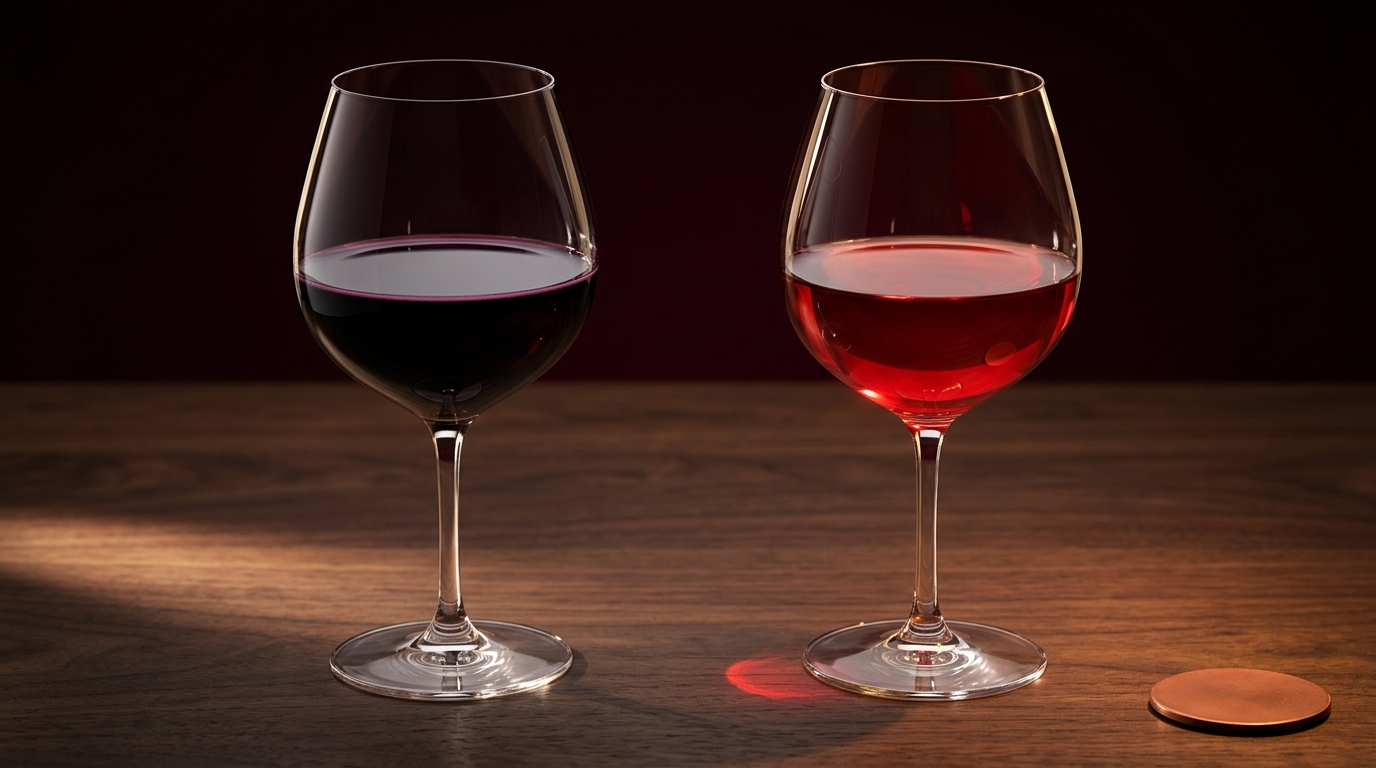
The riper style is the one most people meet first. It's deep enough in colour to look nearly black in the glass, with flavours running from black cherry into plum and dried fig, often with vanilla, cocoa or coffee laid over the top from time in oak barrels. It feels broad and warming, and it's the style that earns Nero d'Avola its usual comparison to Syrah or to a soft Cabernet.
The fresher style is a different drink. It's translucent rather than opaque, the fruit is red cherry and pomegranate instead of plum, there's a dried-herb and blood-orange note underneath, and the acidity is what you notice rather than the weight. Little or no new oak gets used. Producers making this version are usually working in the cooler, higher southeastern corner of the island, and the wine they turn out has more in common with a Chianti than with anything from the Rhône.
Both versions carry real tannin, the drying grip you feel along your gums rather than a flavour you taste. In the riper style the tannin is padded by fruit and alcohol so it reads as softness. In the fresher style there's less to hide behind, so the structure shows.
Is Nero d'Avola sweet or dry?
It's dry, and that isn't an opinion. The production rules for Sicilia DOC, published in Italy's national register of designations, describe the finished Nero d'Avola as "secco", the Italian word for dry, and set a minimum total acidity of 4.5 grams per litre along with a minimum alcohol of 12 percent by volume (Sicilia DOC disciplinare, Italian Ministry of Agriculture). A wine with meaningful residual sugar could not be described that way and still pass.
People still read it as sweet, and there's a decent reason for that. Very ripe black fruit plus generous alcohol registers on the palate as sweetness even when the sugar is essentially gone, which is the same trick that makes a big Californian Zinfandel taste sweeter than its numbers say. The riper the style, the more often this happens. If you want a rough read before you open the bottle, look at the alcohol printed on the label, since the DOC floor is 12 percent and the everyday bottles tend to print 13. The higher that number climbs, the more that ripe, almost-sweet impression is likely to be there.
How do you tell which style is in the bottle?
Read the appellation on the front label, because Sicilian labelling rules quietly decide the style for you. Four wordings cover nearly everything you'll find in a US shop, and each one carries a different legal recipe.
| What the front label says | What the rules actually require | What that usually means in the glass |
|---|---|---|
| Nero d'Avola, Sicilia DOC | At least 85% Nero d'Avola, up to 15% other permitted red grapes | A true varietal wine. Either style, so check the alcohol and the producer |
| Sicilia DOC or Sicilia Rosso, no grape named | Only 50% combined of Nero d'Avola, Frappato, Nerello Mascalese and Perricone | A blend, often softened with Syrah or Merlot. Rounder and more international |
| Terre Siciliane IGT | The looser island-wide category, with no DOC varietal minimum | Everything from the cheapest bulk bottling to serious single-estate wine |
| Cerasuolo di Vittoria DOCG | 50% to 70% Nero d'Avola with 30% to 50% Frappato | The light, red-cherry style, guaranteed by law rather than by luck |
Two of those rows do most of the work. The 85 percent minimum for a named varietal comes straight from the Sicilia DOC production rules linked above, and it's the difference between a bottle that has to taste of this grape and a bottle that only has to be half Sicilian. If the front label says Sicilia DOC and names no grape at all, you are holding a blend, and the international grapes allowed into the other half are exactly the ones that smooth the edges off.
Cerasuolo di Vittoria is the useful shortcut for anyone who wants the fresher style without guessing. It's the only DOCG in Sicily, Italy's top tier of appellation, awarded by ministerial decree on 13 September 2005 after thirty-two years as a plain DOC (Consorzio di Tutela Cerasuolo di Vittoria), and Decanter still describes it as Sicily's only one. Article 2 of its production rules requires between 50 and 70 percent Nero d'Avola blended with 30 to 50 percent Frappato, a pale, perfumed local grape (Cerasuolo di Vittoria DOCG production rules, Consorzio di Tutela). Cerasuolo means cherry red, and the wine really does come out that colour. Frappato lifts the whole thing and takes the weight out of it, so you get Nero d'Avola's savoury core in a much lighter frame.
If the tiers themselves are new to you, our breakdowns of what DOCG means on an Italian label and how DOC, DOCG and IGT differ cover the system across the whole country, not just Sicily.
None of this tells you whether you'll enjoy the style you just identified, which is the genuinely annoying part of standing in an aisle with a bottle in your hand. That's the moment Fit Check is built for: you type, say or scan the bottle in front of you and Sommy gives you a straight verdict on whether it suits your taste, rather than another description of what the wine is like.
What should you pay for a good Nero d'Avola?
Somewhere between $12 and $18 buys a genuinely good everyday bottle, which is the whole appeal of the grape. Checking US retail listings on 23 September 2026, the two widest-distributed names in American shops, Cusumano and Stemmari, were both sitting at roughly $10 to $15 for a 750ml bottle, and both print 13 percent alcohol on the label.
Move up and the money buys concentration and, more often, a single estate rather than a regional blend. Single-vineyard Sicilia DOC bottlings from the better-known producers generally run in the high teens to the high twenties. Cerasuolo di Vittoria sits a step above that again, partly because the zone is small: checking the same day, Valle dell'Acate was listed around $25 and the benchmark bottles from Planeta and COS were averaging roughly $26 and $36.
What you should not do is assume the cheapest tier is a compromise. Nero d'Avola is one of the few grapes where the $13 bottle is a fair representation of what the grape does, because the climate does the hard work and there's no scarcity premium propping up the price. Spending $30 gets you a more detailed wine, not a fundamentally better-made one.
What food goes with Nero d'Avola?
Roasted and grilled meat, tomato-based sauces, and anything with aubergine. Its combination of savoury fruit and real acidity makes it one of the easier reds to put on a table without much thought.

The riper style wants fat and char to push against. Lamb chops off a grill, beef short ribs, sausages with fennel, a burger with too much cheese on it, or a slow-cooked ragù that has been on the stove for three hours. The tannin cuts the richness and the dark fruit stands up to the char instead of disappearing under it. Spices that work surprisingly well alongside it include fennel seed, bay, orange zest and cocoa, all of which echo notes already in the wine.
The fresher style and Cerasuolo di Vittoria go somewhere else entirely. Serve those with caponata, a tomato and aubergine pasta, grilled tuna or swordfish, roast chicken with herbs, or a pizza with anchovy on it. The acidity handles tomato, which is the thing that trips up softer reds, and the lighter body means it won't flatten a fish dish. Sicilian cooking leans on aubergine, capers, olives and tomato, and the local wine evolved next to all of it, which is not a coincidence.
Vegetarian tables do well here too. Mushrooms, lentils, roasted red peppers and aged pecorino all have the savoury depth this grape likes. If you're building a wider Italian menu, our guide to matching wine with Italian food covers the regional logic across the rest of the country.
Is Nero d'Avola similar to Pinot Noir or Cabernet Sauvignon?
Neither, though each comparison gets at something real. Nero d'Avola is its own grape, genetically unrelated to both, and the confusion comes from the fact that its two styles happen to land near two very different reference points.
The question about Pinot Noir comes up because the fresher, unoaked style is translucent and red-fruited, which is how people describe Pinot. Look past the colour and they part company quickly: Nero d'Avola carries more tannin, a savoury, slightly bitter twist through the finish, and a warmer, riper feel that Pinot from a cool region never has. If Pinot is what you usually drink, Cerasuolo di Vittoria is the sensible place to start, and our Pinot Noir taste guide is a useful baseline to compare against.
The Cabernet comparison fits the riper style better, and it's still imperfect. Nero d'Avola has similar weight and a comparable grip of tannin, but where Cabernet gives you blackcurrant and often a green, leafy edge, Nero d'Avola gives you black cherry, plum and a dried-herb warmth with no green note at all. The closer match among familiar grapes is Syrah, or a Sicilian take on what Zinfandel does in California.
How should you serve Nero d'Avola?
Serve it slightly cool rather than at room temperature. The riper style is best at around 60 to 64°F, which means twenty minutes in the fridge if your room sits at normal indoor temperature, and the fresher style and Cerasuolo di Vittoria are better again a couple of degrees below that. Served genuinely warm, the alcohol comes forward and the fruit turns jammy, which is the single most common way people mishandle this wine at home. Our wine serving temperature reference has the numbers for other styles if you want a rule you can reuse.
Use a large-bowled red wine glass so the aromatics have room to open, and fill it about a third full rather than to the brim. A young, oaky bottle benefits from thirty minutes of air, either in a decanter or just poured and left alone in the glass. Cerasuolo di Vittoria needs less patience and can go straight from bottle to table.
Most everyday bottles are made to drink now and will be at their best within three or four years of the vintage. Serious single-estate Sicilia DOC wines and the better Cerasuolo bottlings can hold and improve for longer, though ageing a $13 supermarket bottle for a decade is a way of turning a good wine into a tired one.
Where to start this week
If you've never had Nero d'Avola, buy two bottles rather than one, and buy them from opposite ends of the range. Take a $13 Sicilia DOC varietal with the grape named on the front, and take a Cerasuolo di Vittoria DOCG at whatever the shop has in the mid-twenties. Open them on consecutive nights with roughly the same food, something tomato-based and not too delicate, and you'll learn more about the grape in two evenings than any tasting note can teach you.
The one to buy again is the one you'd open on a Tuesday without an occasion attached. That's a better test than points or price, and it's the only test that accounts for the fact that these two wines were never really trying to be the same drink.
Frequently asked questions
Is Nero d'Avola a sweet or dry red wine?
It's dry, and that is set by the production rules rather than left to the producer. Sicilia DOC describes the finished wine as "secco", the Italian word for dry, and requires a minimum total acidity of 4.5 grams per litre. Ripe black fruit and 13 to 14 percent alcohol can make the riper style read as sweet on the palate, but there's no meaningful sugar in it.
What type of wine is Nero d'Avola?
A dry red varietal wine from Sicily, made from the island's most widely planted red grape. It's bottled either as a varietal wine under Sicilia DOC, which requires at least 85 percent Nero d'Avola, or blended with Frappato in Cerasuolo di Vittoria DOCG.
Is Nero d'Avola the same as Pinot Noir?
No, they're unrelated grapes from different countries, and Nero d'Avola carries more tannin and a savoury, warmer character than Pinot Noir does. The lighter, unoaked style of Nero d'Avola looks similar in the glass, which is where the comparison comes from.
What is Nero d'Avola similar to?
The ripe, oaked style sits closest to Syrah or a soft Cabernet Sauvignon. The lighter style has more in common with Sangiovese and Chianti. Cerasuolo di Vittoria, the Nero d'Avola and Frappato blend, is the lightest version you'll find.
How do you pronounce Nero d'Avola?
Roughly NEH-roh DAH-vo-la, stressing the first syllable of each word. The phrase means "the black grape of Avola", a town in southeastern Sicily.
Is Nero d'Avola worth the money?
It's one of the better-value reds in a US wine shop. A $12 to $18 bottle is a fair representation of the grape rather than a compromise version of it, because Sicily's climate ripens the fruit reliably and there's no scarcity premium built into the price.
Does Nero d'Avola need decanting?
A young, oak-aged bottle opens up nicely with about thirty minutes of air, in a decanter or simply poured and left in the glass. Cerasuolo di Vittoria and the lighter unoaked styles are ready to drink straight away.