
Meta description: Feeling stuck in the wine aisle or at a restaurant? A wine value app can help you choose faster, with less stress and more confidence.
You're standing in front of a wall of bottles. Or staring at a restaurant list that suddenly looks like a test you forgot to study for.
You don't need more wine knowledge. You need a faster way to decide.
A good wine value app helps you choose a bottle that fits your taste, your budget, and the moment you're in. Not the “best” wine on paper. The right wine for you, right now.
That Overwhelmed Feeling in the Wine Aisle Is Normal
You pick up one bottle, then another. The labels blur together. Everything starts sounding expensive, risky, or weirdly serious.
That reaction is normal.
It's not that wine is too advanced; the stress comes from not wanting to choose wrong. Nobody wants to bring the disappointing bottle to dinner, overpay at the store, or order something at a restaurant that feels like a mistake after the first sip.

More people are using apps for exactly this
A lot of drinkers have stopped trying to memorize wine facts and started using digital help instead. The digital wine cellar app market is projected to reach $4.6 billion by 2034, up from $1.8 billion in 2025, according to DataIntelo's digital wine cellar app market report.
That matters for one simple reason. Using an app to choose wine is no longer a niche habit for collectors or hobbyists. It's becoming a mainstream way to make a quick decision with less friction.
Practical rule: If a wine choice feels stressful, treat it like any other everyday decision. Use a tool that helps you narrow options fast.
Relief matters more than expertise
A wine value app should feel like a calm friend in your pocket. You show it the shelf, the label, or the menu. It helps you sort the noise.
Not every app does that well. Some are built more for tracking bottles than helping people decide. Some throw too much data at you. Some assume you already know what you like.
For an everyday drinker, the primary benefit is simpler. You want less second-guessing. You want to stop spiraling over whether a bottle is “worth it.” You want to leave the aisle, place the order, and move on with your night.
What a Wine Value App Actually Does
A lot of people hear “wine value app” and think “price checker.”
That's too narrow.
Real value isn't the cheapest bottle on the shelf. It's the bottle you'll enjoy, at a price that feels fair, in the situation you're in. Tuesday takeout and a birthday dinner don't need the same answer.
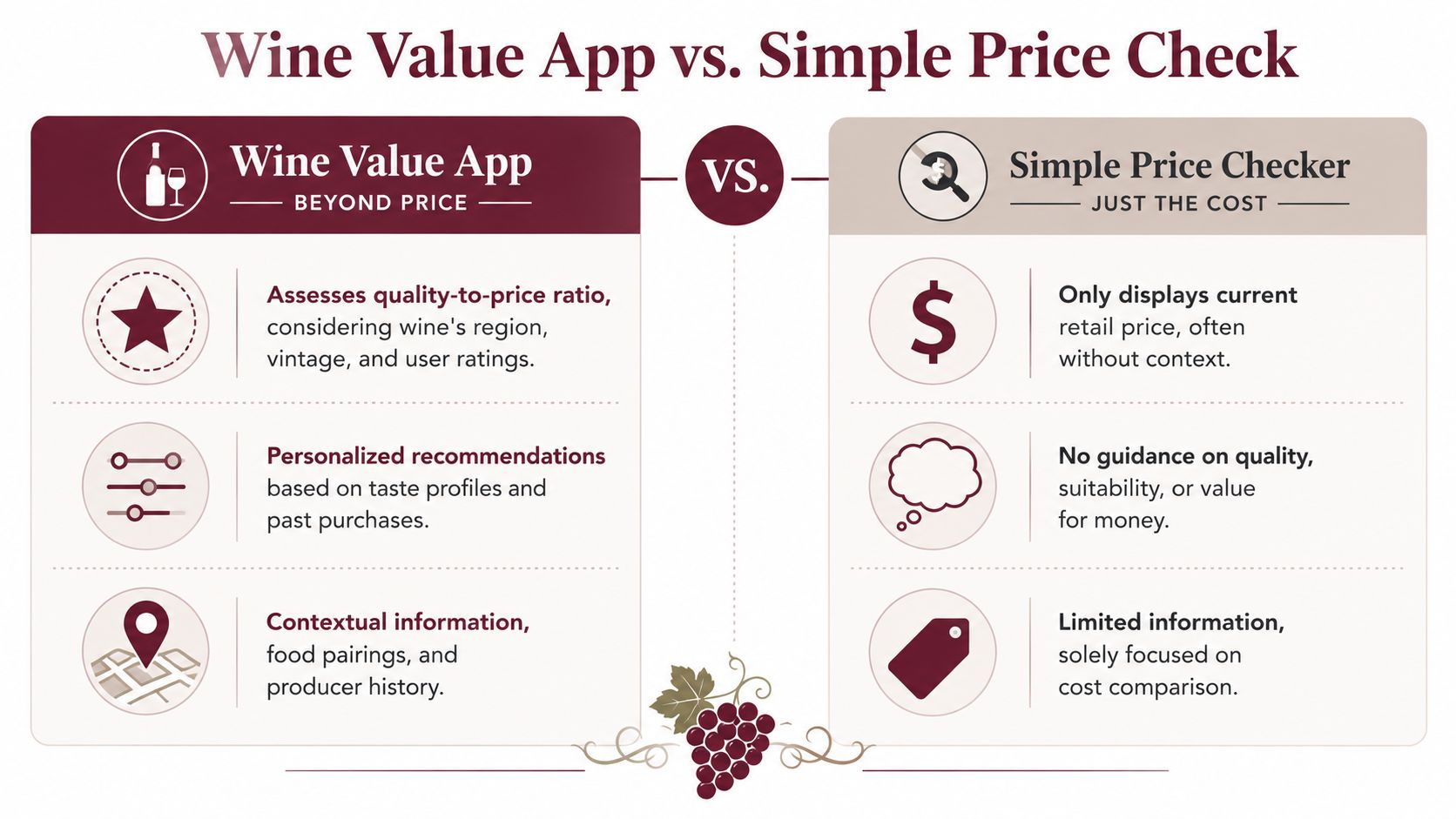
Price is only one part of value
It's like directions.
A simple price checker is a street sign. It tells you one fact. A real wine value app is more like GPS. It helps you get somewhere useful based on where you are, what you want, and what you'd rather avoid.
That means a helpful app should weigh a few things at once:
- Your taste so you don't end up with something harsh, sweet, heavy, or bland when that's not what you wanted
- Your budget so you can choose confidently without doing awkward mental math in public
- Your setting because a dinner party bottle and a solo weeknight bottle play different roles
- Your food so the wine supports the meal instead of fighting with it
Good apps reduce decision pressure
You do not need an app that turns wine into homework.
You need one that shortens the path from “I have no idea” to “that one looks right.” That's why scan-based tools matter. If you want a closer look at how scanning changes the shopping moment, Sommy's guide to a wine scanner app for real-time decisions is useful.
A bottle can be low priced and still be poor value for you if you don't enjoy drinking it.
Value for collectors is different
There's also another meaning of “value” that matters more to collectors than casual drinkers. Some apps try to estimate bottle value using retail or auction data, but they often miss one important detail for older or flawed bottles: condition.
A bottle with label damage, fill-level issues, or capsule wear may be worth much less than a standard example, and automated tools often don't account for that well. So if you're just trying to pick a bottle for dinner, don't let collector-style pricing distract you. Personal fit matters more than theoretical resale value.
Key Features That Reduce Decision Stress
The best features aren't impressive because they sound advanced. They're useful because each one removes one piece of stress.
That's the standard I'd use. If a feature doesn't help you decide faster or feel calmer, it's noise.
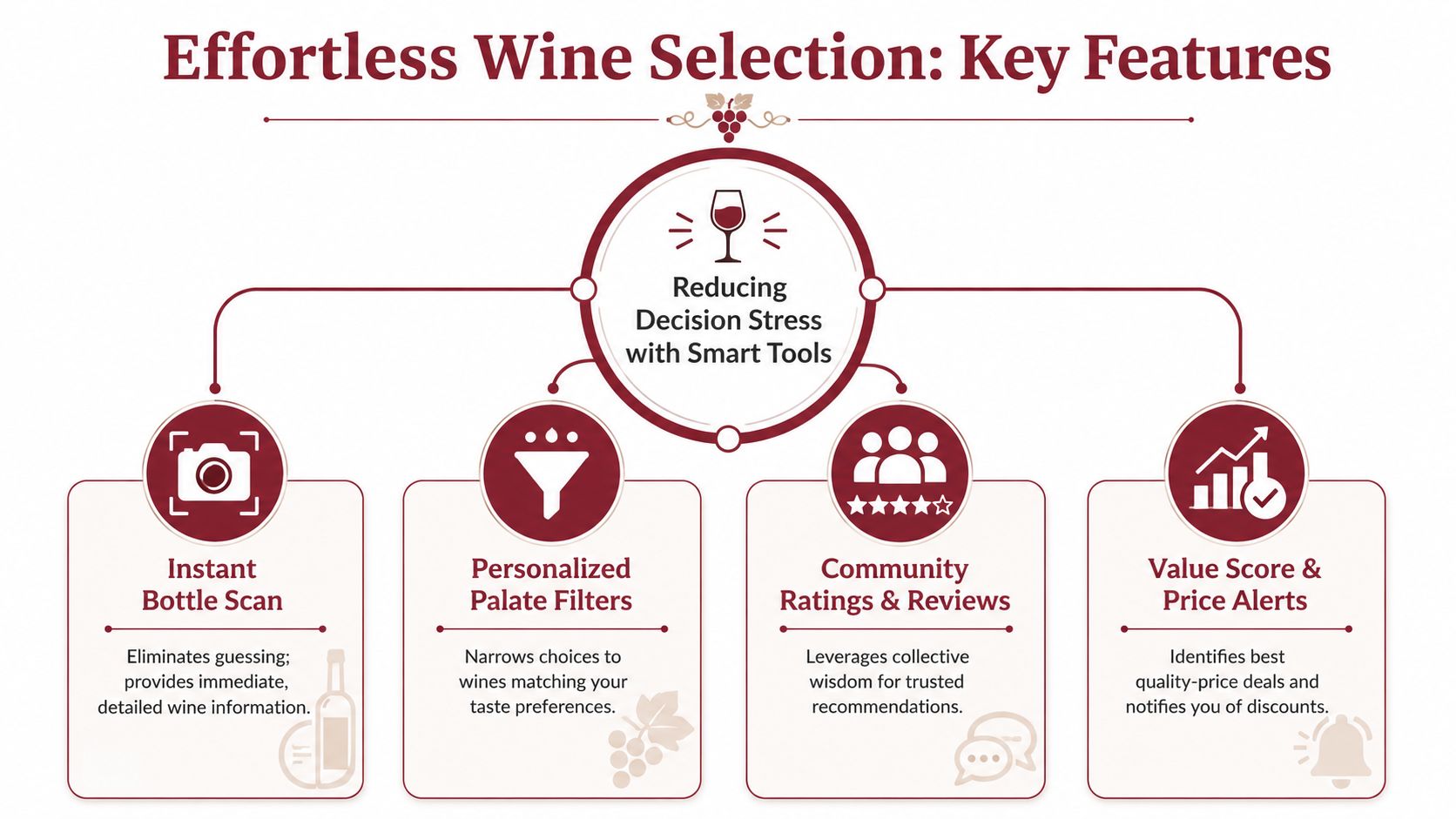
What actually helps in the moment
Leading wine apps use computer vision to recognize labels and text from a database of wines and wineries. That scale is what lets a phone photo turn into quick recommendations.
Here are the features that matter most when you're under pressure:
- Label scanning that works fast
You point your camera at a bottle or list and get instant context. That saves you from typing long names, misreading labels, or pretending you know what “good” looks like. - Taste-based filters
Some people like lighter, smoother, or less dry wines. Others want something richer with dinner. Filters help cut a wall of options down to a smaller group that matches how you like to drink. - Budget guidance
A useful app should help you stay inside a comfort zone. Not because cheap is always better, but because surprise spending is one of the fastest ways to make wine feel stressful. - Food matching
Pairing doesn't need to be fancy. You just want to know whether a bottle is likely to work with pizza, salmon, takeout noodles, or steak. That's enough.
Why these features calm people down
Each feature handles a different type of panic.
A tool like Sommy's label scan feature for recognizing bottles and menus fits this everyday use well because it starts with the thing in front of you, not a lesson.
The right feature set doesn't make you smarter about wine. It makes the choice feel smaller.
What to ignore
Some features sound useful but often add clutter for everyday drinkers.
Skip apps that lean too hard on wine theory, collector stats, or endless catalog browsing when all you want is a bottle for tonight. You shouldn't need to study regions, memorize producers, or compare ten near-identical options just to buy wine for dinner.
If the app makes you feel more behind after opening it, it's the wrong app.
How Sommy Helps You Choose Confidently
The biggest problem with many wine apps is simple. They ask too much from you too early.
They want lots of ratings, lots of history, and lots of patience. That doesn't work when you're standing in a store with a cart in one hand and your phone in the other.
Why the first recommendation matters
Many AI apps struggle with the cold start problem. New users often have to rate a lot of wines before the app gives helpful suggestions, which can make the whole thing feel pointless when guidance is needed most.
That's why I'd choose a tool that helps from the first interaction. You should be able to say what you're eating, what you usually like, what you want to spend, or what bottle you enjoyed before. That's enough to get moving.
One practical example is how to use Sommy in a crowded supermarket aisle. The point isn't to build a perfect taste profile before you buy anything. The point is to make tonight's choice easier.
Real-life moments where this helps
Say you're at a restaurant on a work dinner. You don't want the cheapest bottle because it feels awkward. You also don't want to overspend just to feel safe. A good app helps you find the middle. Something appropriate, approachable, and likely to please the table.
Or maybe you're hosting a few friends and staring at a store shelf. You know one friend likes lighter wines, another hates anything too sweet, and you just want a bottle that won't start a whole conversation about whether it was a “good pick.” A personal decision assistant can narrow that quickly.
For a quick look at how that kind of guidance feels in practice, here's the product in motion.
Quiet help beats wine performance
What I like about the decision-assistant approach is that it lowers the social pressure around wine.
You're not trying to impress anyone with terminology. You're not trying to decode a list like you're studying for an exam. You're trying to choose something you'll enjoy.
That's a much healthier goal.
Privacy Accuracy and Finding a Trustworthy App
Not all wine apps deserve your trust.
Some are built to keep you browsing. Some are built for collectors, not normal purchase decisions. Some ask for your preferences without being clear about what happens to that information.
Use a short checklist
If you're choosing a wine value app, check these things first:
- Clear privacy information
You should be able to read the app's privacy terms in plain language. If you want to review what that looks like, Sommy publishes its privacy policy here. - Taste first, not status first
A useful app should help you pick a wine you'll like, not push you toward whatever sounds most impressive. - Fast decisions over endless browsing
Good design helps you act. Bad design keeps you scrolling. - Honest limits
Be cautious with apps that act like they can know your palate instantly with no context, or perfectly value every bottle regardless of condition.
If an app tries to make wine feel more intimidating, it's solving the wrong problem.
Accuracy depends on the kind of question
For everyday drinkers, “accuracy” usually means “Will this recommendation fit my taste and meal?” That's different from collector-style price valuation.
For rare bottles or bottles in damaged condition, automated market estimates can be misleading because condition changes value and many tools don't account for it well. For new users, recommendation accuracy can also be shaky if the app depends too heavily on a long rating history.
So look for honesty. The trustworthy app is usually the one that helps you make a good decision now, while staying clear about what it can and can't know.
Your Next Confident Wine Choice
You don't need to become a wine person to choose wine well.
You need a simple way to cut through the noise, match a bottle to your taste, and stop overthinking a decision that should feel easy. That's what a good wine value app is for.
The right app won't lecture you. It won't expect you to know regions, producers, or tasting language. It will help you answer the only questions that matter in the moment: Do I think I'll like this? Does it fit what I'm eating? Does the price feel right?
That's enough.
If you want one more practical read before your next store run or dinner order, Sommy also has a helpful piece on finding best value wine and liquor without overthinking it.
Choosing wine should feel calm. Not performative. Not stressful. Just clear enough to let you enjoy the evening.
If you want help choosing wine in the moment, Sommy.ai is built for exactly that kind of decision. It can help you narrow the options, match a bottle to your taste and meal, and move from uncertainty to a confident pick without needing wine expertise.

I have spent four decades building software. Wine was the one thing I never quite cracked: an ocean of possibility with no reliable way in. I wanted a tool that could tell me whether I'd like a bottle, not whether a critic did, and waited years for the technology to make it possible. Sommy is that tool. I write about wine from the data side. What 150,000 bottles look like when you try to predict a single person's palate.