
Finding the best value wine and liquor comes down to three decisions made in order: settle on a price you're happy with, describe the taste you want in ordinary words, and look for value clues rather than prestige signals. Value isn't the cheapest bottle on the shelf, and it isn't a secret list of insider labels, it's the bottle that fits your budget, your taste, and the occasion in front of you.
Below is a method you can run in a supermarket aisle, on a restaurant list, or in a liquor store, along with the pricing patterns worth knowing and the marketing signals worth ignoring.
Why does buying wine on a budget feel so hard?
Because the choice feels public and permanent in a way that most shopping doesn't. Overpaying feels careless, underpaying feels visible, and a wall of unfamiliar labels gives you almost nothing to decide with.
If price is the first thing you look at, you're in the majority by a wide margin. A YouGov study of more than 1,000 American drinkers, published in April 2024 as American Opinions on Wine, found that 49% rated price as very important, far ahead of alcohol content at 18%, region at 17%, and vintage at 15%. The same study found 45% of US drinkers typically spend $11 to $20 a bottle, while only 6% pay more than $50.
Those numbers are worth sitting with, because they dismantle the idea that caring about price marks you out as unserious. Most people are shopping in the same band you are, and the region and vintage details that wine writing obsesses over barely register for three quarters of actual buyers.
So the useful question isn't what the best bottle on the shelf is. It's which bottle is the smartest choice for this particular evening, because a weeknight pasta dinner, a birthday table, and a bottle you're bringing to someone's house are three genuinely different problems.
What's the framework for spotting a high-value bottle?
Pick your price, name your taste, then read for value clues. Those three steps take under a minute and they work identically in a shop and on a menu.
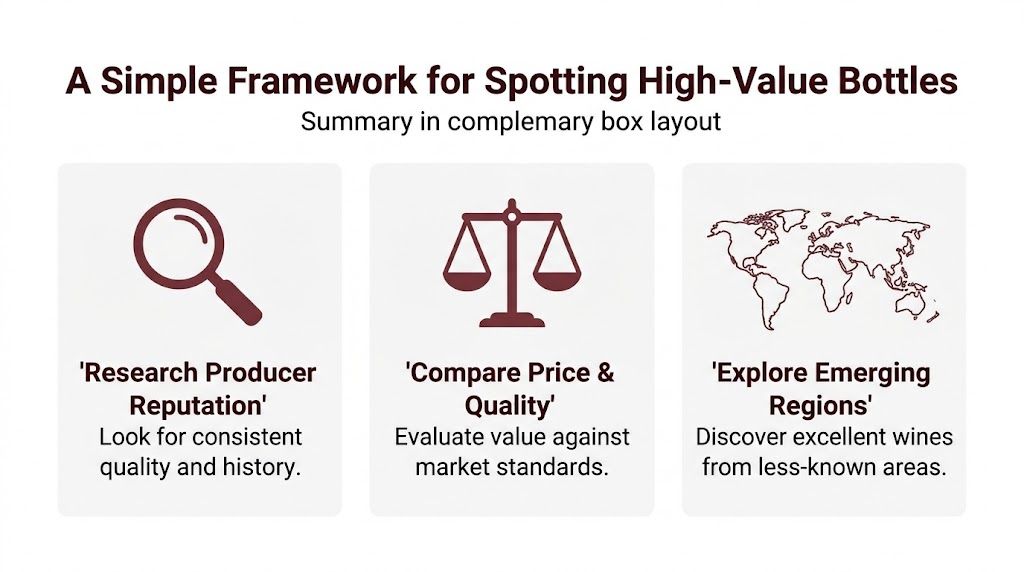
Your price comes first because it removes most of the options before you've read a single label. Choose the number where you won't feel irritated either before opening the bottle or the morning after, and let the occasion set it rather than the shelf.
| Situation | How to think about price | Typical range |
|---|---|---|
| Weeknight at home | Keep it easy and low risk | $12 to $18 |
| Dinner party | Spend a little more for broad appeal | $20 to $30 |
| Restaurant | Expect markup and set a ceiling first | Two to three times retail |
| Gift | Presentation counts alongside the wine | $25 to $40 |
Naming your taste comes second, and plain words beat grape names every time. Saying you want something easy and fresh for seafood, something fuller and softer for pizza or roast chicken, or something bold for steak gives a shop assistant far more to work with than a half-remembered varietal. If you've ever said you like reds that don't feel harsh, you already know enough to choose well, and our guide to choosing wine without ratings goes further into trusting that instinct.
Reading for value clues comes last. Less fashionable regions consistently deliver more wine per dollar than famous ones, because you're not paying for the name on the front, and a plain label from a reliable producer will regularly beat a dramatic one at the same price. Store staff recommendations are worth taking when they're specific about taste and food, and worth ignoring when they're just enthusiastic.
How do you shop the wine aisle without getting lost?
Screen the shelf rather than reading it. Decide your price band and your style first, then compare three or four bottles inside that lane instead of weighing up the whole section.
Eye-level placement is worth resisting, since those positions are bought and arranged rather than earned, and the lower shelves often hold better value from producers who don't pay for prominence. Scanning the full section before you commit stops you locking onto the first acceptable label you see, which is how most rushed wine purchases actually happen.
If a staff member is nearby, the question you ask determines how useful the answer is. Asking what's good is too broad to answer well, whereas asking for a smooth red for pasta under a set budget gives them a lane to work in. The single best question is which bottles people come back for in your price range, because repeat purchases are a far more honest signal than any shelf tag or promotional sticker.
Shelf tags themselves deserve mild skepticism. A good one tells you what the wine tastes like in plain terms, what food it suits, and why the store rates it, while a weak one offers vague praise that would fit any bottle in the aisle. Our guide to the best grocery store wines covers supermarket ranges specifically, and if you want reassurance at the lower end, cheap wine that tastes good is a useful companion read.
Where is the value on a restaurant wine list?
Usually in the unfamiliar regions, and usually not in the middle of the price range. Restaurants tend to keep margins slimmer at the bottom of a list to encourage people to order at all, and slimmer at the top to tempt customers into trading up, which leaves the heaviest markup sitting around the median price.
That's the opposite of where most people instinctively look, since the middle feels like the responsible choice. Research from the London School of Economics and the University of Sussex tested this across thousands of real menus, and our breakdown of the second-cheapest wine myth covers what they found and what to do with it.
The practical approach is to pick a narrow price band you're comfortable with and stay inside it rather than reading the whole list. For a table ordering different dishes, a bottle that works reasonably with everything beats a perfect match for one plate, so table-friendly usually wins over precision. Handing the server a specific request works better than asking for a recommendation, and something like "we're having a mix of dishes and want a good-value bottle around $50, nothing too heavy" tells them your budget and your priorities in one sentence. Our guide on how to read a wine list covers that conversation in more depth.
When is a discount actually a good deal?
When the bottle was already something you'd have bought at full price. A discount on a wine you don't want is just a smaller amount of wasted money, and supermarkets rely heavily on that arithmetic going unnoticed.
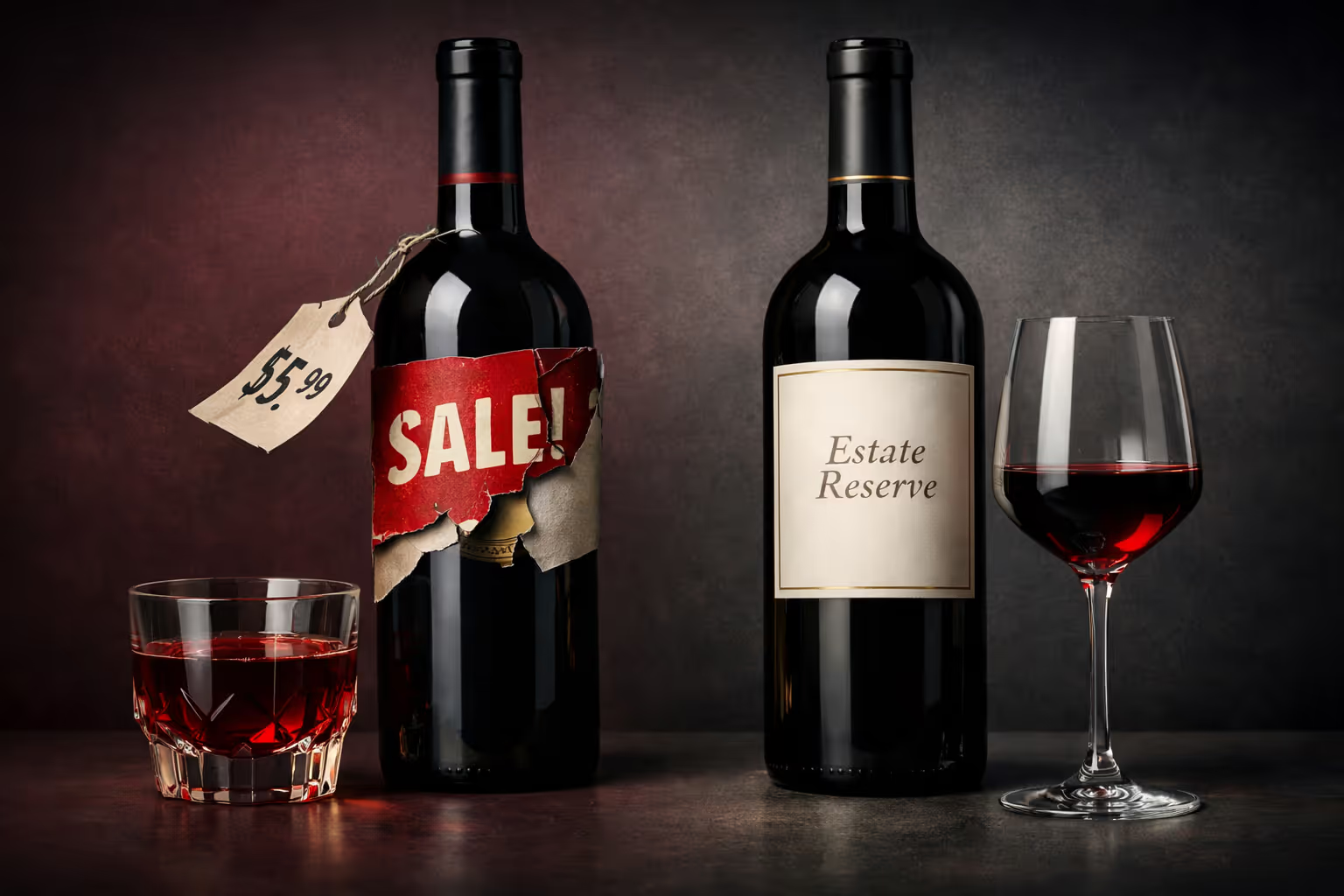
Percentage-off tags deserve the most caution, because the reference price they're discounting from is often set with the promotion in mind. A bottle permanently marked down from an inflated figure has an anchor rather than a saving attached to it, and the honest test is whether the current price alone looks like decent value for that style and region.
Genuine bargains do exist, and they tend to look different. Bin ends and closeouts happen when a shop is clearing stock it no longer carries, so those discounts are real even though the selection is unpredictable. Case discounts are similarly honest, since most retailers take around 10 to 15 percent off six or twelve bottles, and that suits wines you already know you like rather than experiments.
One pattern is worth knowing at the cheap end. Below roughly $10 a bottle in the United States, a large share of the price goes on glass, packaging, shipping, and tax before any wine is accounted for, which is why quality climbs so steeply between $10 and $20 and much more gently after that. Moving from an $8 bottle to a $15 one usually buys a noticeably better drink, while moving from $30 to $60 rarely does anything as dramatic.
How do you find value in spirits?
Buy for the job the bottle has to do, because purpose matters more in spirits than anywhere else in the store. A bourbon destined for old fashioneds and a bourbon you'll sip neat are judged on completely different things, and paying prestige prices for a mixing bottle is the most common way people waste money in a liquor store.
For cocktails, value means clean, consistent, and reasonably priced, since the other ingredients are doing much of the talking. A mid-range gin disappears into a martini just as happily as an expensive one, and the same is true of rum in anything mixed. For sipping, the details start to earn their keep, so the distillery, the style, and any age statement become worth paying attention to.
Markups in spirits also run considerably higher on premium bottles than on everyday ones, which means the gap between what you pay and what you get widens as you climb. Category habits help too: whiskey gives you real information through age statements and distillery reputation, rum rewards knowing whether you're buying a mixer or a sipper, gin comes down to whether its botanical style suits your drinks, and tequila is the category where branding most often outruns what's in the bottle. A good value spirit is one you'll open regularly rather than one that looks impressive unopened.
Can an app do this for you?
It can do the narrowing, which is the part that actually causes the stress. Standing in front of two hundred bottles, the difficulty isn't lack of wine knowledge so much as having no way to filter, and that's a problem a phone handles well.

Sommy is built around exactly that job. Scanning a shelf or a wine list with Vision turns it into a shortlist, Fit Check gives you a straight verdict on a specific bottle you're hesitating over, and your Taste Profile sharpens with every wine you rate so the recommendations come from your own history rather than a general chart. For a worked example in a supermarket, read how to use Sommy to pick the right bottle in a crowded aisle.
Common questions about value wine and liquor
Is the second-cheapest wine really the one to avoid?
No, and research suggests the middle of the list carries the heaviest markup instead. Our full breakdown of the second-cheapest wine myth covers the study behind that.
Does a higher price mean better quality?
Only up to a point, and the returns fade quickly. Price also reflects prestige, packaging, and markup, so quality climbs fastest in the lower ranges and much more slowly above about $30.
What's a good value bottle to bring to dinner?
Something versatile rather than something specific, since you rarely know the menu in advance. A dry rosé, a light red, or a sparkling wine will suit almost any table and any mix of tastes.
What's a good price range for everyday wine?
Roughly $12 to $20 is where most American drinkers land, and it's where quality improves fastest relative to price. Below $10 you're often paying for bulk production more than anything else.
Should I buy wine based on reviews?
Use them as a filter rather than a decision. A well-reviewed bottle can still be wrong for your dinner or your taste, and fit matters more than general praise.
Is buying wine in bulk actually cheaper?
Usually yes, since most retailers discount six or twelve bottle cases by around 10 to 15 percent. It only saves money if you'd have bought those bottles anyway, so it suits wines you already know you like.
Putting it into practice
Good value comes from deciding your price before you look, describing what you want in ordinary language, and reading for substance rather than prestige. Do that and you'll buy better bottles at every price point, whether you're in a supermarket, a liquor store, or holding a restaurant list.
If you'd rather not run that process yourself every time, Sommy Chat answers the question in plain language and your Taste Profile means the answers get more like you the longer you use it. The goal was never to become an expert, just to stop feeling stuck every time you buy a bottle.