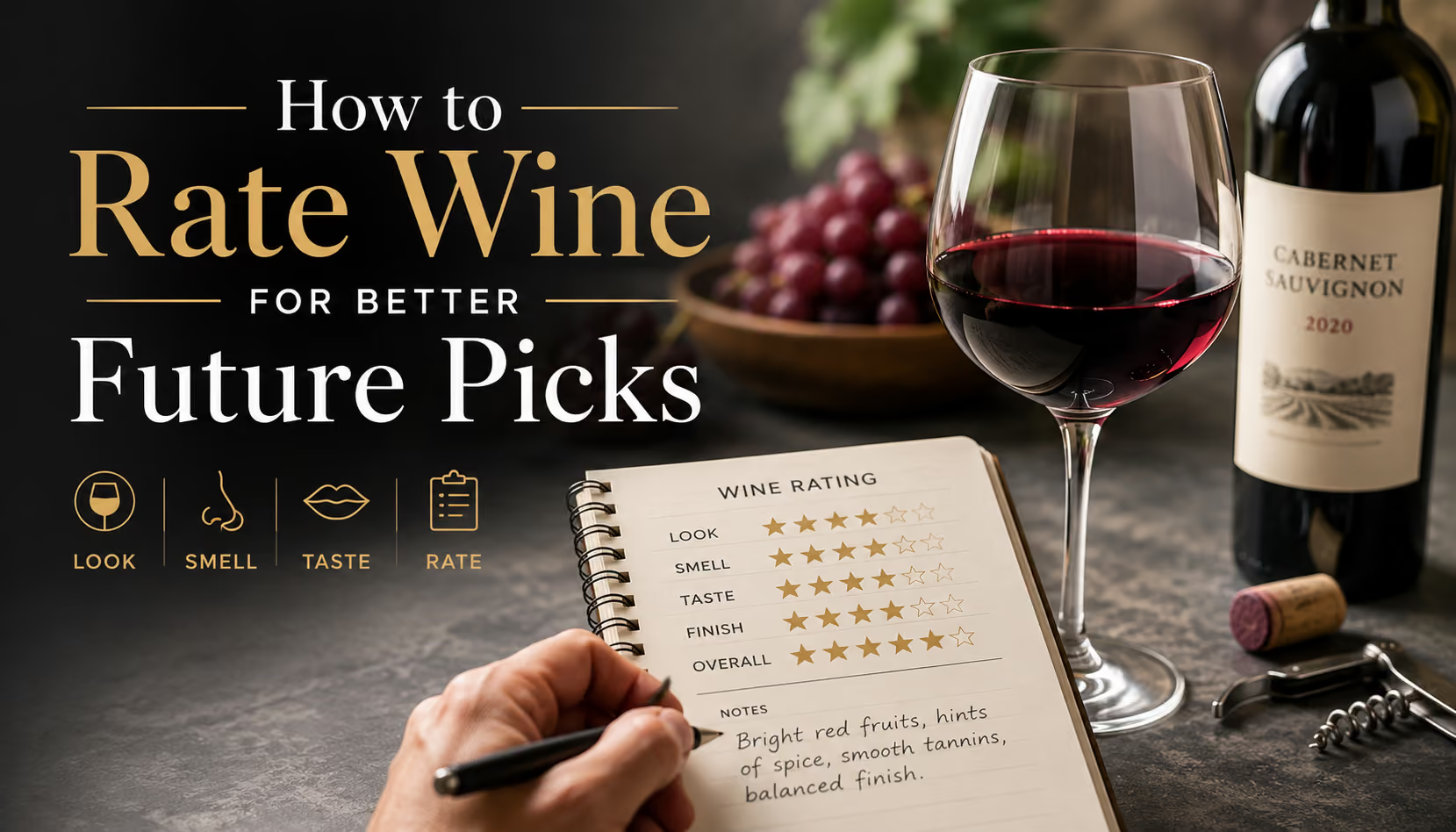

A wine tasting notes template is a structured guide to help you remember what you thought about a wine's look, smell, taste, and finish. Using a consistent format transforms casual sipping into a focused practice, helping you build a genuine memory of the wines you try and sharpening your palate over time.
How a Template Transforms Your Wine Tasting
Let's be honest. Sipping wine is fun, but trying to remember the specific details of a fantastic bottle you had months ago? That can be a nightmare. Was it the Cabernet Sauvignon from that little shop or the Merlot from dinner with friends? This is where a simple wine tasting notes template changes the game.
Switching from random jottings on your phone to a consistent format isn't about following strict rules. It's about giving yourself a roadmap. It nudges you to look for specific characteristics you might otherwise miss. Suddenly, you're not just tasting "red wine"—you're noticing the deep garnet color, smelling the black cherry and cedar, and feeling that smooth, lingering finish.
Building Your Personal Wine Memory
Each note you take becomes a book in your personal wine library. Think of it as a reliable memory bank that helps you understand your own preferences on a much deeper level.
You’ll start to see patterns emerge. Maybe you consistently rate Zinfandels with notes of blackberry jam highly. Or perhaps you realize you prefer the zippy, crisp acidity of a Sancerre over a buttery, oaked Chardonnay. This is the kind of insight that apps like Sommy thrive on; the more you record, the better it gets at recommending wines you'll love.
This structured approach is what separates casual drinkers from confident enthusiasts. It's the same method professionals use to sharpen their skills. You can even learn more about what a sommelier does and how they develop that incredible expertise in our detailed guide to the sommelier profession.
A tasting template is your personal guide to unlocking the complex world of wine. It trains your brain to connect aromas and flavors with specific grape varieties, regions, and winemaking styles, turning vague impressions into sharp, insightful knowledge.
So, what should you actually be looking for? At its core, a great tasting note captures four key things.
Anatomy of a Great Tasting Note
Here's a quick overview of the four essential parts of any tasting note, giving you a framework for what to observe.
| Component | What You're Observing |
|---|---|
| Appearance | Color, clarity, and intensity. Is it pale straw or deep gold? Bright ruby or inky purple? |
| Aroma (Nose) | The scents you pick up. Think fruit (berries, citrus), earth (minerals, soil), or oak (vanilla, spice). |
| Palate (Taste) | Flavors, sweetness, acidity, tannins, and body. How does it feel in your mouth? |
| Finish | How long the taste lingers after you swallow. Is it short and clean or long and complex? |
Keeping these four components in mind will give your notes a solid foundation, making them useful when you look back on them later.
This whole practice has really taken off in the last 50 years. The trend got a famous boost from American winemaker Robert Mondavi, who started adding detailed tasting notes to his labels back in the 1970s to help educate drinkers. Back then, only about 15% of labels included notes like that; by 2020, that number had jumped to over 60% in major markets.
Ultimately, using a template builds confidence. You learn the language to describe what you're experiencing, making it way easier to talk to sommeliers or the staff at a wine shop. And with a tool like Sommy, this memory becomes even more powerful—letting you scan a label and instantly pull up your old notes to make sure you always pick a bottle you'll love.
Breaking Down Each Part of the Template
Ever wonder what sommeliers are actually writing down when they furiously scribble in their notebooks? A solid wine tasting notes template isn't just a random list; it’s a structured way to decode a wine, piece by piece. When you break it down this way, vague feelings turn into specific, memorable details.
This structured method isn't just a modern fad. The idea of formally noting a wine's character started picking up steam back in the 18th century, moving evaluations from subjective stories to a more organized process. Today, most templates focus on 5-7 key categories to paint a complete picture of the wine in your glass.
This simple tool helps you train your palate, build a reliable wine memory, and ultimately, talk about wine with a lot more confidence.
Let's walk through the fields you'll find on a good template.
Decoding Appearance and Nose
The first step is always visual. You have to look at the wine against a white background to get an accurate read on its Appearance. This tells a story before you even take a sip.
- Color and Intensity: Is that white wine a pale straw, a vibrant lemon, or a deep gold? Is the red a bright ruby, a deep purple, or is it showing some age with garnet or brick-colored edges? For instance, an older Nebbiolo often shows a tell-tale garnet hue with brick-colored edges, signaling its maturity.
- Clarity: Is the wine clear and brilliant, or is it a bit hazy? Keep in mind, haziness isn't always a flaw—it can simply mean the wine is unfiltered, which is a stylistic choice many winemakers prefer.
Next, you move on to the Nose (or aroma), which is arguably where most of a wine's complexity lives. Don't be shy—give the glass a good swirl to release all those aromatic compounds. A good trick is to think in broad categories first, then get specific.
A wine's aroma is its first true introduction. Your brain processes scent and memory together, so identifying specific notes like 'gooseberry' or 'wet gravel' in a Sancerre creates a powerful mental anchor for that wine profile.
Capturing the Palate and Finish
Now for the best part—the Palate. This is where you confirm the aromas you picked up and really assess the wine's structure. Take a decent sip and let it coat your whole mouth. Think about:
- Flavors: Do the aromas match what you taste? Are you getting ripe black cherry, zesty lemon, vanilla from oak aging, or something more earthy?
- Acidity: This is that mouth-watering sensation. High acidity makes a wine feel crisp and refreshing, like a classic Sauvignon Blanc.
- Tannins: You’ll find this mostly in reds. It's that drying sensation on your gums, kind of like drinking strong black tea. Are the tannins harsh and grippy, or are they smooth and well-integrated?
- Body: How does the wine feel in your mouth? Is it light and delicate like skim milk, or is it full and rich like heavy cream?
Finally, the Finish is all about the lasting impression. After you swallow, how long do the flavors stick around? A long, complex finish is almost always a sign of a high-quality wine.
Jotting down these details helps you build a detailed log of your preferences. When you consistently capture this data, tools like Sommy can start to learn your unique taste. You can learn more about our system by exploring how AI taste profiles create personalized wine picks for you. It's how your notes turn into truly useful insights for your next purchase.
Download Your Free Printable and Digital Templates
Alright, enough theory. It's time to put pen to paper (or finger to screen).
I’ve put together a wine tasting notes template. Go ahead and download it here.
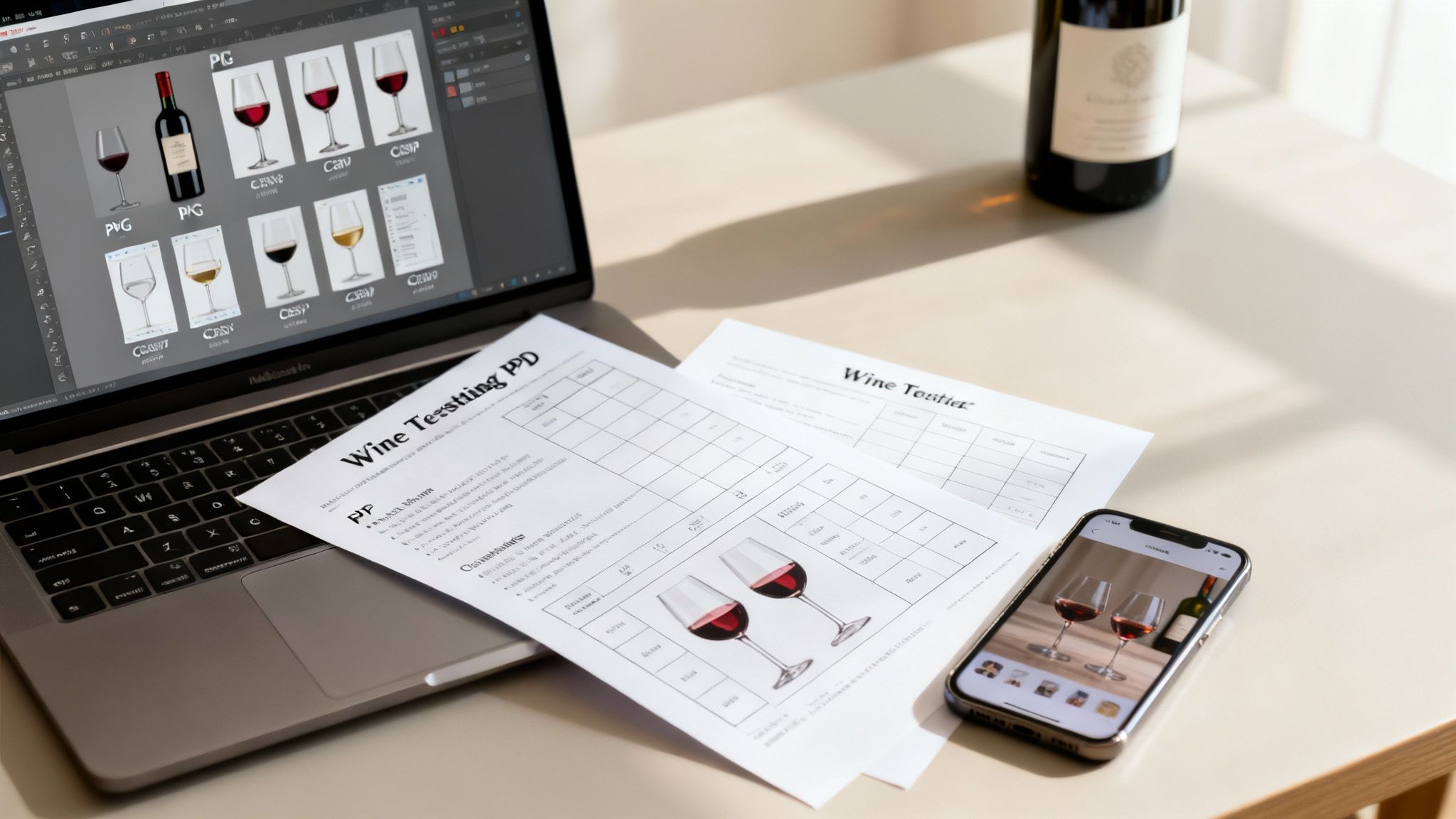
While printable templates are fantastic for capturing thoughts in the moment, a digital approach is key for building a searchable, long-term wine memory. Think of paper as the draft and digital as the permanent archive.
This is exactly where a dedicated wine journal app starts to make a ton of sense. Let's be honest, manually typing all your paper notes into a spreadsheet later is a chore that rarely (if ever) gets done.
This is where modern tools completely change the game. For instance, a good wine scanner app lets you snap a picture of the label, instantly pulling in all the bottle's details. No more tedious typing. This frees you up to focus purely on what you're tasting, creating a seamless link between the physical bottle and your digital journal. From there, all those notes are just a quick search away, ready whenever you need them.
Bringing Your Tasting Notes into the Digital Age
Paper notes are fantastic in the moment, but let's be honest—they have their limits. They get lost, stained with a tell-tale drop of Merlot, and are impossible to search when you're standing in a wine shop trying to remember that amazing Cabernet you tried six months ago.
This is where taking your tasting notes digital completely changes the game. It’s the difference between having a shoebox full of paper scraps and having a smart, searchable wine journal that travels with you everywhere.
The Power of a Digital Wine Journal
The whole idea of a wine tasting notes template has grown up a lot, thanks mostly to the shift online. Just look at an app like Vivino—it has over 50 million users who have collectively logged more than 100 million tasting notes. The global wine community is clearly voting with its thumbs.
This digital wave has made discovering and sharing wine easier and more accessible for everyone. If you're curious, you can read more about the history and evolution of wine tasting on thisdayinwinehistory.com.
And this is exactly where a tool like Sommy fits in. Imagine just scanning a wine label with your phone. Instantly, all the boring details—the winery, grape, region, vintage—are filled in for you. No more squinting at the fine print or trying to type "Gewürztraminer" with one hand.
The focus is on action. You scan a label or a wine list to get instant, personalized feedback. It’s all about saving you time so you can get back to what matters: the wine in your glass.
From Simple Notes to Smart Insights
With the basics automatically captured, you get to focus on your actual impressions. You just add your thoughts on the aroma, palate, and finish, building a rich, detailed entry for every bottle.
A digital journal becomes more than just a log; it’s a tool that learns your palate. Every note you take helps refine future recommendations, ensuring you spend less time searching and more time enjoying wines you genuinely love.
This creates a simple but powerful feedback loop. The more you taste and record, the smarter the system gets at figuring out your unique preferences. It’s like having a personal sommelier who remembers every single wine you've ever tried. Curious how that works behind the scenes? You can check out our guide on how to train an AI wine palate.
The real magic happens when you're faced with a choice.
- At a restaurant? Scan the wine list to see if you’ve tried anything similar before.
- In a shop? Scan a bottle to instantly pull up your past notes and rating.
- Forgot a favorite? Just search your journal for "crisp Sauvignon Blanc" or "jammy Zinfandel" to find exactly what you're looking for.
Your digital memory makes sure you never forget a standout bottle again, turning your tasting journey into an organized, ever-growing resource you can actually use.
Practical Tips for More Insightful Notes
A solid template gives you the structure, but a few pro tips can elevate your notes from a simple log to an insightful journal. It really comes down to creating the best possible conditions to let the wine speak for itself. Taking just a moment to control your environment and focus your senses will make a huge difference in what you're able to perceive in the glass.
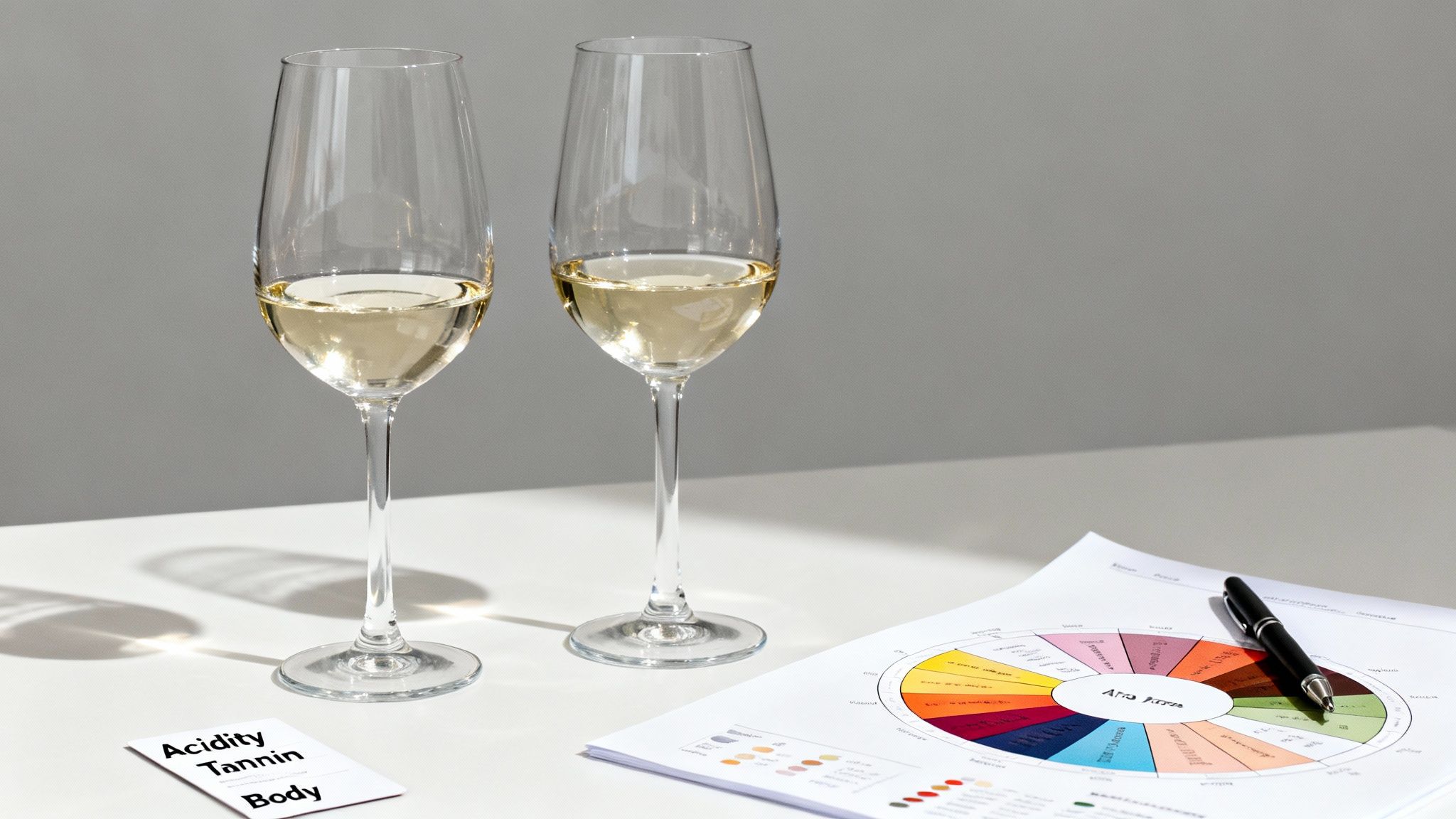
Whenever possible, try to taste in a neutral environment. Strong cooking smells, scented candles, or even perfume can easily muscle in on a wine's delicate aromas. Your sense of smell is responsible for the vast majority of what you "taste," so giving it a clean slate is crucial for picking up those subtle notes.
Expand Your Descriptive Vocabulary
Are you stuck describing every red as "fruity" or every white as "crisp"? The best way to break out of this rut is with an aroma wheel. This simple visual tool organizes common wine scents into categories and subcategories, helping you pinpoint exactly what you're smelling.
Instead of just landing on "fruit," the wheel prompts you to dig a little deeper:
- Is it citrus (lemon, grapefruit)?
- Is it berry (strawberry, blackberry)?
- Is it tropical (pineapple, mango)?
Using a wheel transforms a vague impression into a specific descriptor. Suddenly, your wine tasting notes template becomes much more powerful, and you start building a mental library of scents that you can connect to specific grapes and regions.
Sharpen Your Palate with Comparisons
One of the fastest ways to train your palate is to taste two wines side-by-side. This technique, known as comparative tasting, makes the differences pop. You don't need expensive bottles; the goal is simply to compare and contrast.
For example, try an oaked Chardonnay next to an unoaked one. The influence of the barrel—notes of vanilla, butter, and spice—will jump out at you when tasted against the clean, fruity profile of its stainless-steel-fermented cousin. It’s a simple exercise that sharpens your focus and builds your tasting confidence in a hurry.
The right glassware isn't just about looking fancy; it's a functional tool. A glass with a large bowl and a tapered rim concentrates the wine's aromas, directing them straight to your nose for a more intense and detailed experience.
Connect the Dots with Food Pairings
Finally, make your notes truly practical by jotting down food pairing ideas. This isn't just about what tastes good; it's about understanding why certain pairings click. Think about the wine's core components and how they'd interact with a dish.
Here are a couple of classic examples:
- High-Acidity Wines: A zesty Sauvignon Blanc has enough bright acidity to cut right through the richness of goat cheese or a creamy sauce.
- Tannic Red Wines: A bold Cabernet Sauvignon with firm tannins can stand up to the fat and protein in a grilled steak, with each component softening the other.
Adding these ideas turns your journal into a genuinely useful guide for future meals. It's also a key feature in apps like Sommy, which uses this exact logic to recommend perfect pairings on the spot, using your own notes and preferences to guide its suggestions.
Common Questions About Wine Tasting Notes
As you start using a wine tasting notes template, a few questions are bound to pop up. Don't worry, that's completely normal. Getting a handle on these common hurdles is the fastest way to build confidence and make the whole process feel natural.
Think of this as your quick-reference guide. It's here to help you sharpen your skills and get more out of every single glass. It might feel a bit clunky at first, but like any skill, mindful tasting gets easier—and way more rewarding—with a little practice.
What Is the Best Format for a Template?
The honest answer? It really depends on your goal and where you're tasting. There’s no single "best" option, but each one has its own strengths.
- A printable PDF is fantastic for a dinner party or a more formal tasting. Having a physical copy you can jot notes on is just easier in those settings.
- If you're tracking your tastes over time, a CSV spreadsheet is your best friend. It lets you sort and filter your notes to spot patterns, like realizing you consistently enjoy wines from a specific region or grape.
- But for pure convenience and building a permanent, searchable log, a dedicated app like Sommy is the most powerful choice. It combines super-fast label scanning with a digital journal that’s always right there in your pocket.
How Do I Describe Aromas as a Beginner?
This is where most people get intimidated, but there's a simple trick to it. Start broad, then get specific.
First, just ask yourself if the wine smells fruity, earthy, spicy, or floral. Once you land on a category, try to dig a little deeper. If it’s fruity, is it more like red fruit (cherry, raspberry) or black fruit (plum, blackberry)? Does it smell like fresh-picked fruit, or is it more cooked, like jam or a baked pie?
The goal isn't to be "right." It's to build your own personal sensory library. An aroma wheel can be a great visual tool to have handy when you feel stuck.
Do I Have to Score Every Wine I Taste?
Not at all. Scoring is completely optional, but it can be a useful shorthand for remembering your overall impression later on. For your own notes, a simple 1-5 star rating often works much better than the complex 100-point scales professional critics use.
Your descriptive notes are far more valuable than any score. They explain why you felt a certain way about the wine—the bright acidity, the smooth tannins, the long finish. That's what really jogs your memory and helps you understand your own palate.
How Can I Improve My Palate for Tasting Wine?
Improving your palate really boils down to two things: practice and paying attention. The more you mindfully taste what's in your glass, the more you'll start to notice.
One of the best ways to learn is to taste two wines side-by-side to really highlight the differences. Another great tip is to actively smell common ingredients you find in wine aromas—things like lemon, vanilla, black pepper, and berries—to train your nose.
But most importantly, just be consistent with your tasting notes template. The simple act of writing down what you perceive forces you to focus more intently, and you'll be surprised how quickly your palate develops.
Ready to turn those scattered notes into a smart, searchable wine journal? With Sommy, you can scan any wine label to instantly start a new note, track your tasting history, and get personalized recommendations based on what you truly love.
Never forget a great bottle again.