

A wine pairing app suggests a wine to drink with whatever you are eating, usually by matching your dish to a bottle or a grape. The useful ones go a step further and pair to your own taste, not just to the food, so the wine they name is one you will actually enjoy rather than a textbook answer. Most apps still give everyone the same pairing for the same dish, which is where they fall down. The one worth keeping learns what you like as you go and factors that in, and it lets you start from a photo of your meal or a recipe instead of typing anything at all.
TL;DR
• A wine pairing app matches a wine to your meal; the best ones also match it to your personal taste.
• Most apps give a generic, one-size-fits-all pairing from a database, so two very different drinkers get the identical answer.
• Sommy's 'Meal Scan' Pairing works from a photo of your meal or a recipe and matches the wine to both the dish and your Taste Profile.
• Look for personalization, an honest recommendation, and the ability to start from a picture, not a form.
What does a wine pairing app actually do?
A wine pairing app takes what you are eating and hands you a wine that goes with it, so you are not left guessing in a shop or staring at a restaurant list. At its simplest, you tell the app the dish, or snap a photo of it, and you get one or more wine suggestions back. Some apps match on the food alone, some let you scan a wine list or a shelf and score the bottles in front of you, and a few try to learn your taste over time so the answers get sharper the more you use them.
The reason these apps exist is that pairing is genuinely hard to do in your head. There are thousands of grapes and styles, the same dish can suit several very different wines, and the "rules" you half remember from somewhere are full of exceptions. A good app compresses all of that into a single confident answer in a few seconds, which is exactly what you want when the food is on the table and everyone is waiting. The catch is that not all of them are actually pairing for you. Many are just reading a lookup table, and that table was written for an imaginary average drinker who might be nothing like you.
That difference, between an app that looks up a generic answer and one that reasons about your taste, is the whole story of whether a pairing app is worth your phone space. If you want the background on how the food side of pairing works before you lean on an app for it, our plain-language walk through how to pair wine with food covers the fundamentals the apps are trying to automate.
Why do most wine pairing apps give everyone the same pairing?
Most wine pairing apps give everyone the same answer because they run on a fixed database, matching a dish to a preset wine style with no idea who is asking. Type in "grilled salmon" and the app returns the pairing its makers decided is correct for grilled salmon, full stop. It does not know that you find oaky whites too heavy, or that you have quietly fallen for lighter reds this year, or that the last three bottles it suggested left you cold. Everyone who searches the same dish gets handed the same bottle.
That works well enough as a starting point, and for a total beginner it is better than nothing. The problem shows up the moment your taste has any shape at all. Two people can sit at the same table eating the same pasta and want genuinely different wines, one reaching for a bright, high-acid red and the other for something soft and fruit-forward. A database cannot tell them apart, so it serves them both the same "classic" match and quietly disappoints at least one of them. The recommendation is not wrong exactly, it just is not personal, and pairing is one of those things where personal is the entire point.
You can usually spot a generic app within a few uses. If the suggestions never change based on what you told it you liked or disliked, if there is no sense of memory from one session to the next, it is reading a table. The wines might be reasonable, but they are reasonable for the average person, and nobody actually drinks like the average person.
How does a wine pairing app match wine to your taste?
A pairing app matches wine to your taste by building a model of your palate and then weighing the dish against it, so the wine it names fits both the food and you. This is what Sommy's 'Meal Scan' Pairing does. Instead of a lookup table, it leans on your Taste Profile, the living picture of your palate that Sommy refines every time you rate a wine, and it uses that to steer the pairing toward the styles you actually enjoy. Feed it the same salmon dish and it will suggest a different wine for a fan of crisp, mineral whites than it will for someone who leans sweet and fruity, because it knows the difference.
The longer you use it, the better this gets. Early on, before Sommy knows you well, the pairings behave a bit more like a smart general recommendation. As you rate the wines you drink, the picture sharpens, and the suggestions start to feel less like a textbook and more like a friend who has watched you drink for a year and remembers what made you happy. If you want to see how that palate model is built in the first place, our look at how Sommy's taste profiles work walks through the mechanics without the jargon.
The honest version is that no app reads your mind, and the first pairing you ever get will not be perfectly tuned to you. What personalization buys you is a system that improves, so the answer in month six is meaningfully better than the answer on day one. A generic app gives you the same answer forever, however long you use it, because it was never paying attention to you in the first place.
Can you just snap a photo of your meal or recipe?
Yes, and it is the fastest way to use a pairing app, since a photo skips all the typing and describing. With Sommy's 'Meal Scan' Pairing you can point your phone at the plate in front of you, or at a recipe in a cookbook or on a screen, and it works out what the dish is and what to pour with it. You do not have to know the "official" name of what you are eating or break it down into ingredients yourself. Sommy reads the meal and goes from there.
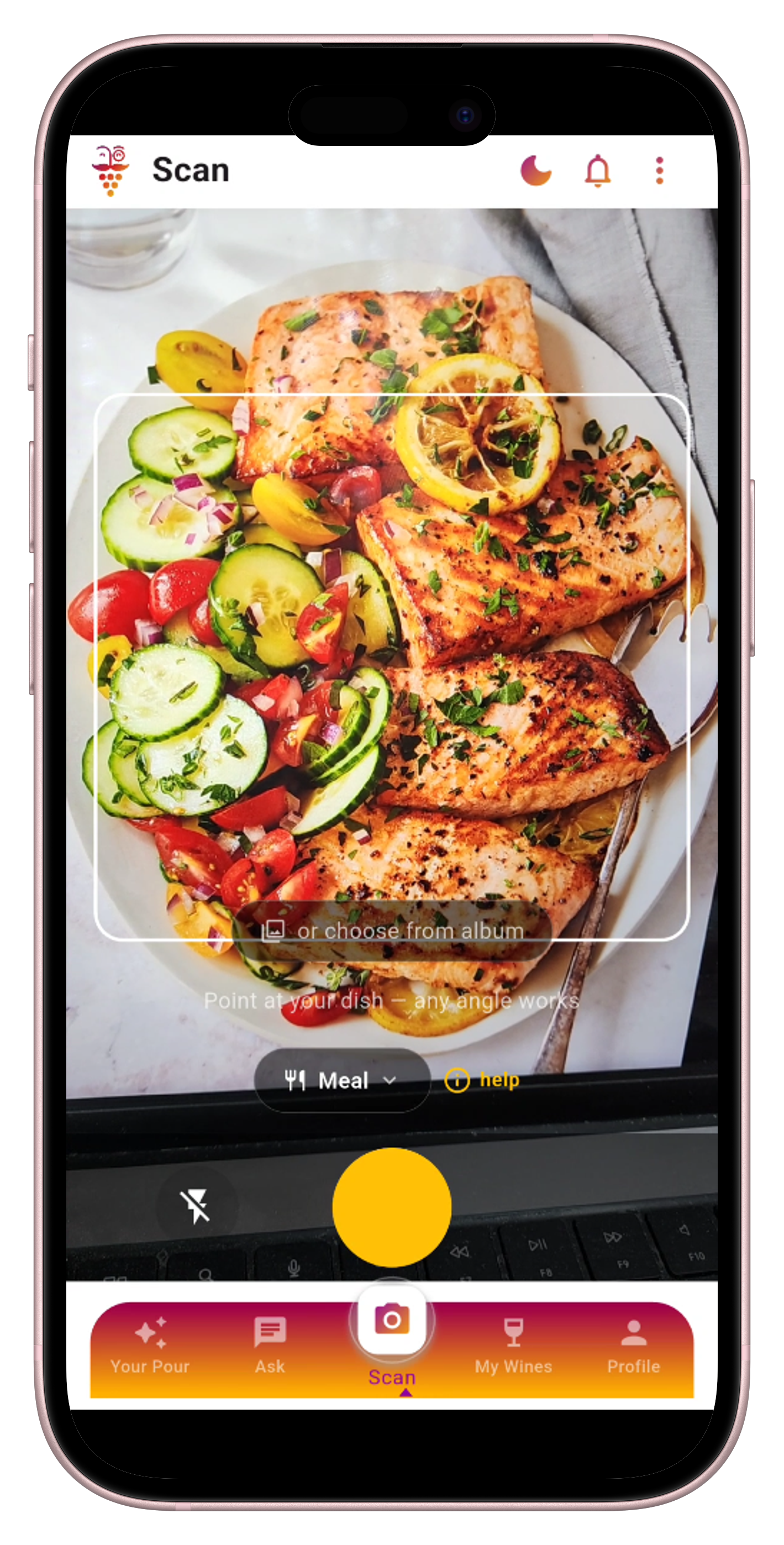
Here is what the Meal Scan flow looks like:
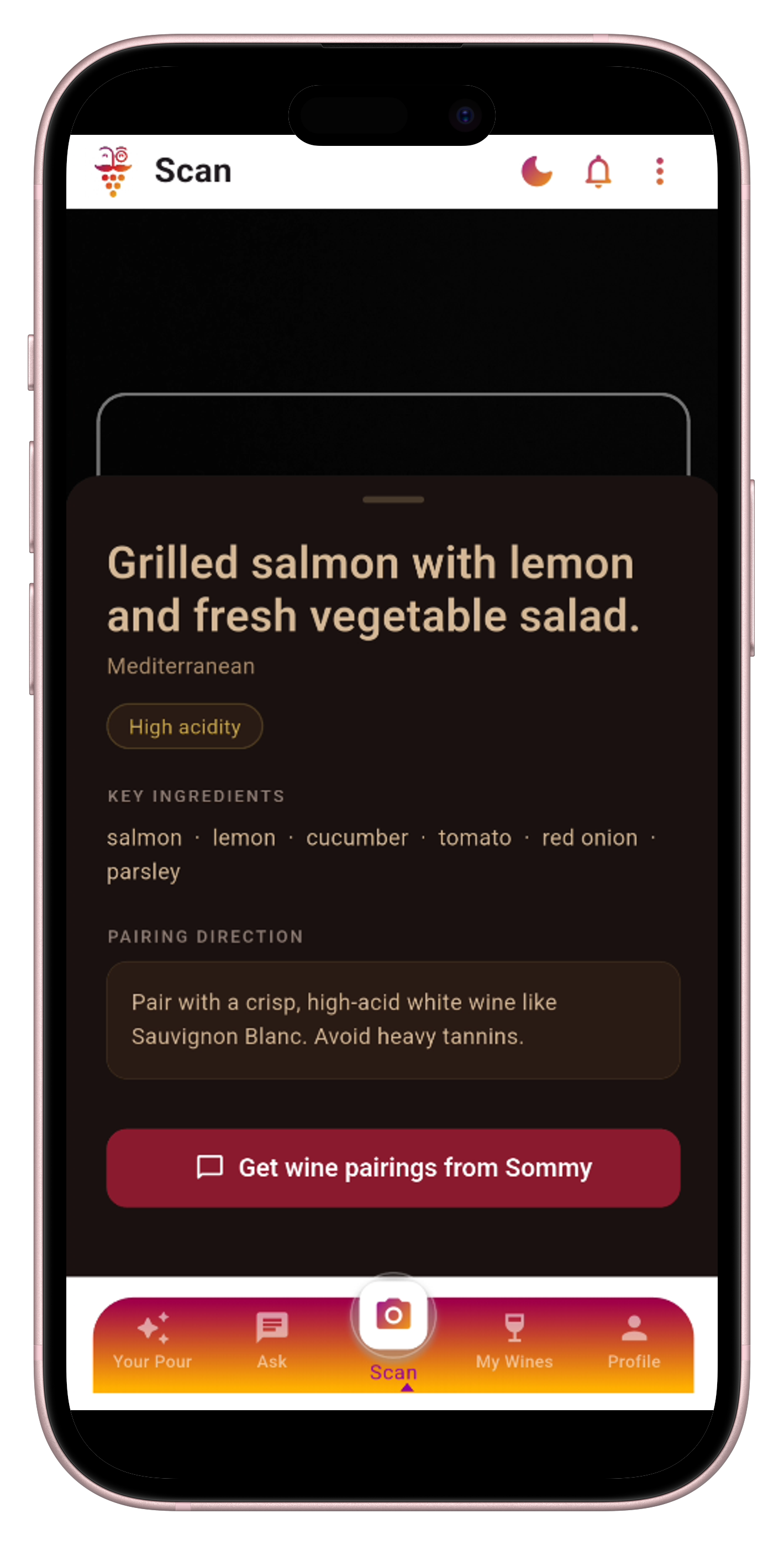
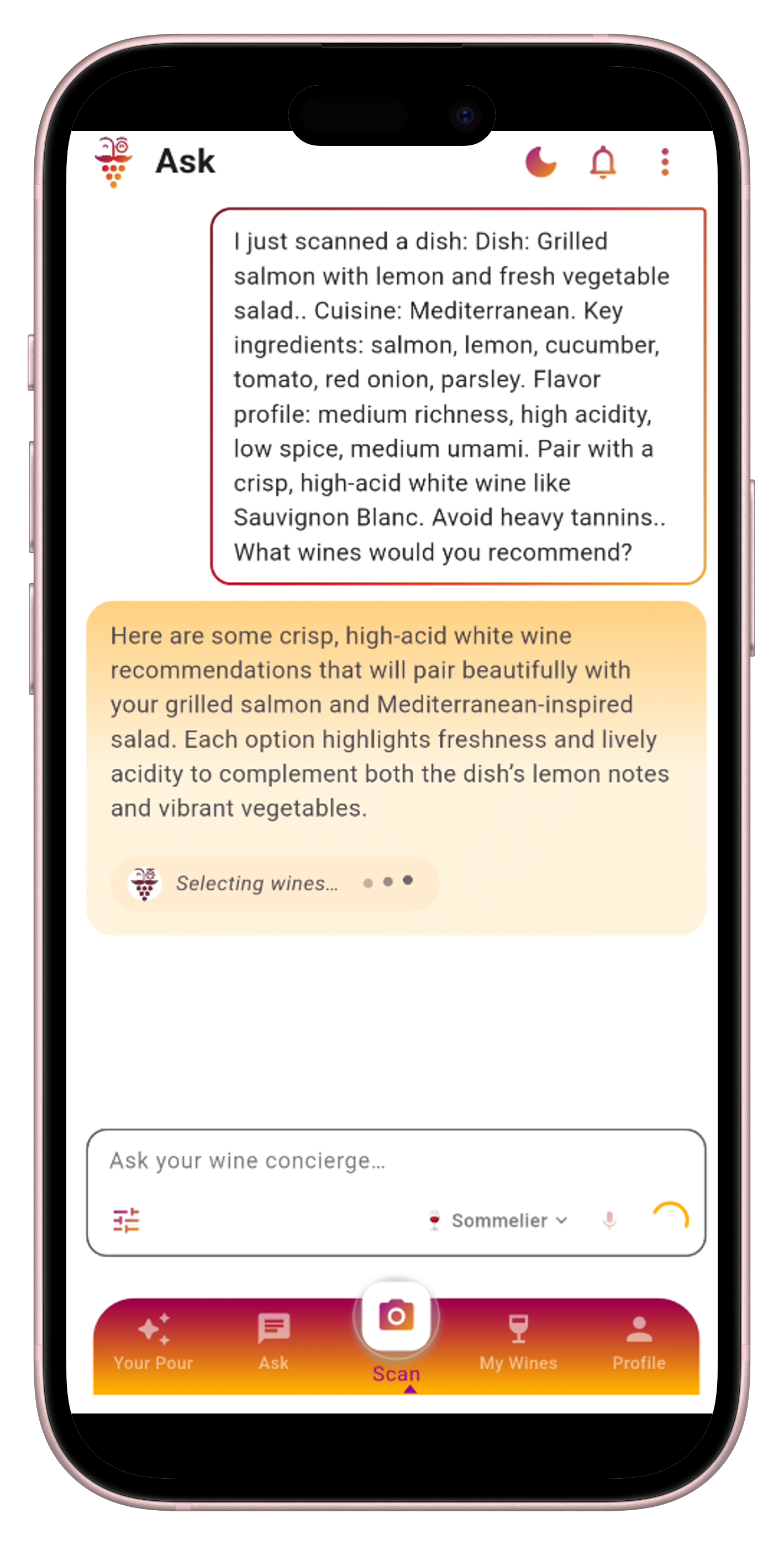
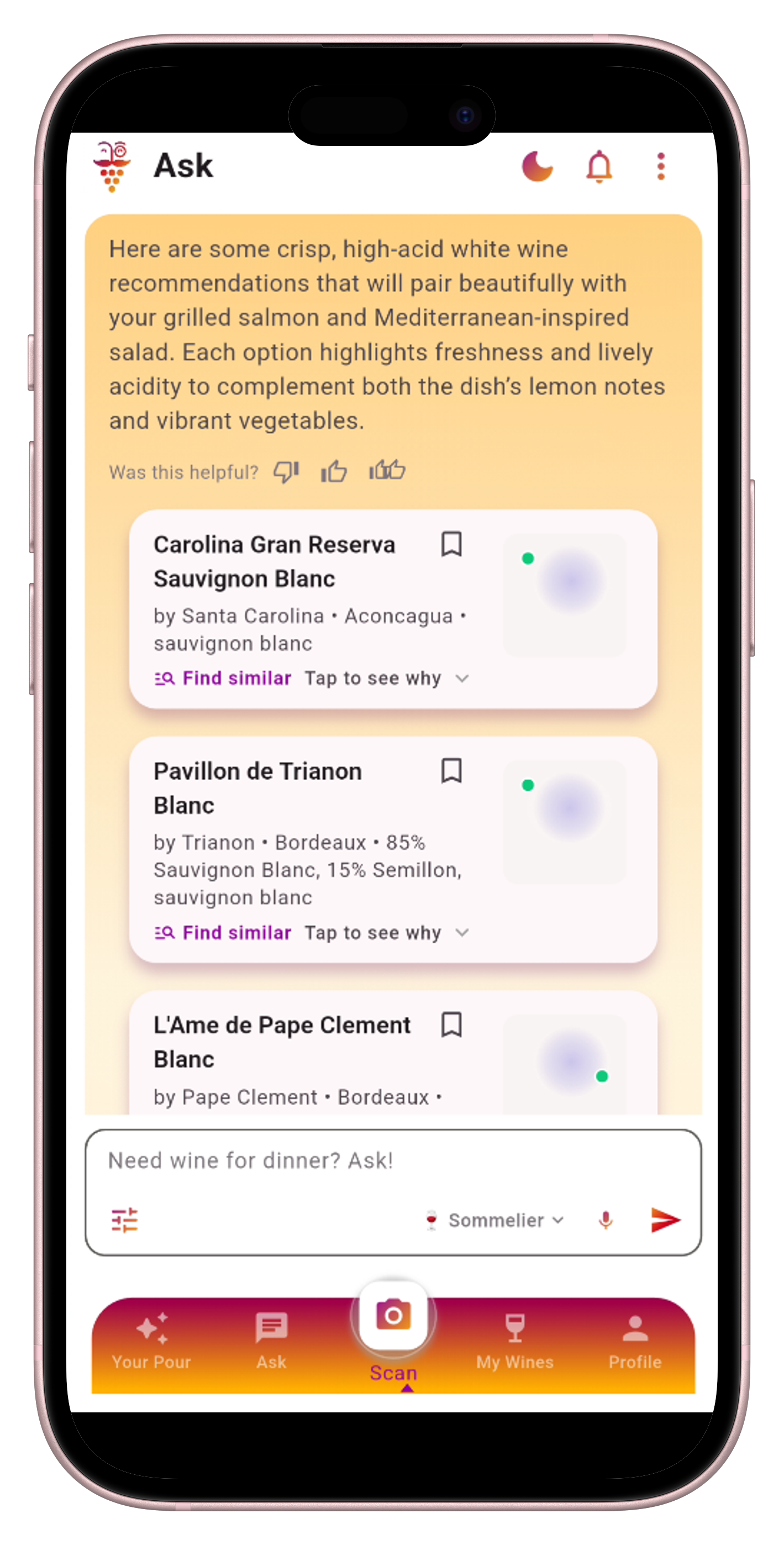
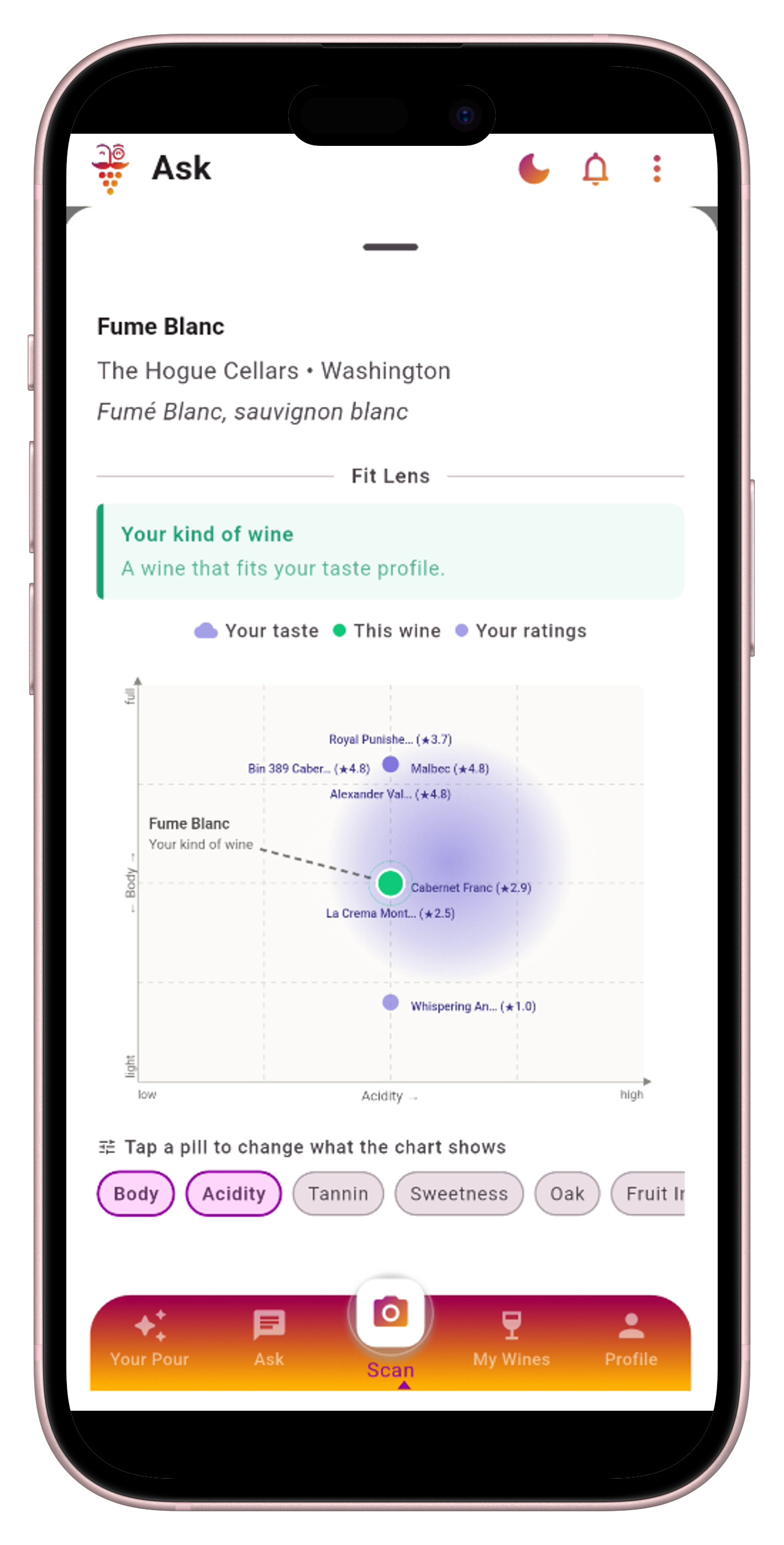
This matters more than it might sound. This is because the moment you actually need a pairing is usually the moment you least want to fill in a form. Dinner is ready, or you are halfway through cooking, and you just want to know what to open. Snapping a picture takes a second and meets you where you already are. Scanning a recipe is just as handy when you are planning ahead, so you can buy the right bottle before you cook rather than making do with whatever is in the rack. Our piece on the recipe scan and cookbook pairing flow goes deeper on that side if you cook from recipes a lot.
The photo route also sidesteps the biggest weakness of type-it-in apps, which is that you have to describe the food well for them to help. A person who does not cook much may not know whether their sauce counts as "creamy" or "tomato-based" in the way the app expects. A photo removes that guesswork and lets Sommy do the identifying, which is exactly the kind of small friction that decides whether you actually use a tool or forget it exists.
What should you look for in a wine pairing app?
The single most important thing to look for is whether the app pairs to your taste or just to the food, because that is what separates a useful tool from a glorified chart. Before you commit to one, it is worth checking a few things that reliably tell the good from the generic.

• Personalization that actually changes the answers. If your dislikes and favorites never shift what it suggests, it is a database with a nice coat of paint.
• A photo or scan option, so you can start from your meal, a recipe, a shelf, or a restaurant list instead of typing everything by hand.
• An honest, specific recommendation, ideally a named style or grape with a reason, rather than a vague "try a red" that helps nobody.
Beyond that short list, pay attention to how the app feels after a couple of weeks, once it has seen a few of your ratings. A good one should feel like it is getting to know you, with suggestions that drift toward what you keep enjoying. A weak one feels frozen, handing out the same handful of safe answers no matter what you tell it. Price matters too, but less than you would think, since the difference between a free generic app and a genuinely personal one is about the approach, not the price tag.
It also helps to notice what an app does when it is unsure. The trustworthy ones will hedge honestly or ask a question rather than confidently naming a bottle that has nothing to do with your taste. If you would rather ask in plain words than tap through menus, being able to open Sommy Chat and simply ask what to pour with tonight's dinner is the kind of low-effort path that keeps you actually using the thing.
Where do wine pairing apps still fall short?
Even the best wine pairing app has limits, and it is worth knowing them so you are not let down. The clearest one is that any app needs a little time and a few ratings before it truly knows you, so the very first pairings lean more general than personal. If you download something on a Friday expecting it to nail your exact taste by dinner, you will be slightly disappointed, whichever app you pick. Personalization is a slope, not a switch.

There are practical limits worth naming too. A photo of a complicated, many-component dish is harder to read than a simple plate, and an unusual regional dish might not be recognized cleanly. Wine availability is another gap most apps gloss over, since the perfect theoretical pairing does you no good if no shop near you stocks it. And taste is personal enough that even a well-tuned suggestion is a strong starting point rather than a guarantee, because the way a wine lands on your particular palate is something only you can confirm by drinking it.
None of this makes a pairing app not worth using. It just means the right expectation is a knowledgeable, fast, improving assistant rather than an infallible oracle. Treat the first pairings as smart guesses, rate what you drink so the app can learn, and the whole thing gets quietly better underneath you. For the deeper food-side reasoning that no app fully replaces, our wine pairing guide is a good companion to keep around.
Frequently asked questions
What is the best wine pairing app?
The best wine pairing app for you is the one that pairs to your personal taste rather than serving a generic database answer, and that lets you start from a photo or a recipe. Look for real personalization that changes its suggestions as you rate wines, an honest named recommendation, and a scan option, since those three things separate a genuinely useful app from a lookup table.
Are wine pairing apps accurate?
They are accurate in the sense of giving a sensible, food-appropriate suggestion, but generic apps are only accurate for an average drinker. An app that learns your taste gets more accurate for you specifically over time, while a database app stays the same forever. The best way to judge accuracy is whether the suggestions improve as the app gets to know you.
Can a wine pairing app work from a photo of my food?
Yes, and it is one of the easiest ways to use one. Sommy's 'Meal Scan' Pairing lets you snap a photo of your meal or a recipe, works out what the dish is, and suggests wine matched to both the food and your Taste Profile. It saves you describing the dish in the app's own terms, which is the part most people get wrong when they type it in by hand.
Do I need to know about wine to use one?
No, and that is rather the point. A good pairing app is built precisely so you do not need to know grapes or regions to drink well. You rate what you like in plain terms, or just snap your meal, and the app handles the translating into styles and bottles, learning your taste quietly in the background as you go.
Is a wine pairing app better than asking a sommelier?
They do rather different jobs, so it is not really a competition. A sommelier is wonderful in the moment at a good restaurant, while a pairing app is with you every day, at home, in shops, and at places without a wine expert on hand. An app that remembers your taste also carries that knowledge from meal to meal, which even the best sommelier cannot do once you leave the table.
Getting a pairing that fits you
The thing to remember when choosing a wine pairing app is that pairing to the food is only half the job, and the easy half. Plenty of apps can tell you a "classic" match for salmon or steak, because that answer is written down somewhere and never changes. The harder, more valuable half is pairing to you, the actual person drinking, with your own history of what you have loved and left behind. That is the difference between a suggestion that is technically fine and one you are genuinely glad you took.
That is the whole idea behind Sommy's 'Meal Scan' Pairing. Snap your meal or a recipe, and it matches a wine to both the dish and your Taste Profile, then gets sharper every time you rate what you drink. If you would rather just talk it through, ask Sommy in the chat what to pour tonight and let your own taste, not a generic table, decide what ends up in the glass. If you are still finding your feet, our roundup of food that pairs with red wine is a friendly place to start building the instinct the app is there to back up.