
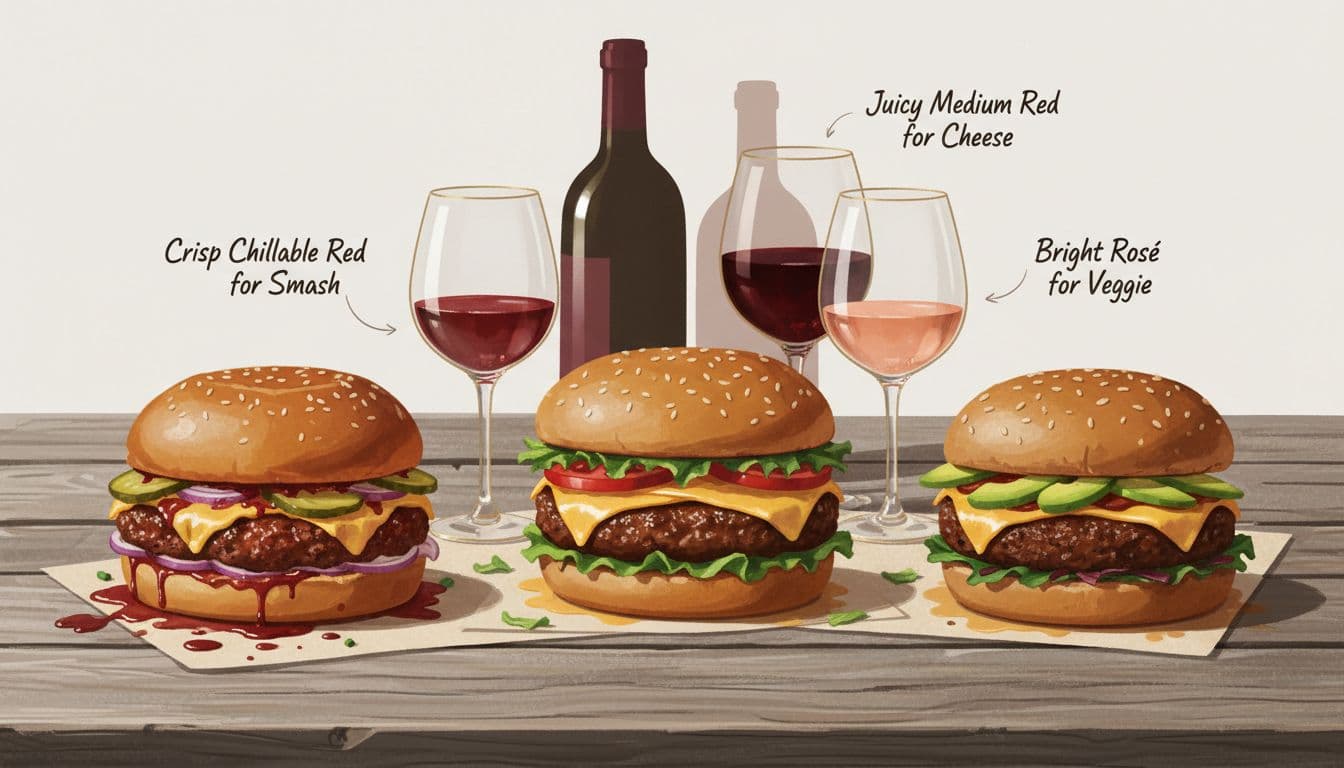
For burger night, three bottles cover almost everything: a chilled Gamay or Beaujolais for smash burgers, a Grenache blend or Merlot for cheeseburgers, and a dry rosé for turkey and veggie patties. Keep the tannin moderate so the char doesn't turn bitter, keep the acidity high so it cuts the fat, and serve your reds cooler than you probably do, somewhere around 55 to 60 degrees Fahrenheit.
That really is the whole method. You're matching wine to four things on the plate, which are fat, salt, char and whatever sweetness the sauce brings, and once you can name which of those is loudest you can pick a bottle in about ten seconds.
What makes a wine work with a burger?
A burger is a salty, fatty, charred thing, and those three qualities pull a wine in different directions. Fat coats your palate and dulls the next bite, so you want acidity to rinse it away, which is the same reason a pickle tastes so good halfway through. Salt has the useful side effect of making a wine taste fruitier and softer, so a red that seems a little austere on its own often blooms next to a burger.
Char is where most pairings go wrong. The bitter compounds in a hard sear stack on top of the bitterness in tannin, and past a certain point the two together taste harsh and drying rather than rich. That's why a big, heavily oaked Cabernet can feel like a fight with a smash burger even though both are intense, and why lighter reds so often win a matchup they look like they should lose.
Sweetness is the last variable, and it sneaks up on people. Ketchup, burger sauce, barbecue glaze and caramelized onions all carry real sugar, and a bone-dry red tasted against a sweet sauce reads as thin and sour. A wine with generous ripe fruit meets that sweetness halfway without needing to be a sweet wine itself. Wine Folly's burger and wine pairings lands in much the same territory, and if you want the underlying method rather than the shortcuts, our guide to pairing wine with food walks through it properly.
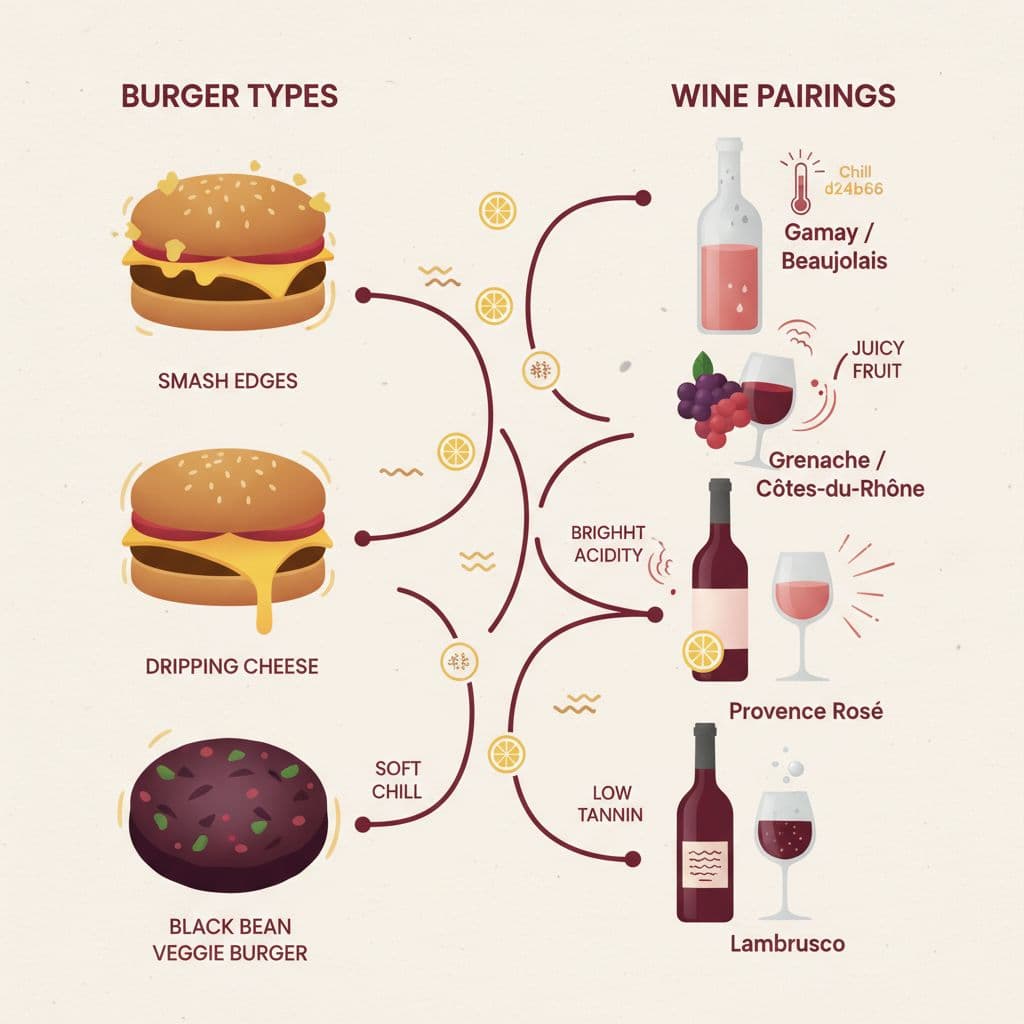
What wine goes with a smash burger?
A smash burger is mostly crust. The patty gets pressed thin onto a hot griddle so you end up with lacy browned edges, a lot of salt, and usually pickles, raw onion and mustard rather than a heavy sauce. That combination is tangy and savory more than it is rich, so it wants a red that shows up fresh rather than one that shows up heavy.
Gamay is the single best answer here, whether it says Beaujolais-Villages on the label or names a cru like Morgon or Fleurie. It has bright red-berry fruit, low tannin and enough acidity to keep pace with the pickles, and good bottles generally sit between $14 and $22. A dry Lambrusco is the more entertaining choice, because the carbonation physically scrubs the fat off your palate between bites, and you want one labelled secco rather than the sweet style most people remember. Cool-climate Pinot Noir from the Willamette Valley or the Sonoma Coast does the same job with more elegance and usually costs a bit more.
Spend your money on freshness rather than prestige for this one. A $14 bottle with lively acidity genuinely does more for a smash burger than a $35 bottle with a lot of new oak, and that's not a budget consolation prize, it's just how the pairing works. If Gamay is new to you, our guide to how Gamay tastes covers what to expect before you commit.
What wine goes with a classic cheeseburger?
Melted cheese adds fat and salt on top of a patty that already has plenty of both, and most cheeseburgers also arrive with something sweet, whether that's ketchup, burger sauce or onions cooked down soft. You need a red with a bit more flesh than the smash burger picks, but still one that keeps its tannin under control.
Grenache-based blends are the reliable middle ground, and a Côtes du Rhône or a Grenache-Syrah-Mourvèdre blend from anywhere gives you ripe red fruit, a peppery edge and a round texture that sits comfortably against cheese. Merlot works for the same reason, provided you pick a modern style rather than something buried in oak, and it's the easiest bottle on this list to hand to someone who says they don't really drink red. Cabernet Franc from Chinon or Bourgueil is the pick if your burger leans savory, with sharp cheddar, mushrooms, herbs or plenty of grilled onion, because its slightly leafy, peppery character meets those flavors rather than flattening them.
Match the wine to the cheese rather than to the beef, since the cheese is usually the louder ingredient. American cheese is mild and salty and wants something fruity and soft, so Grenache or Merlot. Sharp cheddar has its own acidity and bite, which is where Cabernet Franc earns its place, and you can read more in our Cabernet Franc food pairing guide. Blue cheese is a different problem entirely, salty and pungent enough to need a wine with real sweetness or very generous fruit, so reach for Zinfandel there. Our wine and cheese pairing guide goes further if you want the logic behind those splits.
What wine goes with a bacon or barbecue burger?
Add bacon and barbecue sauce and you change the pairing more than adding cheese does, because now you've got smoke and a genuinely sweet glaze rather than just fat and salt. The wine needs enough ripe fruit to meet that sugar and enough body to stand next to smoke, without bringing so much tannin that the char problem comes back.
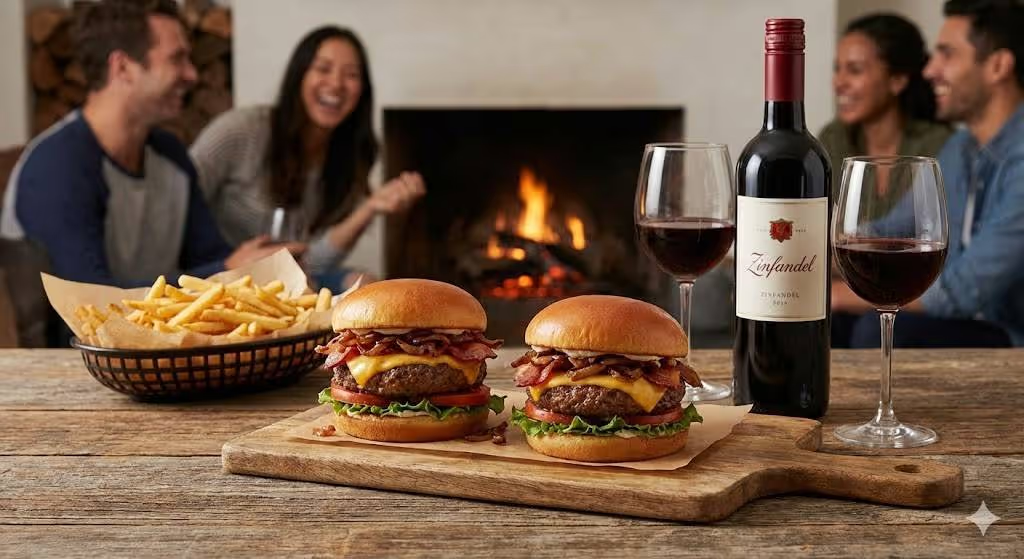
Zinfandel is made for this, with jammy dark fruit, a hint of sweetness in the finish on many bottles, and moderate tannin. Syrah, or Shiraz if it comes from Australia, brings a peppery savory note that flatters bacon in particular. Malbec from Mendoza is the safe supermarket pick, since it's plush and dark-fruited and rarely aggressive, and it tends to be good value between $12 and $18. Our guide to wine with barbecue ribs and pulled pork covers the same smoke-and-sugar problem in more depth.
The one style to avoid is a heavily oaked, high-alcohol red. Sweet sauce plus high alcohol reads as hot and slightly bitter together, and the oak piles more toast onto something that's already smoky.
What wine goes with a turkey or chicken burger?
A poultry patty is much leaner, so there's far less fat for the wine to cut through, and the seasoning tends to do the heavy lifting with herbs, garlic, lemon or a yogurt-based sauce. A red that works beautifully with beef will simply bulldoze it.
Dry rosé is the most flexible answer, with enough berry fruit to feel like a red and enough acidity and chill to feel like a white. Sangiovese in a lighter style suits a turkey burger with tomato, basil or roasted peppers, and unoaked Chardonnay or a Chablis works surprisingly well when there's a creamy or lemony sauce involved. If the patty has been grilled hard enough to pick up real char, a chilled Gamay bridges the gap without overwhelming the meat.
What wine goes with a veggie or plant-based burger?
Plant-based burgers vary far more than beef does, so the patty itself decides the pairing. A black bean patty is earthy and often spiced, a mushroom patty is savory and umami-rich, and a lentil or grain patty tends to be milder and nuttier. Dry rosé handles all three without much thought, and a lighter Sangiovese is the better call whenever there are tomatoes, peppers or Italian-leaning seasoning on the plate.
Beyond and Impossible patties are the exception, because they're built to mimic beef fat and they succeed well enough that you should pair them as if they were beef. Treat one like a cheeseburger and pour the Grenache blend rather than the rosé. Mushroom patties are the other special case, since their savory depth genuinely suits Pinot Noir, which is one of the few pairings on this page that works better with a vegetarian burger than a beef one.
When do the toppings matter more than the patty?
Often, and this is the part most pairing guides skip. The loudest ingredient on the plate wins, and a patty is frequently not the loudest thing there. If your burger has pickled jalapeños, chipotle mayo or hot sauce, the heat becomes the deciding factor, and you want an off-dry Riesling or a rosé rather than a big red, because alcohol and tannin both amplify capsaicin heat instead of soothing it. Our guide to wine with spicy food explains why that happens.
A fried egg or a lot of avocado pushes the burger toward richness and softness, which suits a rounder, fruitier red or a fuller rosé rather than anything with a sharp edge. Heavy ketchup or a sweet burger sauce means fruit matters more than structure, so lean toward Zinfandel, Grenache or Malbec. Blue cheese overrides literally everything else on the burger, and you should pick the wine for the blue cheese and ignore the rest.
How cold should the wine be for burger night?
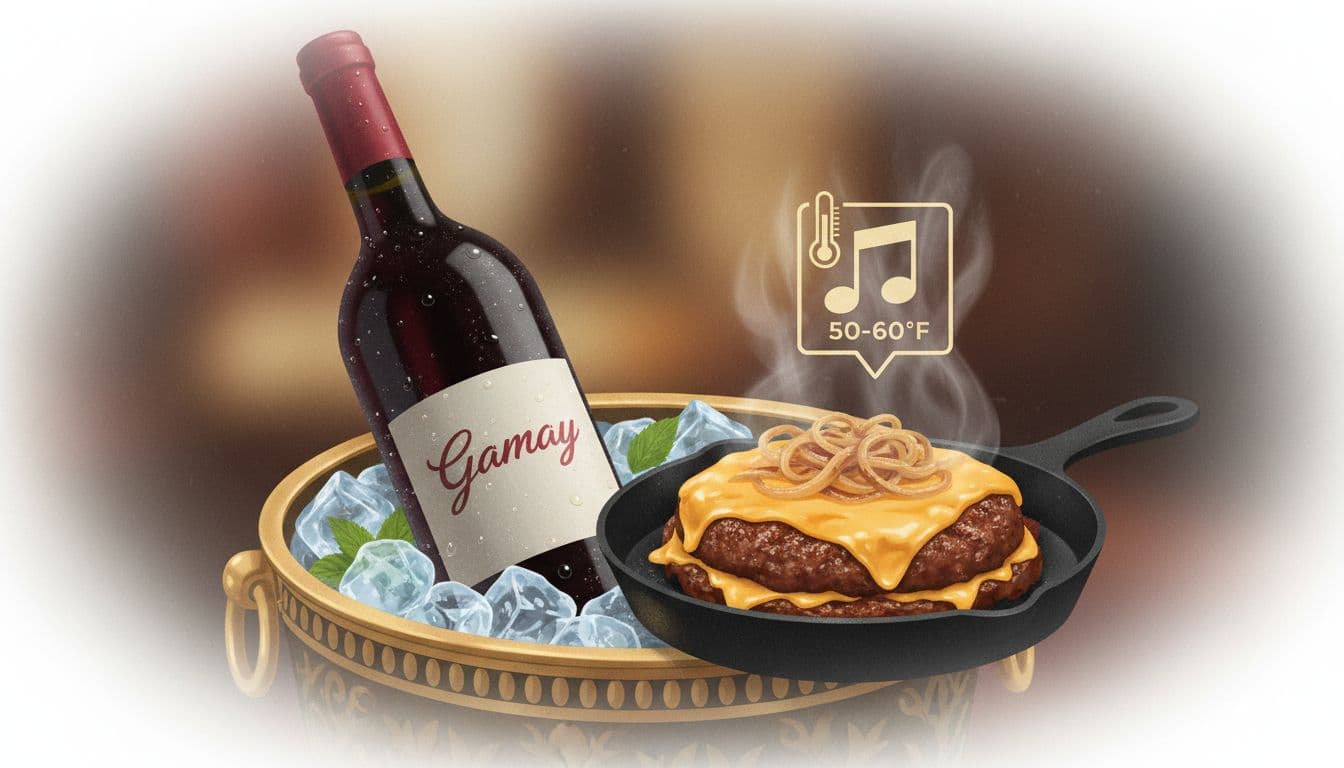
Colder than most people serve it, and this single change improves more burger pairings than swapping the bottle does. Light and medium-bodied reds show best between 55 and 60 degrees Fahrenheit, which is 12 to 15 degrees Celsius, while bolder reds want 60 to 68 degrees Fahrenheit, or 15 to 20 Celsius. Whites and rosés sit between 49 and 55 degrees Fahrenheit, meaning 7 to 12 Celsius, which is slightly warmer than your fridge actually runs.
In practice that means about 20 to 30 minutes in the fridge for a red before you pour it, and about 10 minutes out of the fridge for a rosé or a Lambrusco. A room-temperature red in a warm kitchen can easily be sitting at 72 degrees or higher, and at that temperature the alcohol turns volatile and slightly harsh, the fruit flattens out, and the tannin feels coarser against the char. Chilling it back down fixes all three at once and costs you nothing.
What should you order with a burger at a restaurant?
Ask for a style rather than a grape, because it gets you a better answer faster. Saying you want something light, juicy and low in tannin to go with a burger gives the server or sommelier enough to work with, whereas naming a grape limits you to whatever they happen to stock. Watch for oak language on the list as well, since words like reserve, barrel-aged or toasted signal the heavier style that tends to clash with char.
By-the-glass reds are very often served too warm, especially in a busy dining room, so it's entirely reasonable to ask for an ice bucket or a couple of cubes on the side for a lighter red. Nobody will think less of you, and it makes a real difference. If you're shopping rather than ordering, our guide to the best grocery store wines covers what tends to be worth buying in a supermarket aisle, and if you're standing there holding a bottle you don't recognize, Fit Check in Sommy gives you a quick read on whether it suits your style before you spend the money.
The habit worth building is simply noticing what worked. Burger night comes around often enough that a rough memory of which bottle you enjoyed last time is more useful than any pairing chart, including this one, because it's built from your own taste rather than an average of everyone's.
Frequently asked questions
Can you drink Cabernet Sauvignon with a burger?
Yes, though it's a better match for a thick, rare pub-style burger than for a thin smash burger, because Cabernet's firm tannin needs a lot of fat and protein to soften against. Pick a bottle that isn't heavily oaked, and serve it at the cooler end of the range, closer to 60 degrees Fahrenheit than 68.
Does white wine work with burgers?
It works better than its reputation suggests, particularly with turkey, chicken and lighter veggie patties. An unoaked Chardonnay, a Chenin Blanc or a dry Riesling all have the acidity to cut through fat, and a sparkling wine does the job even more effectively because the bubbles clear your palate as well.
What is the best cheap wine for burgers?
Beaujolais-Villages and Mendoza Malbec are the two most dependable picks under $15, since both deliver ripe fruit and soft tannin without much oak. A dry Lambrusco in the same price range is the more interesting option if your store carries one.
Should you chill red wine for burgers?
Yes, and it makes the biggest difference to lighter reds, where around 20 to 30 minutes in the fridge brings a Gamay, a Pinot Noir or a lighter Grenache into the 55 to 60 degree Fahrenheit range where the fruit is freshest and the tannin feels smoothest against char.
What wine goes with a burger and fries?
Fries add salt and fried richness rather than changing the direction of the pairing, so they reinforce whatever the burger already wanted. Sparkling wine and dry Lambrusco are especially good with fries in the picture, because carbonation handles fried food better than almost anything else.