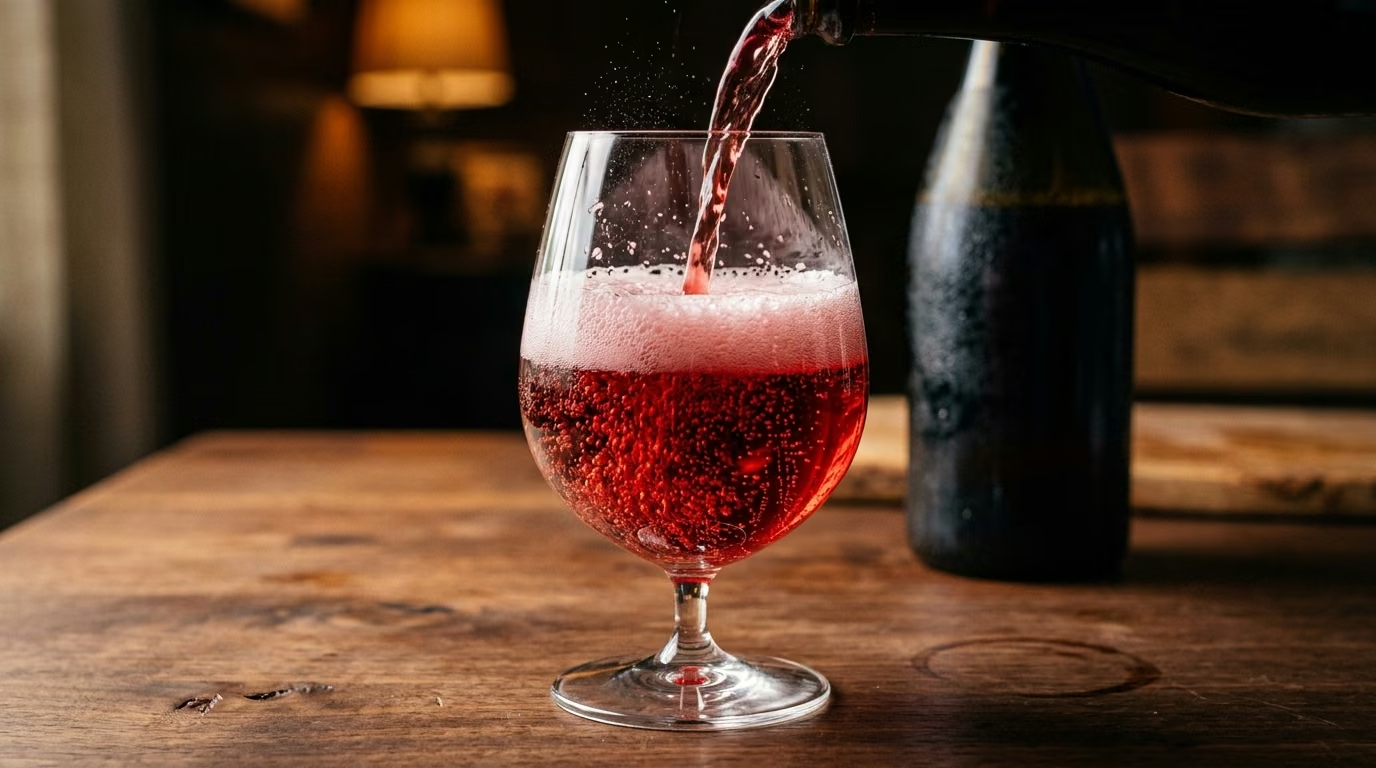

Sparkling Shiraz is a chilled, dry-to-off-dry red sparkling wine made from Shiraz grapes, and it is almost entirely an Australian creation. It tastes like the still wine you already know, all blackberry, plum and pepper, with the fruit lifted and the weight cut by a fine mousse of bubbles. Serve it properly cold, pour it with roast lamb or glazed ham rather than with canapes, and it turns into one of the most useful bottles you can put on a table where people want different things.
Red wine with bubbles sounds like a novelty for about ten seconds, until you taste one alongside a plate of Christmas ham and understand why an entire country has been drinking it for over a century.
What is a Sparkling Shiraz?
Sparkling Shiraz is a red sparkling wine made from Shiraz, the grape known as Syrah in France, produced mainly in Australia and mainly for the festive end of the year. It sits apart from every other sparkling wine on the shelf because it keeps the tannin and the dark fruit of a red wine instead of trading them for the citrus and toast of a white one.

The Victorian producer Best's, one of the few estates with a continuous history in the style, describes it as uniquely Australian and tied to the festive season, with new vintages released as the year winds down. Best's also makes the point that red sparkling wine is less strange than it first appears, since most Champagne contains a good proportion of Pinot Noir or Pinot Meunier and Italy has been making sparkling Lambrusco for generations. Sparkling Shiraz simply stops hiding the red grape behind a white wine.
Colour runs from deep ruby to something close to black in the glass, and the mousse is usually a purplish foam rather than the white bead you get on Champagne. Most examples carry a little residual sugar, which softens the tannin and stops the wine turning austere once it is cold. If the Syrah and Shiraz naming has ever confused you, our guide to Syrah against Shiraz untangles what each word signals about style.
Where did sparkling Shiraz come from?
Sparkling Shiraz was born in Australia in the 1890s, though the two regions with the strongest claim tell the story differently. Best's, in Great Western, says the region has been pioneering the method since the 1890s and that the style was first produced in Victoria over a century ago. The Glass of Bubbly account credits South Australia instead, naming the French winemaker Edmond Mazure, who began experimenting with the traditional method and Shiraz in 1893 after earlier attempts to make a sparkling Burgundy from Pinot Noir produced something closer to rose.
Both accounts agree on the decade and on the motive, which was a group of French-trained winemakers trying to make sparkling wine in a country whose best red grape happened to be Shiraz. Earlier versions were sold as sparkling Burgundy, a name that survived on Australian labels for decades before the style took the grape's own name. Best's re-released its Great Western Sparkling Burgundy in the 1950s and, after a long gap, brought the wine back again in 2006, a decision the winery describes as a mutiny by its own staff while the owners were away on holiday.
The category remains small and concentrated. Best's names Seppelt and Grampians Estate as fellow Grampians producers, alongside Rockford Black Shiraz, Primo Estate Joseph Sparkling Red and Bleasdale elsewhere in Australia. Very few producers outside Australia attempt the style at all, which is why almost every bottle you find will have crossed the Pacific.
What is the difference between Shiraz and Sparkling Shiraz?
The grape is identical, and everything else about the winemaking diverges after fermentation. Still Shiraz is fermented dry, matured in oak, and bottled without bubbles, so it arrives full-bodied and tannic and asks to be drunk at room temperature. Sparkling Shiraz takes that same base wine through a second fermentation that traps carbon dioxide, then usually receives a small sweetening dose before the bottle is sealed.
Those two changes do most of the work. Carbonation lifts aromatics out of the glass and scrubs the palate between mouthfuls, so a wine that would feel heavy still feels lively with bubbles running through it. The touch of sweetness rounds off tannin that would otherwise taste harsh at fridge temperature, since cold makes tannin read as more astringent than it does when a wine is warm. The result keeps the flavour of Shiraz while behaving on the table like a sparkling wine.
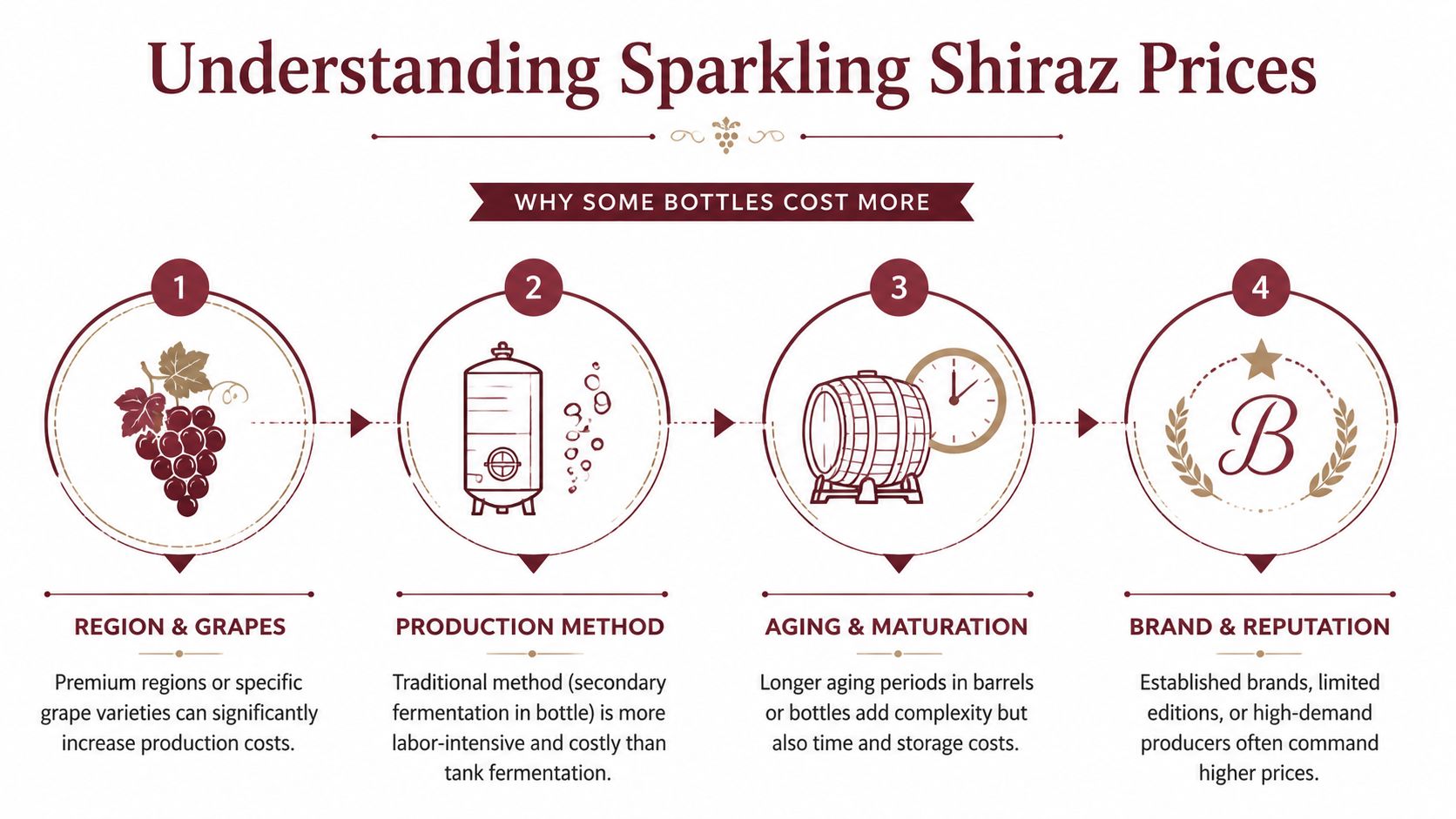
The best examples use the traditional method, with the second fermentation happening inside each individual bottle. Best's calls this the most expensive and time-consuming route and the one that gives the finest result in texture and complexity, and it is the same process behind Champagne. Cheaper sparkling Shiraz is made in a pressurised tank instead, which is quicker and gives larger, softer bubbles. If the vocabulary on sparkling labels trips you up, our explainer on what brut actually means covers the sweetness terms, and Prosecco compared with Cava and Champagne covers the production methods side by side.
What does sparkling Shiraz cost, and what are you paying for?
Price tracks production method and time far more than it tracks the region on the label. A tank-fermented sparkling Shiraz made for supermarket shelves costs a fraction of a traditional-method bottle that has spent a year or more resting on its yeast lees, and the difference shows up mostly in texture rather than in flavour. The cheap bottle gives you fruit and froth, while the expensive one gives you a creamier mousse and a longer finish.
Some of the most celebrated examples are non-vintage blends built from a solera-style reserve of older wines, which is part of why they cost what they do. We are deliberately not quoting dollar figures here, because Australian sparkling Shiraz reaches the United States in small allocations and the shelf price swings by state and by importer in a way that would make any number we printed wrong within a season.
The practical rule is to match the bottle to the occasion rather than to buy up the range by default. For a barbecue where the wine is going in a cooler and the glasses are being refilled fast, the tank-made bottle is genuinely the better choice. For a Christmas table where the wine sits next to the food and people actually taste it, the traditional-method one earns its premium.
Is sparkling Shiraz any good?
Sparkling Shiraz is very good at the specific job it exists to do, which is being the one bottle that suits a rich, warm-weather festive meal. Australians drink it at Christmas for a reason worth borrowing: their Christmas falls in summer, so the traditional heavy red is uncomfortable and a light white cannot stand up to glazed ham. A chilled red with bubbles solves both problems at once.

It is also good at a much more ordinary task, which is satisfying a table where one person wants red and another wants something sparkling. Rather than opening two bottles and leaving both half full, you open one that neither person can object to. That flexibility is the honest reason to keep a bottle in the fridge, and it holds up better than any argument about the wine's complexity.
Where it disappoints is against a claim nobody should make for it, which is that it competes with fine Champagne on finesse. It does not, and it is not trying to. If what you want is precision and a long mineral finish, this is the wrong bottle and a traditional-method white is where you should be looking instead.
What is Australia's best sparkling Shiraz?
There is no single best sparkling Shiraz, but the producers with the deepest track record in the style are concentrated in Victoria's Grampians. Best's and Seppelt are the two names most associated with Great Western, where the method has been practised since the 1890s, and Grampians Estate works the same ground. Outside Victoria, Rockford's Black Shiraz from the Barossa has the strongest cult following in Australia, and Primo Estate's Joseph Sparkling Red and Bleasdale are both long-running producers of the style.
What actually reaches American shelves is a narrower and more commercial group. The bottles that turn up most often in United States searches and stores are The Chook, Paringa, McWilliam's, Banrock Station and Mollydooker's Miss Molly, which sit at the accessible end of the category rather than the collectable one. None of them is a bad introduction, and the Grampians estates are what to graduate to if the style clicks.
We do not score wines out of a hundred here, so treat that as a map of who makes the style seriously rather than a ranking. Standing in front of an unfamiliar red fizz with no idea whether it suits you is exactly the moment Sommy's Fit Check is built for, since scanning the bottle gives you a verdict against your own taste rather than someone else's.
How should you serve sparkling Shiraz?
Serve it properly cold, the same way you would serve Champagne or any sparkling white. Best's is unambiguous on this point, and it matters more here than with white fizz because warmth in a red sparkling wine pushes the alcohol and the tannin forward and flattens the bubbles. An hour in the fridge or twenty minutes in an ice bucket is enough.
Use an ordinary wine glass rather than a narrow flute. The flute was designed to preserve bubbles in a delicate white and it strangles the aromatics of a wine this dark and spicy, whereas a standard white wine glass gives the fruit room to open up while keeping the wine cold. Our guide to serving temperatures by wine type covers where the sparkling range sits relative to still reds.
One practical warning about opening it: a sparkling red under pressure stains everything it touches, so point the bottle away from anything pale and ease the cork out with a hand over the top rather than letting it fly.
What food goes with sparkling Shiraz?
Sparkling Shiraz is built for rich, salty, festive food, and glazed ham is the classic partner. Best's recommends it with glazed ham, roast lamb, pudding and dark chocolate, and adds that it handles some genuinely awkward dishes that defeat most wines, including Peking duck, teriyaki salmon and a wedge of vintage cheddar. The combination of sweetness, acidity and bubbles is what lets it cope with sweet glazes that would make a dry red taste hollow.

That makes it unusually good on an American Thanksgiving table, where the turkey is mild but the sides are sweet and the cranberry sauce breaks most red wines. Barbecue works on the same logic, since the bubbles cut through fat and the residual sugar meets a sweet sauce halfway instead of fighting it, which is where our guide to food to pair with red wine would otherwise send you toward a soft, fruity red. Dark chocolate and berry desserts are the other reliable direction, covered further in our wine and dessert pairing guide.
What it does not suit is delicate food. Oysters, sushi, green salads and light white fish all get flattened by it, and there is no clever trick that rescues those combinations.
Frequently asked questions about sparkling Shiraz
Is sparkling Shiraz sweet?
Most sparkling Shiraz carries a small amount of residual sugar, which makes it taste off-dry rather than sweet. The sweetness is there to balance the tannin at cold serving temperature rather than to make a dessert wine, and the finished wine reads as fruity and rounded rather than sugary. Producers vary, and the drier examples come from the traditional-method end of the category.
Is sparkling Shiraz the same as Lambrusco?
No, though both are sparkling reds and the confusion is reasonable. Lambrusco is Italian, made from the Lambrusco family of grapes, and tends to be lighter in body with higher acidity and a more sour-cherry character. Sparkling Shiraz is darker, fuller and more peppery, and Best's makes the same point that the two are distinctly different styles.
Can you age sparkling Shiraz?
Good traditional-method examples age well, and some Australian producers release library vintages precisely because the style rewards time. The tannin softens and the fruit turns from fresh berry toward dried fruit and spice while the bubbles gradually soften. Inexpensive tank-made bottles are built for drinking young and gain nothing from being kept.
Where can you buy sparkling Shiraz in the United States?
Sparkling Shiraz turns up in larger wine shops and in the Australian section of big-box stores, usually around the end of the year when Australian producers release new vintages. Selection is thin outside that window, so a bottle spotted in November is worth buying then rather than looking for it again in March.
Is sparkling Shiraz a good gift?
It works well as a gift for someone who already drinks red wine and has been given enough Prosecco, since it is unfamiliar without being difficult. The style carries a genuine story about where it came from, which is more interesting to unwrap than another bottle of the expected thing, and our guide to wine for a Thanksgiving table covers the same occasion from a different angle.
Worth opening one
Sparkling Shiraz is a genuine Australian original rather than a gimmick, invented in the 1890s by winemakers who had the wrong grape for Champagne and made something better suited to their own country instead. Buy it cold, drink it cold, put it next to food with fat and salt and a sweet glaze, and it does a job no other bottle on the shelf does as well.
If you are still unsure whether the style suits your taste specifically, that is a fair question that no guide can answer for you, and it is the one Sommy is designed to work out.