


Petite Sirah and Syrah are two different grapes, and Petite Sirah is the darker and more tannic of the pair. Syrah leans on black plum, tobacco and green peppercorn, with medium-high tannin and a body that stays reasonably supple. Petite Sirah pours almost opaque and finishes with a firm, mouth-drying grip, carrying high tannin and usually more alcohol. They are genuinely related, because Petite Sirah is a cross of Syrah and an old French grape called Peloursin. If you want the chewier glass tonight, reach for Petite Sirah, and if you want pepper and savory perfume with a gentler finish, reach for Syrah.
What's the difference between Petite Sirah and Syrah?
Petite Sirah is Syrah's offspring rather than a smaller version of it, which makes the name the most misleading thing about the wine. The UC Davis Foundation Plant Services grape registry lists the variety under its real name, Durif, with a pedigree of Syrah crossed with Peloursin, a breeder credited as Durif, and a release year of 1880. The same registry records Petite Sirah and Petite Syrah as common synonyms, and the federal label authority treats Durif and Petite Sirah as the same approved name.

Syrah has its own paper trail, and it runs somewhere quite different. A 1998 study by Carole Meredith's group in viticulture and enology at UC Davis used DNA typing to identify Syrah as the offspring of two obscure grapes from southeastern France, Dureza and Mondeuse Blanche. Syrah is the grape of the northern Rhone, where it has centuries of documented history, and it travelled to Australia and became Shiraz.
Petite Sirah went the other way entirely. The crossing happened in a French nursery, the wine it produced was judged mediocre by local authorities at the time, and the grape is now almost nonexistent in France. California and Australia are the two leading producers, and in California you will find it planted in Lake, Mendocino, Sonoma, Napa, Monterey and San Joaquin County. So a bottle labelled Syrah is likely to be speaking in a French or Australian accent, while a bottle of Petite Sirah is very probably Californian.
One more wrinkle sits underneath all of this, and it matters when you taste an older bottle. DNA fingerprinting has shown that while most California Petite Sirah plantings really are Durif, some old vineyards turned out to be field blends of Durif mixed with other varieties such as Mondeuse noire, with everything in the block labelled Petite Sirah together. The label is accurate about the wine in your glass without always being precise about the vines.
Why is Petite Sirah bigger than its own parent?
Petite Sirah ends up more tannic and more alcoholic than Syrah, and the clearest way to see that is to put the two reference profiles beside each other. Wine Folly's grape profiles, written by Madeline Puckette, measure both grapes the same way, which makes them worth reading as a pair rather than one at a time.
| Petite Sirah | Syrah | |
|---|---|---|
| Tannin | High | Medium-high |
| Typical alcohol | Over 15% | 13.5% to 15% |
| Body | Full | Full |
| Acidity | Medium | Medium |
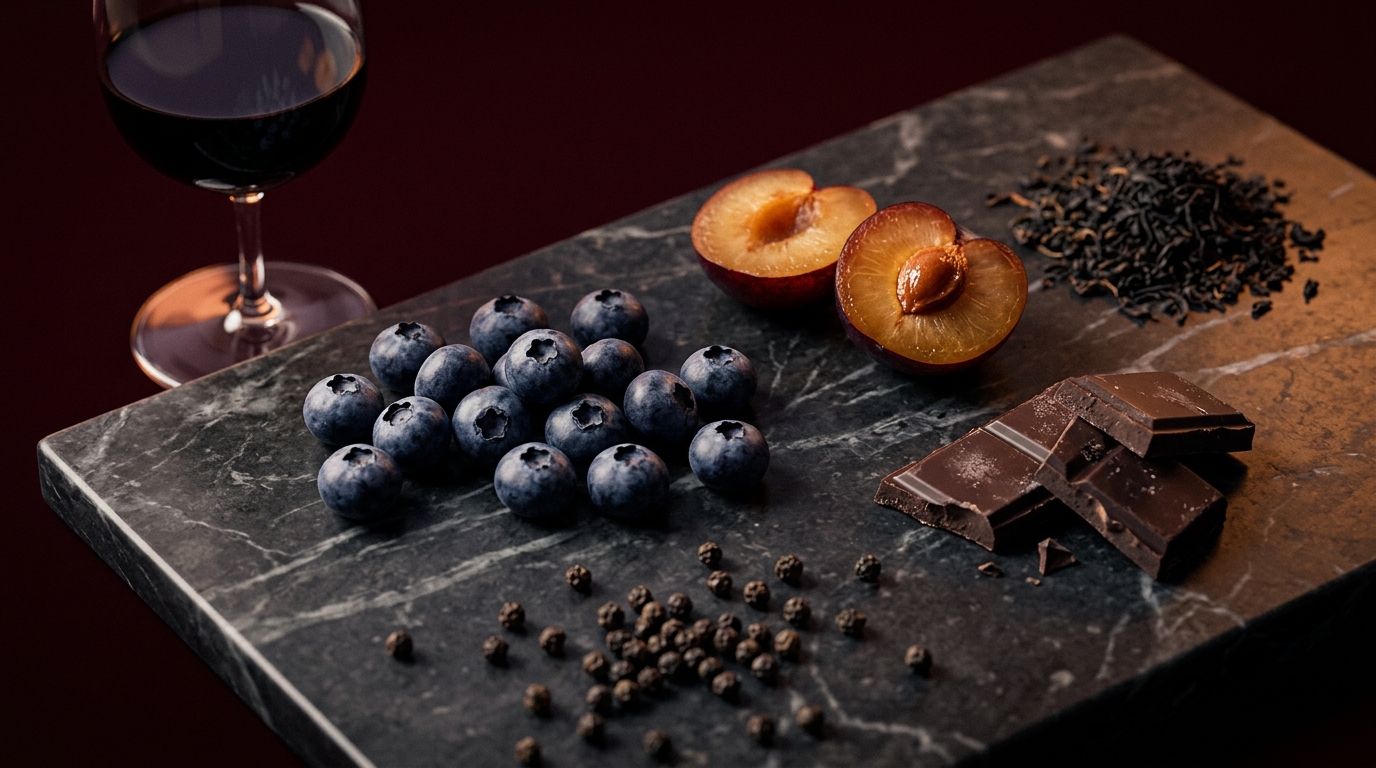
| Signature flavors | Sugarplum, blueberry, dark chocolate, black pepper, black tea | Blueberry, black plum, milk chocolate, tobacco, green peppercorn |
Those two columns are more interesting for where they agree than where they differ. Both grapes are dry, both are full bodied, and both sit at medium acidity, which is why the wines get shelved together and recommended interchangeably. The separation happens in two places, and both are things you can feel rather than guess at.
The first is tannin, rated high for Petite Sirah against medium-high for Syrah. That is the drying sensation on your gums and the inside of your cheeks, the one that reminds people of strongly brewed black tea. If you have ever wondered why some reds leave your mouth feeling scrubbed, our explainer on what wine tannins actually do walks through the sensation without the chemistry lecture.
The second is alcohol, and the gap is real. Petite Sirah is profiled at over 15% while Syrah runs 13.5% to 15%, so a glass of Petite Sirah tends to feel warmer and weightier even before the tannin arrives. Put those two together and you get a wine that takes up more room in your mouth than the grape that fathered it.
The flavor columns separate along a darker-versus-sweeter line too. Petite Sirah gets dark chocolate, black pepper and black tea, while Syrah gets milk chocolate, tobacco and green peppercorn. Those are small differences on paper that read as a noticeably more brooding glass in practice.
How do the two taste when you drink them side by side?
Pour them together and the first difference arrives before you smell anything, because Petite Sirah is visibly darker. The wine is described as deeply colored and nearly inky, relatively acidic, with a firm texture, herbal and black pepper overtones and flavors of blue fruit, black fruit and plums, with blueberry especially prominent. Tilt the glass and you often can't see your fingers through it.
Syrah's character shifts with where it grew, which is something Petite Sirah does far less. In moderate climates such as the northern Rhone Valley and parts of the Walla Walla AVA in Washington, Syrah produces medium to full bodied wines with medium-plus to high tannin and notes of blackberry, mint and black pepper. In hot climates such as Crete, or the Barossa Valley and McLaren Vale in Australia, the same grape turns more consistently full bodied with softer tannin, jammier fruit and spice notes of licorice, anise and earthy leather.
That climate sensitivity is genuinely useful when you're choosing. A Syrah from a cool site and a Syrah from a hot one are close to two different wines, so the region on the label tells you more than the grape name does. Petite Sirah is steadier across its growing areas, so what you get is closer to predictable from bottle to bottle.
Oak changes both, and it changes Petite Sirah more dramatically. Aged in new oak barrels, Petite Sirah can develop an aroma of melted chocolate on top of its already dark fruit, which is where some bottles pick up the mocha and cocoa character you see on shelf cards. Bogle's Petite Sirah, one of the widely stocked names, leads its own tasting notes with exactly that, describing aromas of cocoa and mocha.
Which one suits the red wine you already drink?
Your current favorite red is the most reliable starting point, better than any tasting note either of us could write. These comparisons describe the common styles rather than promising what a particular bottle will do, and the honest caveat is that producer choices matter as much as grape.
If you drink Cabernet Sauvignon and enjoy its structure, Petite Sirah is the natural next experiment, because you already like a wine that grips. If you drink Malbec for its plushness, Syrah is the safer move, since Petite Sirah's finish is firmer than what Malbec trained you to expect. Zinfandel drinkers will find Petite Sirah darker and more drying than their usual bottle, which is unsurprising given the two grapes are often blended together, and our guide to Syrah against Zinfandel covers that neighborhood in more detail. Pinot Noir drinkers should be careful with both, because either one is a considerably heavier mouthful.
The useful question underneath all of that isn't which grape is better, it's whether you personally enjoy a drying finish. That preference splits wine drinkers more sharply than any flavor note, and it never needs correcting in either direction. Plenty of people love dark fruit and dislike the grip that usually comes with it, and the answer for them is a rounder wine rather than a sweeter one.
This is the moment where Fit Check earns its place. You're standing in the aisle holding a bottle of Petite Sirah with no way to know whether that high tannin reading translates into something you'll actually enjoy, and Fit Check gives you a verdict on that specific bottle against your own taste rather than against an average drinker's. For a wider sweep of the category, our roundup of Syrah worth buying under $35 is a reasonable place to start a shortlist.
What food should you pour each one with?
Both wines want rich, savory food, and the difference in how you use them follows the difference in tannin. Petite Sirah's firmer grip needs fat and umami to soften against, so Wine Folly recommends it with steaks from the grill or a plate of beef stroganoff. Syrah's slightly gentler structure handles spice better, and the same source points it at lamb shawarma, gyros, Chinese five-spice pork and Indian tandoori dishes.

The practical rule is to match the strongest flavor on the plate rather than the main ingredient, which is the approach our guide to pairing wine with food is built around. A charred ribeye and a delicate roast chicken are both poultry-and-beef shaped decisions on paper, and completely different wine decisions in the glass.
Two cautions are worth knowing before you commit. Hot chili heat and firm tannin fight each other, and higher alcohol makes capsaicin burn feel stronger, so Petite Sirah at over 15% is the wrong partner for a heavily chili-glazed dish. Sweet sauces cause the other problem, because a sticky barbecue glaze makes a dry red taste harder and less fruity than it is. Chocolate deserves the same skepticism, since the cocoa notes in a Petite Sirah do not make it a dessert wine.
Serving them is almost identical, which simplifies matters. Both grapes are recommended at 60 to 68°F, roughly a cool room temperature rather than fridge-cold, and both benefit from about an hour of decanting. Air changes how the aromas and texture come across without removing tannin, so if the grip still bothers you after an hour, that's real information about your palate rather than a bottle that needed longer.
Does "Petite Syrah" on a label mean something different?
No, and this is the single most common point of confusion in the whole category. The UC Davis registry lists Petite Sirah and Petite Syrah as synonyms of the same variety, Durif, so a bottle spelled either way holds the same grape. Both spellings are in commercial use, which means searching only one of them at a shop or on a wine list will hide half the inventory from you.
The genuinely different name to watch is Shiraz, which is Syrah under its Australian name rather than a separate grape. Wikipedia's grape entry puts the relationship plainly, noting that Syrah shouldn't be confused with Petite Sirah, a cross of Syrah with Peloursin dating from 1880. The distinction has practical weight on a wine list, because producers who choose the word Shiraz are often signalling the riper, jammier, softer-tannin style that hot climates produce, and our piece on Syrah against Shiraz unpacks what that naming choice usually tells you.
So you're dealing with three label words covering two grapes. Syrah and Shiraz are the same grape wearing different hats, while Petite Sirah and Petite Syrah are the same grape as each other and the child of the first one.
Frequently asked questions about Petite Sirah and Syrah
Is Petite Sirah wine sweet or dry?
Petite Sirah is dry, and it is profiled as a dry wine with high tannin and medium acidity. Its ripe blackberry, blueberry and sugarplum flavors can read as sweetness to some drinkers even though very little sugar remains, which is a common and perfectly reasonable confusion. If residual sweetness genuinely matters to you, check the producer's own description rather than judging by how fruity the wine smells.
What wine is Petite Sirah similar to?
Petite Sirah sits closest to Syrah, Cabernet Sauvignon and Zinfandel, all of which are dark, full bodied and tannic. Syrah is the nearest relation because it is literally Petite Sirah's parent grape. Among those three, Cabernet Sauvignon is probably the best reference point for structure, while Zinfandel is the better reference point for dark jammy fruit.
Is Petite Sirah like Cabernet Sauvignon?
They have a lot in common, since both are full bodied and firmly tannic, which is why Cabernet drinkers usually get along with Petite Sirah. The differences are that Petite Sirah tends to pour darker, to lean more toward blueberry and sugarplum than cassis, and to carry higher alcohol. Cabernet also has far more stylistic range available to it at every price level.
Are a Syrah and a Shiraz the same?
Yes, Syrah and Shiraz are the same grape under two names, with Shiraz being the Australian term that spread to other new world regions. The names do carry a stylistic hint in practice, because Shiraz on a label often signals the riper and jammier style that warm climates give, while Syrah more often signals the peppery and savory style of cooler sites. The grape itself is identical either way.
Which has more tannin, Petite Sirah or Syrah?
Petite Sirah has more tannin, rated high against medium-high for Syrah, and it also typically carries more alcohol at over 15% against 13.5% to 15%. In the glass that combination reads as a bigger, warmer and more drying wine. Decanting either one for about an hour softens how the tannin comes across without actually reducing it.
Can I serve Petite Sirah or Syrah with the same meal?
Usually yes, because both want rich and savory food, so a grilled steak or a braised short rib suits either bottle. Lean toward Syrah when the dish carries real spice, since its slightly softer tannin and lower alcohol cope better with heat. Lean toward Petite Sirah when the plate is fatty and umami-heavy, because that fat is what its firmer grip needs to push against.
Is Petite Sirah or Syrah the better bottle for a first try?
Syrah is the easier introduction for most people, since its tannin and alcohol are both a step down from Petite Sirah's and its range of styles gives you more room to find a version you like. Start with a cool-climate Syrah if you want pepper and savory character, or an Australian Shiraz if you want ripe fruit and a softer finish. Come to Petite Sirah once you know you enjoy a drying finish.
Pick the grip you actually enjoy
The choice between these two grapes comes down to one question that has nothing to do with prestige or price, which is how much drying tannin you want in your mouth at the end of a sip. Petite Sirah gives you more of it, along with darker fruit, dark chocolate and usually more alcohol. Syrah gives you a step less tannin, a lighter touch of warmth, and a much wider spread of styles depending on whether the grapes grew somewhere cool or somewhere hot.
Buy one of each within your budget this month and drink them with the same meal a week apart. Notice which one you reach for a second glass of, because that single observation will tell you more about your own palate than any tasting note, including this one. If the answer turns out to be neither, you have still learned something worth knowing, and a bold red that suits you better is not hard to find.
