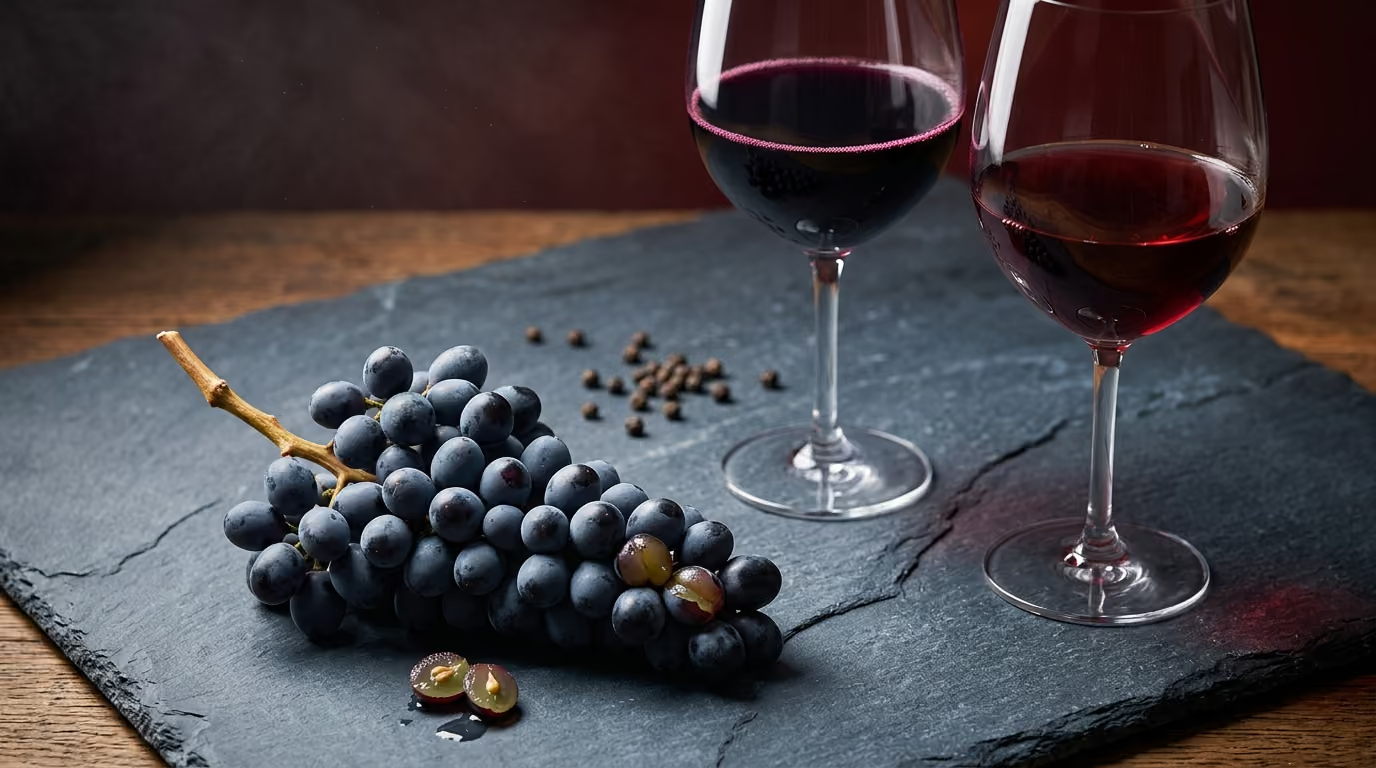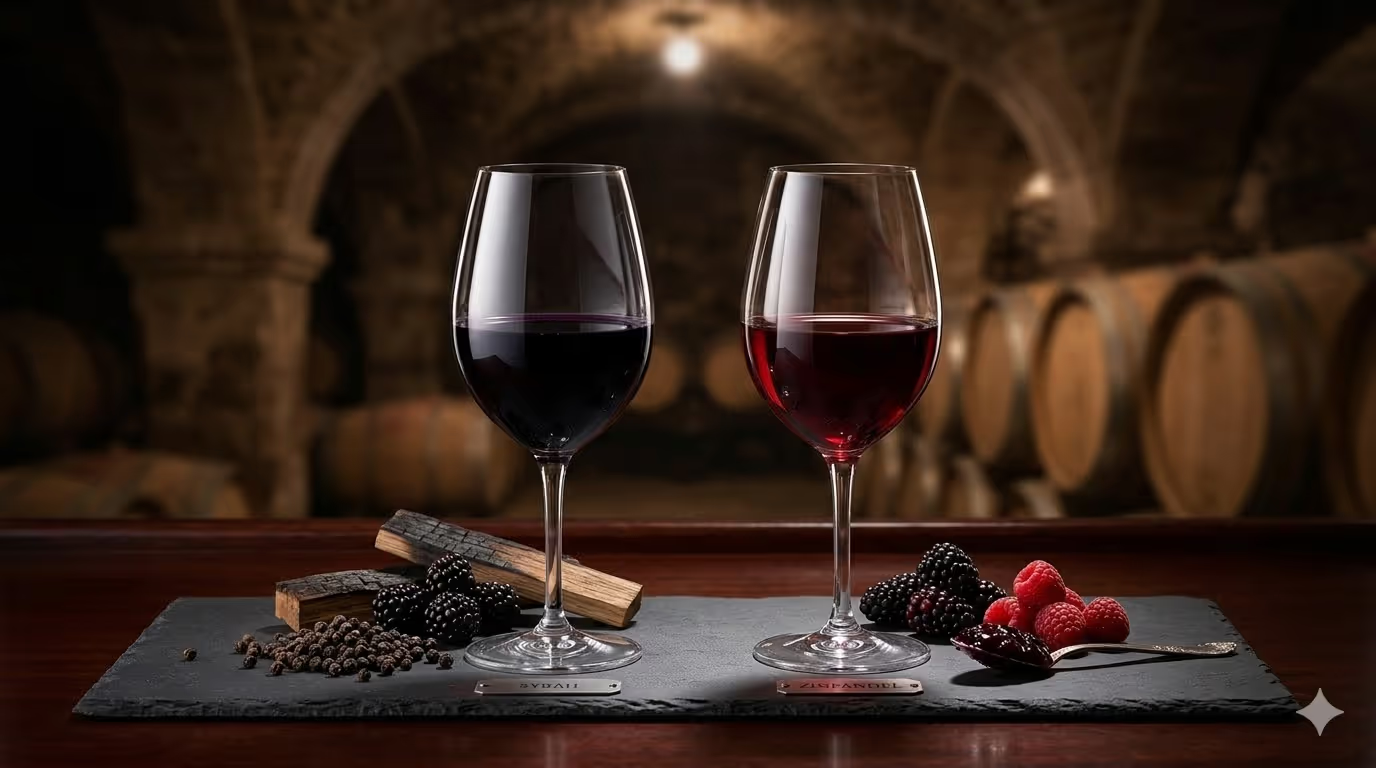

The best Syrah for you is decided by one number printed on almost every bottle, and it isn't the price. Alcohol by volume separates the two very different wines that both get called Syrah: at 13% you're buying something peppery, red-fruited and light on its feet, while at 15% you're buying something dark, dense and built for grilled meat. Both are excellent and they're barely the same drink, which is why so many people who say they don't like Syrah have simply met the wrong end of that range.
If you want names rather than theory, the sub-$35 bottles further down this page are the practical answer, and they come from a tasting by a wine publication rather than from a retailer's shelf. If you want to understand what you're choosing between first, start here.
What does Syrah actually taste like?
Black fruit, black pepper and something savory underneath, with the balance between those three shifting dramatically by where the grapes grew. The savory element is the part people struggle to name, and it gets described as smoked meat, olive, leather or cured bacon depending on who's writing. It's the signature of the grape and the reason Syrah tastes grown-up in a way that many fruit-forward reds don't.

The grape itself is more widely planted than most drinkers assume. Natalie MacLean's overview of Syrah notes that it was the seventh most planted variety in the world in 2004 and is now estimated to sit fifth, which is why it turns up on shelves in so many forms. The same piece records that DNA testing at UC Davis and Montpellier in 1998 identified Syrah as the offspring of two obscure vines from southeast France, Dureza and Mondeuse Blanche.
Tannin is the other variable worth knowing about, because Syrah carries a fair amount of it and young examples can feel gripping. If that word doesn't mean much to you yet, our explainer on what tannin is in wine covers the sensation rather than the chemistry. The short version is that tannin is the drying, slightly grippy feeling on your gums, and it softens as a bottle ages.
Which number on the label tells you which Syrah you're getting?
The alcohol percentage, and the spread within a single county proves how much work it does. In VinePair's tasting of seven West Coast Syrahs, the Paradise Springs bottling from the Sta. Rita Hills came in at 13% and was described as leading with red fruit and white pepper aromas into raspberry and pomegranate flavors, light enough on its feet to work with roast chicken and grilled salmon. The Rancho Sisquoc from the Santa Maria Valley, roughly thirty miles away in the same Santa Barbara County, carried 15.1%.
That's a real difference you can read before you buy. Under about 13.5%, expect brighter acidity, red fruit and more of the peppery side, which suits lighter food and a warmer room. Above about 14.5%, expect darker fruit, more weight and more of the oak and smoke character, which wants something substantial on the plate. The middle of the range does what middles usually do and splits the difference.
VinePair's reviewer frames the regional version of the same contrast clearly. West Coast Syrahs run higher in alcohol and more tannic, dominated by dark fruit with hints of smoke and meat and a good deal of oak, while the East Coast wines he'd tasted from the Finger Lakes and Long Island were light in color with red fruit flavors and lively acidity. Cool sites on the West Coast can produce that leaner expression too, which is exactly what the Paradise Springs bottle demonstrates.
What are the best Syrahs under $35?
Four of the seven wines in that VinePair tasting landed under $35 at the time it was published in February 2024, and they cover most of the stylistic range worth knowing. Prices move, so treat these as the level each wine was released at rather than what your store will charge today.

The Rusack Vineyards Ballard Canyon Estate Syrah 2019 from the Santa Ynez Valley was the outright bargain of the set. VinePair listed a suggested price of $36 with one retailer selling it at $19, and described dense black fruit with leather, graphite and black licorice, still young and spicy but drinking well. It's 95% Syrah with 5% Petite Sirah, which is a traditional blending move that adds color and grip.
The Luke Columbia Valley Wahluke Slope Syrah 2020 at $25 is the easiest one to actually find, described as big and spicy with concentrated sweet blueberry and blackberry flavors alongside dark chocolate, pepper and minerals, and noted as widely available in stores. If you want to try Washington Syrah without hunting, start here.
The Damsel Cellars Stillwater Creek Vineyard Syrah 2019 at $32 comes from the higher-elevation Royal Slope in south-central Washington, with dense but bright dark fruit leaning toward blackcurrant, plus violets and savory notes, and refreshing acidity that keeps 14.8% alcohol from feeling heavy. The Rancho Sisquoc Flood Family Vineyard Syrah 2020 at $34 is the Santa Maria Valley bottle mentioned above, carrying red and dark berry fruit with flint, cinnamon and pencil shavings despite its 15.1% label.
One buying note from the same tasting is worth more than any individual recommendation. The reviewer found that young West Coast Syrah can taste harsh, with the fruit hidden behind oak and aggressive tannins, and that even a couple of years in the bottle lets it relax and the fruit come forward. If you buy a current release and it feels closed on the first night, that's a normal stage rather than a bad bottle.
Why do people think they don't like Syrah?
Almost always because they met one end of the range and assumed it was the whole grape. Someone whose only Syrah was a 15% Australian Shiraz at a barbecue will remember it as heavy and sweet-tasting, and someone whose only Syrah was a stern young northern Rhone will remember it as dry and tannic. Neither person has met the other wine, and both have formed an opinion about a category that contains both.
The second common reason is timing. VinePair's tasting notes repeatedly mention young West Coast Syrah tasting harsh before it settles, and a current release opened the week you bought it is showing you its most closed face. Wine in this style genuinely improves over a couple of years, and the bottles most people buy are the ones that have not had them.
The third reason is temperature, which is the easiest to fix. A big Syrah served at a warm room temperature reads as alcoholic and flabby, because warmth exaggerates alcohol and flattens acidity. Twenty minutes in the fridge before pouring takes a bottle from roughly room temperature down toward the low sixties Fahrenheit, which is where the fruit tightens up and the pepper becomes visible. If you've had a Syrah that tasted like warm jam, this is probably why.
Where does the best Syrah come from?
The northern Rhone Valley in France is the historical answer and still the reference point, with Washington State, Santa Barbara County and Australia making the wines most Americans will actually meet. MacLean's overview points out that Syrah owes most of its fame to Hermitage, the northern Rhone appellation whose small parcels produced long-lived reds that fetched high prices.
The grape's history there runs deeper than its modern reputation suggests. MacLean's overview notes that Syrah has been producing fine wines in the Rhone since Roman times, which makes it one of the longest continuously cultivated varieties in French winemaking. That matters less as trivia than as an explanation of why the northern Rhone appellations are drawn so tightly around specific slopes, since the boundaries encode centuries of working out which sites ripen the grape properly.
The practical problem with the Rhone's famous names is that Hermitage and Cote-Rotie now sell for hundreds of dollars a bottle, which puts them outside what this page is for. The useful move is to buy the same grape from the appellations next door. Crozes-Hermitage sits on the flatter land around Hermitage and gives you a recognizably northern Rhone profile at ordinary prices, and Saint-Joseph on the opposite bank does something similar with a touch more perfume. Those two are where the region's value lives.

In California, Santa Barbara County has the strongest claim, and VinePair quotes Karen MacNeil in The Wine Bible calling those AVAs possibly Syrah's ultimate California home, the singular place where it consistently makes uncommonly good wine. Washington State is the other serious American source, and the Columbia Valley sub-appellations such as Wahluke Slope and Royal Slope are where most of the value sits. Our piece on old world versus new world wine covers why the same grape reads so differently across those addresses.
Australia is the fourth source and the largest after France, where MacLean notes it is the number one variety in the country and goes by Shiraz rather than Syrah. Australian Shiraz is also the S in a GSM blend, alongside Grenache and Mourvedre, which is worth knowing because those blends are often the softer, friendlier way into the style. Our guide to what Grenache tastes like covers the partner grape.
Are Syrah and Shiraz the same wine?
Same grape, different name, and in practice a different house style. MacLean records that the variety is labeled Syrah in France and across the rest of Europe, the United States, Argentina, Chile and New Zealand, while Australia calls it Shiraz, a convention also common in South Africa and Canada. Australia used the term Hermitage until the late 1980s and dropped it because Hermitage is a protected French appellation name.
The naming has become a rough signal of intent. A bottle that says Shiraz is more often aiming for full body, deep color and forward fruit, while a bottle that says Syrah more often leans savory and structured. It's a tendency rather than a rule, and plenty of American producers use Syrah for a big ripe wine. We go through the practical differences in detail in Syrah versus Shiraz, and if you're weighing it against another big red, Syrah versus Zinfandel covers that comparison.
What should you eat with Syrah?
Grilled and roasted red meat is the classic answer for the darker style, and VinePair's reviewer makes exactly that point about West Coast Syrah, naming grilled and roasted red meats, pork and other hearty food as its natural partners. The pepper and savory notes in the wine do something specific with charred meat that a softer, fruitier red doesn't.
The lighter, lower-alcohol style opens up a wider table. The Paradise Springs bottle at 13% was recommended in that tasting with roast pork, chicken and grilled salmon, which is a range most people wouldn't guess for a Syrah. That's the practical payoff of reading the alcohol percentage before you buy, since it tells you which dinner the bottle belongs to. Our broader guide to food to pair with red wine covers the reasoning across other grapes.
How should you serve and store it?
Serve it cool rather than cold, around 60 to 65 degrees Fahrenheit, which for most American homes means a short spell in the refrigerator rather than the cellar temperature nobody actually has. The heavier the wine, the more that matters, because a 15% bottle poured at 72 degrees gives you the alcohol before it gives you anything else.
Decanting helps young Syrah more than it helps most reds. An hour in a decanter, or even vigorous swirling in a big glass, softens the grip and lets the savory character come through, which is the same effect a couple of years in the bottle would achieve more slowly. A wine that seems tight and sullen on the first pour is often unrecognizable an hour later.
An opened bottle holds up for two or three days in the fridge with the cork pushed back in, and Syrah's tannin actually makes it more durable than a delicate red. Pull it out half an hour before you want the second glass, since the same temperature logic applies on day two.
Questions people ask about Syrah
What is a good Syrah wine?
One that matches the style you already enjoy in red wine, since Syrah spans a wider range than almost any other single grape. If you like bold and dark, look for a Washington or Santa Maria bottling above 14.5% alcohol. If you like bright and savory, look for a cool-climate California or northern Rhone bottle nearer 13%.
What is the best Syrah wine under $30?
The Rusack Ballard Canyon Estate Syrah and the Luke Columbia Valley Wahluke Slope Syrah both fell under $30 in VinePair's 2024 tasting, at $19 and $25 respectively. The Luke is the more widely distributed of the two, so it's the easier one to find without hunting.
What is the best Syrah under $50?
Everything under $35 above still applies, and the extra headroom mostly buys you cool-climate Santa Barbara bottlings and single-vineyard wines from Washington. Crozes-Hermitage and Saint-Joseph from the northern Rhone also sit comfortably in this band and give you the French savory profile the region is famous for.
Are Shiraz and Syrah the same thing?
Yes, the same grape variety under two names. Australia and, commonly, South Africa and Canada use Shiraz, while France, the rest of Europe, the United States, Argentina, Chile and New Zealand use Syrah.
Which wine is sweeter, Syrah or Shiraz?
Both are usually made dry, so neither carries meaningful residual sugar. Australian Shiraz often tastes sweeter because ripe fruit and higher alcohol read as sweetness on the palate, which is a perception rather than sugar in the glass.
Why is Syrah so good with food?
Because it brings savory and peppery notes alongside the fruit, which gives it something to trade with grilled, roasted and spiced dishes rather than simply sitting beside them. Its tannin also cuts through fat in a way that softer reds cannot.
Picking your bottle tonight
Turn the bottle around, read the alcohol percentage, and match it to what you're eating and how you like your reds. Under 13.5% points to the bright, peppery, food-flexible version of Syrah, and over 14.5% points to the dark, weighty one that wants something off the grill. That single check does more for your odds than any ranked list, because it's the one piece of information on the label that reliably predicts the taste.
Sommy exists for the part that comes after. You log the bottle you liked, and the next recommendation is built from your own reactions rather than a stranger's ranking, which matters more with a grape this variable than with almost any other red.