

You buy a few bottles worth saving for a birthday, holiday, or future dinner. Then a new worry shows up. How do you make sure the cellar or wine fridge is protecting them?
A hygrometer for wine cellar use is the simple tool that answers that question. It tells you whether the air is in the safe humidity range, so your corks stay healthy and your bottles age the way you hoped.
There's no need for more wine theory. What's needed is one clear way to avoid a preventable mistake. Humidity is one of those quiet details that matters a lot, and checking it is easier than most collectors expect.
Protecting Your Wine Starts with One Simple Tool
A lot of wine storage anxiety starts the same way. You begin with a few bottles you care about, maybe gifts, trip souvenirs, or wines you want to save for a special meal. Then you realize storage isn't just about keeping them cool.
Humidity sits in the background, but it affects whether your bottles stay protected over time. A hygrometer is the tool that tells you what the air is doing. It doesn't make wine collecting complicated. It makes it manageable.
Think of it as a quiet checkpoint. If the room is too dry, corks can start losing their seal. If it's too damp, labels and cork exteriors can suffer. A quick reading gives you a chance to fix the room before the bottles pay the price.
Practical rule: If you're storing wine for more than casual short-term keeping, humidity is worth monitoring, not guessing.
People often assume cellar care requires expensive gear and constant attention. In reality, a hygrometer is one of the simplest parts of the setup. You hang it, place it, or connect it, then check it as part of your normal routine.
If you're still getting your space in order, a guide on how to organize a wine cellar can help you think about bottle placement, airflow, and access at the same time.
Why Humidity Is a Big Deal for Your Wine
You open a bottle you've saved for years, expecting freshness and balance. Instead, the fruit tastes flat, the color looks a little tired, and the moment feels smaller than it should.
Humidity often plays a quiet part in that outcome.
Wine storage gets reduced to temperature so often that humidity can feel secondary. It isn't. Cork is a natural material, and natural materials respond to the air around them. If the cellar stays too dry for long enough, the cork can lose some of its elasticity and seal less tightly. A weaker seal gives oxygen more room to creep in, which can push a wine to age faster than you planned.
That matters most with bottles you're holding for future enjoyment, special occasions, or resale. Good storage protects more than liquid. It protects timing, flavor, and value.
What low humidity does
Low humidity puts the cork under stress over time. The effect is slow, which is why people miss it. Nothing looks dramatic at first, but the bottle can start aging in a different way than the winemaker intended.
The practical risk is simple. A drier cork can seal less effectively, and that can lead to oxidation. In the glass, that may show up as muted fruit, less freshness, and a wine that seems older than its age.
If you keep tasting notes or track your collection, humidity belongs in that routine too. A wine journal is not only for recording aromas and scores. It also helps you connect storage conditions with how a bottle develops, which makes storing wine properly at home feel like part of enjoying wine, not a separate chore.
What high humidity can cause
High humidity creates a different set of problems. The wine inside the bottle may remain protected, but the bottle itself can suffer.
Labels can wrinkle, stain, or grow mold. Cork exteriors can look dirty or deteriorated. If you give bottles as gifts, plan to sell part of your collection, or like opening a bottle that still looks cared for, those details matter.
Very damp air can also make it harder to spot other problems in the cellar because everything starts to look a little neglected.
Wine Cellar Environment At a Glance
| Condition | Ideal Range | Risk if Too Low | Risk if Too High |
|---|---|---|---|
| Humidity | 55-70% RH | Corks can dry out and lose seal quality | Mold can grow on labels and corks |
| Temperature | Stable cellar temperature | Poor storage conditions can stress wine over time | Poor storage conditions can stress wine over time |
A hygrometer helps because it turns a hidden condition into something you can check in seconds.
That is the reason humidity matters. You are not monitoring air for the sake of precision. You are protecting how your wine tastes when the bottle is finally opened, and preserving the condition of the collection while it waits.
Comparing Hygrometer Types for Your Cellar
You open your cellar, glance at a reading, and decide whether your bottles are aging safely or drifting toward trouble. That small moment is why the type of hygrometer matters. The best choice is not the one with the longest feature list. It is the one that fits how you check on your wine.
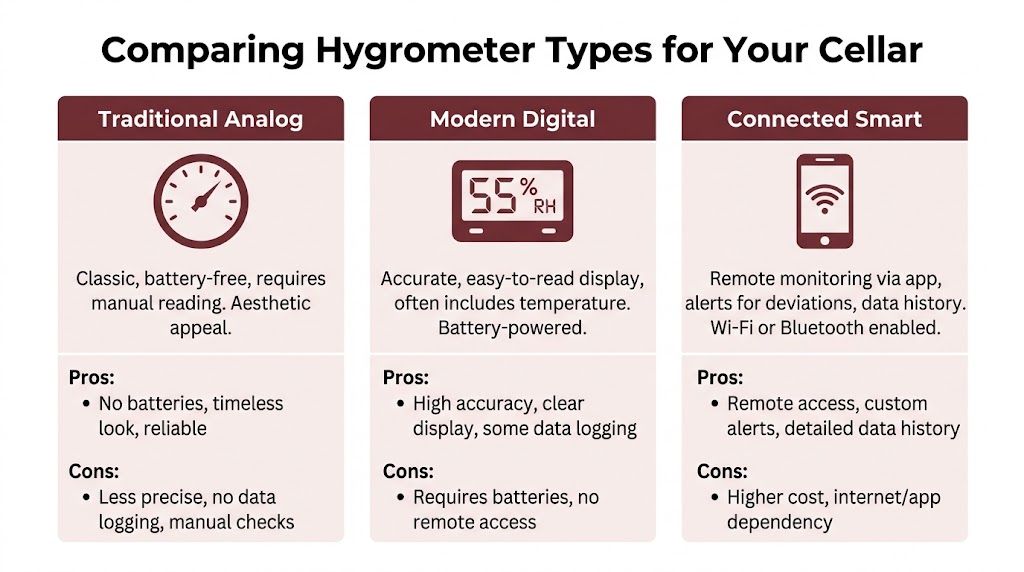
Three types show up most often: analog, digital, and smart connected models. They all answer the same basic question, but they do it in different ways. A good comparison starts with daily use, because a reading only helps if you notice it and trust it.
Analog hygrometers
Analog hygrometers use a dial and needle. They suit a traditional cellar well, especially if you like the look of wood racks, labels, and old-world details working together.
Their appeal is simple. No batteries, no app, no notifications.
That simplicity comes with a tradeoff. Analog models can need occasional recalibration, so they tend to fit owners who do not mind a little hands-on upkeep. If checking your cellar already feels like part of your wine routine, that may not be a burden at all. It can feel more like caring for a favorite watch than managing another household device.
Analog is usually a good fit if you want:
- A classic appearance that blends into the cellar
- A battery-free tool with very little setup
- Quick in-person checks during regular cellar visits
It is less suited to anyone who wants records, alerts, or readings while away from home.
Digital hygrometers
Digital models trade the dial for a screen. That sounds like a small difference, but in practice it changes how often people use the device. A clear number is faster to read than a needle position, especially in dim cellar light.
For many collectors, digital is the most practical middle ground. You get quick readings, an easy display, and fewer judgment calls about whether the humidity looks slightly high or slightly low. If your goal is to protect bottles without turning storage into a hobby of its own, digital often feels easiest to live with.
Some units also pair humidity with temperature on the same display, which helps you spot changes in the room without checking multiple tools.
Connected smart hygrometers
Smart hygrometers add phone access through Bluetooth or WiFi. That matters less in a small cellar you walk past every day. It matters much more in a basement corner, garage conversion, or second home where conditions can change before you notice.
A connected model works like a baby monitor for your cellar. You are not standing there all the time, but you can still check in and get warned when something drifts out of range.
That added visibility can be especially useful if you already treat storage as part of a broader wine practice. Seeing a humidity swing, then noting it alongside tasting impressions later, can help you connect cellar conditions to how bottles show over time. If you are also planning the room itself, this guide on how to climate control a wine cellar can help you build around the monitor rather than treating it as a separate gadget.
Smart models make the most sense when you want:
- Remote checks while traveling or away from the house
- Alerts instead of relying on memory
- Stored history that helps you notice patterns
A simple way to choose
Choose analog if you enjoy a traditional look and do not mind occasional manual care.
Choose digital if you want clear, quick readings with very little fuss.
Choose smart if you want your cellar monitored even when wine is the last thing on your mind.
A hygrometer should support the way you care for your collection. The right one helps you protect flavor, preserve presentation, and fold humidity checks into the same habit as logging bottles, tasting notes, and special openings.
Key Features to Evaluate When Choosing
A good hygrometer should answer a simple question fast. Is your cellar still protecting your wine, or is it starting to drift?
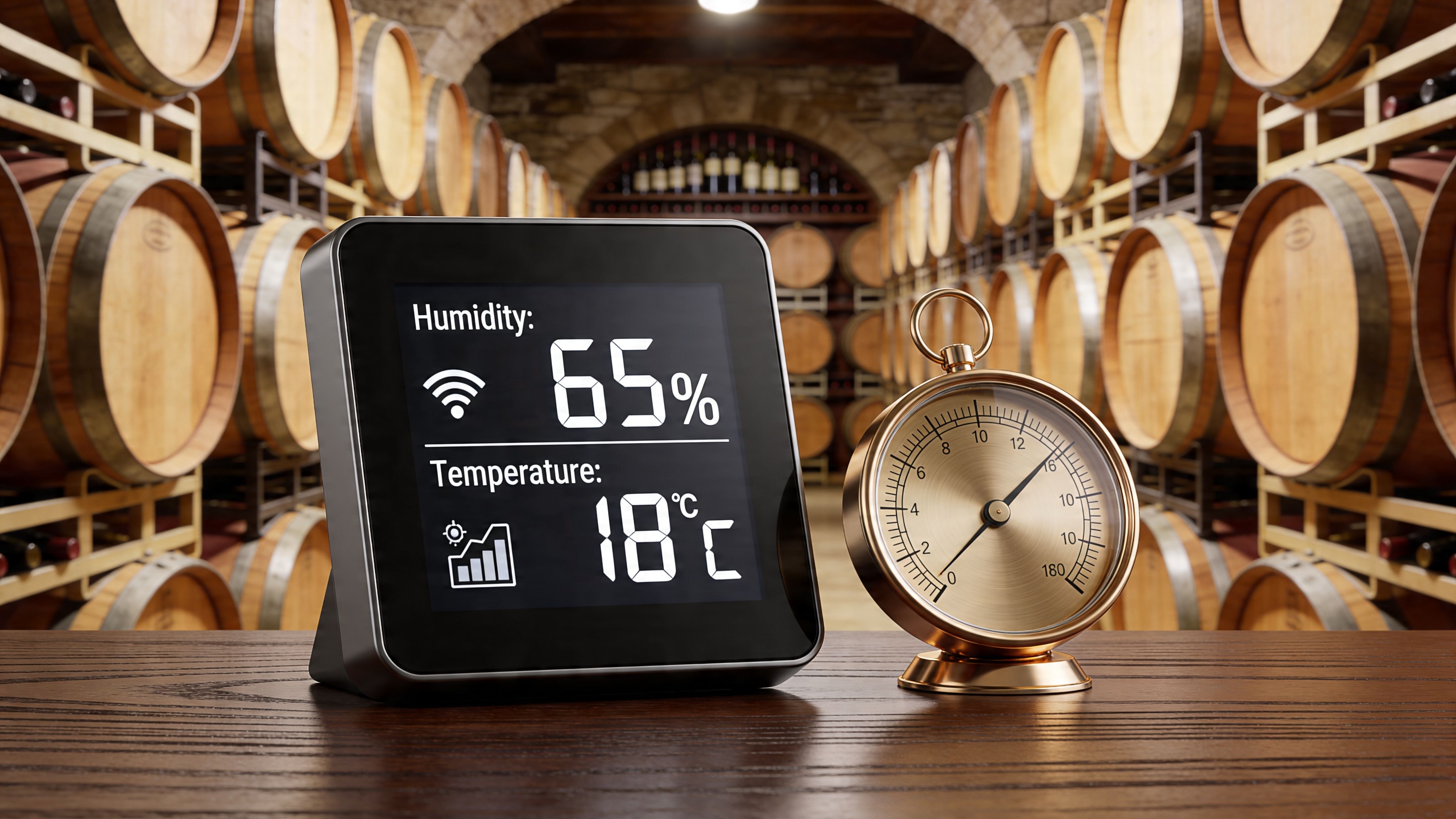
That mindset helps you shop better than comparing product names alone. You are choosing a tool that helps keep corks healthy, labels clean, and aging conditions steady enough that the bottle you open years from now still tastes like it should.
Accuracy that helps you act
Accuracy matters, but only if the reading is clear enough to guide a decision. If a hygrometer is a few points off, you may miss a slow humidity drop that dries corks or a damp stretch that starts to affect labels and packaging.
For most home collectors, the best choice is a unit that reads consistently and stays close enough to reality to show whether conditions are safely in range. Consistency matters because trend changes are often more useful than a single perfect number. If the reading keeps slipping lower over a week, that is the signal you need.
Easy calibration
Calibration sounds technical, but the idea is simple. You are checking whether the tool still tells the truth.
Some hygrometers make this easy with a manual adjustment option or a straightforward reset process. That saves frustration later. A model that can be recalibrated is often a better long-term buy than one that looks polished but slowly drifts.
Ask yourself three practical questions:
- Can I recalibrate this without special tools?
- Are the instructions clear enough that I will do it?
- Will this still be easy a year from now?
Readability in real cellar conditions
A hygrometer is only useful if you can read it quickly. Low light, crowded shelving, and a quick glance before dinner are real-world conditions, not edge cases.
Look for a display or dial that is easy to read from a normal standing distance. Clear numbers, strong contrast, and an uncluttered layout matter more than decorative styling. If you need to squint, bend down, or tap buttons every time, you will check it less often.
Alerts, memory, and logging
Some features protect wine in the background. High and low alerts, stored readings, and simple history logs help you catch patterns before they become storage problems.
This is also where a hygrometer becomes part of a broader wine habit rather than a wall accessory. If you keep tasting notes or track bottles digitally, humidity history can sit beside those records and add useful context. A short note like "humidity dipped during January cold snap" can explain a storage adjustment later, much like noting decant time helps explain how a wine showed in the glass.
Power source and day-to-day fit
A good device should match the way you use your cellar. Battery models are easy to place almost anywhere. Plug-in or USB-powered units can be convenient if you want fewer battery changes and already have power nearby.
Neither is automatically better. The better choice is the one you will maintain without effort. A forgotten dead battery helps no bottle.
Build quality for your specific room
Wine cellars are not all alike. A compact cabinet, a finished basement cellar, and a rougher garage conversion put different demands on the device.
Choose a hygrometer that suits the room's conditions and size. If the space tends to run damp, look for materials and construction that hold up well over time. If you are still improving the room itself, good wine cellar insulation choices will do as much for stable readings as the monitor you hang on the wall.
The best pick is rarely the fanciest one. It is the one you can read, trust, maintain, and naturally fold into the same routine as checking your bottles and recording what you open.
Proper Placement and Installation for Accurate Readings
You walk into the cellar, glance at the hygrometer, and feel reassured by the number on the screen. That reassurance only helps your wine if the device is reading the room, not a draft, a vent, or a damp corner.
Placement matters because a hygrometer samples one small pocket of air. Your goal is to give it a spot that represents the cellar as a whole, the same way you would judge a bottle by how it stored over time, not by one brief temperature change when the door opened.
Where it should go
Start with the center of the room if possible. In many cellars, that gives you the most honest picture of everyday conditions.
A good setup usually follows a few simple rules:
- Place it near the middle of the cellar so it reflects average humidity rather than one microclimate
- Keep it around eye level if you mount it on a wall, because a reading you can see easily is a reading you will check
- Leave some open space around it so air moves naturally
- Set it away from the door to reduce the effect of short bursts of outside air
- Keep it clear of fans, vents, and humidifier output so it tracks the room, not a direct stream of air
Wall mounting and shelf placement can both work. The better choice is the one that gives the device open airflow and makes regular checks easy during normal cellar visits.
Places to avoid
The wrong locations are usually the most convenient ones.
Avoid putting the hygrometer right beside the cooling unit, directly above a humidifier, immediately inside the door, or tucked behind stacked cases where air barely moves. Be cautious with exterior walls too, especially if one wall runs cooler or damper than the rest of the room. In that case, the hygrometer may report that wall's behavior instead of the conditions protecting your bottles.
If the room itself has uneven conditions, placement alone will not solve everything. Better wine cellar insulation choices often make humidity readings steadier and much more useful.
A short visual walkthrough can help if you're more comfortable seeing setup ideas than reading about them.
Give the spot a trial run
Treat the first location as a test, not a final answer.
Watch the readings over several days and during normal cellar use. Check what happens after the door opens, when the cooling system cycles, and when the room has been closed for a while. If the numbers jump every time someone walks in, or stay oddly high in one corner, move the device a little and compare.
This small step protects more than your equipment setup. It helps you trust the humidity history you record alongside bottle notes, purchase dates, and tasting impressions. Over time, that makes the hygrometer part of your wine routine, not just a gadget on the wall.
A Simple Guide to Calibration and Maintenance
A hygrometer only helps your wine if you can trust what it says.
After you have taken care to place it well, the next job is simple. Check it now and then, make sure it is reading reasonably, and give it basic upkeep so it does not drift away from reality. That small habit protects more than corks and labels. It protects the tasting experience you planned when you bought each bottle.
The easy salt test
Calibration is a reference check. A bathroom scale works better when you know it is not a few pounds off. A hygrometer works the same way.
Many analog hygrometers can be checked with a salt test that creates a stable humidity point inside a sealed container. You do not need lab skills. You need patience and a clear goal: confirm that the reading is close enough to guide cellar decisions with confidence.
Here is the plain-language process:
- Prepare a salt-test setup that matches your hygrometer maker's instructions.
- Place the hygrometer in the sealed test environment so outside air does not interfere.
- Wait for the reading to settle fully because early checks can be misleading.
- Compare the final reading to the test standard.
- Adjust the calibration screw if your model has one until the reading lines up as closely as the design allows.
Some analog units have a small adjustment point on the back or side. Digital models often cannot be manually adjusted, but the test still tells you whether the reading is trustworthy or consistently offset.
How often to do it
A simple schedule works well. Check calibration once or twice a year, and also any time the reading starts to seem odd.
That is enough for many wine collectors.
If your cellar goes through seasonal swings, or if you rely on one device for the whole room, checking before the dry season and again later in the year is a practical routine. Add a reminder to your phone or wine journal so it becomes part of regular cellar care, like updating bottle notes or logging a wine you opened at its peak.
Simple maintenance habits
Maintenance is light. The goal is reliability, not another household chore.
- Dust the hygrometer gently so the display stays easy to read and moving parts stay clean
- Replace batteries in digital models before they fail so you do not lose tracking at the wrong time
- Recheck calibration if the number suddenly looks suspicious especially after moving the device or changing the room setup
- Watch the pattern over time because a trend matters more than one strange reading
A well-kept hygrometer becomes part of how you care for your collection. You are not monitoring humidity for its own sake. You are keeping the cellar conditions steady enough that, months or years later, the bottle in your hand still tastes the way it should.
Troubleshooting Common Wine Cellar Humidity Problems
Sometimes the hygrometer gives you a reading you don't like. That doesn't mean your collection is doomed. It means you've caught the issue early enough to do something about it.
A calm response works best. Start with the simplest fix before buying more equipment.
If humidity is too low
Dry readings often show up in winter, in arid climates, or in rooms with aggressive cooling.
Try these in order:
- Check the door seal because air leaks can pull moisture out of the room
- Move the hygrometer if it's sitting too close to airflow from the cooling unit
- Add a small container of water to gently increase moisture in the space
- Reduce unnecessary door opening so the room doesn't keep resetting
- Consider a dedicated humidification solution if the room stays dry despite basic fixes
If bottles are stored on their sides, the wine also helps keep cork contact from drying too quickly. That's helpful, but it doesn't replace proper room humidity.
If humidity is too high
High readings are common in damp climates, enclosed spaces with poor airflow, or cellars with leaks or condensation trouble.
Start here:
- Inspect for water intrusion around walls, floors, or pipes
- Look for condensation near the cooling system
- Make sure the hygrometer isn't directly above a moisture source
- Improve ventilation if the room allows it
- Use a dehumidifier if moisture stays persistently high
Mold on labels or cork exteriors is a sign to act soon, not later. The sooner you solve the room issue, the easier cleanup usually is.
If readings swing up and down
Fluctuation is often more frustrating than one steady off-target reading.
Common causes include:
- Frequent door opening
- Poor insulation
- An oversized or poorly calibrated cooling setup
- A hygrometer placed in a drafty zone
- A sensor that needs recalibration or replacement
One odd reading isn't the story. A repeated pattern is.
That mindset helps you avoid overreacting. Check the placement, confirm the device is calibrated, then look at what the room is doing during the day.
If you don't know whether the hygrometer or the room is wrong
Use a second device for comparison. Even a temporary cross-check can tell you whether the problem is the environment or the instrument.
If both units agree, act on the room. If they disagree sharply, calibrate or replace the less trustworthy one. Clarity usually comes fast once you compare readings side by side.
Connecting Monitoring to Your Wine Experience
A hygrometer can feel like a purely technical purchase. It becomes more useful, and more satisfying, when you connect it to the reason you're storing wine in the first place.
You're not protecting numbers on a screen. You're protecting future moments. A dinner with friends. A bottle from a trip. Something you planned to open years from now.
Turn readings into part of the bottle's story
A simple habit can make cellar monitoring feel less like maintenance and more like part of collecting.
When you add a bottle to your cellar, note:
- What the bottle is
- When you bought it
- Why you saved it
- What the cellar conditions looked like at the time
- Any major storage changes later on
Over time, those notes become useful context. If a wine shows beautifully, you have a clearer picture of how it was stored. If a bottle disappoints, you have a record worth checking. Keeping them in a wine cellar app means the note travels with the bottle instead of living in a drawer.
Keep the routine simple
You don't need a spreadsheet unless you enjoy spreadsheets.
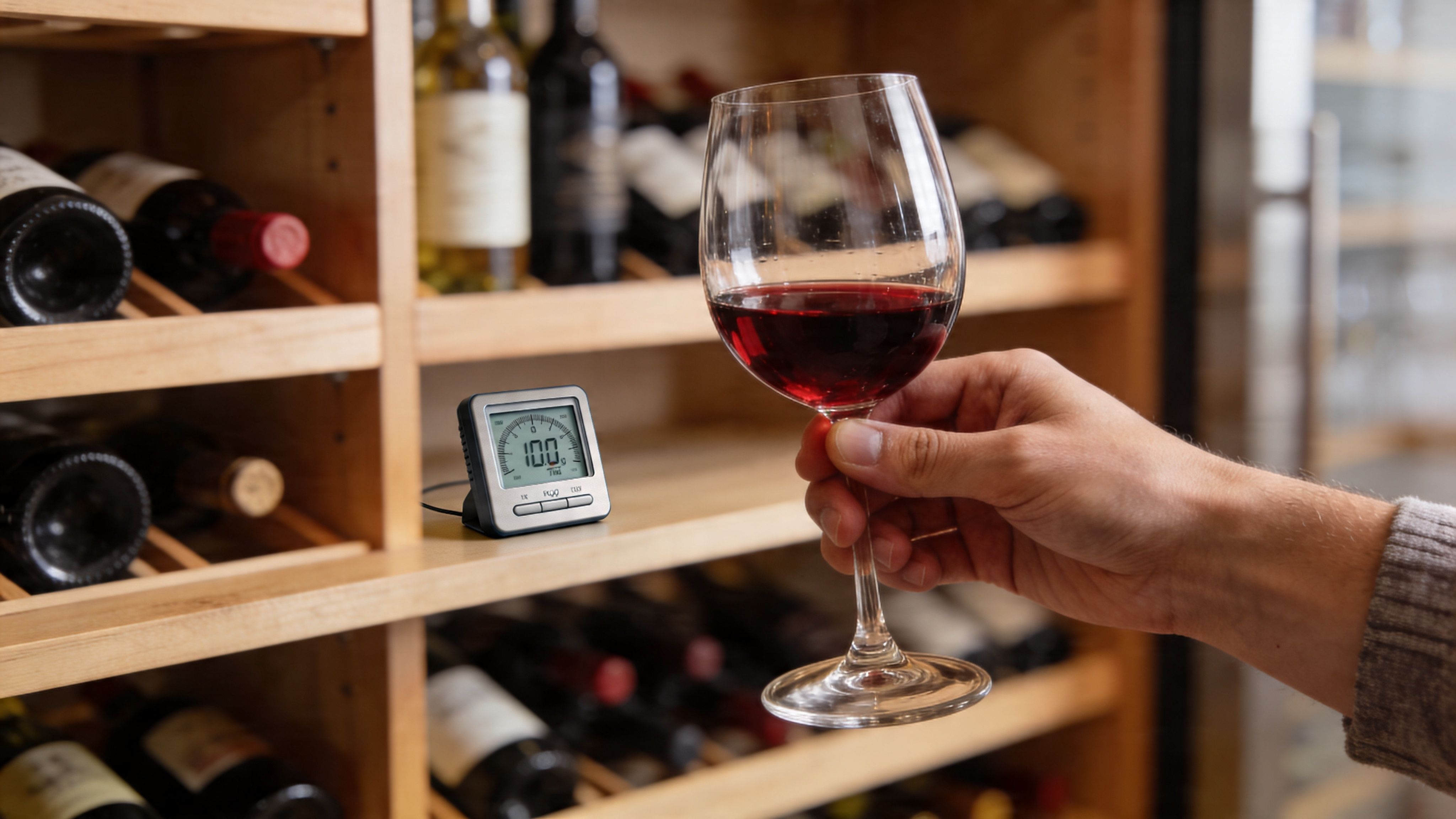
A notebook works. A note app works. A photo of the hygrometer beside a few bottle notes works too. Some people even snap periodic dial or screen photos just to create a rough history without doing much writing.
The best storage journal is the one you'll keep using.
That idea matters because perfect tracking isn't the goal. Confidence is. A few practical notes can make your collection feel less mysterious and easier to manage.
Why this matters for everyday collectors
Those storing wine don't want a second hobby in data management. They want reassurance that they're doing enough.
A hygrometer helps with that. So does a habit of writing down just enough to remember what happened in the room and what happened in the glass.
If digital tracking sounds easier than paper notes, the best wine tracking app guide can help you think through what kind of tool fits your style.
A good cellar routine should leave you calmer, not busier. Check the humidity. Fix problems early. Keep a simple record. Then go back to enjoying the part that matters, opening the bottle with confidence.
If you want help choosing wine in the moment and keeping track of bottles you loved, Sommy.ai works as a quiet personal wine decision assistant. It can help you pick wine confidently, remember what you liked, and keep your wine notes in one place without turning wine into homework.
