


The best champagne for mimosas is usually not Champagne at all, but a dry Brut Cava or a Prosecco, because orange juice covers the toasty, aged flavors you pay extra for in a real Champagne. Pick Cava if you like your mimosa crisp and lively, Prosecco if you like it softer and fruitier, and save real Champagne for a small group where you'll pour three parts wine to one part juice. Whatever you buy, look for Brut or Extra Dry on the label and skip anything called Asti, Moscato, demi-sec or doux.
Most pages on this question stop at that list, so this one goes further and does the sugar math on what's actually in the glass, walks through the official recipe (which isn't the one most people make), and gives you a shopping table for how many bottles and how much juice to buy for six, twelve or twenty guests.
What is the best champagne for mimosas?
A Brut Cava from Spain is the best all-round champagne for mimosas, with an Extra Dry Prosecco from Italy a close second and an American traditional-method Brut a solid third. All three are dry enough to balance sweet orange juice, all three have enough acidity to keep the drink from tasting like flat soda, and all three cost far less than a bottle from the Champagne region of France.
Cava is our first pick because it's bottle-fermented like Champagne, so its fine bubbles survive being topped with juice, and it's usually lean enough to make a crisp mimosa rather than a sugary one. Prosecco is softer and fruitier, and if your crowd likes a gentler drink, it may well be the more popular bottle on the table.
The International Bartenders Association, which publishes the reference recipes bartenders train on, actually specifies Prosecco in its official Mimosa recipe, not Champagne. So if anyone at brunch tells you a "real" mimosa needs French Champagne, the people who write the recipe down disagree with them.
For a deeper side-by-side of how the three styles taste on their own, our breakdown of Prosecco vs Cava vs Champagne covers the grapes, the methods and what you'll notice in the glass.
Why doesn't expensive Champagne make a better mimosa?
Expensive Champagne doesn't make a better mimosa because the orange juice brings far more flavor and sugar to the glass than the wine does, and it buries the delicate notes you're paying for. Real Champagne earns its price through long aging on the spent yeast, which builds flavors of brioche, toast and nuts, and those subtle flavors are the first thing a glass of orange juice wipes out.
The sugar numbers make this concrete. The USDA's FoodData Central lists raw orange juice at 8.4 grams of total sugar per 100 grams. A Brut sparkling wine, by the label rules that Wine Folly lays out in its sparkling wine sweetness chart, carries no more than 12 grams of residual sugar per liter, which is 1.2 grams per 100 ml. Put those side by side and the juice is carrying roughly seven times as much sugar as the wine, ml for ml, before you've even thought about its acidity and its big citrus aroma.
In practice that means a pricey Champagne and a far cheaper Cava taste much more alike in a mimosa than they ever would in two flutes side by side. The fine bubbles and some of the crispness still come through, and that's what the wine is really there to supply. The layered, aged character mostly doesn't, so you're paying for flavors nobody at the table will notice.
Champagne earns its place only when you flip the ratio, because at three parts wine to one part juice a good non-vintage Brut still tastes like itself and the juice becomes a splash of color rather than the main event.
Should you buy Brut or Extra Dry for mimosas?
Buy Brut if your orange juice is sweet, like most store-bought cartons, and Extra Dry if your juice is tart, like fresh-squeezed juice from early-season oranges. The confusing part is that Extra Dry is actually sweeter than Brut, so the label runs backward from what the words suggest.
Here's the scale as Wine Folly prints it: Brut Nature carries 0 to 3 grams of residual sugar per liter, Extra Brut 0 to 6, Brut 0 to 12, Extra Dry 12 to 17, Dry 17 to 32, Demi-Sec 32 to 50, and Doux anything above 50. The Prosecco DOC consortium uses the same ladder for its sparkling wines, which run from Brut Nature to Demi-sec. For mimosas you want to stay in the Brut and Extra Dry rows, and our page on what Brut means on sparkling wine labels explains the whole ladder in more depth.
What nobody mentions is how small the difference is once the juice goes in. In the official recipe, each mimosa is 75 ml of sparkling wine and 75 ml of orange juice. Even at the very top of the Extra Dry range, that 75 ml of wine carries about 1.3 grams of sugar, against more than 6 grams from the juice, so the Brut versus Extra Dry choice nudges the drink a little and no more.
If you're standing in the aisle with a Brut in one hand and an Extra Dry in the other, take whichever one you'd happily drink on its own, because someone at brunch will want a glass without juice.
Is Prosecco or Cava better in mimosas?
Cava is better if you want a crisp mimosa with bubbles that last, and Prosecco is better if you want a softer, fruitier one that tastes more like a sparkling orange drink. Both are good choices, and the difference comes down to how each wine gets its fizz.
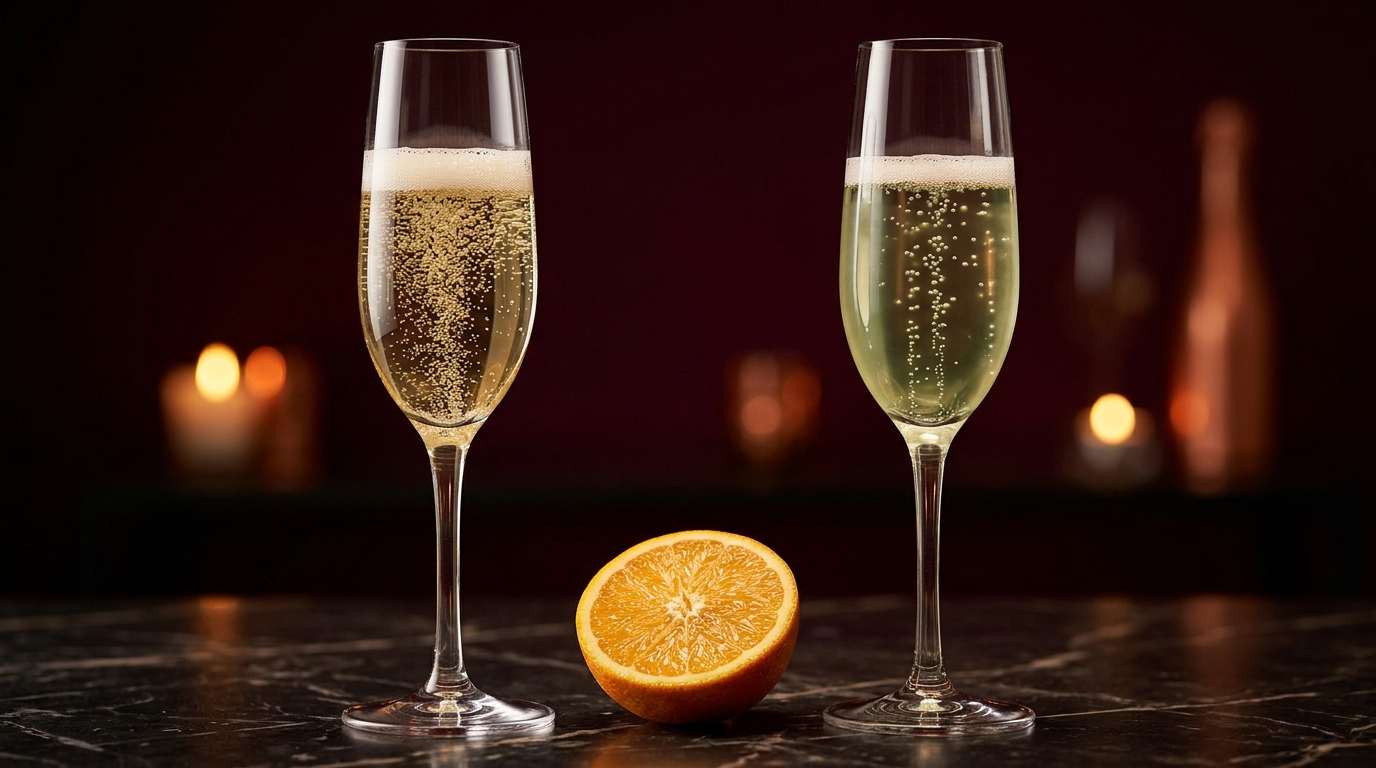
Cava is made by the traditional method, the same process used in Champagne, where the second fermentation happens inside each bottle. That gives it small, tight bubbles that hold on after you add juice, plus a lean, slightly savory edge, so over a long brunch Cava stays lively from the first glass to the last.
Prosecco is made mostly from the Glera grape in northeastern Italy, and its second fermentation happens in a large sealed tank rather than in each bottle. The tank method keeps the wine's fresh fruit front and center, which is why Prosecco tastes of pear, apple and white flowers, and why it's so easy to drink. The trade-off is that its bubbles are a bit bigger and fade sooner, so a Prosecco mimosa is best poured and drunk fairly quickly.
If you're hosting a crowd and can't decide, buy one of each and let your friends show you which they reach for. Our comparison of Champagne vs Prosecco goes further into how the tank and bottle methods change the wine.
What does "California Champagne" on a label mean?
"California Champagne" on a label means the wine is a sparkling wine made in California, not in the Champagne region of France. American labeling law treats Champagne as what it calls a semi-generic name, and under 27 CFR 4.24 a semi-generic name can only be used on wine from somewhere else if the label shows the true place of origin right alongside it, which is why you see "California Champagne" or "American Champagne" rather than the word on its own.
That label tells you where the wine was made, but it doesn't tell you how. Some domestic bottles are made by the traditional method, the same bottle-fermented process as Champagne and Cava, and Korbel, for example, describes its wines as California méthode champenoise champagnes. Others are made in tanks the way Prosecco is. Either kind can work in a mimosa, so long as the label says Brut or Extra Dry.
So a domestic bottle labeled "champagne" is a perfectly good mimosa base, just don't let the word on the label talk you into paying more for it than you'd pay for a Cava.
Which sparkling wines should you skip for mimosas?
Skip anything labeled Asti, Moscato d'Asti, demi-sec, doux or "sweet", because these wines are already sweeter than the orange juice you're about to add. Mixing them makes a drink that tastes syrupy and flat, and no amount of fresh juice fixes it.
WineAlign's report on the Asti appellation lists Asti Dolce at 90 to 100 grams of residual sugar per liter, and Moscato d'Asti at 120 to 130. Compare that to orange juice at 8.4 grams per 100 grams, which works out to roughly 84 grams per liter if you treat a liter of juice as weighing about a kilogram. So a sweet Asti carries more sugar than the orange juice itself, and Moscato d'Asti carries a good deal more. The same report puts Moscato d'Asti at just 2.5 bars of pressure, which makes it only lightly fizzy, so it also brings less sparkle to the glass than a fully sparkling wine would.
Sweet Moscato bubbly is a lovely wine with fruit desserts, but if you already have a bottle, use it with a very tart juice like grapefruit and only a splash, or save it for dessert. Skip any sparkling wine that's been open for more than a day or two as well, because the bubbles are what the wine contributes most, and flat wine plus juice is just diluted juice.
What is the right mimosa ratio?
The official mimosa ratio is one to one, with 75 ml of orange juice and 75 ml of Prosecco, according to the International Bartenders Association recipe. That makes a 150 ml drink, about 5 fluid ounces, which fits comfortably in a standard flute with room for the foam.
The IBA's method is worth reading, because it's the opposite of what many recipes online tell you. It says to pour the orange juice into the flute first, then gently pour the sparkling wine on top, and then stir gently. Most blog recipes say to pour the wine first and never stir, on the theory that stirring kills bubbles. Both approaches work well, since pouring the wine onto the juice mixes the two naturally and keeps the foam under control, while a single gentle stir evens out the color without knocking out much fizz. We'd only skip the stir if you're using a Prosecco whose bubbles are already starting to fade.
You can shift the ratio to suit your taste. Two parts wine to one part juice makes a drier, fizzier drink that tastes more like wine, which is the version we pour when the sparkling wine is one we'd happily drink on its own. (The IBA notes, incidentally, that the mimosa is also known as a Buck's Fizz.) Three parts wine to one part juice is where a real Champagne starts to show its character, and it's the only ratio where we'd spend the extra money. Going the other way, with more juice than wine, makes a lighter, softer drink that suits a long, lazy brunch, but it also mutes the bubbles fast.

Chill everything well before you start, the wine and the juice both, because warm juice knocks the bubbles out of the wine almost immediately. Skip the ice too, since it waters the drink down and makes it go flat quicker.
How many bottles of champagne do you need for mimosas?
You need one standard 750 ml bottle of sparkling wine for every five guests, if each guest has two classic one-to-one mimosas. At the IBA's 75 ml of wine per drink, a 750 ml bottle makes exactly ten mimosas, so the math is simple once you know how many drinks you're pouring.
Here's the planning table we use, assuming two mimosas per guest over a two to three hour brunch and rounding bottles up so you don't run short.
| Guests | Mimosas (2 each) | Bottles at 1:1 | Orange juice at 1:1 | Bottles at 2:1 | Orange juice at 2:1 |
|---|---|---|---|---|---|
| 6 | 12 | 2 | 900 ml (about 30 oz) | 2 | 600 ml (about 20 oz) |
| 12 | 24 | 3 | 1.8 liters (about 61 oz) | 4 | 1.2 liters (about 41 oz) |
| 20 | 40 | 4 | 3 liters (about 101 oz) | 6 | 2 liters (about 68 oz) |
At two to one, each drink takes 100 ml of wine and 50 ml of juice, so a bottle makes seven and a half drinks instead of ten, which is why the bottle count climbs and the juice count drops. A standard half-gallon carton holds 64 ounces, so twelve guests at one to one is almost exactly one carton. We'd always buy one bottle more than the table says, since some guests will want a glass of bubbly with no juice at all, and an unopened bottle keeps fine for the next occasion.
If you want to plan the rest of the drinks for a bigger party, our page on how many glasses are in a bottle of wine covers still wine pours and bottles per guest for a full evening.
Which juice works best with which bubbly?
Store-bought, pulp-free orange juice works best with a Brut Cava or Brut domestic sparkling wine, while fresh-squeezed juice, which is usually tarter, works best with an Extra Dry Prosecco. The rule underneath it is simple: the sweeter the juice, the drier the wine should be, so the drink ends up balanced rather than tart or cloying.
Pulp is worth thinking about too. It gives the bubbles something to cling to, so pulpy juice makes the wine foam up and then go flat faster, and it leaves bits floating in the flute. If you squeeze your own oranges, strain the juice through a fine sieve before you pour it.
Orange isn't the only option, and the IBA lists several named cousins under its Bellini recipe, which itself is Prosecco with white peach purée. The Puccini uses fresh mandarin orange juice, the Rossini uses fresh strawberry purée, and the Tintoretto uses fresh pomegranate juice. That last one is a great holiday option, since pomegranate's deep red color looks festive on a Christmas morning table, and its tartness pairs best with a Brut. Grapefruit juice is sharper than orange and suits an Extra Dry, while pineapple juice is sweeter and calls for a Brut.

For a mimosa bar, set out two bottles of dry sparkling wine in an ice bucket next to three or four juices, so guests can mix their own. That way the person who wants a juice-heavy drink and the person who wants a splash of juice in their bubbly are both happy, and you don't have to guess anyone's preference.
What should you serve with mimosas at brunch?
Mimosas go best with savory brunch dishes like eggs Benedict, smoked salmon, quiche and frittatas, because the drink's acidity cuts through rich hollandaise, cheese and egg yolk. They're a weaker match for very sweet dishes like syrupy waffles or French toast, where the sugar in the food makes the juice taste sour.
Our page on the best wine for eggs Benedict goes variation by variation, and our brunch wine pairing page explains why a straight Moscato d'Asti beats a mimosa beside crepes and waffles. If the brunch is Christmas morning, our page on the best wine for Christmas covers the rest of the day.
Frequently asked questions
What is the best cheap champagne for mimosas?
The best cheap champagne for mimosas is a Brut Cava, since it's made by the same bottle-fermented method as Champagne and usually sells for far less. A domestic Brut labeled "California Champagne" or "American Champagne" is another good budget option, as long as you avoid the sweet Moscato bottles sitting on the same shelf.
Is Brut or Extra Dry better for mimosas?
Brut is better for mimosas made with sweet, store-bought orange juice, and Extra Dry is better with tart, fresh-squeezed juice. Extra Dry is slightly sweeter than Brut despite the name, but in a one-to-one mimosa the difference between the two adds up to at most about 1.3 grams of sugar per glass.
Can you use Prosecco instead of champagne for mimosas?
You can use Prosecco instead of champagne for mimosas, and the International Bartenders Association's official recipe actually calls for Prosecco. It makes a softer, fruitier mimosa than Cava or Champagne, so it's a good fit for crowds who prefer a gentler drink.
Is Asti good for mimosas?
Asti is not a good choice for mimosas because it's sweeter than the orange juice you'd mix it with. Asti Dolce carries 90 to 100 grams of residual sugar per liter, so the finished drink tastes syrupy rather than bright, and it works only in small amounts with a very tart juice like grapefruit.
Should you stir a mimosa?
You can stir a mimosa gently, and the International Bartenders Association's recipe says to stir gently after pouring the sparkling wine onto the juice. One soft stir evens out the color without losing much fizz, but skip it if your wine's bubbles are already fading.
What should you buy for brunch this weekend?
For most brunches, buy a Brut Cava as your main mimosa bottle, add an Extra Dry Prosecco if you're squeezing your own juice or your crowd likes a softer drink, and plan on one bottle for every five guests at a one-to-one pour, plus one spare. Pick up a half-gallon of pulp-free orange juice for every twelve guests, chill everything the night before, and leave the sweet Moscato and Asti bottles on the shelf.
Keep real Champagne for small groups, poured three to one so you can actually taste it, or served on its own for a toast, and set pomegranate and grapefruit juice next to the orange if you want the table to feel more festive without spending more.
