

You had a bottle a few weeks ago that you loved. Then you get to a restaurant, stare at the wine list, and the name is gone. Maybe the label was cream-colored. Maybe it was from Italy.
Maybe.
That gap in memory is one of the biggest reasons people keep playing it safe with wine. They order the same bottle, avoid trying anything new, and worry about choosing wrong.
A wine journal app fixes that in the simplest possible way. It helps you remember what you liked, where you had it, and why it worked for you, so the next choice feels easier.
Never Forget a Great Wine Again
A lot of people think they have a wine problem when they really have a memory problem.
You go to a friend's dinner, someone opens a bottle you love, and you tell yourself you'll remember it. A month later you're in a wine shop trying to buy something similar, and all you have is a vague memory of "it wasn't too heavy" and "the label looked nice." That's not enough to make a confident choice.
A wine journal app gives you a place to save the wines that mattered. Not for study. Not to sound clever. Just to build a personal record of what made you happy.
Safe choices happen when memory fails
When people can't remember what they liked, they fall back on familiar habits.
- Same bottle loop: You keep buying one or two "safe" wines because at least they won't disappoint.
- Menu freeze: You scan a restaurant list and hope someone else orders first.
- Store doubt: You stand in the aisle comparing labels instead of trusting your own taste.
None of that means you're bad at choosing wine. It means your past preferences aren't easy to retrieve.
Practical rule: If you liked a wine enough to mention it out loud, it's worth saving.
That's why a simple note on your phone is more useful than trying to remember producer names in your head. Even a quick photo and one sentence can save you from repeating the same uncertainty later.
If you want a simple format for what to save, this wine tasting notes template keeps it easy and low-pressure.
Your goal isn't knowledge. It's recall.
The best reason to use a wine journal app is emotional relief. You stop relying on vague memory. You start building proof of your own taste.
That changes how you buy wine. Instead of asking, "What's supposed to be good?" you ask, "What's close to what I've already enjoyed?" That's a much calmer question, and it usually leads to a better bottle.
What a Wine Journal App Actually Does
A wine journal app is basically a memory tool for your taste.
It isn't there to make wine harder. It isn't asking you to become a student. It just helps you capture a bottle quickly, save a simple reaction, and find it again later when you're in the middle of a real decision.
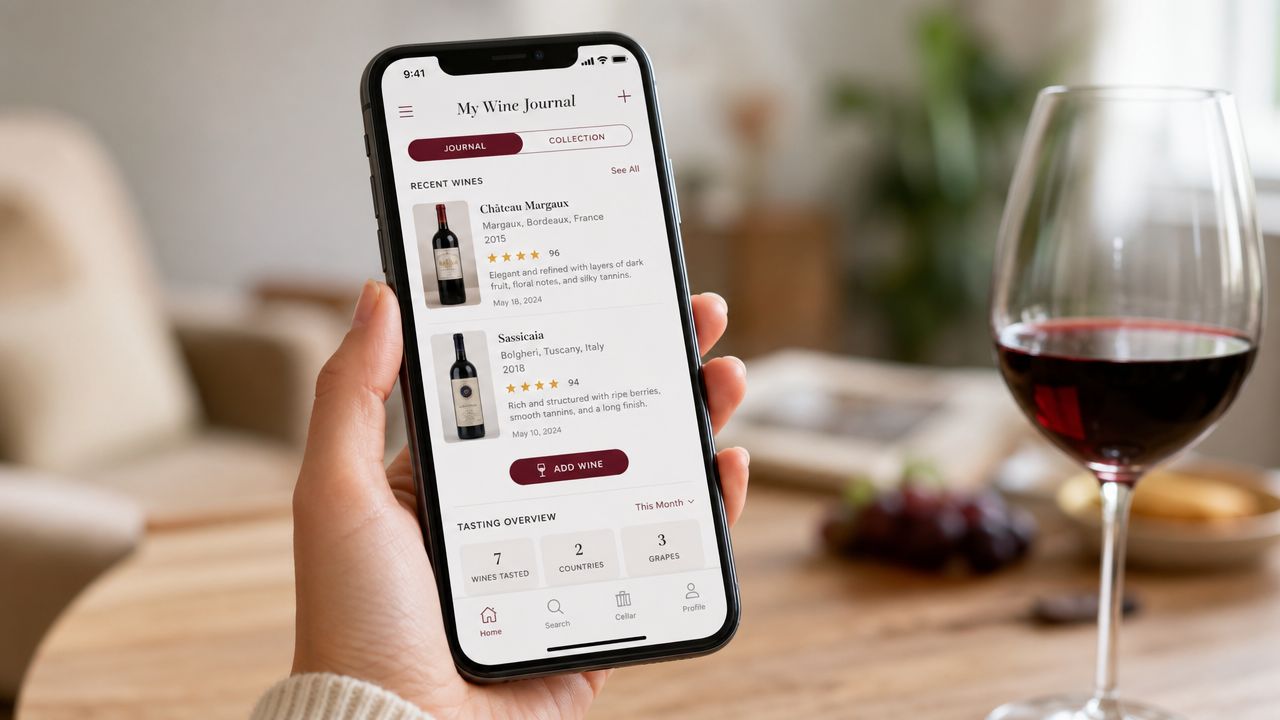
The job is simple
A wine journal app typically requires three things:
- Capture the bottle fast
- Add a quick reaction
- Find it again later
Why digital beats paper
A notebook sounds charming until you're trying to search it in a busy shop.
Paper journals make you write everything by hand. They get left at home. They don't help when you're looking at a shelf full of bottles and need an answer now. A wine journal app lives on the phone you're already using, and that's what makes it practical.
The best wine journal is the one you'll still use when you're tired, distracted, and ordering under pressure.
A useful entry can be tiny. Snap the label. Mark it as loved, liked, or not for you. Add one short note if you want. That's enough to build a personal reference library over time.
What matters most
Forget fancy dashboards. A good wine journal app should help you answer basic questions fast:
- Have I had this before?
- Did I enjoy it?
- What did I like about it?
- Would I buy it again?
If the app can't do that without slowing you down, it isn't helping.
Core Features That Reduce Decision Stress
A feature only matters if it removes friction. That's the standard worth using.
Most wine apps advertise long lists of tools, but only a few features lower stress when you're in a restaurant or standing in a store. The best ones help you remember faster, decide faster, and trust yourself more.

Label scanning removes the first barrier
Typing out wine names is annoying. Some are long, unfamiliar, or hard to spell. That's why scanning matters so much.
With a camera-first workflow, you can save a bottle before the moment passes. You don't need to transcribe a label or remember the details later. You just point, capture, and move on.
That speed matters because if logging a wine feels like homework, people stop doing it.
Simple notes beat fancy tasting language
A lot of wine tools still assume you want to describe acidity, structure, and other technical details. Many users, however, are not interested in such details. They want to remember whether the wine felt easy, rich, crisp, soft, fun, or worth buying again.
A good wine journal app should make room for normal language.
- Keep the reaction honest: "Loved it with pasta."
- Keep the memory specific: "Had this on vacation."
- Keep the future useful: "Would order again."
Those kinds of notes are better for real choices than a paragraph written to impress nobody.
Taste profiles help the app help you
The hidden value of journaling is pattern building. Once you log enough wines, the app can start noticing what you tend to like.
You don't need to obsess over data. You just need enough simple input for the tool to start recognizing your preferences.If you're curious how that kind of learning works in a practical way, Sommy's taste profile feature shows the general idea clearly.
The most useful features by job
| Feature | What it does for you |
|---|---|
| Label scan | Saves the bottle before you forget it |
| Quick rating | Tells future-you whether to repeat it |
| Short note | Adds context that makes the memory usable |
| Search and history | Helps you retrieve old favorites fast |
| Taste patterning | Starts turning past choices into better future suggestions |
A wine journal app doesn't need to feel smart. It needs to feel calming.
Journaling Wine Without Feeling Like a Snob
The biggest mistake people make is assuming they need the "right" wine words.
You don't. In fact, trying to sound like a sommelier is often what stops people from starting at all. The better approach is to keep your notes casual, personal, and fast.
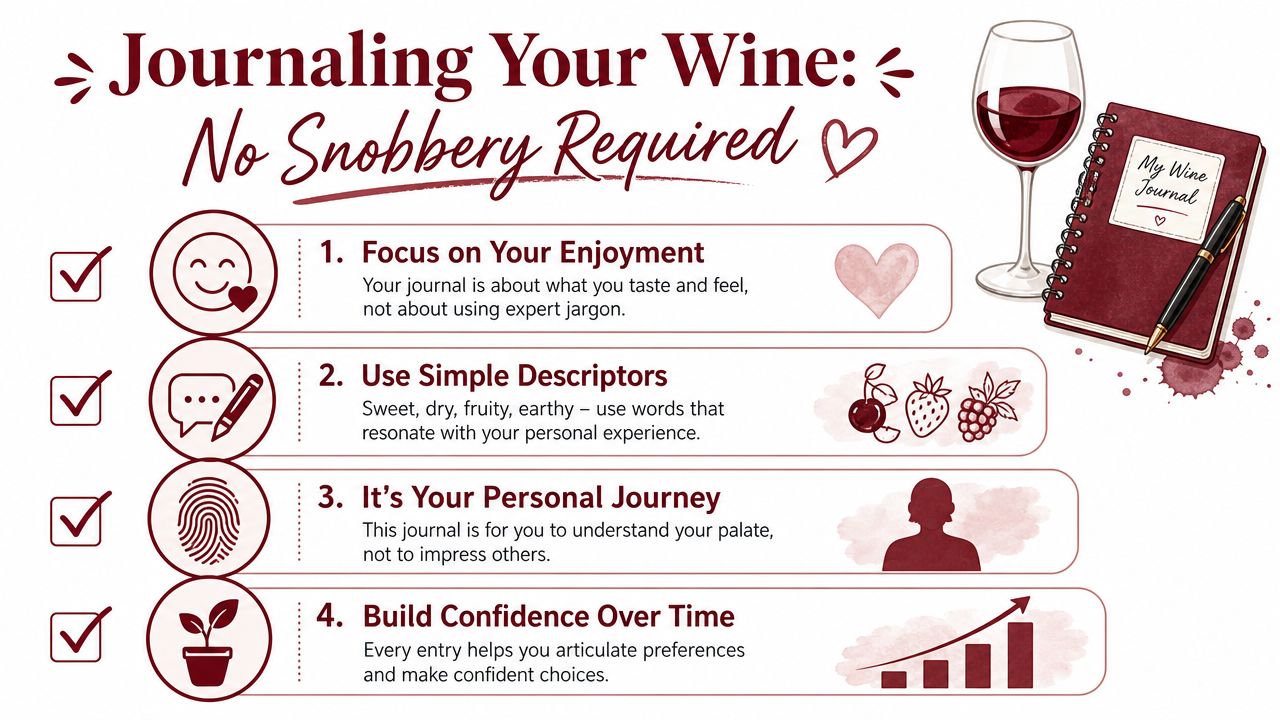
A useful question in the category is, "How do I journal wine without being a sommelier?" That concern is real, and the Vintg App Store listing points to the same issue. Many tools assume people already know industry terms, even though label photos are often "faster and more accurate than writing down wine details."
Use the three-step version
Here's the easiest way to journal wine without making it weird.
- Take a photo of the label
That's most of the work done. You don't need to type out the full name. - Choose a simple reaction
Try "love it," "like it," or "not for me." That's enough to be useful later. - Add one sentence if it helps
Examples work best. "Great at Sarah's birthday dinner." "Too strong for a weeknight." "Would buy again for takeout."
Your note doesn't need to describe the wine perfectly. It only needs to help you remember how you felt about it.
Plain language is better language
Try words you already use in normal life.
- Easy
- Fresh
- Rich
- Soft
- Too much
- Perfect with dinner
That kind of language is personal, and personal is what matters. Your journal isn't a test. It's a shortcut back to a good decision.
If describing taste still feels awkward, this guide on how to describe wine taste keeps it grounded in everyday words.
What to write when you're busy
A fast entry can look like this:
- "Loved it. Ordered again."
- "Nice, but I wouldn't buy a full bottle."
- "Worked with pizza."
- "Too heavy for me."
That's enough. You are not doing it wrong if your notes are short. Short notes are often the ones you'll make, and made notes beat ideal notes every time.
Turning Memories into Confident Choices
A wine journal starts as a diary, but its true value shows up later.
You save a few bottles over time. You add tiny reactions. Maybe you note who you were with, or what you ate, or where you were traveling. Eventually you stop looking at each bottle as a one-off experience. You start building a map of your own preferences.
Memory gets stronger when context is included
A bottle alone is easy to forget. A bottle connected to a moment is easier to recall.
Wine Travel Guides' piece on wine tasting journals notes that dates and situational details are important for reconstructing trips and linking wines to memories, yet many apps still don't give users good ways to tag things like dinner companions or setting. That's a missed opportunity because context is often the reason a note becomes useful.
Think about the difference between these two entries:
- "Liked it."
- "Loved this at a tiny restaurant in Lisbon with grilled fish."
The second one gives future-you something to work with.
Your past choices become decision support
When you're staring at a menu, you're rarely asking for wine education. You're asking for help. You want something that feels likely to work.
That's where old journal entries become more than memories. They become evidence.
A good recommendation isn't random. It should feel connected to bottles and moments you've already enjoyed.
Over time, a personal log can help an app recognize repeating patterns in what you choose and what you avoid. If you've liked lighter, easier bottles in relaxed dinners and skipped heavier ones on weeknights, that pattern matters. It can shape better suggestions in the moments when indecision usually shows up.
If you want a plain-English look at how stored preferences become useful suggestions, this breakdown of how AI taste profiles work behind the scenes of personalized wine picks is worth reading.
Why emotional memory matters
People don't just remember flavor. They remember atmosphere.
They remember the birthday dinner, the holiday table, the first glass on a trip, the bottle that made a random Tuesday feel better. A wine journal app that captures those cues becomes more human and more useful. It helps future choices feel less like guesses and more like returning to something that already worked for you.
How to Choose the Right Wine Journal App
Don't choose a wine journal app based on how polished the home screen looks. Choose it based on what it helps you do in a real moment of uncertainty.
The wrong app turns wine into admin. The right app helps you remember your preferences and retrieve them fast.
Ask three practical questions
The easiest way to choose is to filter for usefulness.
| Question | Why it matters |
|---|---|
| Is it fast to add a wine? | If logging takes too long, you won't keep up with it |
| Can I find old notes quickly? | A saved memory is only useful if retrieval is easy |
| Can I export my entries? | You should be able to keep your own history |
That first point matters a lot. Vivino's Google Play listing supports a larger truth about the category. Successful apps prioritize "capture speed" and "retrieval" because users care more about finding old notes without digging than about flashy design.
Two kinds of wine apps
Some apps are built for learning wine in depth. Others are built for helping you make a decision.
If your goal is to study terminology, compare lots of technical detail, or treat wine as a hobby project, a more education-heavy tool might suit you. If your goal is simpler, meaning "help me remember what I like so I can choose faster," then you want a lighter workflow.
Look for these signs of a good fit:
- Camera-first entry: You can log a bottle quickly with a photo.
- Simple reactions: You aren't forced into long forms.
- Strong search: Old notes are easy to pull up in a shop or restaurant.
- Data access: Export options are available, which adds peace of mind.
Choose for your real life, not your ideal self
A lot of people download the app they think they should want. Then they abandon it.
Pick the one you can imagine using after a long day, in bad lighting, halfway through dinner, while someone asks what bottle to order. That's the standard that matters.
If you want a broader comparison of tools built for memory and decision-making, this guide to the best wine tracking app is a helpful place to narrow your options.
If you want help choosing wine in the moment, not just recording it after the fact, Sommy.ai is built for exactly that. It acts like a personal wine decision assistant, learns your taste over time, and helps you pick with more confidence when you're facing a shelf, a menu, or a hosting decision and don't want to guess.