
Is Wine Vegan? How to Check Before You Buy
Grapes are vegan, but plenty of finished wine isn't. During production, many winemakers clarify their wine using fining agents drawn from animals: gelatin from collagen, isinglass from fish swim bladders, casein from milk, and albumen from egg whites. Those materials get filtered out before bottling, so nothing animal remains in your glass, and most vegans still count the wine as off limits because the process used them. The label almost never tells you either way, so the reliable move is checking the specific bottle against the producer's own statement or a database like Barnivore.
That sounds like more homework than buying a bottle of wine should involve. In practice it takes about two minutes the first time you check a producer, and then you can buy their wines freely for years.
What actually makes a wine not vegan?
Fining is the step that decides it. After fermentation, young wine is cloudy with suspended proteins, tannins and other particles that would make it hazy in the bottle or harsh on the palate. A winemaker adds a fining agent that binds to those compounds, the whole bundle settles out or gets filtered away, and the wine comes out clearer and softer.
According to the Australian Wine Research Institute's guidance on fining agents, the purpose is to soften or reduce astringency and bitterness, to remove proteins capable of forming haze, and to reduce color by binding up polymeric phenols and tannins. It's a correction step, used when the winemaker thinks the wine needs it.
The complication for vegan shoppers is that several of the most effective fining agents come from animals, and they're classed as processing aids rather than ingredients. A processing aid does its job and leaves, which is why the finished wine contains no measurable animal material and why no regulator makes anyone print it on the bottle. If your line is drawn at what a product contains, that may satisfy you. If it's drawn at what was used to make it, the animal-derived version doesn't pass.

Worth knowing before you start checking: the grape variety tells you nothing here. Cabernet Sauvignon, Chardonnay, Prosecco and everything else can each be made with or without animal fining, because the decision belongs to the cellar rather than the vineyard. Country of origin doesn't predict it either.
Which fining agents come from animals?
Four names account for nearly all of it, and recognizing them makes a producer's website much faster to read.
| Fining agent | Where it comes from | What it's used for |
|---|---|---|
| Gelatin | Collagen, usually from pigs or cattle | Softening tannin and bitterness in reds |
| Isinglass | Dried fish swim bladders | Polishing white wines to a bright clarity |
| Casein | Milk protein | Lightening color and removing oxidized notes |
| Albumen | Egg whites | Gently smoothing tannin in structured reds |
The AWRI lists all four among the most commonly used and permitted fining agents, alongside skim milk and the non-animal options we'll get to shortly. Egg white in particular has a long history in red Bordeaux and Burgundy, where a few beaten whites per barrel is a traditional technique that predates anyone thinking about vegan labeling.
You don't have to memorize the table. A single question covers every one of them: did you use any animal-derived fining agents on this wine? Producers get asked it often enough now that most have a prepared answer.
How can a wine be clear without animal fining?
Perfectly well, and the alternatives have been in common use for decades. Bentonite, a volcanic clay, is the workhorse for removing haze-forming proteins from white wine and handles that job better than most animal agents do. Activated carbon strips unwanted color and off-aromas. PVPP, a synthetic polymer, binds the phenolics that cause browning and bitterness. Pea protein and potato protein now cover much of the tannin-softening work that gelatin and albumen used to do.
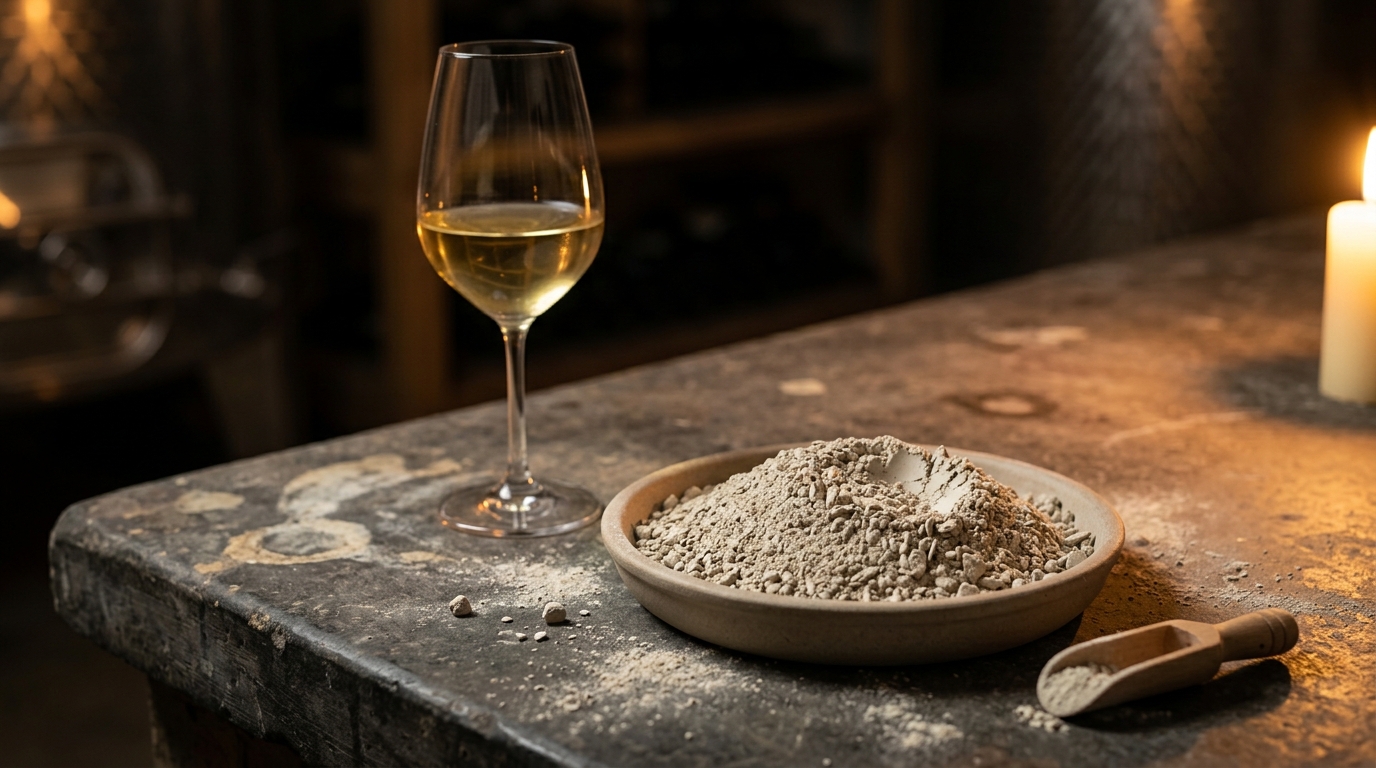
These aren't interchangeable with each other, so a producer switching away from animal agents has to re-learn their fining regime rather than swap one powder for another. That's the real reason the change took a while to spread, and it's also why a wine being vegan says nothing about whether it's any good. The flavor comes from the fruit, the site and the winemaking as a whole.
Some producers skip fining entirely and let the wine settle in tank over months, bottling it unfined, and a good number of those skip filtration as well. A wine labeled unfined genuinely did avoid every fining agent, animal or otherwise, so that word on a back label is one of the few honest shortcuts available. Unfiltered is a different claim about a different step, and it tells you nothing about whether animal fining happened earlier. Cloudiness in the glass isn't evidence of anything by itself.
Why doesn't the label just say so?
Because no major market requires it. The TTB's wine labeling requirements set out what has to appear on a bottle sold in the United States: the brand name, the class or type, alcohol content, net contents, country of origin for imports, the government health warning, the name and address of the bottler, and a sulfite declaration where it applies. Fining agents appear nowhere on that list, so a fully compliant American label can be silent about the entire question.
Europe has moved closer to answering it. The European Commission's wine labeling rules took effect on December 8, 2023 and now require an ingredient list and a nutrition declaration on wine, which other foods had been carrying for years. Producers can put that information on the physical label or behind a QR code, though allergen information stays on the physical label. The rules apply to everything from the 2024 harvest onwards, while wine produced before December 2023 stays exempt until those stocks run out, so you'll still meet unlabeled older bottles for a while.
Even a complete EU ingredient list may not settle it, because processing aids are generally exempt from ingredient lists by design. Scanning the QR code is worth doing and will often help, yet a wine fined with isinglass and then filtered can legitimately show an ingredient list with no fish on it. Missing information isn't confirmation of anything.
Does organic or natural wine mean vegan?
No, and conflating them is the most common way people buy the wrong bottle. Organic certification governs what happens in the vineyard, mainly the exclusion of synthetic pesticides and herbicides, and it doesn't prohibit animal-derived fining in the cellar. Our guide to organic and biodynamic wine covers what each certification actually promises, and neither of them promises this.
Biodynamic farming goes further into soil and ecosystem practice, and some biodynamic preparations use animal materials in the vineyard itself, which puts it further from vegan rather than closer. Natural wine is the most tempting assumption of the three, because natural winemakers very often do skip fining and filtration. The phrase carries no single enforceable definition anywhere in the world though, so it stays a strong hint rather than a guarantee. Our piece on what natural wine really means goes through where the term holds up and where it doesn't.
Keep the two questions apart and both get easier. Settle the production question first, then choose among the bottles that passed on the things that actually affect your dinner.
How do you check a specific bottle?
Start with the producer rather than the bottle, since most wineries apply one fining philosophy across their whole range and verifying them once covers everything they make.
- Look for an explicit vegan statement on the back label or the producer's website, and check whether it covers the whole range or one particular wine.
- Search the exact product in Barnivore, a volunteer-run database holding 22,471 wine entries, and read the correspondence behind the verdict along with its date.
- Email the producer or the importer if the answer is unclear, naming the four agents directly so there's no ambiguity about what you're asking.
Barnivore is genuinely useful and it isn't a certifying body, so treat an entry from several years ago as a starting point rather than a current fact. Producers change their methods, and the ones who switch to plant-based fining tend to be happy to confirm it. A missing entry means nobody has asked yet, which is different from a no.
One shortcut that works surprisingly well in a shop: several large producers now print a vegan mark on the back label as standard, and a few countries' supermarket own-label ranges are vegan across the board. Once you've found two or three producers you like who qualify, the weekly decision stops being a research project. Our guide to reading a wine label covers the rest of what that back label is telling you.
How do you pick among the bottles that pass?
Verification handles the requirement, and then you're back to the ordinary problem of which of these you'll actually enjoy. A vegan mark tells you nothing about whether the wine is light or full, dry or off-dry, bright or rich.

This is the moment where a shortlist helps more than more research does. If you've narrowed things to three verified bottles on a shelf and you're guessing between them, Sommy's Fit Check gives you a straight read on whether a specific bottle suits your taste, built from what you've rated before rather than from an average of strangers. The vegan question is one you have to settle yourself; the question of whether you'll like a particular Carignan is the one Sommy is built for.
For food, lead with the strongest flavors on the plate rather than with the wine. Our plant-based pairing guide maps that out for smoky, fresh and spicy bowls, and the logic holds for most vegetable-led cooking: roasted and charred things want some structure behind them, while bright herby dishes want acidity.
How do you ask at a restaurant without making it awkward?
Wine lists never mention fining, and servers field dietary questions constantly, so this lands as a normal request rather than a difficult one. A clear version sounds like: could you check whether this one is vegan, including whether any animal-derived fining agents were used? Naming the agents saves a round trip, because plenty of staff will otherwise answer the ingredients question instead.
Follow it with what you enjoy and roughly what you want to spend, since that turns a constraint into a recommendation. Our guide on ordering wine at a restaurant has more on framing that well. If the server says a wine is organic or natural, treat that as a hint and ask them to confirm the vegan part separately. For wines by the glass, ask about the bottle currently open rather than the one on the printed list, because house pours change.
Somewhere with a serious wine programme can usually call the importer. Somewhere that can't will often have one or two bottles they already know about, and asking is how you find them.
Common questions about vegan wine
Does "contains sulfites" mean a wine isn't vegan?
There is no connection between the two. Sulfur dioxide is produced naturally during fermentation and added by most winemakers to protect wine from oxidation and spoilage organisms, and it has no animal origin. The sulfite declaration is required on American labels above a low threshold, which is why it appears on almost everything. A wine with no added sulfites can still have been fined with isinglass. Our explainer on wine sulfites covers what the warning actually means for you.
Is vegetarian wine the same as vegan wine?
They're different, and the gap matters. A wine fined with egg white or casein suits most vegetarians, since neither involves killing an animal, while gelatin and isinglass don't. That makes vegetarian a broader category that includes wines a vegan would decline. Since producers and shops use the words loosely, an explicit vegan statement is worth more than a general vegetarian one.
Is vegan wine more expensive?
It costs no more as a rule. Bentonite and pea protein cost less than isinglass, and supermarket own-label wines at $8 are as likely to qualify as a $60 bottle. What you're paying for in any wine is fruit quality, yields, oak and time, and the fining decision sits well below all of those in the cost of a bottle.
The short version
Separate the production question from the taste question and vegan wine stops being difficult. Check the producer once, note the ones who qualify, and let that list carry you through the next year of ordinary shopping. Keep a note on your phone with two or three verified names, because the moment you'll want it is standing in a shop with twenty minutes before dinner.
The cellar decisions behind a bottle are worth understanding, and you don't need to understand all of them to drink well. You need a clear answer on the one that matters to you, and then permission to enjoy what you like.
