
The best inexpensive wine brands are the ones you can find twice, in a style you already know you enjoy, and most of them sit between roughly $8 and $20 on a US supermarket shelf. Argentinian Malbec, Spanish Tempranillo and Garnacha from outside the famous regions, Portuguese whites, Languedoc reds from southern France and South African Chenin Blanc are the categories that reliably deliver more wine than their price suggests. The brand name on the front matters less than the region and the grape behind it, which is why this page gives you both.
Shelf prices move constantly by state, store and promotion, so treat any specific number you read online as a starting point rather than a promise. What doesn't move is the underlying logic of why certain wines cost less without tasting cheap, and that logic works in any store you walk into.
What makes a wine cheap without making it bad?
Three things, and none of them is a compromise on drinkability. Higher grape yields spread the cost of farming across more bottles, less new oak removes one of the largest expenses in a winery, and a region without a famous name carries no price premium for the name itself. A wine can be built on all three and still be perfectly well made, because none of those choices makes wine taste worse on its own.
What does make cheap wine taste bad is a mismatch between the price and the ambition. A budget version of a famous expensive style usually disappoints, because the style depends on the very things the low price had to cut. Jamie Goode makes this point bluntly in his guide to drinking well on a budget, writing that finding good cheap Bordeaux is almost impossible while drinkable Vin de Pays from the Languedoc abounds. The lesson generalizes to any shelf in any store. Buy the cheap version of a wine that was always meant to be affordable, not the cheap version of a wine that was meant to be expensive.
It's also worth knowing how loosely the word value gets used further up the market. James Suckling's Top 100 Value Wines of 2024 sets its threshold at $40 and below, which is a perfectly reasonable definition for a critic and roughly four times what most people mean when they search for an inexpensive bottle. When a list calls something a value, check the number attached to it before you get excited.
Which regions give you the most wine for the money?
Southern and southwestern France, Spain outside its star regions, Portugal, and Argentina, with South Africa close behind for whites. Goode's budget guide walks through these country by country, and the specific advice is more useful than any brand list because it survives a change of store.
In the Languedoc he suggests steering clear of Cabernet, Merlot and Chardonnay and looking instead for Shiraz, Grenache, Carignan, Petit Verdot, Malbec, Rolle, Roussanne, Marsanne and Sauvignon, plus the appellations Minervois, Saint-Chinian, Corbières and Fitou. Southwest France is his other happy hunting ground, naming Cahors, Coteaux du Quercy, Gaillac, Marcillac, Jurançon and Madiran as places where authentic flavor turns up at ordinary prices.
Spain earns the strongest language in that piece. He describes enormous plantings of old-vine Garnacha and Tempranillo, and notes that the inexpensive reds from away from Rioja and Priorat improved sharply once producers stopped ageing them for ages in old American oak. He also points at Rueda and Penedès for affordable whites, which is the tip most shoppers miss because Spanish white gets far less shelf space than Spanish red. For Portugal he singles out Ribatejo, Estremadura, Dão and Minho rather than the Douro and Alentejo, whose best reds are pushed up by domestic demand.
Italy is the country that rewards the most patience, and Goode is candid about why. He describes it as producing a bewildering diversity of wines, warns that plenty of branded Italian bottles disappoint along with the cheap versions of Barolo, Chianti and Brunello, and puts the best value in the northeast for whites from Friuli and reds from Valpolicella, or in the far south with Puglia and Sicily. His verdict on the country as a whole is that it could do better, which is a fair summary of what most American supermarket shelves offer in Italian wine under $15.
South Africa belongs on the list too, and for one grape in particular. Goode is unenthusiastic about Pinotage, the country's own red variety, while singling out its Chenin Blanc as the standout alongside fresh Sauvignon and some attractive oaked Chardonnay. Chenin Blanc from South Africa is one of the genuinely underpriced whites on an American shelf, largely because the grape has no marketing machine behind it.
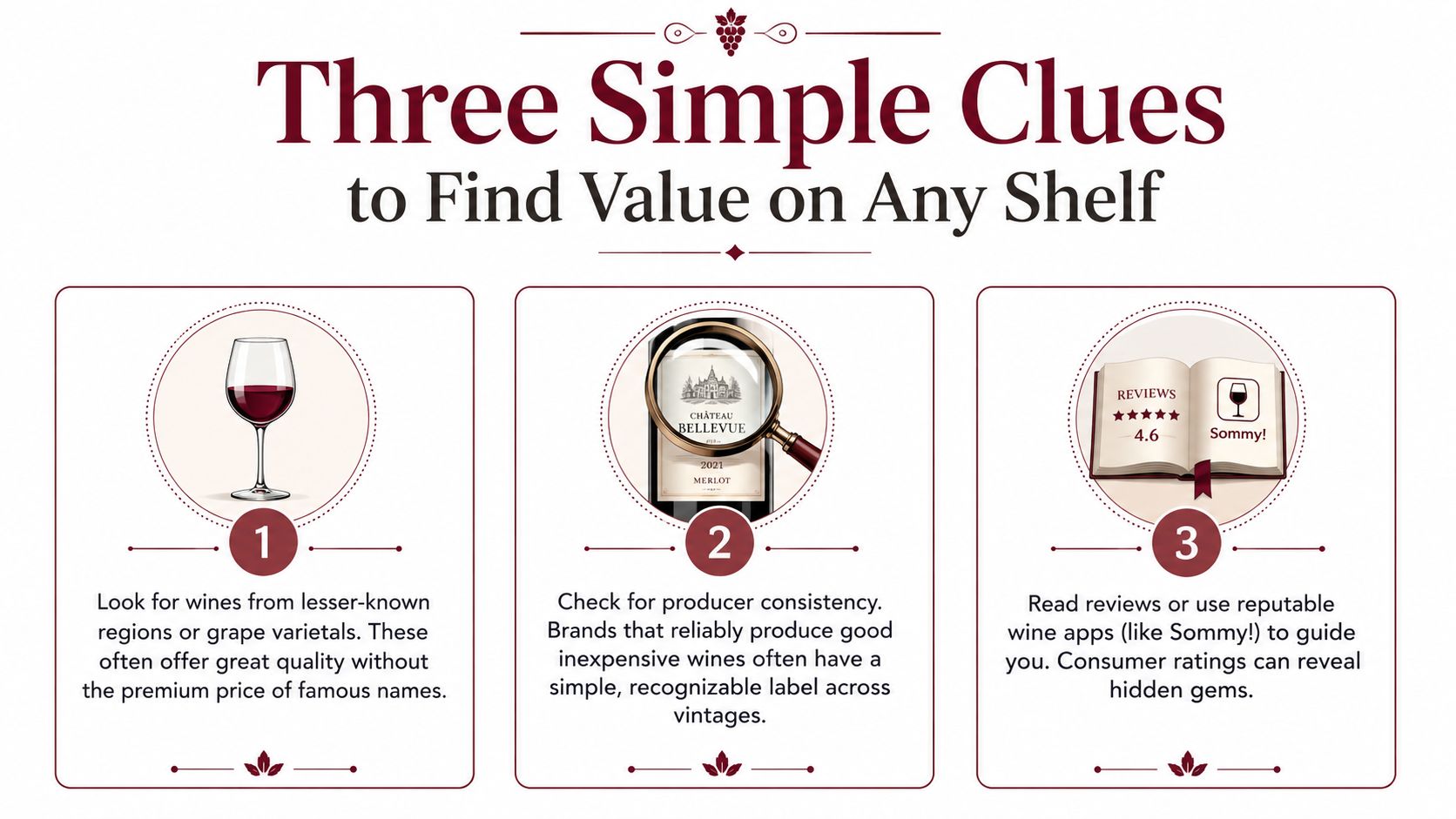
The honest caveats in the same guide are worth as much as the recommendations. He rates Chilean reds as genuinely good value at the bottom of the range while calling the country a bit of a one-trick pony, since paying more tends to buy concentration rather than a different experience. He reckons Australian branded wines at the lowest price point have run out of steam and get more interesting a few dollars up, where regional wines replace the large irrigated industrial vineyards. Argentina he reads as better value than its reputation suggests, with Malbec the safest bet and the whites generally skippable. No retailer listicle is going to tell you a whole country is boring, which is precisely why that kind of assessment is useful.
Which inexpensive brands are worth knowing by name?
The useful ones are the widely distributed labels whose style barely changes from bottle to bottle, because consistency is what actually lowers your risk. Here are the ones we've written up individually, grouped by the kind of drinker each suits, with the full taste and price detail on each page.
If you want a soft, fruit-forward red with no tannic edge, Apothic Red is the California blend that built that category, and our piece covers what to drink when you want the same effect from a different bottle. For Argentinian Malbec with a bit more structure behind the fruit, Trivento Golden Reserve comes from Luján de Cuyo rather than a generic Mendoza blend, which is a meaningful difference at the price. Josh Cellars Cabernet is the default American supermarket Cabernet, and our page on it exists mostly to answer what to buy when your store is out of it.
On the white side, Kim Crawford is the New Zealand brand most people meet first, and its Chardonnay is a gentler introduction than the Sauvignon Blanc it's famous for. If sweetness and a light fizz are what you actually enjoy, Stella Rosa is the Italian brand that owns that lane, and there's no reason to pretend otherwise. And if you shop at Costco, Kirkland Signature deserves its reputation, because the store label is sourced from real regions and priced without a brand premium.
Use those names the way you'd use a landmark rather than a destination. Knowing that you like Apothic tells you something durable about your taste, which is that you want soft texture and obvious fruit, and that knowledge transfers to fifty bottles you haven't met yet.
Why does the same brand cost different amounts in different stores?
Because American wine moves through the three-tier system, which the National Alcohol Beverage Control Association describes as the bedrock of the country's alcohol regulatory structure, an hourglass with producers at the top funnelling through wholesalers in the middle to retailers at the bottom, with each state running its own rules on top. That's why a bottle can be $11 in one state and $16 two hundred miles away without anything being wrong, and why a brand your friend swears by may simply not be distributed where you live.
Two practical consequences follow from that structure. The first is that a specific price quoted in any article, including this one, is a rough guide rather than a number to hold anyone to, and the closer a recommendation gets to a precise figure the faster it goes out of date. The second is that availability deserves as much weight as quality when you're choosing an everyday wine. A brilliant bottle you can find once is a pleasant memory, while a good bottle stocked in your usual store is the thing that actually improves your week.
This is also why store labels behave differently from national brands. A retailer's own wine skips a layer of margin and answers to a single buyer, which is how Kirkland Signature manages to put real regional fruit in the bottle at a price national brands struggle to match. The tradeoff is that you can only buy it in one place, and the specific wine behind the label can change between bottlings without the label saying so.
How do you read the back label of a cheap wine?
Look for plain descriptive words and ignore the marketing adjectives, because the plain ones are the only part written to tell you what's in the glass. Crisp and fresh point toward a lighter, higher-acid style. Fruity and juicy point toward obvious ripe flavor. Smooth usually signals softer texture and less grip, which is the quality most people mean when they say a red isn't harsh.
The front of the bottle is where the least reliable information lives. Heavy glass, embossed lettering and gold foil are packaging decisions, and they cost money that came out of the same budget as the wine. A plain label from a region known for value is a better bet than an ornate one from a region known for prestige, at the same price. Our walkthrough of reading a wine label covers which terms are legally defined and which are simply nice words.
One more shelf habit is worth building. Check the region and the grape before you check the brand, because those two pieces of information predict the taste and the brand mostly predicts the consistency. If you find yourself squinting at unfamiliar terms, our beginner wine chart translates the shelf into ordinary language.
Does spending more actually get you a better bottle?
Up to a point, and that point arrives earlier than most people assume. The jump from the very cheapest tier to the next one up is usually the most valuable dollar you'll spend on wine, and the returns flatten fast after that unless you're buying into a specific style that needs the money. We looked at the research behind the famous advice to always buy the second-cheapest bottle on a list in our piece on the second-cheapest wine rule, and the findings are more interesting than the folklore.
The related question of what your money actually buys as prices climb gets its own treatment in cheap wine versus expensive wine. The short version is that price correlates with scarcity, oak, handwork and reputation far more tightly than it correlates with whether a particular person enjoys the glass. That gap is the reason a $12 bottle can beat a $40 one for you specifically, and it isn't a paradox or a trick.
Which style should you start with?
Start from a drink you already like rather than from a wine you think you should like, because the fastest route to a bottle you enjoy runs through preferences you already have. The table below maps a few ordinary tastes onto the words that appear on wine shelves.
| What you already enjoy | Look for wines described as |
|---|---|
| Sparkling water, citrus, lighter drinks | Crisp, fresh, refreshing (Vinho Verde, Rueda, Languedoc whites) |
| Juice-forward cocktails or ripe fruit flavors | Fruity, juicy, smooth (Argentinian Malbec, Puglian reds) |
| Red wine without the bitterness | Lower-tannin softer reds (Spanish Tempranillo, Garnacha) |
| Something gently sweet and lightly fizzy | Off-dry or semi-sweet styles, stated plainly on the label |
If none of those rows quite describes you, that's useful information too, and our plain-English guide to describing how a wine tastes gives you the vocabulary to pin it down. Getting your own preference into words is worth more than any ranking, because it's the one piece of information no list can supply.
Questions people ask about inexpensive wine brands
What is the best and most affordable wine?
There isn't a single answer, because affordability is a number and quality is a match with your taste. The most reliable combination for most American shoppers is an Argentinian Malbec or a Spanish Tempranillo from outside Rioja, both of which deliver ripe fruit and soft texture in the range where inexpensive wine actually lives.
What are the best wines for a budget?
Wines from regions that were never expensive in the first place. Languedoc and southwest France, Spain away from Rioja and Priorat, Portugal's Dão and Minho, and Argentinian Malbec all appear in Jamie Goode's budget guide for exactly this reason, and all of them are widely stocked in the United States.
What is the best and most affordable wine I can buy at the grocery store?
The supermarket versions of those same categories, which is where the widely distributed brands earn their place. Our guide to grocery store wines goes through the aisle specifically, since the selection and the pricing work differently from a dedicated wine shop.
What is the best wine for the money?
Whichever bottle you'd happily buy again, which sounds glib but is the only definition that holds up. A wine you finish and remember has given you full value, and a technically impressive bottle you didn't enjoy has given you none regardless of the score attached to it.
Which wine is best on a small budget?
A lighter, fresher style is usually the safest bet when you're spending less, because tannin and oak are the two elements that most often go wrong at low prices. Crisp whites and soft, fruit-forward reds are forgiving in a way that a cheap imitation of a big structured red is not.
What is the smoothest wine to drink?
Smooth generally means low tannin and soft acidity, so look for Merlot, Garnacha, Argentinian Malbec, or an off-dry white. The word appears on back labels often enough to be a genuinely useful search term while you're standing at the shelf.
Buying your next everyday bottle
Pick a region with a value reputation, a grape you already like the sound of, and a price you'd be comfortable spending twice, then buy it and pay attention to what you thought. That single loop, repeated four or five times, teaches you more about inexpensive wine than any ranked list can, because it's built entirely out of your own reactions.
Sommy exists to keep that record for you and use it. You scan a label or describe what you're after, and the recommendation accounts for the bottles you've already liked rather than what a stranger rated highly. Our walkthrough of choosing a bottle in a crowded supermarket aisle shows what that looks like with a cart in your hand and fifty options in front of you.