
You learn about wine by drinking it deliberately rather than by studying it, and the whole method fits in one habit: taste something, decide in your own words whether you liked it, and write that down. Do that for a couple of months and you'll choose bottles more confidently than someone who has read three books and tasted nothing. Wine knowledge that transfers to a shop or a restaurant is a record of your own preferences, not a stock of facts about regions.
What follows is the practical version of that: where to start, roughly how long it takes before you notice a difference, the handful of terms that carry their weight, and how to run a useful tasting at your own kitchen table without buying anything special.
Where should you start if you know nothing about wine?
Start by drinking two wines side by side instead of one on its own, because comparison is the only thing that makes flavor differences obvious to a beginner. A single glass of Chardonnay tells you almost nothing, since you've got nothing to measure it against. Two glasses of Chardonnay, one from Burgundy and one from California, tell you immediately which style you prefer and give you language for why.
Buy small and buy in pairs. A pair of bottles under $15 each, opened on the same evening and poured into two glasses, is a better first lesson than a single expensive bottle you drink respectfully and forget. You don't have to finish either one, and the leftovers keep for a few days with a stopper in.
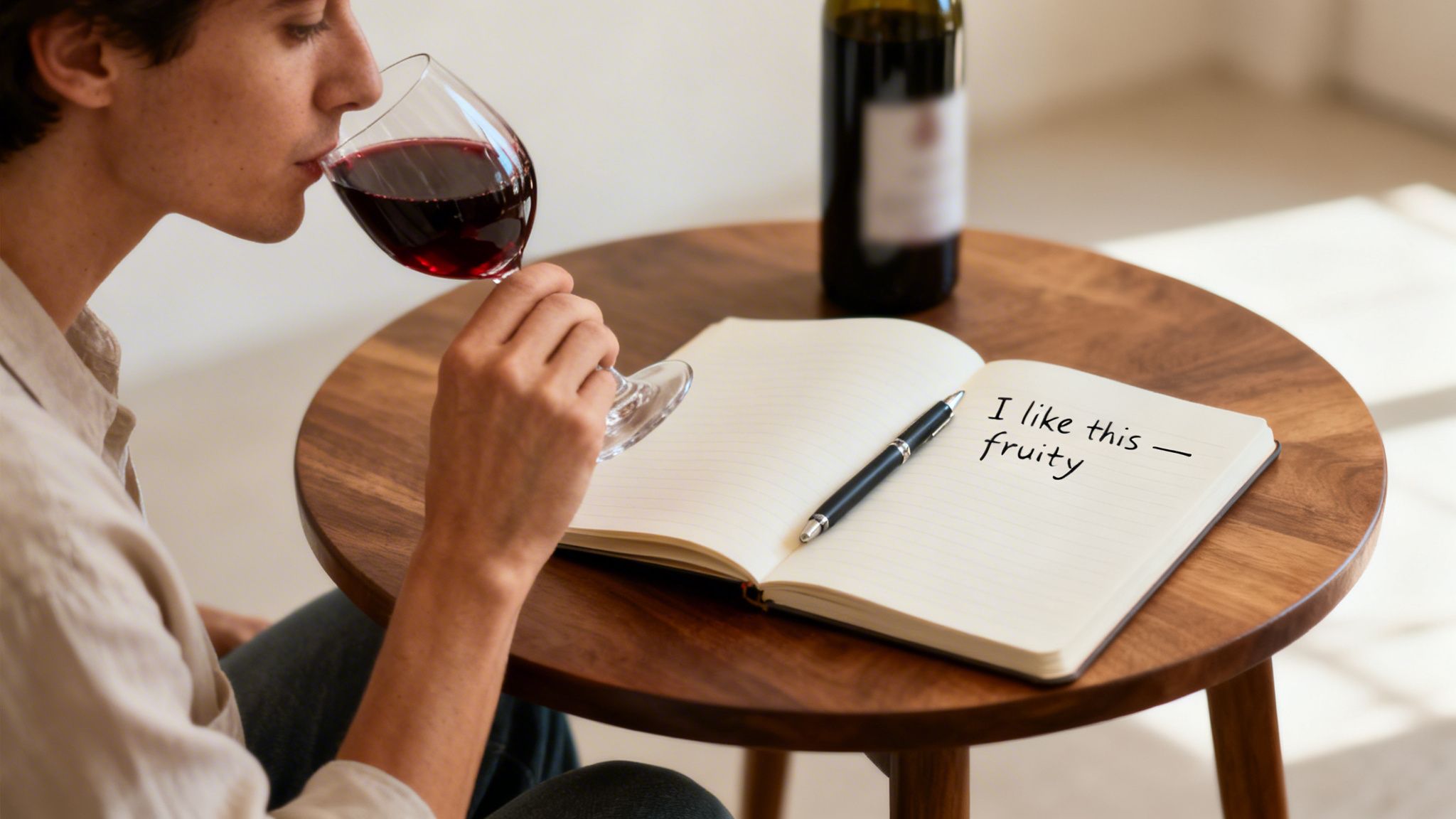
The second habit is writing something down, and it genuinely can be three words in your phone. The wine, whether you liked it, and one thing you noticed is enough, because the value is in the pattern that shows up after fifteen or twenty entries rather than in any single note. Our guide to choosing wine without ratings covers why your own record beats a score out of a hundred.
How long does it take to learn about wine?
About three months of casual drinking to order confidently in a restaurant, and a few years before you can guess a wine blind with any reliability. Those are very different goals, and most people only want the first one, so it's worth being clear that the useful part arrives much sooner than the impressive part.
The first month is mostly about noticing that you have preferences at all. Somewhere around the tenth or twelfth wine, you'll catch yourself thinking that you already know you don't like this style, which is the moment the whole thing starts working. After roughly thirty wines you'll have a rough map of what you reach for, and after a hundred you'll be able to walk into an unfamiliar shop and find something you'll enjoy within a couple of minutes.
Blind tasting, the party trick where someone names the grape and the vintage from the glass, sits on a completely different timescale and requires structured practice that most people never bother with. It's also close to useless for the actual task of buying a bottle you'll like, so ignore anyone who implies it's the goal.
What are the only wine terms you actually need?
Four of them: grape, body, tannin and acidity. Everything else in the wine vocabulary is either a synonym for one of those or a detail you can pick up later, and these four are enough to describe any wine well enough that a shop assistant or a server can help you.
The grape, sometimes labeled as the varietal, is the biggest single influence on how a wine tastes, so knowing you like Malbec and dislike Sauvignon Blanc is real information. Body is how heavy the wine feels, and the useful comparison is skim milk against heavy cream, since it's about weight rather than flavor. Tannin is the drying, slightly grippy sensation across your gums that mostly shows up in reds, and strong black tea produces the same feeling if you want a reference. Acidity is the tartness that makes your mouth water and a wine feel refreshing rather than heavy.
Describing wine for the first time is easier if you drop the fruit-naming entirely and stick to those four dimensions plus whether you liked it. Saying you want a light red with soft tannins and bright acidity is more useful to a server than any adjective, and it needs no confidence at all to say out loud.
How do you read a label for clues about taste?
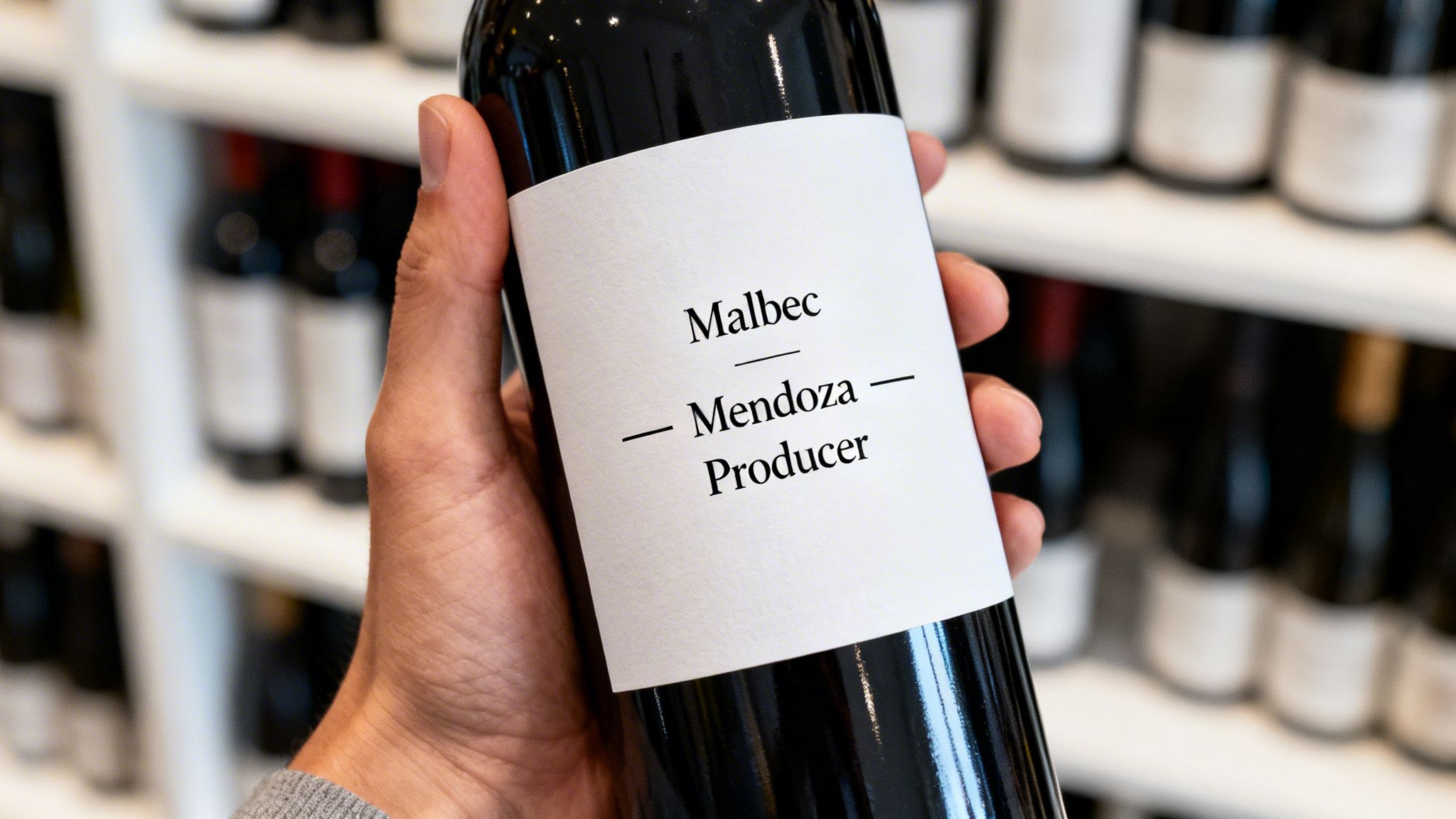
Look at the grape, the region and the alcohol, and ignore everything else on the front. Those three between them tell you roughly what style is in the bottle, which is all a label can honestly do.
Region works as a climate signal. The same grape grown somewhere cool comes out leaner and sharper, and grown somewhere warm comes out riper and rounder, which is why a Sauvignon Blanc from the Loire Valley in France tastes of green apple and lime while one from Napa Valley leans tropical. Once you know that rule, half the geography on a wine label becomes useful rather than decorative.
Alcohol is the underrated clue, because it tracks ripeness closely. A red at 12.5 percent will almost always feel lighter and fresher than the same grape at 15 percent, so it's a quick way to sort a shelf when you've never heard of any of the producers. Our guide to how to choose wine goes further into using those clues in an actual shop.
What is the 20/20/20 rule for wine?
There isn't a 20/20/20 rule, and the one people mean is the 20/20 rule about serving temperature: white wine comes out of the fridge 20 minutes before you drink it, and red wine goes into the fridge for 20 minutes before you pour it. The Essex Local Wine School's explanation is the clearest write-up of it.
It belongs in a beginner's guide because temperature accounts for more bad wine experiences than grape choice does. A white served straight from a cold fridge has almost no smell, and since most of what you think you're tasting is smell, you get a glass of nothing much. A red served in a warm room tastes jammy and its tannins turn bitter.
If a wine you expected to like tastes flat or harsh, check the temperature before you decide the wine is at fault. Twenty minutes in either direction fixes a surprising proportion of disappointing bottles, and it costs nothing to try.
How do you practice tasting at home?
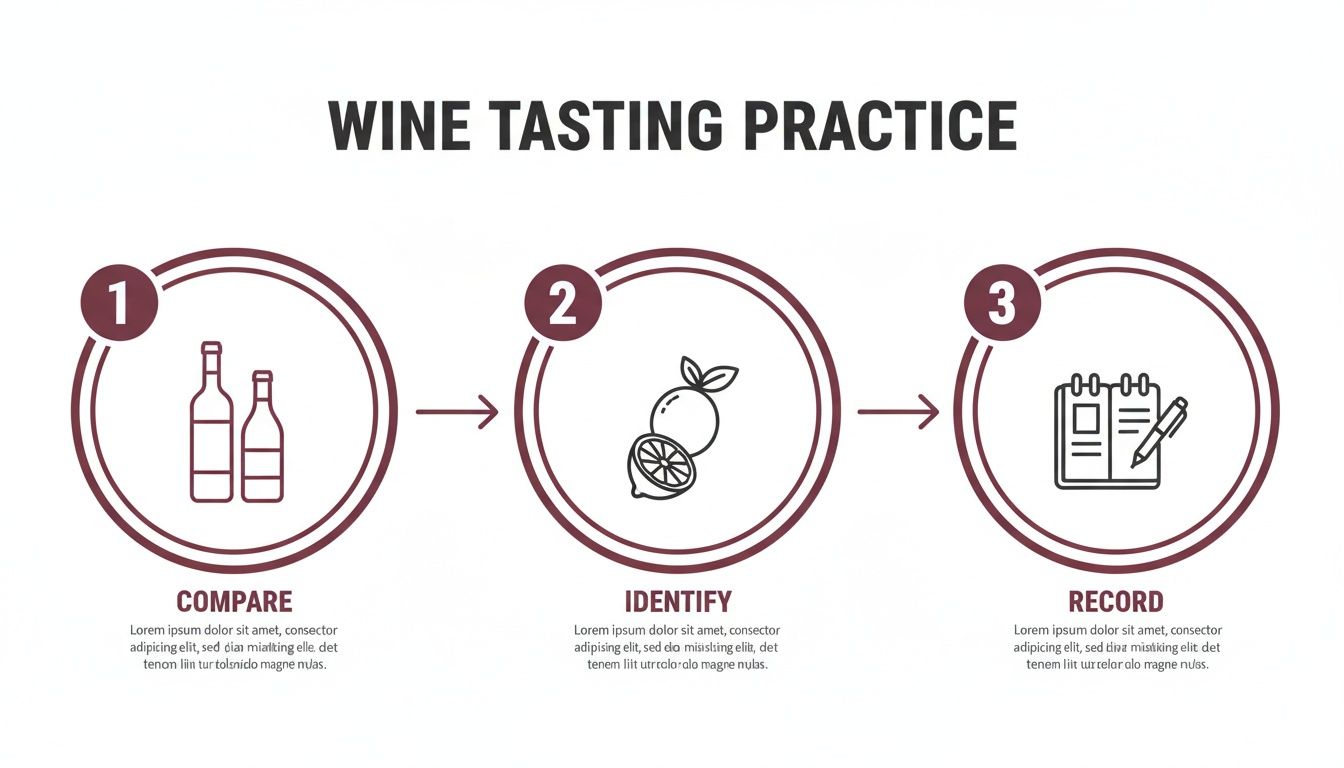
Pour two related wines at once and go back and forth between them, which is the single exercise that teaches more than anything else you can do at a kitchen table. Tasting one wine well is hard, and tasting the difference between two is easy, so structure every session as a comparison.
Three matchups are worth doing early. Two Chardonnays, one from a cool region such as Burgundy and one from warm California, show you what climate does to a grape. Two Pinot Noirs from Oregon and New Zealand show the same thing more subtly. Two Sauvignon Blancs, from the Loire Valley and from Marlborough, produce the most dramatic contrast of the three and are the easiest place to start.
The other exercise is free and involves no wine. Most of tasting is smelling, and you can build the reference library by deliberately smelling things already in your kitchen, so pick up the lemon, the vanilla, the black pepper and the jar of cherry jam and pay attention for a second each. The names you can already attach to smells are the names you'll be able to find in a glass later, and our wine tasting tips for beginners has more of these.
Which wine styles should you know first?
Eight, and they're categories rather than grapes, because style is what you're actually choosing between when you stand in front of a shelf. Learning the map first means every new bottle you meet has somewhere to sit, which is the difference between accumulating experience and accumulating trivia.
On the white side there are crisp light whites such as Pinot Grigio, Sauvignon Blanc and Albarino, then fuller whites such as oaked Chardonnay and Viognier, then the aromatic whites such as Riesling and Gewurztraminer that smell strongly of flowers and stone fruit. Dry rosé sits alongside them and behaves more like a light white than like a red.
On the red side there are light reds such as Pinot Noir, Gamay and Frappato, medium reds such as Merlot, Chianti and Rioja, and full reds such as Cabernet Sauvignon, Malbec and Syrah. Sparkling wine and sweet wine make up the last two categories and both cover an enormous range on their own.
Those eight groups account for nearly everything on a normal shop shelf. If you can say which two or three you tend to enjoy, you can shop anywhere in the world without recognizing a single producer, and that's a genuinely more useful skill than knowing what the words on a Bordeaux label mean.
Where should you get information you can trust?
Prefer sources that explain how a wine tastes over sources that tell you which bottle to buy, since the first kind teaches you something transferable and the second kind expires the moment that vintage sells out. Wine Folly is the standard recommendation for the visual, style-first approach, and Decanter and Food and Wine both publish reliable explainer pieces without assuming any trade background.
Be careful with two categories in particular. Anything that leads with a score out of a hundred is telling you about one critic's palate rather than yours, and retailer-published guides are advertising with an educational tone, so read them for the explanation and ignore the recommendation at the end.
The best source of all is a wine shop with staff who ask questions before answering. Telling someone what you drank last and liked, and being handed something adjacent to it, is the fastest form of learning there is, and independent shops are usually happy to do exactly that.
Do you need to take a wine course?
No, not if the goal is buying and ordering wine you enjoy. Formal courses such as the WSET levels are genuinely good and genuinely enjoyable, but they're built for people entering the trade, and a large part of what they teach is production detail and regional law that never comes up when you're standing in front of a shelf.
A course does one thing a self-taught route struggles with, which is putting a lot of structured, guided comparisons in front of you quickly with someone explaining what you're supposed to notice. If you have the time and the money and you enjoy studying, that's a real advantage. If you don't, tasting deliberately twice a week gets you to the same practical place over a longer period.
The free version of the structure is simply to pick a theme each time rather than buying at random. One grape across three countries, or one region across three producers, gives you the same controlled comparison a class would, and it's the reason a tasting evening with friends teaches more per bottle than a month of drinking whatever was on offer.
What should your first month look like?
One new bottle a week, chosen to be different from the last one, with a one-line note each time. That's a low enough bar to actually stick to, and four contrasting wines is enough to give you reference points for everything that comes after.
A sensible order is a light crisp white in the first week, a full-bodied red in the second, a richer white in the third and a medium red in the fourth, so a Sauvignon Blanc, a Cabernet Sauvignon, an unoaked Chardonnay and a Pinot Noir would cover it. The point is the spread rather than the specific bottles, since you're mapping the corners of the territory before filling in the middle.
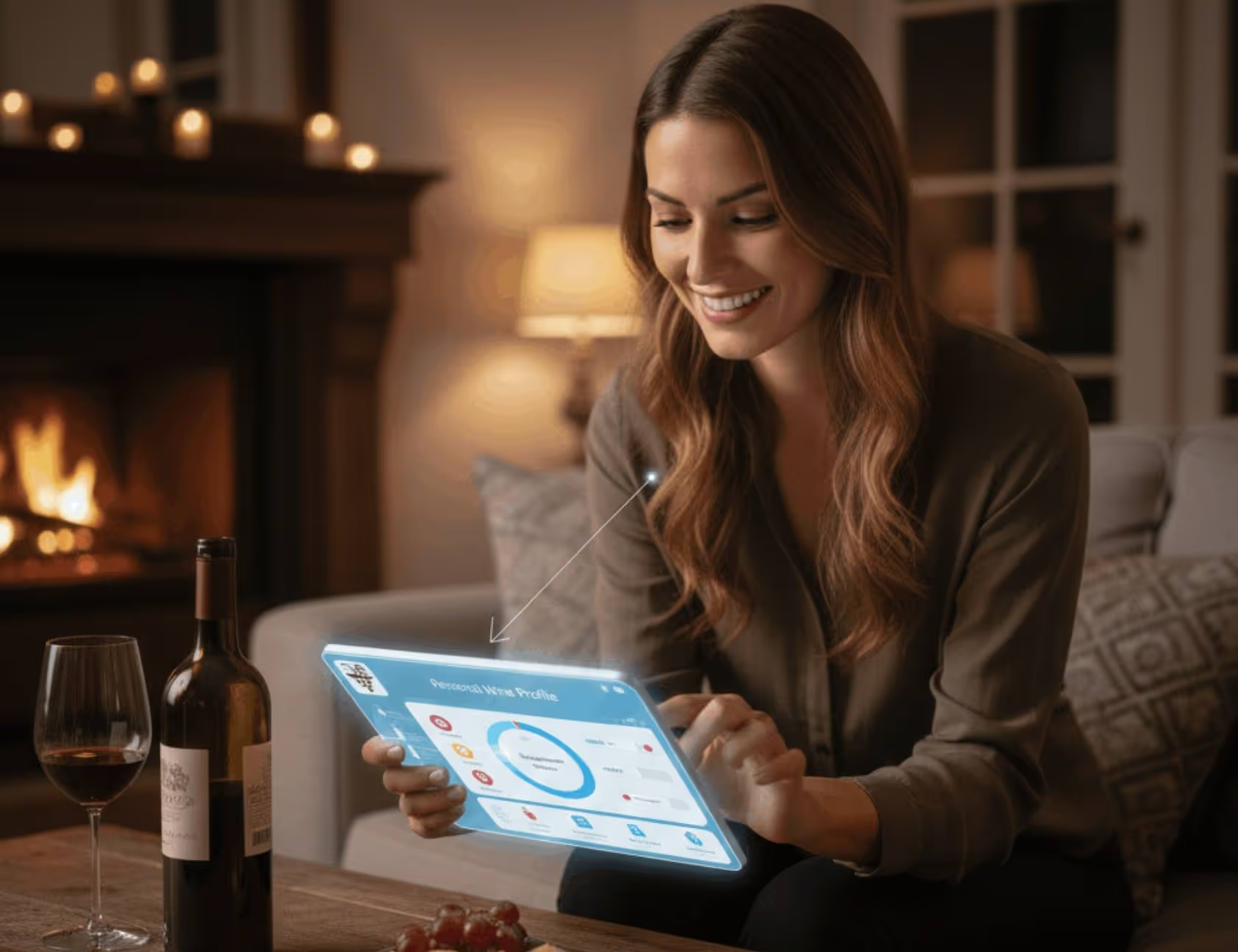
Once those four are behind you, the next stretch is variations on whichever one you liked most, which is where the learning accelerates because you already care about the answer. Sommy's Taste Profile does the record-keeping part of this automatically, building a picture of your palate from what you rate so the pattern is visible without you having to reread your own notes.
Frequently asked questions
How do you start drinking wine as a beginner?
Start with lighter, fruitier, lower-tannin styles, since the grippy dryness in a big red is the thing most new drinkers dislike. A Pinot Noir, a Beaujolais, a dry rosé or an unoaked white are all easy first steps, and our roundup of the best wine for beginners lists specific styles worth trying.
How do you describe wine without sounding silly?
Use weight, sweetness, sharpness and grip rather than fruit names. Saying a wine felt heavy, dry, quite sharp and a bit grippy is precise, honest and immediately useful to anyone helping you pick the next one, and it avoids the guessing game of trying to name specific fruits you may not be able to detect.
Is expensive wine actually better?
Up to a point, and in our view that point arrives lower than most people expect. Moving from a $8 bottle to a $20 one usually buys noticeably better fruit and more careful winemaking, while moving from $40 to $120 increasingly buys scarcity, reputation and age-worthiness rather than something you'd enjoy more on a Tuesday. Spending more is worth it when you know what you're buying and much less so when you don't.
Should you swirl and sniff the wine?
Yes, and it isn't a performance. Swirling releases the aromatic compounds and smelling them is where most of the flavor information actually arrives, so the ritual has a practical reason behind it. Two seconds of swirling and one sniff is all it takes.
How do you learn about food and wine pairing?
Two rules cover most cases: match the weight of the wine to the weight of the dish, and lean on what grows together going together. A light dish wants a light wine, a rich dish wants a heavy one, and an Italian dish is rarely wrong with an Italian wine.
How do you order wine at a restaurant without embarrassing yourself?
Name a price and a style, then let the server do the work. Pointing at a spot on the list and saying you'd like something around there, light and not too dry, is a normal thing that servers deal with constantly, and our guide to reading a wine list covers the rest of it.
The version that fits on a napkin
Drink two wines at once so you can compare them, note whether you liked each one and one thing you noticed, and keep the four words that matter close by: grape, body, tannin, acidity. Take whites out of the fridge and put reds in for twenty minutes. Spread your first four bottles as widely as you can, then dig into whichever one you liked.
That's most of what a beginner needs, and the part nobody can hand you is the record itself, which only accumulates by drinking. Confidence in a wine shop comes from having twenty or thirty of your own verdicts behind you, not from knowing which river runs through Bordeaux.