
Choosing a good Rioja wine is simpler than you think. The key is to look for one of four words on the label: Crianza, for a smooth, reliable red; Reserva, for something richer and more complex; Gran Reserva, for a special occasion; or Joven, for a fresh, fruity sipper. These words tell you exactly what the wine will taste like, so you can confidently pick the right bottle for any moment without needing to be a wine expert.
How to Choose a Good Rioja, Step by Step
You're in the wine aisle, staring at a wall of Spanish bottles. Words like ‘Crianza’ and ‘Reserva’ swim before your eyes. You just want a good red wine, but the fear of picking the "wrong" one can make the whole process stressful.
This feeling of being overwhelmed is completely normal. The wine world often seems designed to be confusing, but it doesn't have to be. You can choose a fantastic bottle of Rioja calmly and confidently, just by decoding a few key words on the label.
Think of these terms not as jargon, but as a simple roadmap to the flavors inside. They tell you if the wine is fruity and fresh or deep and spicy. This guide gives you a simple framework to make a quick choice you'll be happy with.
Your Simple Rioja Roadmap
Here’s the only thing you really need to know:
- Joven (or just "Rioja"): Fresh, fruity, and easy-drinking. Perfect for casual sipping.
- Crianza: The most popular style. Smooth, with red fruit and a hint of vanilla. Great for dinner.
- Reserva: A step up in complexity. Deeper flavors of dark fruit, leather, and spice. Ideal for a nice meal.
- Gran Reserva: The most mature and elegant. Savory, silky, and saved for special celebrations.
This simple table connects those words directly to your moment.
Quick Guide to Rioja Styles and Tastes
| If the label says... | It will taste... | And it's perfect for... |
|---|---|---|
| Joven | Fresh, bright, and fruity, like cherries and raspberries. | Casual sipping, tapas, or pizza night. |
| Crianza | Smooth, with red fruit, vanilla, and a touch of spice. | Your reliable weeknight dinner wine. |
| Reserva | Deeper, with dark fruit, leather, and tobacco notes. | A nice steak dinner or a special occasion. |
| Gran Reserva | Savory and elegant with dried fruit and earthy notes. | Milestone celebrations or a gift. |
That’s it. This breakdown is often all you need to navigate the aisle.
If you'd like to understand what makes any bottle a solid choice, you can see our guide on the general characteristics of good red wine bottles. With this simple foundation, you can turn a moment of stress into a moment of discovery.
What Those Words on the Label Really Mean
The words Joven, Crianza, Reserva, and Gran Reserva on a Rioja bottle aren't there to confuse you. They are a cheat sheet to the wine's flavor profile.
The difference between them is simply time. The longer a Rioja ages in oak barrels and in the bottle, the more its flavor changes from fresh and fruity to deep and savory.
Joven: The Young and Lively One
Joven means "young" in Spanish. This wine has spent very little, if any, time in an oak barrel. The result is a wine that’s all about fresh, bright fruit flavors.
Think of a Joven as vibrant and uncomplicated. It’s perfect for casual moments when you don’t want a heavy or complex red.
Choose a Joven when:
- You're having a casual get-together with friends.
- You're eating tapas, pizza, or light appetizers.
- You want a fun, fruity red that's easy to drink.
Crianza: The Reliable Dinner Companion
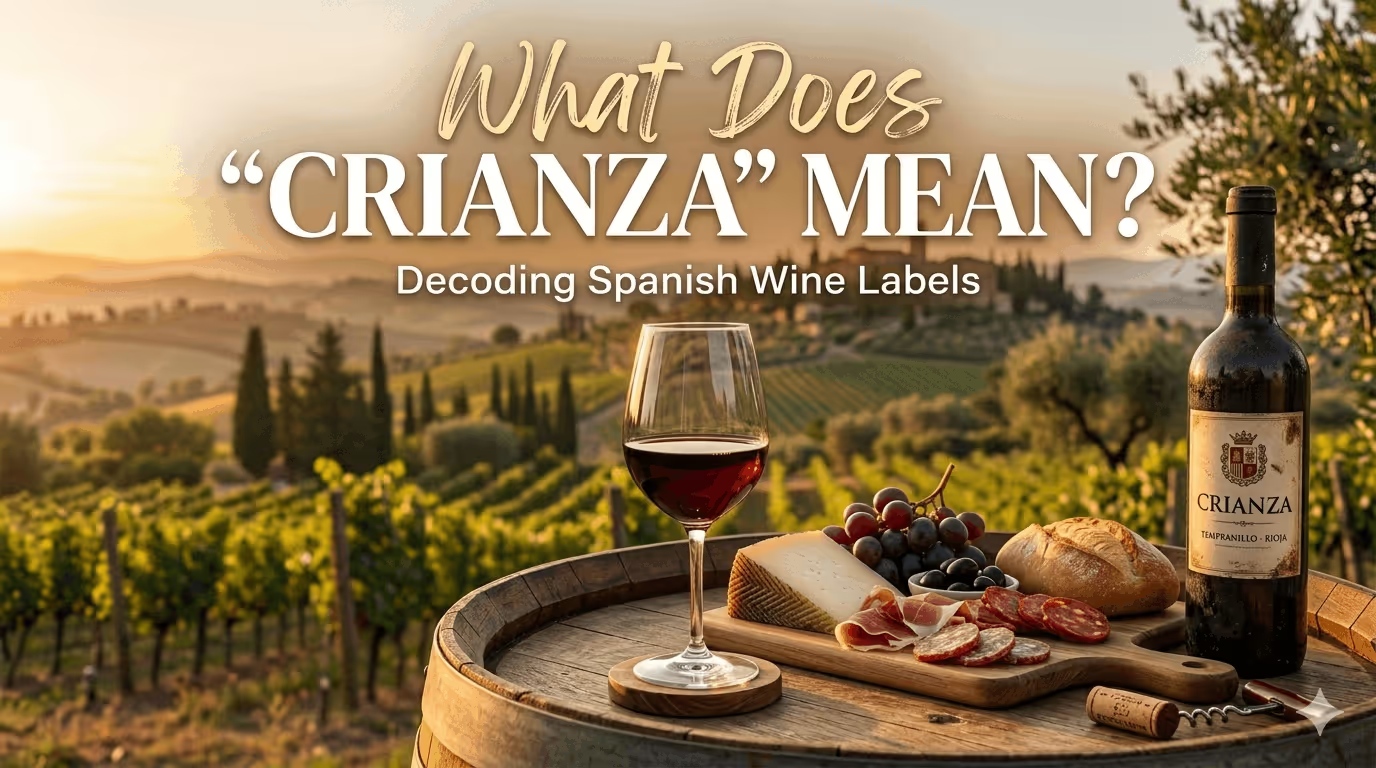
Crianza is the most popular style of Rioja for a reason. It is aged for at least two years, with at least one of those in oak barrels. That time in oak smooths the wine out and adds gentle layers of vanilla and spice.
A Crianza is balanced, approachable, and incredibly food-friendly. It's the perfect go-to for a weeknight dinner or when you need a crowd-pleasing red that works with almost anything.
This chart breaks down the core personality of a good Rioja.
As you can see, a Rioja can be fruity, smooth, or spicy, which lines up neatly with its aging category.
Reserva: The Special Occasion Bottle
When you see Reserva on the label, you're looking at a wine with more depth and character. These wines are aged for at least three years, with at least one year in oak. This extra aging develops more complex flavors.
The bright fruitiness of a younger Rioja evolves into notes of dark plums and cherries, with savory hints of leather and tobacco. A Reserva has a silky texture and is perfect for when you want something a bit more special, like a date night or a nice dinner. For a deeper dive into label-speak, check out our guide on how to read wine labels.
Gran Reserva: The Milestone Celebration
Gran Reserva is the pinnacle of Rioja aging. Made only in the best years, these wines are aged for at least five years—two in oak and three in the bottle. By the time a Gran Reserva reaches you, it has developed incredible complexity.
The experience of a Gran Reserva is less about bold fruit and more about layered, savory elegance. You’ll find delicate flavors of dried figs, coffee, and spice, all wrapped in a smooth, velvety texture.
This is a bottle for a true celebration—an anniversary, a major promotion, or a special holiday. Opening a Gran Reserva is an event in itself.
By understanding these four simple terms, you can confidently walk up to any shelf of Rioja and know what you're getting.
How to Pick a Good Rioja in the Wine Shop
Walking into a wine shop doesn't have to be a test. Choosing a good Rioja is a calm, simple process. It just takes two questions you can ask yourself right in the aisle.
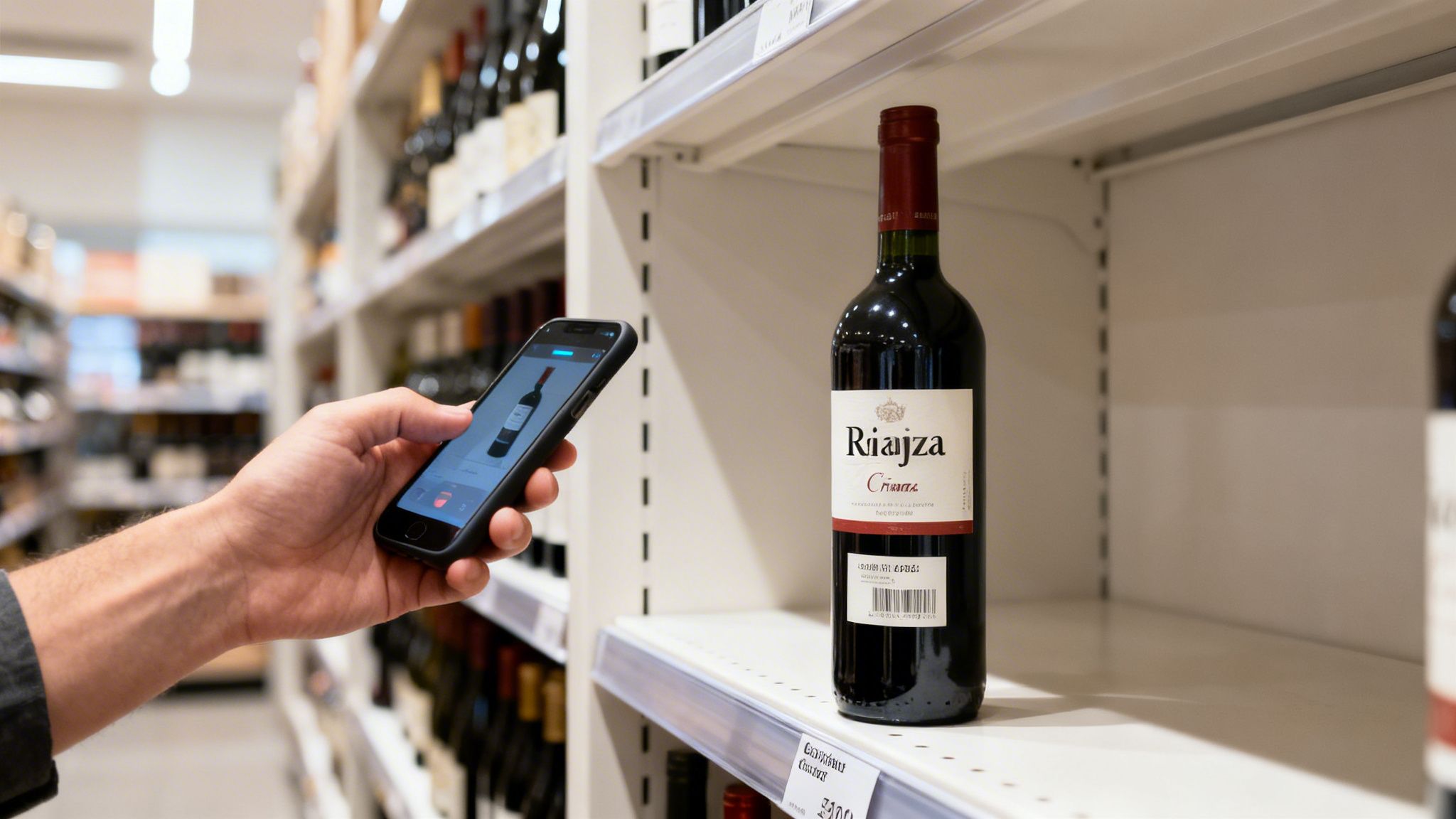
Step 1: Start with the Occasion
Before you touch a bottle, ask yourself: "What is this wine for?" The answer instantly narrows your options.
- Casual Weeknight Dinner? You need something reliable and friendly. A Crianza is almost always the perfect answer.
- Hosting a Dinner Party? Time to step it up a bit. A Reserva hits that sweet spot of being elegant and complex.
- Big Celebration or a Gift? For a milestone moment, a Gran Reserva delivers a truly memorable experience.
- Just Need Something Fun? For a barbecue or casual drinks, a young and fruity Joven is an excellent, uncomplicated choice.
Thinking about the occasion first acts as your primary filter, immediately cutting down the number of bottles to consider.
Step 2: Set Your Budget
Next, decide what you're comfortable spending. With Rioja, the price often connects directly to the aging category. You aren't paying for "good" versus "bad," but for time and complexity.
A higher price on a Rioja usually just means it was aged longer. A Gran Reserva costs more than a Joven because it spent years aging before it ever reached the shelf.
Once you know your occasion and your budget, you can focus on a very specific section of the shelf. Looking for a Crianza around $20? Great. You’ve just eliminated 90% of the other bottles.
Step 3: Make the Final Choice
Now you’re looking at just a handful of options. How do you pick the one?
If a brand looks familiar, it’s a safe bet. If not, just ask a shop employee a simple question: "I'm looking for a smooth Rioja Crianza for around $20. Which of these do you like?" They’ll be happy to point you to a great bottle.
Rioja has such high quality standards that it’s honestly hard to make a truly bad choice. This consistency is a huge reason why Rioja remains so popular. Even when Spanish wine sales saw a dip, Rioja's Reserva category grew by 7%, showing that people consistently trust these bottles. You can read more about these Rioja market trends and what they mean for quality.
This whole process is exactly what an app like Sommy is built for. Instead of analyzing labels yourself, you can simply scan the shelf with your phone. Sommy can highlight the bottles that match your personal taste profile and budget, turning a stressful guess into a simple, confident decision. If you want to explore this idea further, read our guide on how to pick wine without the stress.
Ordering Rioja Confidently at a Restaurant
When the server hands you the wine list, it can feel like a pop quiz. But when you spot the Rioja section, you can take a confident breath. Choosing a great bottle is much easier than it looks. A simple two-step process will nail it every time.
It all comes down to matching the wine to your food and your budget.
Step 1: Start With Your Meal
Your best clue for ordering the right Rioja is already on the menu. Just match the weight of the wine to the weight of your food.
- Lighter Dishes: Ordering chicken, roasted veggies, or a flavorful pasta? A Crianza is your go-to. Its bright red fruit and smoother body will complement these dishes perfectly.
- Richer Dishes: If a steak, lamb, or a hearty stew is on the menu, you’ll want a wine with more complexity. This is where a Reserva shines. Its deeper notes of dark fruit and spice are a classic pairing for rich, savory food.
Just by looking at what you plan to eat, you’ve already narrowed down your options.
Step 2: Match Your Budget
Now that you know if you’re looking for a Crianza or a Reserva, you can look at the prices.
Scan the Rioja section of the wine list and find the bottles in your comfortable spending zone.
You’ll probably see a few options for each style at different price points. Don't just assume the most expensive bottle is the "best." Every bottle of Rioja has to meet seriously high quality standards.
Simply pick a Crianza or a Reserva that fits what you want to spend. Because of Rioja's dependable quality, you can feel genuinely good about your choice. You’ve successfully matched the wine to your meal and your budget—the two things that matter most.
This is exactly the kind of in-the-moment decision where an app like Sommy becomes your secret weapon. If you want a discreet helper, you can scan the wine list with your phone. Sommy can spot the Riojas, understand what you’re eating, and suggest the ideal bottle that lines up with both your taste and your budget. It erases any last-minute doubt and lets you order with total confidence.
Why You Can Trust the Rioja Name
One of the best things about choosing a Rioja is its incredible reliability. This isn’t by accident. Every bottle comes with a special "quality guarantee" seal, which is your quiet reassurance that you’re holding a well-made wine.
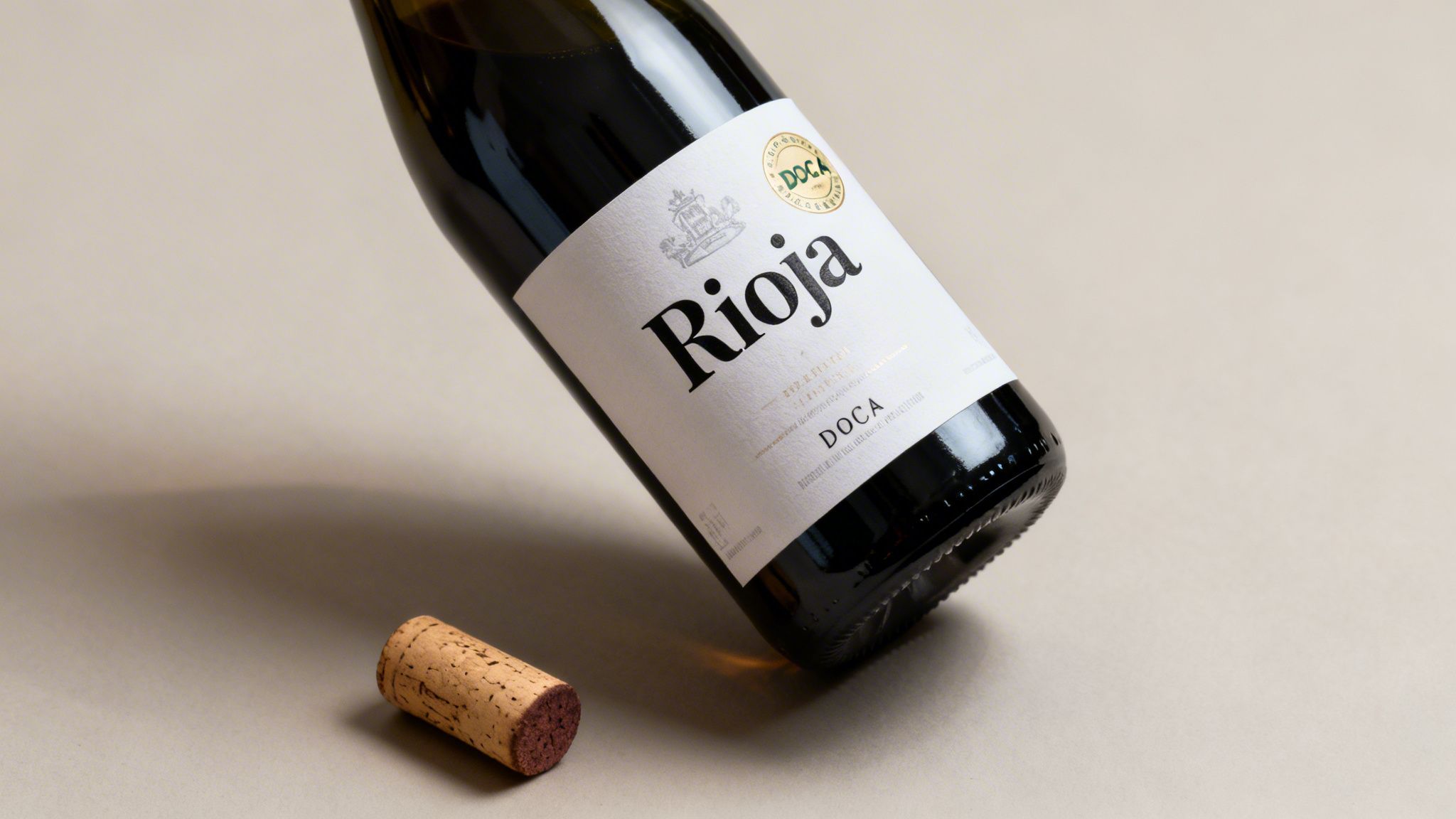
This seal is part of a system called Denominación de Origen Calificada (DOCa). You don’t need to remember that name. Just know it’s the highest quality classification for Spanish wine—a status only two regions have earned.
A Promise in Every Bottle
What does that DOCa seal actually mean for you? It means every bottle of Rioja must follow a strict rulebook covering everything from where the grapes are grown to how the wine is made and aged. It’s a promise of authenticity.
This system is why it’s so hard to find a genuinely 'bad' bottle of Rioja. It removes the fear of making a mistake. When you see Rioja on the label, you can relax, knowing you’re choosing a wine with a dependable pedigree.
This consistency has made Rioja a standout on the world stage. In 2023, the region’s exports grew by 4.42% even as worldwide wine consumption dropped. That kind of performance shows just how much people trust the Rioja name.
Why This Matters for Your Confidence
Understanding this quality control system simplifies your choice. You don’t have to worry about the fundamental quality of the wine. Instead, you can focus on what you prefer. Do you want something fruity or something spicy?
The DOCa seal handles the quality control so you can focus on personal taste. Your job isn't to find a good Rioja—it's to find the Rioja that's good for you.
This approach is central to how Old World wine regions like Rioja build trust. The rules are designed to guarantee a certain style and standard. For more on this, check out our guide explaining the key differences between Old World vs. New World wines.
In the end, Rioja’s seal of quality gives you the freedom to explore with confidence.
Your Next Bottle of Rioja Awaits
Choosing a great bottle of Rioja isn't about memorizing intimidating terms. It’s about having a simple game plan. You now have everything you need to walk into a shop or restaurant and feel completely in control.
The framework is simple: think about the moment, then match it to the word on the label.
A Simple Mental Checklist
Run through this quick mental checklist anytime you’re faced with a choice:
- What’s the moment? A casual pizza night calls for a different wine than an anniversary dinner.
- What’s the style? Match the occasion to the label—a fresh Joven for a party, a smooth Crianza for dinner, or an elegant Reserva for a special evening.
- What’s the budget? Use the aging category as a rough guide. More time aging usually means a higher price.
That's it. You have what you need to choose with certainty, turning a stressful decision into an enjoyable one. It removes the anxiety of picking the "wrong" bottle because you’re no longer guessing.
We believe wine is confusing only because people are afraid of choosing wrong. But when you have a clear, simple framework, that fear disappears.
This straightforward approach is exactly what we built the Sommy app to do. Think of it as having this guide in your pocket, ready to offer personalized help in seconds. Instead of trying to remember everything, you can just scan a wine list or a store shelf.
If you appreciate making calm, simple wine decisions, Sommy can provide that clarity every single time. It learns what you like, works with your budget, and gives you the confidence to know you’ve made a great choice.
A Few Common Rioja Questions
Here are some quick, straightforward answers to common questions that pop up when you're choosing a Rioja.
Does a More Expensive Rioja Mean It Is Better?
Not necessarily "better," but almost always different. In Rioja, a higher price usually reflects more time spent aging in oak barrels and in the bottle.
A pricier Gran Reserva has aged the longest, developing complex, savory flavors for a special occasion. A less expensive Crianza is aged for a shorter period, so it’s more vibrant and fruity. The "best" one is simply the one that fits your mood and your meal.
What if I Do Not Like Red Wine? Is There a White Rioja?
Yes, absolutely! While Rioja is famous for its reds, the region also produces amazing white wines (Rioja Blanco) and rosé (Rioja Rosado).
White Rioja is typically crisp and fresh with citrus notes, making it a brilliant partner for seafood, chicken, or salads. They are definitely worth trying if you're a white wine fan.
Do I Need to Know About Specific Wineries?
You really don't. The strict Rioja quality standards—that DOCa seal—guarantee a high level of quality across the board. You can trust that you're getting a well-made wine, no matter the producer.
Focusing on the aging category on the label (Crianza, Reserva, etc.) is the simplest and most reliable way to know what the wine inside will taste like. It’s a smart shortcut that lets you choose with confidence.
Choosing the right wine shouldn't feel like a test. It's about finding something you'll enjoy without the stress. This is exactly the kind of in-the-moment decision Sommy is designed to help with, giving you the confidence to pick the perfect bottle every time. To see how it works, visit https://www.sommy.ai.