
A corkage fee is what a restaurant charges to open and serve a bottle of wine you brought in yourself, and in the United States it usually lands somewhere between $10 and $40 a bottle, with fine dining rooms climbing past $100. You're covering the glassware, the pouring, the storage and the profit the restaurant gave up by not selling you something off its own list. Whether paying it makes sense comes down to a single comparison, because a bottle that would appear on their list at roughly three times its shop price justifies a corkage fee of up to twice what you paid at the shop.
Almost every guide to corkage online is written for the person setting the fee rather than the person paying it, which is why so many of them end on advice about training your staff. This one is written for the side of the table that has a bottle in a bag and a decision to make.
What Is a Corkage Fee, and What Are You Paying For?
A corkage fee is the charge a restaurant applies when you bring your own wine and ask them to serve it, and it exists because opening your bottle costs the restaurant both money and margin. WebstaurantStore's corkage fee guide lists what the fee is meant to absorb: the revenue lost by not selling you a bottle from the list, the glassware that has to be polished, washed and occasionally replaced, the table space you're occupying, and the investment behind the wine program itself, meaning the buying, the storage, a sommelier's salary and the staff training that goes with it.
Some restaurants call it a bottle charge instead, and the two words describe exactly the same arrangement. You'll also run into free corkage, which doesn't mean the restaurant has no policy but that its policy costs nothing, usually as a promotion on a slow night or around a particular occasion. Bring-your-own places sit at the other end of the same logic, because a restaurant with no liquor license has no wine sales to protect and often no sommelier or fine stemware to pay for, so many of them charge little or nothing. A few still do charge, which is the reason nobody should treat a BYO sign as a promise of a free pour.
The one thing corkage never buys is permission. Restaurants extend it as a courtesy, and a courtesy is something a business chooses to offer rather than something you're entitled to receive, which shapes every piece of etiquette further down this page.
How Much Is a Corkage Fee at a US Restaurant?
The usual American range runs from about $10 to $40 per bottle, and WebstaurantStore's guide notes that the figure can reach $100 or more at the top end. Neighborhood restaurants sit near the bottom of that band, while a room with a serious cellar and a sommelier on the floor sits near the top, because the fee tracks the level of wine service you're being handed rather than the wine you brought.
One pricing pattern turns up often enough to be worth recognizing, which is the restaurant that sets its corkage at exactly the price of the cheapest bottle on its own list. It's a tidy piece of logic on the restaurant's part, since it guarantees the house earns at least what it would have earned from the least expensive sale in the building. It also gives you a useful read on the room before you call, because a place whose entry-level bottle is $60 is unlikely to be charging $15 to open yours.
Corkage is charged per bottle in most restaurants, though a minority charge per table or per person, sometimes described as a per-stem fee. Those two structures behave very differently once a group is involved, since a $25 per-bottle fee on two bottles for six people is $50, while a $25 per-person fee on the same table is $150. Ask which one applies before you assume, especially for a birthday or an anniversary dinner where several bottles are coming with you.
When Is Bringing Your Own Bottle Worth the Fee?
Bringing your own bottle pays whenever the corkage fee is smaller than the markup you're dodging, and that comparison is simple arithmetic once you know roughly what a restaurant would charge for the same wine. Toast's 2025 breakdown of restaurant wine pricing uses a $20 shop bottle appearing on a list at $60 to $80, which is three to four times its retail price, and notes that restaurants generally use graduated pricing where the multiple shrinks as bottles get more expensive.
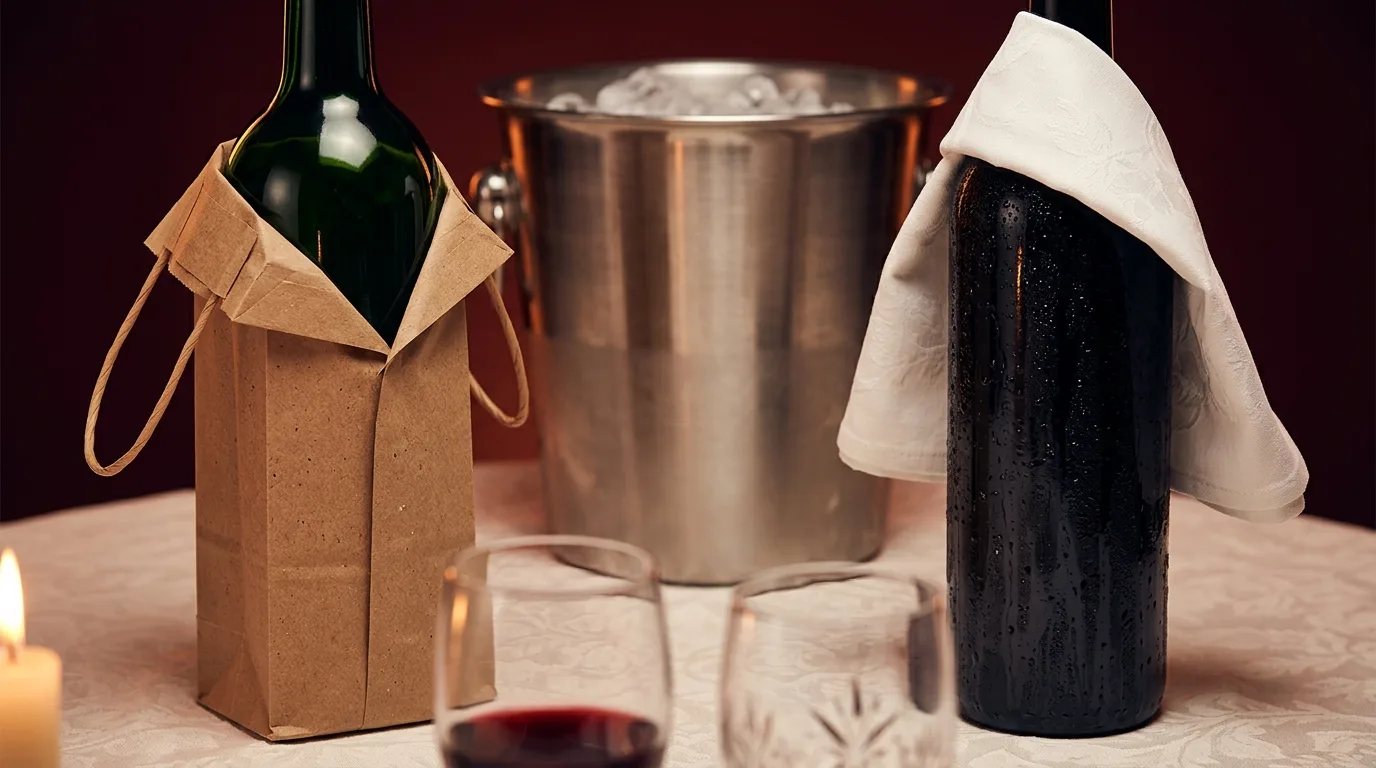
Call that multiple M, and your bottle costs you its shop price plus the fee while the restaurant's comparable bottle costs you its shop price times M, so bringing your own comes out ahead as long as the fee stays below the shop price multiplied by M minus one. At a three-times list, that reduces to something you can do in your head at the bar, because the fee has to stay under twice what you paid at the shop.
| Shop price of your bottle | Break-even fee at a 2x list | at 3x | at 4x |
|---|---|---|---|
| $15 | $15 | $30 | $45 |
| $25 | $25 | $50 | $75 |
| $40 | $40 | $80 | $120 |
| $60 | $60 | $120 | $180 |
| $100 | $100 | $200 | $300 |
Read the table as a ceiling rather than a target, since it only marks the point where the money stops working in your favor. A $25 bottle carried into a three-times list against a $50 fee is a wash on paper, while a $35 fee on a $60 bottle leaves you clearly ahead, and the reason to bring something is usually the wine itself rather than the savings. Our piece on what you actually pay for in an expensive bottle covers where that money goes on the shelf, before any restaurant touches it.
Two adjustments make the math honest. Tipping cuts in your favor here, which is the opposite of what most people assume. You tip on the corkage fee as you would on any other item, but you would also have tipped on their bottle, and their bottle is the bigger number. Tip both sides at eighteen percent and the break-even fee at a three-times list rises from twice what you paid to about two and a sixth times it, so a $25 bottle clears at roughly $54 rather than $50. The table below is pre-tip on both options, which makes it slightly conservative rather than wrong. And the comparison only holds if the restaurant's list genuinely carries something equivalent, because a fee that looks expensive against their list is cheap against a bottle they don't stock at all.
Can a Restaurant Legally Charge Corkage, and Where Is BYOB Banned?
Charging you to open your own wine is legal wherever bringing it is legal, and whether bringing it is legal usually depends on the restaurant's liquor permit rather than on the state line. Texas spells the mechanism out plainly. The Texas Alcoholic Beverage Commission says there are no statewide bring-your-own-beverage rules at all, that it's illegal to carry any alcoholic beverage into a restaurant or bar holding a Mixed Beverage Permit or a Private Club Registration Permit, and that you may bring your own into a venue licensed for beer and wine only or into one with no alcohol permit, where the business is free to charge you a fee for it.
Mississippi works the same way from the other direction. Answering a restaurant worker who had been told corkage was against state law, Wine Spectator's Dr. Vinny explained that businesses holding a beer-only permit there may let guests bring alcohol in, while a restaurant that already sells wine cannot legally charge corkage. Two different states, two different agencies, and the same underlying rule, which is that the permit hanging on the wall decides the answer rather than the map.
A Wine Spectator survey reported in 2011 counted 25 states that specifically allowed corkage without restriction and 15 that forbade the practice outright. Those counts have shifted since, and Virginia was in the middle of joining the permissive column when that piece ran, so treat them as history rather than as a checklist. The sentence in that article worth keeping is the one that hasn't aged at all, because no state requires a restaurant to let you bring in a bottle. Even where the law is entirely on your side, the policy is still the restaurant's to set.
Local rules add another layer, since Texas points residents to their own city or county ordinances and dry counties still exist in several states. Taking home what you didn't finish is regulated separately, and many states require the bottle to be recorked or bagged before it leaves. If you do get it home, our guide to storing an open bottle covers how long you've actually got.
What's the Etiquette, and Do You Tip on Corkage?
Yes, you tip on corkage, at the usual fifteen to twenty percent you'd apply to anything else on the check. WebstaurantStore's guide makes the reasoning concrete: the fee generally goes to the restaurant rather than to your server, while the server is the one opening the bottle, pouring it, refilling glasses, holding it at the right temperature and finding the right stemware. On a $10 fee that's another dollar or two, and on a $40 fee it's about eight dollars.
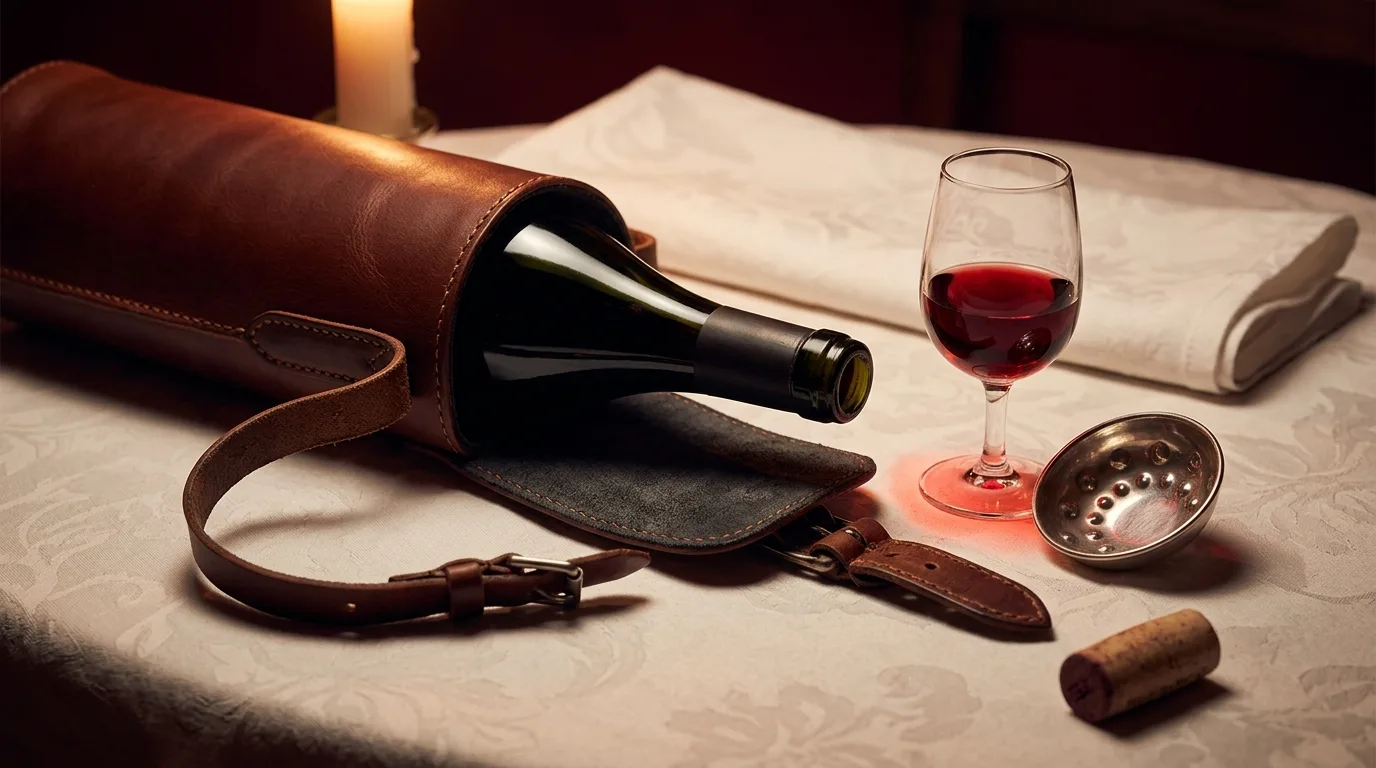
The rest of the etiquette is easier than its reputation suggests, and it starts with a phone call. Ask whether they allow it, what the fee is, whether it's charged per bottle or per person, and whether there's a limit on how many bottles you can bring, because arriving unannounced with a case is how restaurants end up withdrawing the courtesy altogether. Carry the bottle in properly rather than in a supermarket sack, and never bring something cheaper than the least expensive wine on their list, which is the single rule sommeliers mention most.
Offering the sommelier or your server a taste is a small gesture that costs you an ounce and buys a great deal of goodwill, and buying a bottle from the list alongside your own is the version of that gesture with real money behind it. Some restaurants formalize the trade and waive the corkage fee entirely when you also order something of theirs, so it's worth asking rather than assuming. The whole point of bringing a bottle is to drink something the restaurant doesn't have, which is a compliment to your cellar rather than a complaint about theirs, and the etiquette exists to keep it reading that way. If you'd rather skip the logistics and order well from the list instead, our walkthrough on ordering wine at a restaurant covers that side of it.
How Does Sommy Read a Wine List Before You Get There?
Planned Visit is the feature built for the decision this whole page describes, because it reads a restaurant's wine list ahead of your booking and ranks what's on it against your Taste Profile, the living picture of your palate that Sommy builds from everything you rate. You hand Sommy the restaurant, and you arrive already knowing whether their list holds something you'd enjoy.
You start by tapping into Sommy's Your Pour page, and then tapping Scout a Wine List:
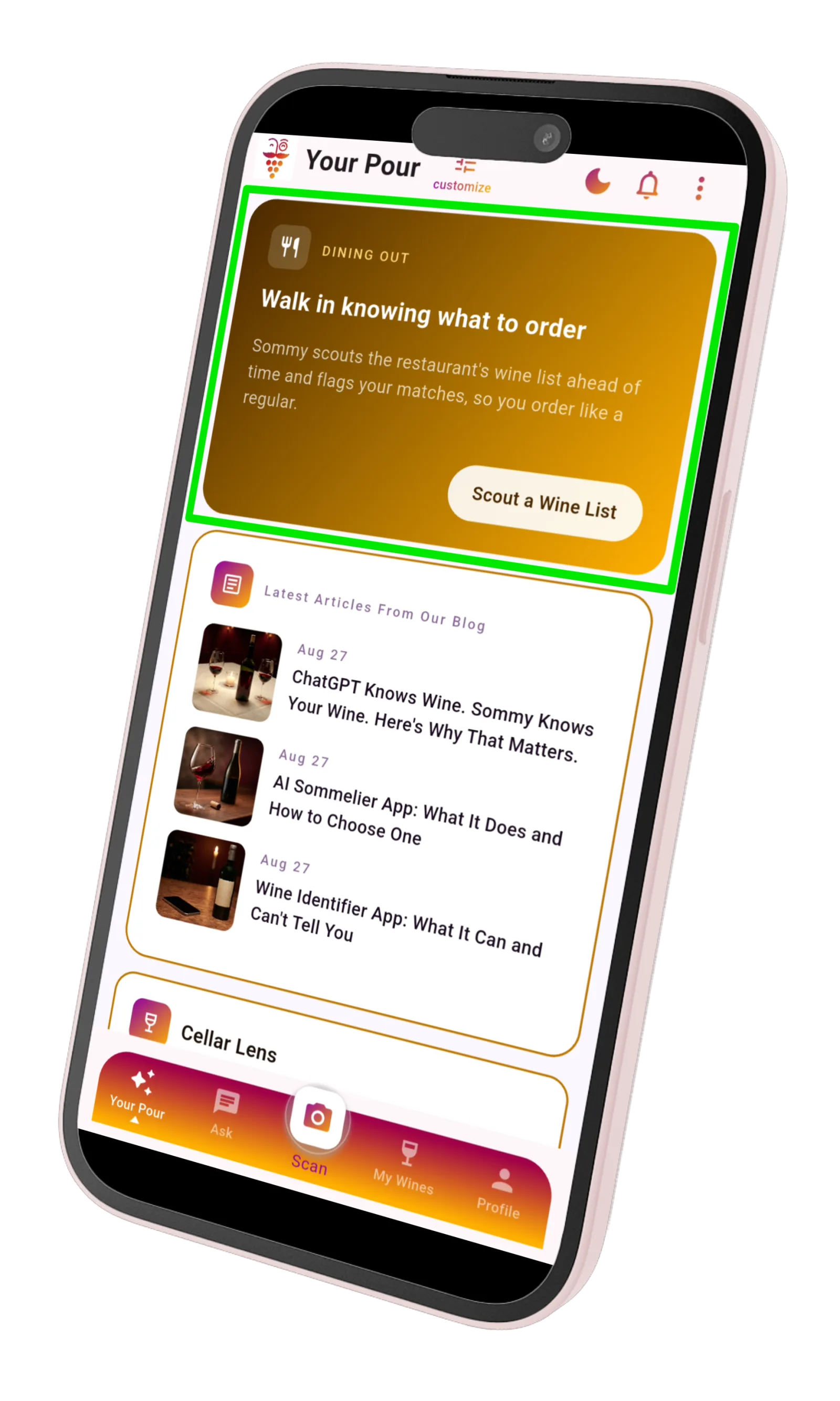
Then begin typing the name of the restaurant. Sommy will render the venue below the input box as you type once it recognizes where you intend to go. When you see your venue, just tap it:
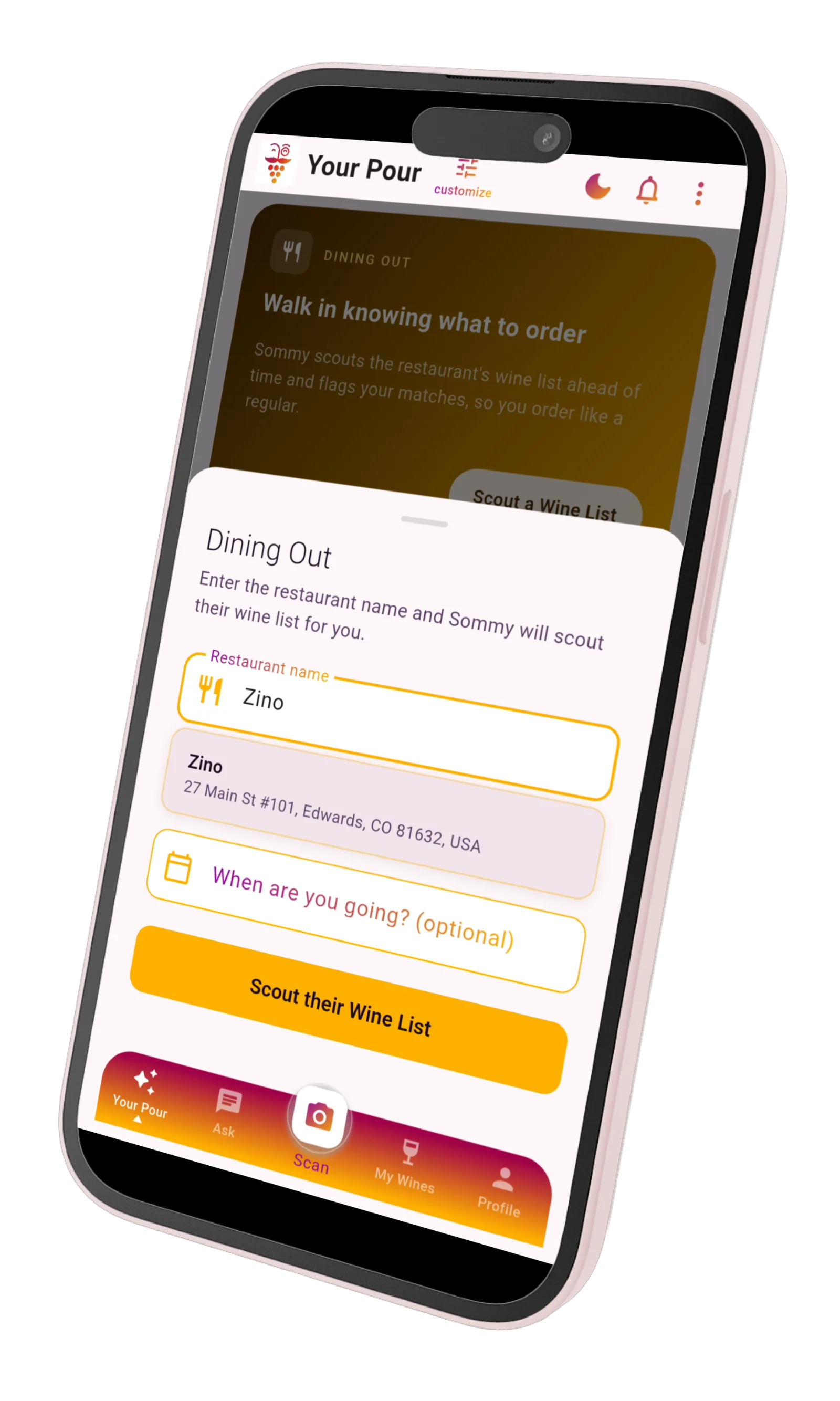
Once you tap your venue, Sommy will retrieve information about it, and if not seen previously, Sommy will begin ingesting their wine list:
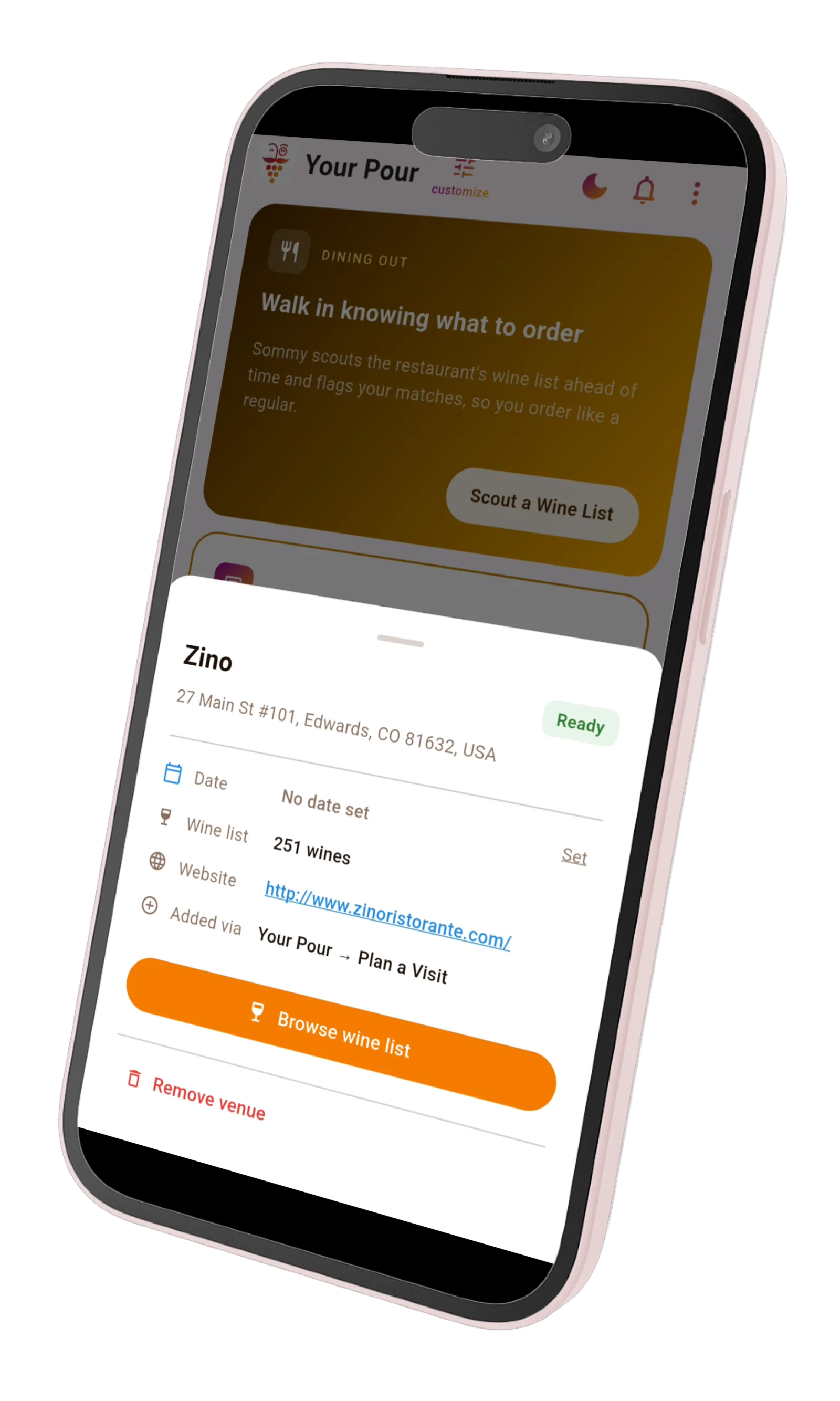
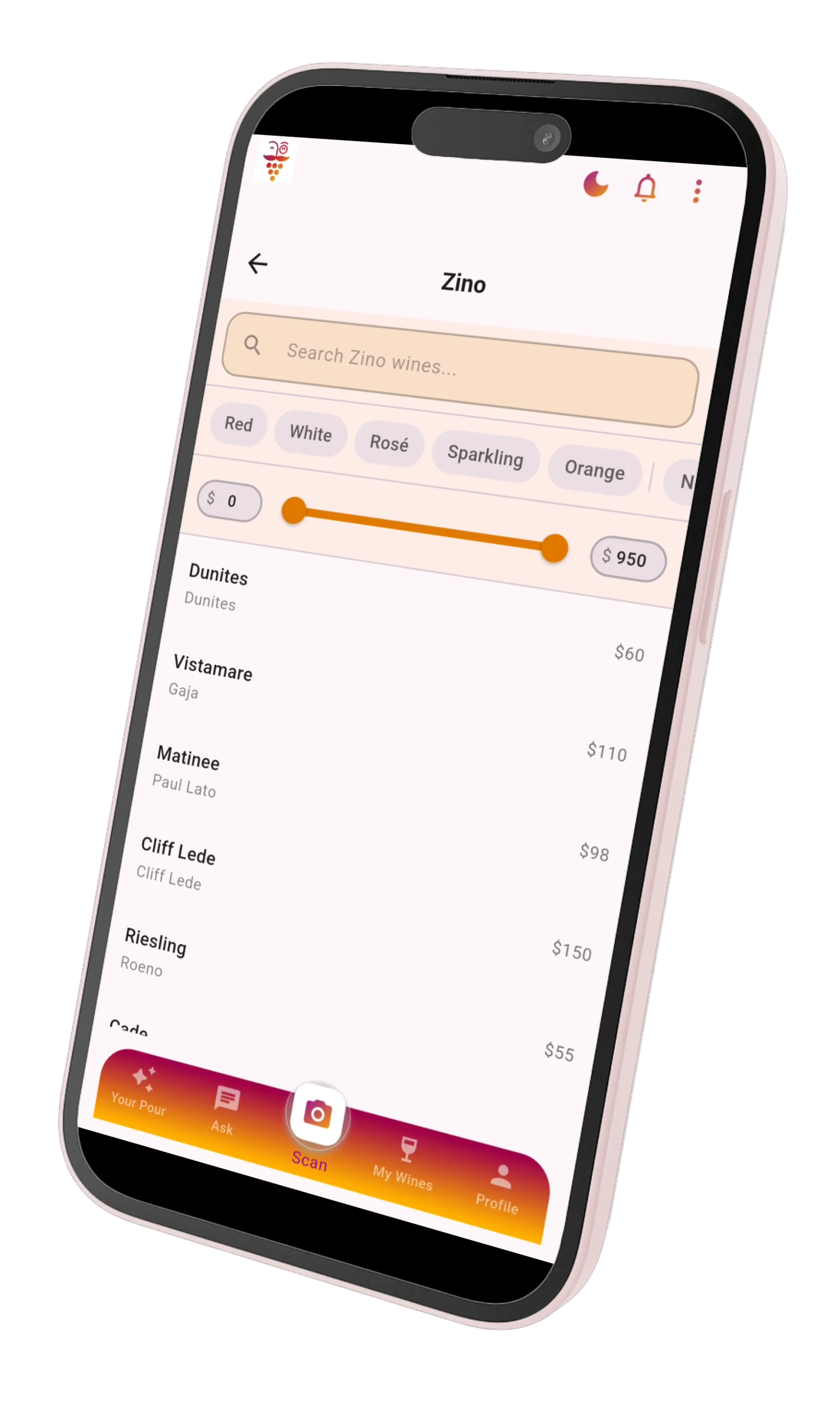
You can then tap into the wine list and explore:
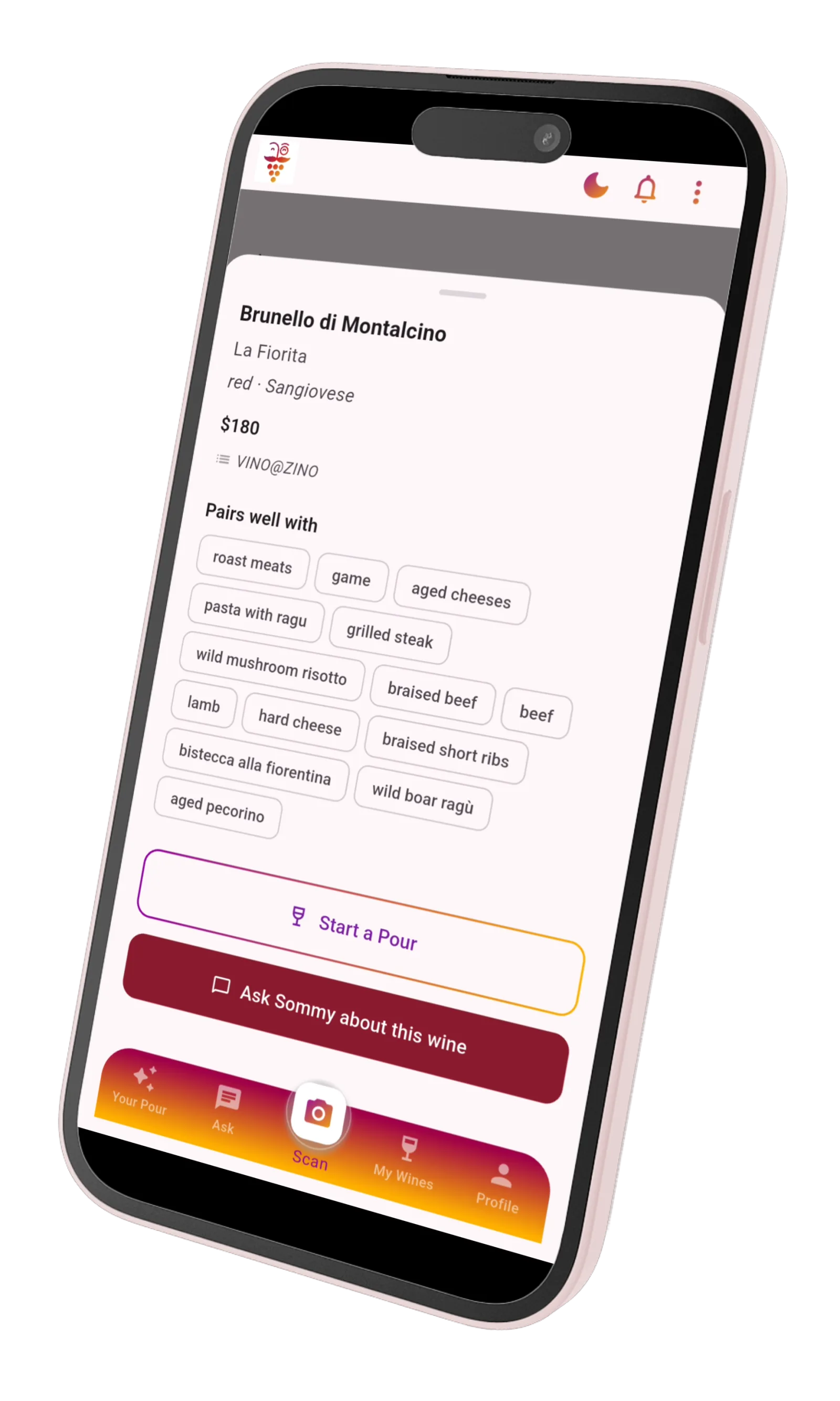
That turns the corkage question into something you can actually answer at home. The arithmetic further up this page needs one input nobody has in the moment, which is whether the restaurant carries a comparable bottle at all, and reading the list the night before supplies it. If their list is full of wines that suit you, the fee is money spent avoiding a good option. If the list runs in a direction your palate has never enjoyed, a $35 corkage fee starts looking like the cheapest part of the evening.
Sommy also knows what you own, since Cellar tracks your collection bottle by bottle, from one-off buys to a deep run of the same wine. Pairing works from the same place, taking a dish or a recipe and pulling a match from your cellar rather than from a generic chart, which is the other half of choosing what to carry out the door. Our piece on tracking a collection in an app covers how that side works day to day.
When Should You Skip Corkage and Order From Their List?
Skip the bottle when the restaurant's list is genuinely good and priced fairly, because the whole case for corkage collapses the moment their wine is both suitable and reasonable. Current Venue handles that read at the table, taking the list in front of you and filtering it down to the wines that fit your taste, which is a faster answer than working through four pages of producers you've never met.
When you open Sommy, and then tap into the Chat page, Sommy will automatically determine where you are and ask you to confirm which restaurant you are sitting in. In this example, we are in Zino, so we select that:
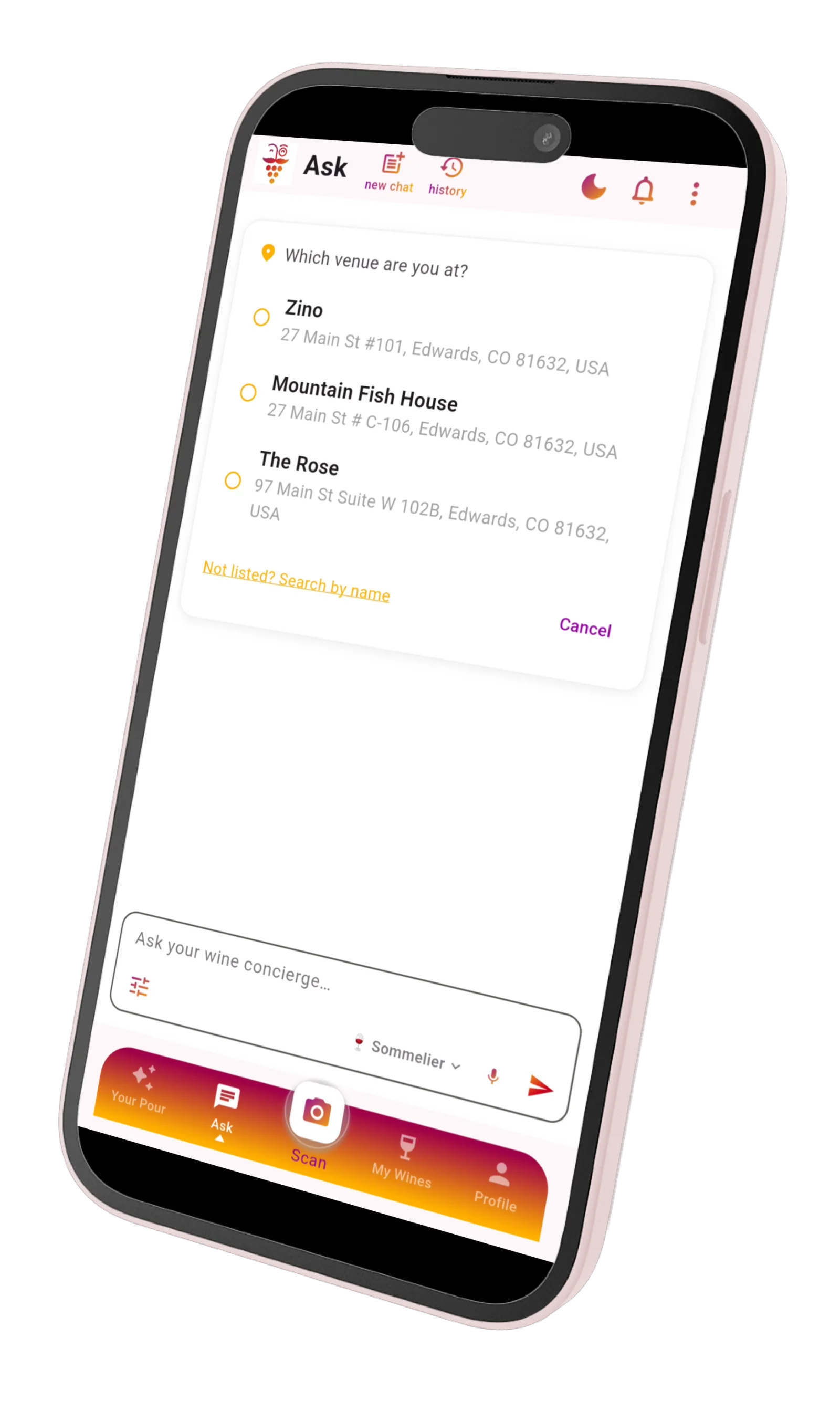
All wine recommendations are now scoped to just those from the restaurant's wine list.
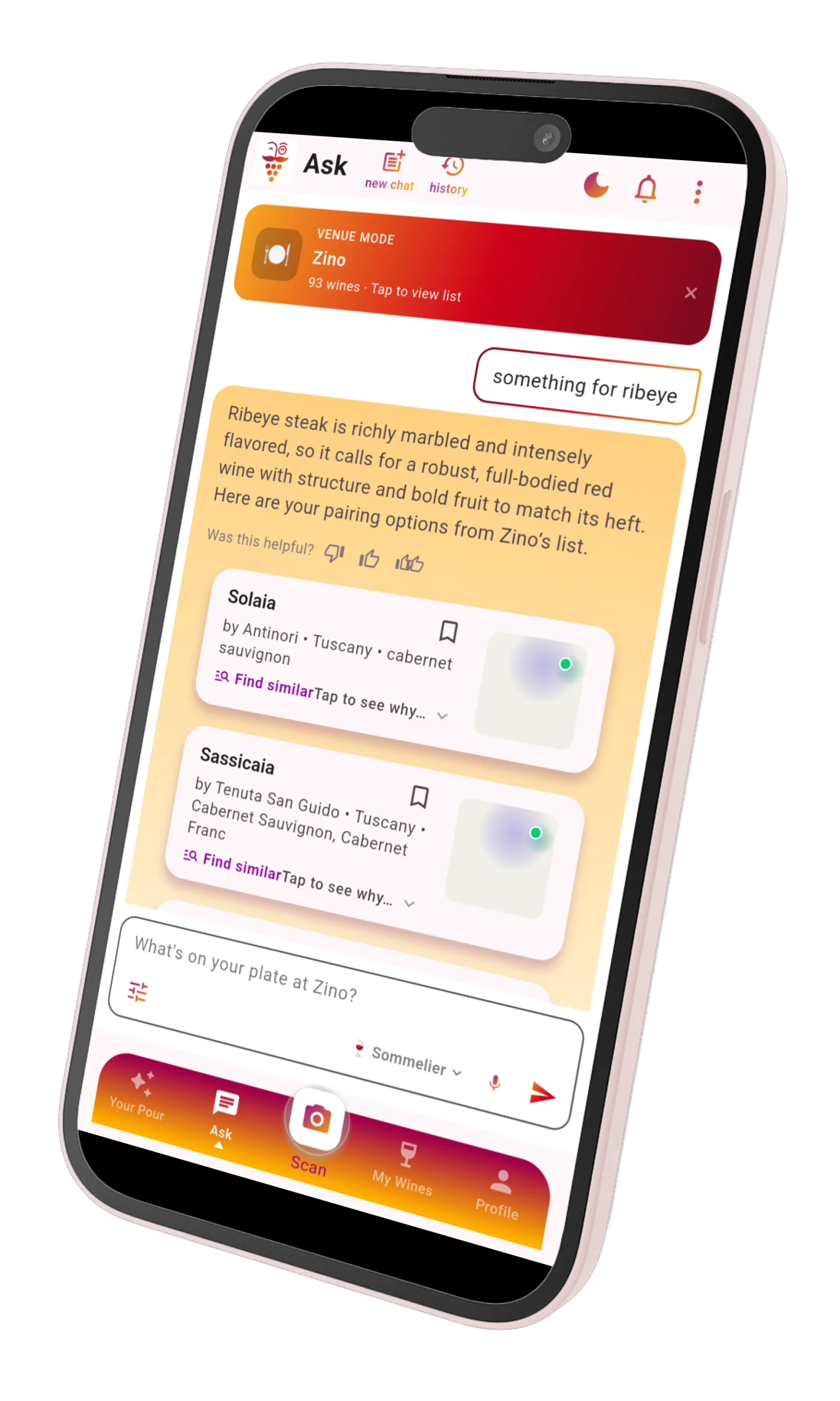
Now you can just type, or speak, the dish you plan to have, and Sommy will select a wine from the restaurant wine list that matches your Taste Profile and pairs well with your dish:
There are also nights when bringing a bottle is the wrong move regardless of the arithmetic. A restaurant with a celebrated cellar has usually earned the right to pour for you, and the bottle in your bag is unlikely to beat what a sommelier would choose for the food. Group dinners with per-person fees can cost more than the wine itself, and a restaurant whose list is priced close to retail is doing you a favor you shouldn't decline.
Bringing your own earns its place when the bottle means something. An anniversary vintage, a wine from a producer nobody imports nearby, a bottle a friend carried back from a trip, or something you've been holding for years all justify a fee that pure arithmetic wouldn't. Those bottles are the reason corkage exists, and the fee is the price of drinking one with food you didn't have to cook.
Frequently Asked Questions
What is the meaning of corkage fee?
A corkage fee is the amount a restaurant charges to open and serve a bottle of wine that you brought in yourself rather than bought from its list. Some restaurants call the same charge a bottle charge, and the two terms are used interchangeably. The fee covers the glassware, the service, the storage and the sale the restaurant gave up.
What is a reasonable corkage fee?
A reasonable corkage fee is one that stays below the markup you're avoiding, which for a bottle a restaurant would list at three times its shop price means anything under twice what you paid. Against the typical American range of $10 to $40 a bottle, a fee at the low end is reasonable almost anywhere, while the top of that range and beyond is fair only where the stemware, the service and the cellar behind them genuinely earn it.
How much is a standard corkage fee?
The standard American corkage fee runs from about $10 to $40 per bottle, and it can exceed $100 at high-end restaurants. Most places charge per bottle, though some charge per table or per person, so a group dinner can cost far more than the headline number suggests.
Can I avoid the corkage fee?
Sometimes, and asking is the only way to find out. Bring-your-own restaurants without a liquor license often charge nothing, some restaurants waive the fee when you also buy a bottle from their list, and others run occasional free corkage nights as a promotion. Free corkage means the restaurant has a policy and charges no money for it.
Is a corkage fee legal?
Charging corkage is legal wherever bringing your own wine is legal, and that generally depends on the venue's liquor permit rather than on the state. Texas allows it at beer-and-wine-only venues and unlicensed ones while forbidding it at holders of a Mixed Beverage or Private Club permit, and Mississippi allows beer-only permit holders to charge it while barring restaurants that already sell wine. Check the restaurant and your local ordinances.
Is corkage charged per bottle or per person?
Per bottle in most restaurants, but a minority charge per table or per person, which is sometimes called a per-stem fee. The difference matters most for groups, since a $25 fee on two bottles for six people is $50 under one structure and $150 under the other.
How do you calculate a corkage fee as a diner?
Multiply your bottle's shop price by the multiple the restaurant would apply, commonly three to four times for everyday wines, then subtract the shop price to get the highest fee that still leaves you ahead. A $40 bottle at a three-times list breaks even at an $80 corkage fee, so anything under that saves you money before tip.
Do you tip on a corkage fee?
Yes, at the usual fifteen to twenty percent. The fee typically goes to the restaurant rather than to your server, and your server is the one opening, pouring, refilling and holding the bottle at temperature, so the tip is what compensates the actual work.
Decide Before You Leave the House
Corkage rewards the person who made two phone calls and did one piece of arithmetic. Call the restaurant for the fee and the structure, check that its permit even allows it, and compare your bottle's shop price against what the list would charge for something similar, remembering that anything under twice the shop price is usually a win at a three-times list. Everything after that is etiquette, and the etiquette is mostly a matter of not turning a courtesy into an imposition.
The part no phone call resolves is whether their list already holds something you'd like more than the bottle in your bag. That's the comparison the fee is really asking you to make, and it needs both halves of the picture at once. Planned Visit reads their list against your taste before you leave, so the bottle you carry out the door is one you chose against the alternative rather than instead of knowing it.
