


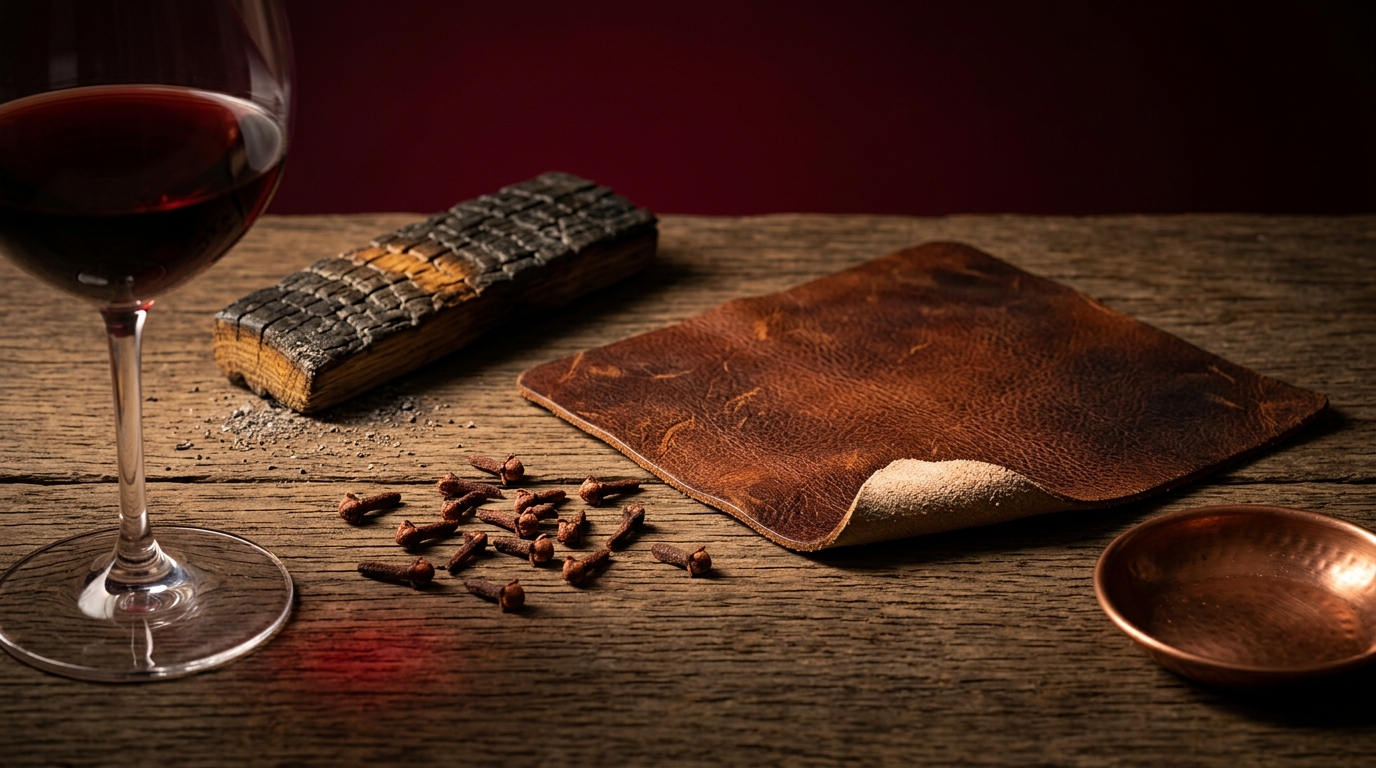
Brettanomyces, or Brett, is a spoilage yeast that converts compounds already in wine into volatile phenols, and the one you notice first is 4-ethylphenol, which smells like a Band-Aid. At low levels you might read it as leather, clove or woodsmoke. At higher levels it thins out the fruit and leaves a drying, metallic aftertaste, and that's where most drinkers stop enjoying the glass. You never have to name the yeast to act on it, because your nose is the instrument that actually decides.
What is Brettanomyces in wine?
Brettanomyces is a yeast that lives in the winery rather than on the grape, and it spoils wine by turning two natural grape acids, p-coumaric and ferulic acid, into volatile phenols you can smell. The Australian Wine Research Institute names three that carry the character: 4-ethylphenol (4-EP), 4-ethylguaiacol (4-EG) and 4-ethylcatechol (4-EC).
Each one contributes something different to what reaches your nose. 4-EP is the general marker for Brett and the source of that adhesive-bandage smell, while 4-EG brings smoke and spice. 4-EC adds the savoury, sweaty-cheese and barnyard nuances that people usually describe as animal. They almost always turn up together, in different proportions, which is why no two bretty wines smell quite alike.
The AWRI also points out something more useful than any of the chemistry, which is that Brett changes the taste and not only the smell. An affected wine shows diminished fruit flavour intensity and a drying or metallic aftertaste. So if a red smells faintly of leather and then tastes hollow where the berry should be, those two observations are related.
Brett works on very little fuel. The AWRI reports that it needs just 0.3 g/L of sugar to produce 1,000 µg/L of 4-EP, a figure drawn from Coulter's 2010 work, and average glucose and fructose levels in Australian reds rose from 0.5 g/L in 1998 to 2.1 g/L by 2008. Riper, softer, slightly sweeter reds give the yeast more to work with than lean ones did a generation ago.
What does Brett smell like in a glass?
Brett smells like a Band-Aid first, and then like some combination of leather, horse stable, clove, woodsmoke and old cheese, depending on how much of each compound is present. The bandage note is the one to anchor on, since 4-EP is both the most abundant of the three and the compound researchers treat as the marker.
How much it takes before you notice depends on the wine around it. The AWRI found a sensory perception threshold of 368 µg/L for 4-EP in Australian Cabernet Sauvignon, while Chatonnet and colleagues reported 605 µg/L in a French Bordeaux Cabernet back in 1992. The compounds also sharpen each other. That 605 µg/L threshold dropped to 369 µg/L once just 37 µg/L of 4-EG was present alongside it.
Everything else in the glass either hides Brett or exposes it. In a heavily oaked Cabernet Sauvignon the 4-EP threshold climbed to 569 µg/L, and in a green, underripe Cabernet it sat at 425 µg/L, because oak spice and vegetal notes both occupy similar ground. Fruit does the same job, which is why an older bottle can suddenly smell bretty when it never used to. The fruit faded and stopped covering for it.
If you want a broader vocabulary for what you're smelling before you decide anything, our guide to describing wine taste is a gentler starting point than a chemistry paper.
Does the grape change what Brett smells like?
Yes, and the grape changes it enough that Shiraz and Pinot Noir carrying identical spoilage will strike you as two different problems. The ratio of 4-EP to 4-EG varies by variety, because each grape carries different levels of the precursor acids, and the AWRI publishes typical ratios for three of them.
| Grape | Typical 4-EP to 4-EG ratio | What tends to come through |
|---|---|---|
| Shiraz | 23:1 | Close to pure Band-Aid |
| Cabernet Sauvignon, Nebbiolo | 9:1 | Band-Aid with a pungent spice behind it |
| Pinot Noir | 3:1 | More leather and barnyard, distinctly spicy |
That bottom row is the troublesome one. A bretty Pinot Noir leans animal and spicy rather than medicinal, which is uncomfortably close to the savoury, forest-floor character that good mature Pinot Noir is supposed to have, and close as well to heavily toasted oak. The AWRI says so directly, noting the two are often confused. A bretty Shiraz gives you much less room for doubt, since almost nothing else in a Shiraz smells like a first-aid kit.
Some grapes carry savoury notes honestly, and knowing which ones saves you from suspecting every earthy red you meet. Mourvèdre is a good example of a variety whose meaty, leathery side is the grape doing its job rather than a yeast doing yours.
Do wine drinkers actually like a little Brett?
Most don't, and this is the part where the received wisdom and the measured evidence part company. The AWRI ran a consumer study, published by Curtin and colleagues in 2008, in which 104 Sydney red wine drinkers assessed wines both untouched and spiked with Brett compounds across a range of concentrations.
The untouched base wine was always the most strongly liked. Every single sample containing Brett compounds scored significantly lower than the base wines, at p<0.05, and the samples people liked least were the heavy spikes at a 3:1 ratio of 4-EP to 4-EG. Even the gentlest dose tested, 4-EP at 600 µg/L, measurably hurt acceptance. Liking scores correlated strongly and negatively with medicinal aroma and medicinal-leather flavour.
The detail that reframes the whole argument is this: only 4% of that panel had ever heard of Brett. They weren't reacting to a wine-trade controversy or to a word. They smelled something, liked the wine less, and mostly couldn't have told you why.
None of which makes you wrong for enjoying it. Plenty of experienced drinkers genuinely prefer a whisper of leather in a mature red, and some regions have carried that character for so long that regulars expect it. The honest summary is that a little Brett is a minority taste rather than a mark of quality, and a lot of it is a fault by almost any measure.
What else gets mistaken for Brett?
Sulfidic characters, mild oxidation, smoke taint and cork taint all get blamed on Brett, and the AWRI's own helpdesk regularly receives samples suspected of Brett that turn out to be Brett-free. Learning what the impostors smell like is worth more than learning the chemistry.

Sulfur compounds read as sewage, sweat or rotting onion rather than bandage, and they often blow off with air in a way Brett never does. Low-level oxidation quietly reduces fruit intensity and adds a savoury edge, so it mimics the hollow palate Brett causes without the medicinal nose. Smoke taint brings ashtray and burnt character. Cork taint is the most common confusion of all, and it smells of wet cardboard and damp basement while flattening the fruit; our 30-second method for spotting a corked bottle separates that one quickly.
A single odd descriptor proves nothing on its own. Mushroom, tobacco and dried leaves all arrive naturally as red wine ages. If you want a repeatable way to work through a suspect glass rather than guessing, the method in how to taste wine properly gives you an order to do it in.
Can white wine have Brett too?
White wine can absolutely have Brett, and Chardonnay is the white variety most frequently affected. The AWRI has also observed it in Riesling and in sparkling base wines. The reason is simple enough: p-coumaric and ferulic acid, the precursors Brett feeds on, occur in white grapes as well as red ones.
Whites carry more risk when they sit exposed to oxygen or get handled with very little sulfur dioxide. Barrel-fermented Chardonnay resting on its lees, or a white given skin contact for texture, extracts more precursor compounds than a tank-fermented one. Malolactic fermentation leaves any wine vulnerable while sulfur levels are still low, which is worth knowing if you like the creamy style malolactic fermentation creates.
Natural winemaking raises the odds, since limited or no sulfur dioxide at the crusher and through ageing is exactly the condition Brett prefers. That isn't an argument against natural wine, and plenty of it is spotless. It does explain why the funk you occasionally meet in that category is sometimes a yeast rather than a philosophy.
What should you do when the bottle smells wrong?
Describe what you smell in ordinary words and ask someone to check it, because you're deciding whether you want to drink this bottle rather than sitting an exam. A sentence like "I'm getting a strong bandage smell and almost no fruit, would you mind checking it?" does the whole job. Bandage isn't a tasting term and it doesn't need to be.
Let the server or the wine staff smell the bottle themselves. If they agree, ask what else they can open. One thing worth saying out loud: another bottle of the same wine may carry the same character, since Brett tends to affect a batch rather than a single bottle, so a different wine is usually the smarter request than a replacement of the same one.
If the staff judge the wine sound and typical, you can still say you'd prefer something fruitier and less savoury. That's a far easier conversation than arguing about whether a wine is objectively faulty, and it gets you a glass you'll enjoy. When you're choosing the replacement from a list you've barely read, Sommy's Current Venue can filter that restaurant's wine list down to what suits your taste, which beats picking the second-cheapest red out of embarrassment.
At home, pour a small measure into a clean glass first, because a scented detergent or last night's garlic can wreck a first impression. Give it a few minutes and smell again. Decanting won't help, and this is worth being clear about: air can open up other aromas and shift your impression, but it cannot remove volatile phenols the yeast has already made. Keep the bottle and the receipt, tell the shop what you smelled rather than announcing a diagnosis, and check their policy.
How do winemakers keep Brett out of the bottle?
Winemakers control Brett with sulfur dioxide timing and cellar hygiene, and the critical window has a name. The AWRI calls it the Brett zone: the stretch between the end of primary and secondary fermentation and the moment sulfur dioxide goes in. Wines left unsulfured through a slow malolactic fermentation are at the greatest risk, which is why finishing that ferment quickly matters.

The target is a molecular sulfur dioxide concentration of 0.6 mg/L, which the AWRI says is best reached with one large addition after malolactic fermentation rather than several small ones. For a wine at pH 3.6 or below that works out to roughly 80 mg/L, and higher-pH wines need more to hit the same protection. There's also a cheap way to catch trouble early, which is watching the ratio of free to total sulfur dioxide. A finished wine should sit near 1:2 or 1:3, and a drift toward 1:5 means something is binding up the free sulfur.
Filtration before bottling removes yeast cells and stops further growth, though nothing removes the aromas already produced. That asymmetry is why prevention gets all the attention in the cellar and why a bretty bottle can't be rescued in your kitchen.
The encouraging part is how much better this has become. Over the AWRI's ten-year survey of Australian Cabernet Sauvignon, the mean level of 4-EP fell by 90%, down to a mean of 107 µg/L for the 2005 vintage, and 21% of wines measured from the 2006 vintage had no detectable 4-EP or 4-EG at all. The old line that every red wine carries some Brett was roughly true in the late 1990s and isn't true now.
Trust the glass in front of you
A bandage smell in your wine says something about the bottle and nothing about your judgement, and the practical response is smaller than the chemistry suggests. Smell it, look for the fruit, notice whether the finish goes dry and metallic, and then decide whether you want to keep drinking. That sequence takes fifteen seconds and doesn't require you to name a yeast or win an argument.
The one habit worth building is writing down what put you off. "Liked the weight, couldn't get past the bandage smell" is a genuinely useful note, and much better than concluding you dislike Syrah or Pinot Noir on the evidence of one spoiled bottle. Bottles vary, batches vary, and your own sensitivity climbs with exposure, since the AWRI notes that repeated contact with the aroma makes it easier to detect.
Most of the wine you meet will be clean. Brett is rarer than it was, the descriptors are learnable in an evening, and the cost of being wrong is one glass you don't finish.
Common questions about Brettanomyces in wine
Is Brettanomyces in wine harmful to drink?
Brettanomyces is a quality and flavour problem rather than a safety one. It's a spoilage yeast, not a pathogen, and a bretty wine is unpleasant rather than dangerous. If the smell puts you off, set the glass aside for that reason alone.
Will decanting remove a Brett smell from wine?
Decanting won't remove the Brett smell from the wine. Air can lift other aromas and change your overall impression of a wine, but the volatile phenols Brett has already produced stay in the liquid. Give a puzzling glass a few minutes if you're unsure, then judge it again.
Can I tell whether a wine has Brettanomyces before I buy it?
Nothing on the label will tell you, and grape, price and region are all unreliable predictors. Natural wine carries slightly higher odds because of low sulfur handling, though plenty of natural wine is spotless. If you know you dislike leathery, animal notes, saying so to a shop or a server works better than guessing from the bottle.
Does Brettanomyces mean the winemaker made a mistake?
Not necessarily, since Brettanomyces lives in cellars and equipment and can take hold in a narrow window during ageing. Some producers also accept a low level as part of their house style. What it does mean is that the wine's character was decided by a yeast rather than by a choice.
Why does Brett smell different in a Pinot Noir than in a Shiraz?
The ratio of the two main compounds differs by grape. Shiraz runs about 23:1 for 4-EP to 4-EG and reads as close to pure Band-Aid, while Pinot Noir runs nearer 3:1 and comes across as leathery, barnyard-like and spicy. Cabernet Sauvignon sits between them at roughly 9:1.
