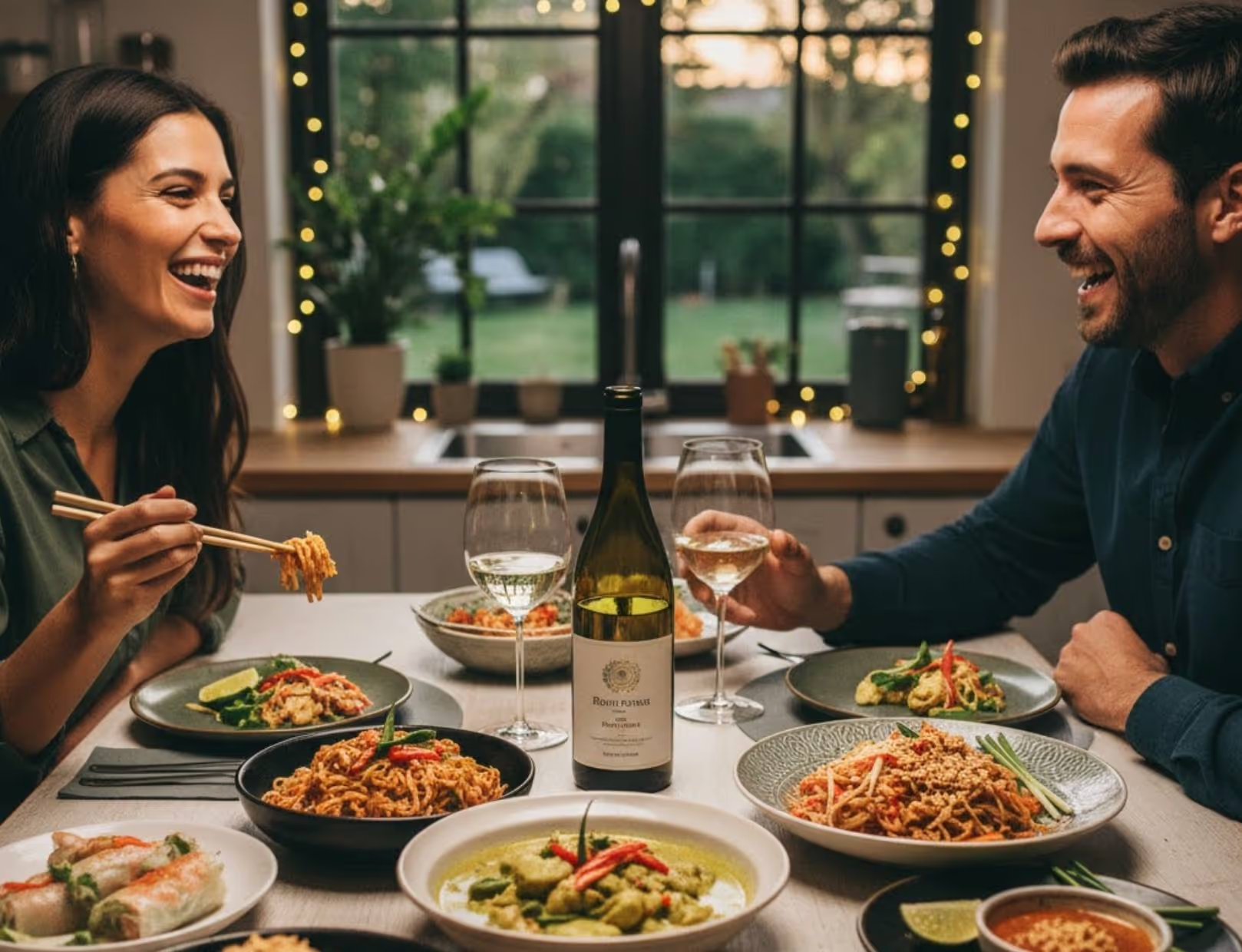

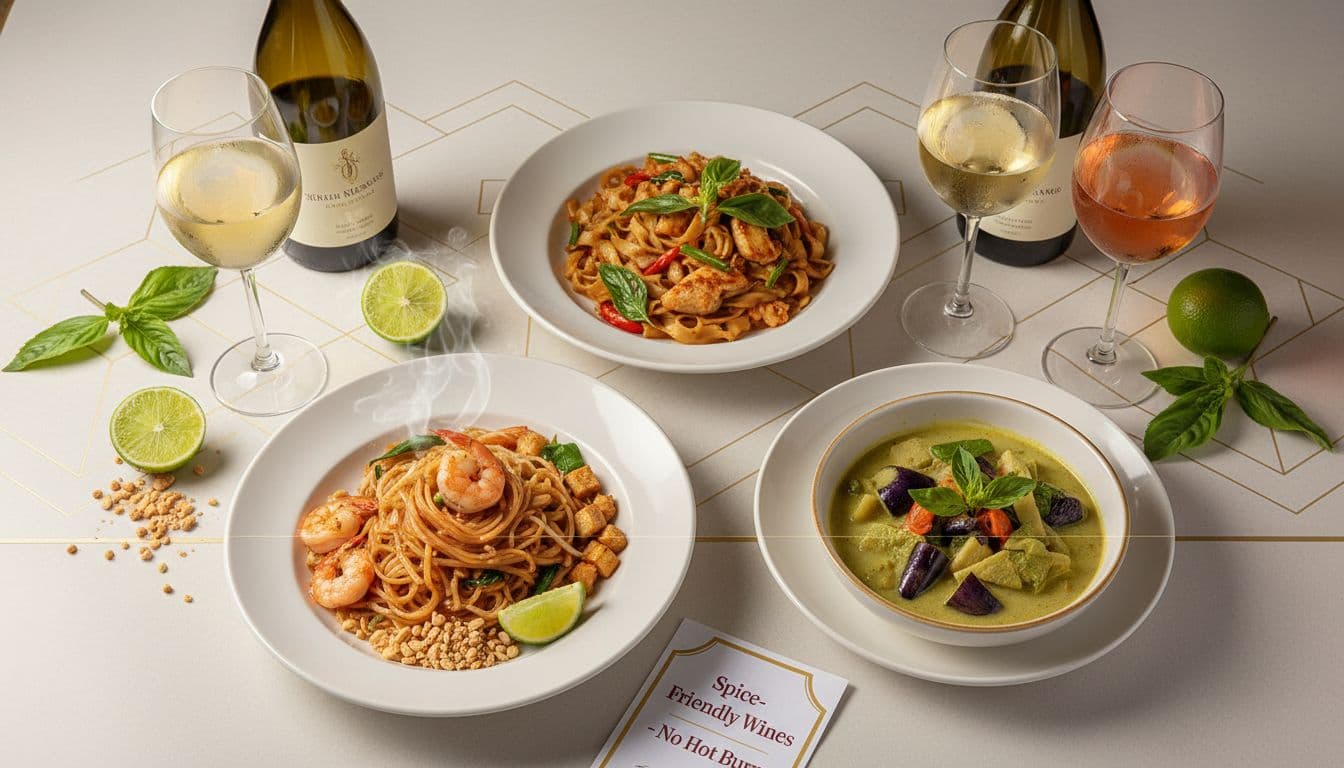
The best wine for Thai food is an off-dry Riesling, and Gewürztraminer and sparkling rosé are the two backups that cover almost everything else on the table. A little sweetness cools chili heat, high acidity keeps up with lime and tamarind, and lower alcohol stops the burn escalating between bites. The mistake that ruins Thai night is a big, dry, high-alcohol wine, red or white, because dryness and alcohol both make the same dish taste noticeably hotter.
What wine goes best with Thai food?
Off-dry Riesling, for four reasons that all point the same way. It has a touch of residual sugar that takes the edge off chili, enough acidity to match lime and tamarind, aromatic fruit that stands up to lemongrass and galangal instead of disappearing behind them, and it's often bottled at 9 to 11 percent alcohol, which is the single most helpful number on the label when the food is hot.
Gewürztraminer is the pick when the dish leans aromatic rather than fiery. Its lychee and rose perfume meets Thai basil, kaffir lime leaf and coconut on their own terms, and it has the weight to sit next to a rich curry. It's lower in acidity than Riesling, so it's less useful when the dish is sharply sour. If you've never bought a bottle of it, our guide to what Gewürztraminer goes with covers where else it shines.
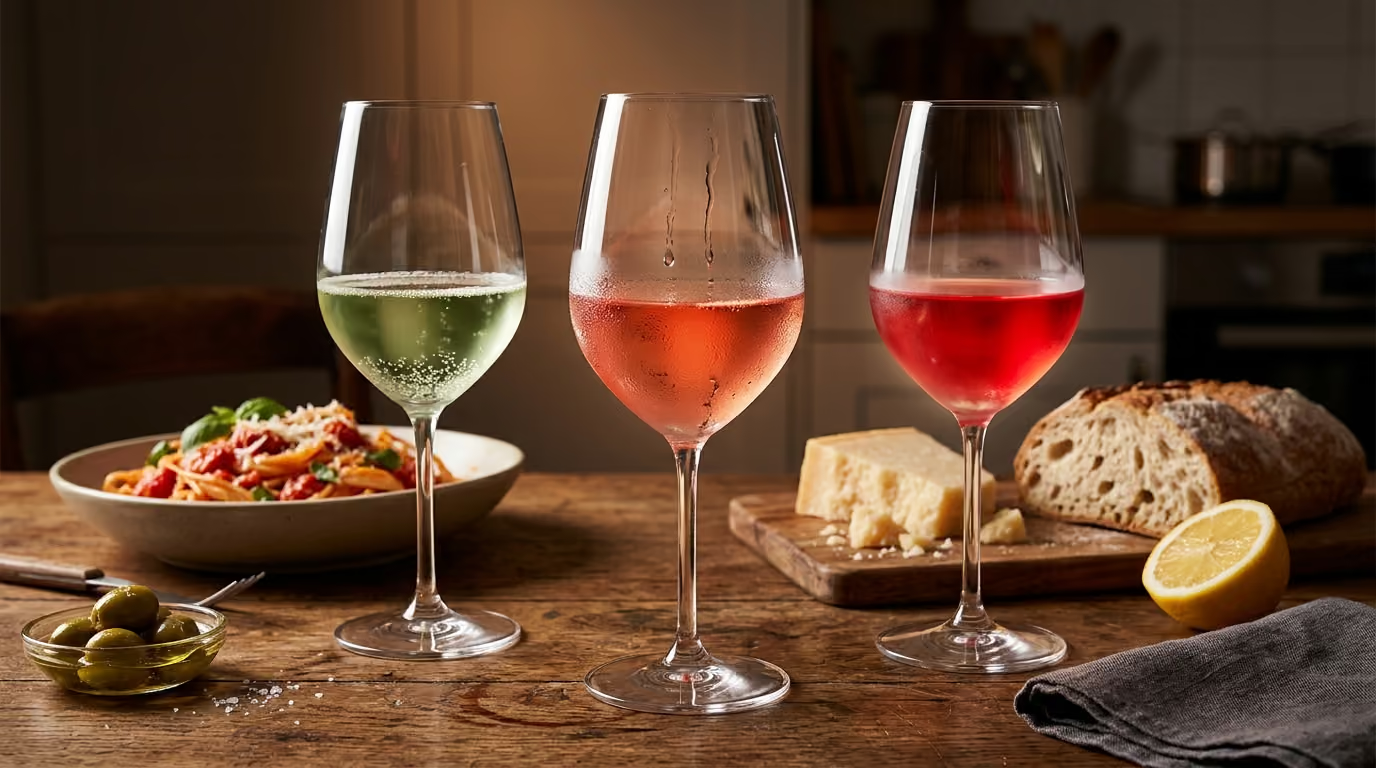
Sparkling rosé is the bottle to open when the table has ordered six different things, which is how Thai food is usually eaten. Bubbles clear your palate between mouthfuls that have nothing in common, and the light red fruit gets along with both the seafood and the meat dishes without committing to either.
Why does wine taste hotter with spicy Thai food?
Alcohol and tannin both amplify the burn, and dryness leaves nothing to soften it. Chili heat is a physical sensation rather than a flavor, and a wine that's high in alcohol adds to that same sensation instead of relieving it, which is why a 14.5 percent Cabernet Sauvignon with a green curry feels like a mistake within two sips.
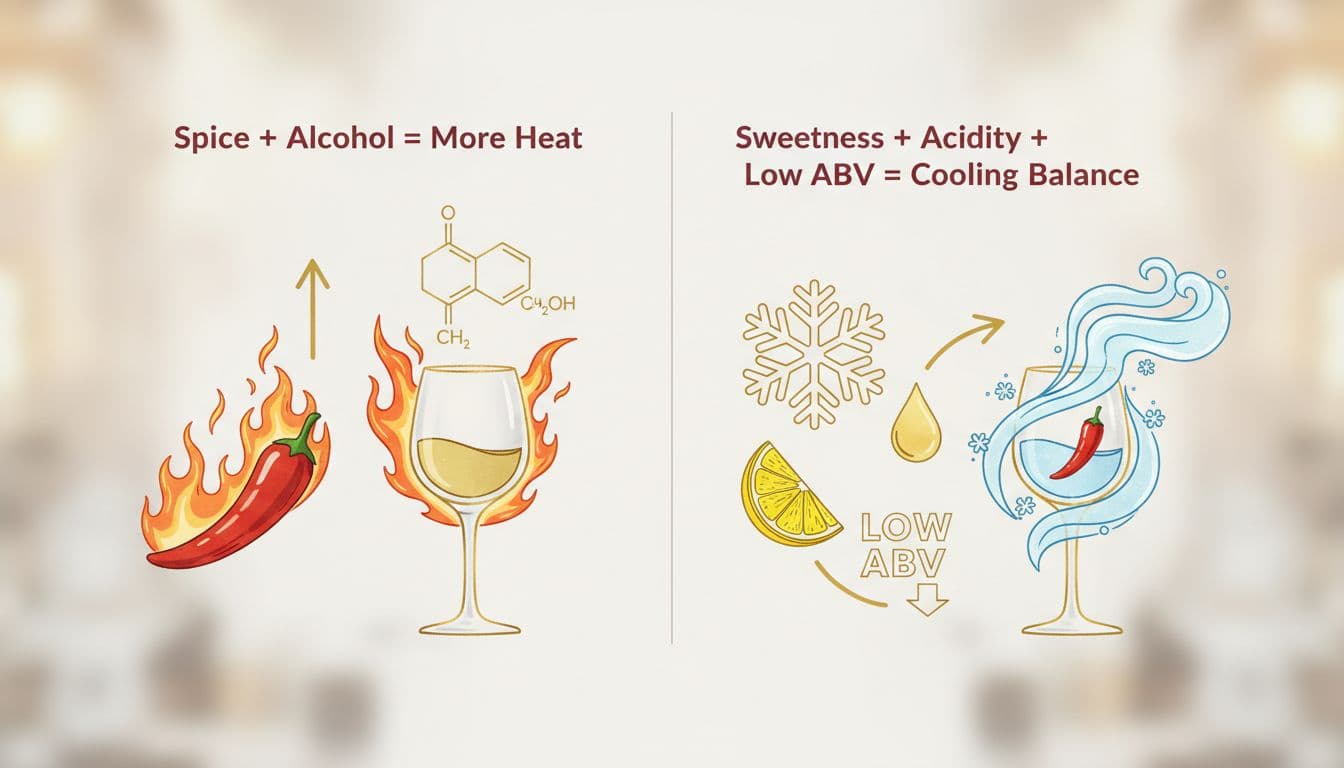
Sweetness is the counterweight. A few grams of residual sugar coat your mouth and pull the intensity down a notch, and the fruit in the wine comes forward as the heat recedes rather than getting buried by it. That's why off-dry works and bone dry often doesn't, even when the dry wine is objectively the better bottle.
Cold does similar work for free. A wine served properly cold reads as more refreshing against a hot dish, and the same bottle at room temperature can taste flabby and alcoholic with the same food. If you take only one thing from this page, take the thermometer rather than the grape.
Tannin is the third dial and the reason most reds struggle. That drying grip, which is what makes strong black tea feel rough, turns bitter against capsaicin. Our explainer on what tannin actually is covers the sensation if the word has always been vague to you, and our wider guide to wine for spicy food applies the same logic beyond Thai cooking.
Can you drink red wine with Thai food?
Yes, and it's better than its reputation suggests, as long as the red is light, low in tannin, modest in alcohol and served cool. The reds that fail with Thai food fail because they're big and oaky, not because they're red.
Gamay, sold as Beaujolais, is the most reliable one and the easiest to find. It's juicy, bright and almost tannin-free, and fifteen minutes in the fridge turns it into something that behaves more like a rosé at the table. Cool-climate Pinot Noir from Germany, Austria, Oregon or New York does similar work with a little more structure. If your shop carries Austrian or Italian wine, Zweigelt and Schiava are both light, fresh reds that were made for exactly this kind of food.
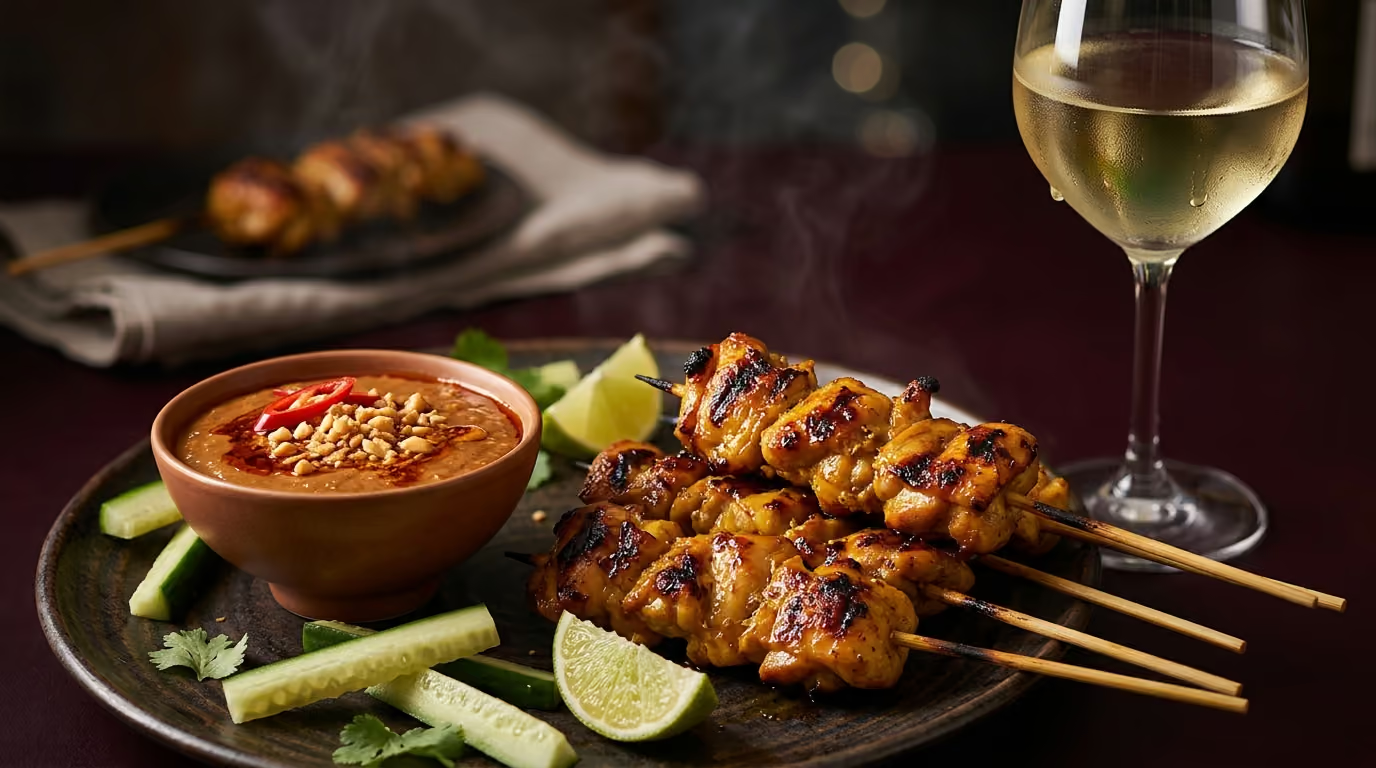
Red makes the most sense with the Thai dishes that aren't primarily about chili. Pad see ew is savory and sweet with soy and charred noodles rather than hot, massaman curry is mild and warm-spiced with beef and potato, and both take a light red comfortably. Grilled and marinated meats such as moo ping or beef larb also lean red, since the char gives the wine something to match. Chicken satay is the one to treat separately, because the peanut sauce rather than the char decides the glass, and our guide to wine for chicken satay and peanut sauce works through the spicy and coconut-rich versions.
What red won't survive is a fiery green curry or a properly spiced som tum. Once real chili heat is the dominant flavor, no red is as good as an off-dry white, and pretending otherwise is how people conclude that wine doesn't work with Thai food at all.
Which wine goes with each Thai dish?
Thai food isn't one flavor, so the single best bottle changes noticeably depending on what you ordered. This is the short version, with a phrase you can say to a server underneath each pick.
| Dish | Best pick | Why | Backup |
|---|---|---|---|
| Pad Thai | Off-dry Riesling | Tamarind and lime want acidity, peanut wants fruit | Sparkling rosé |
| Drunken noodles (pad kee mao) | Gewürztraminer | Meets the Thai basil and garlic head on | Off-dry Riesling |
| Pad see ew | Light Pinot Noir | Sweet soy and char, very little heat | Chilled Gamay |
| Green or red curry | Off-dry Riesling | The hottest curries need the sweetness most | Gewürztraminer |
| Massaman curry | Chilled Gamay or Grenache | Mild, warm-spiced and beefy rather than hot | Off-dry Riesling |
| Panang curry | Gewürztraminer | Thick, peanutty and aromatic | Pinot Gris |
| Tom yum goong | Dry Riesling or Grüner Veltliner | Sour and clear, so it needs acid more than sugar | Sparkling rosé |
| Som tum (papaya salad) | Sparkling rosé | Bubbles handle raw chili and fish sauce together | Off-dry Riesling |
| Larb | Dry rosé | Herbs, lime and ground meat all at once | Chilled Gamay |
| Spring rolls and fresh rolls | Sparkling wine | Fried or fresh, both want a clean palate | Sauvignon Blanc |
| Thai fried rice | Dry sparkling or Pinot Gris | Savory and mild, so nothing needs taming | Chenin Blanc |
| Mango sticky rice | Late-harvest Riesling or Moscato | Dessert has to be sweeter than the wine, or the reverse | Demi-sec sparkling |
If you're ordering for a table rather than for yourself, ignore the row-by-row detail and buy sparkling rosé. It's the only bottle on that list that never actively clashes with anything else on it. The same reasoning holds across the rest of the neighborhood, which is why our picks for wine with Chinese takeout and for Korean BBQ land on the same short list of grapes.
Does coconut milk change the pairing?
It does, and it's the reason two dishes with the same chili count can need different wines. Coconut milk is fat, and fat coats your mouth and blunts capsaicin, so a coconut-based green curry feels less aggressive than a clear, sour soup made with the same number of chilies.
The practical version: coconut curries tolerate a drier wine than you'd expect. A dry Riesling, a Pinot Gris or even a Chenin Blanc can handle a green curry, because the coconut is already doing half the cooling work. A clear soup like tom yum has no fat to soften it, so the heat and the sourness both hit directly, and that's where the acidity of a dry Riesling matters more than sweetness does.
Coconut also adds weight, which is why Gewürztraminer suits a thick panang curry and feels heavy next to a light stir-fry. Match the body of the wine to the body of the sauce and the pairing usually looks after itself.
What do fish sauce and lime do to the wine?
Fish sauce brings salt and savory depth, and lime brings sharp acidity, and each one pulls the wine in a different direction. Salt makes tannin taste harsher, which is another reason big reds struggle, and it makes a wine's fruit read as sweeter and rounder, which is why a young dry white can suddenly feel more generous alongside a salty dish.
Acidity pulls in exactly the opposite direction. A dish with a lot of lime or tamarind makes a low-acid wine taste flat and dull by comparison, because the food has out-sharpened the glass. That's the real argument against a soft, low-acid white here: it isn't that it clashes, it's that it disappears. Whatever else you choose, choose something with acidity.
How cold should the wine be for Thai food?
Colder than you'd normally serve it, which is the cheapest improvement available. Whites and rosé want to be genuinely cold rather than merely cool, and a light red wants fifteen or twenty minutes in the fridge before it hits the table.
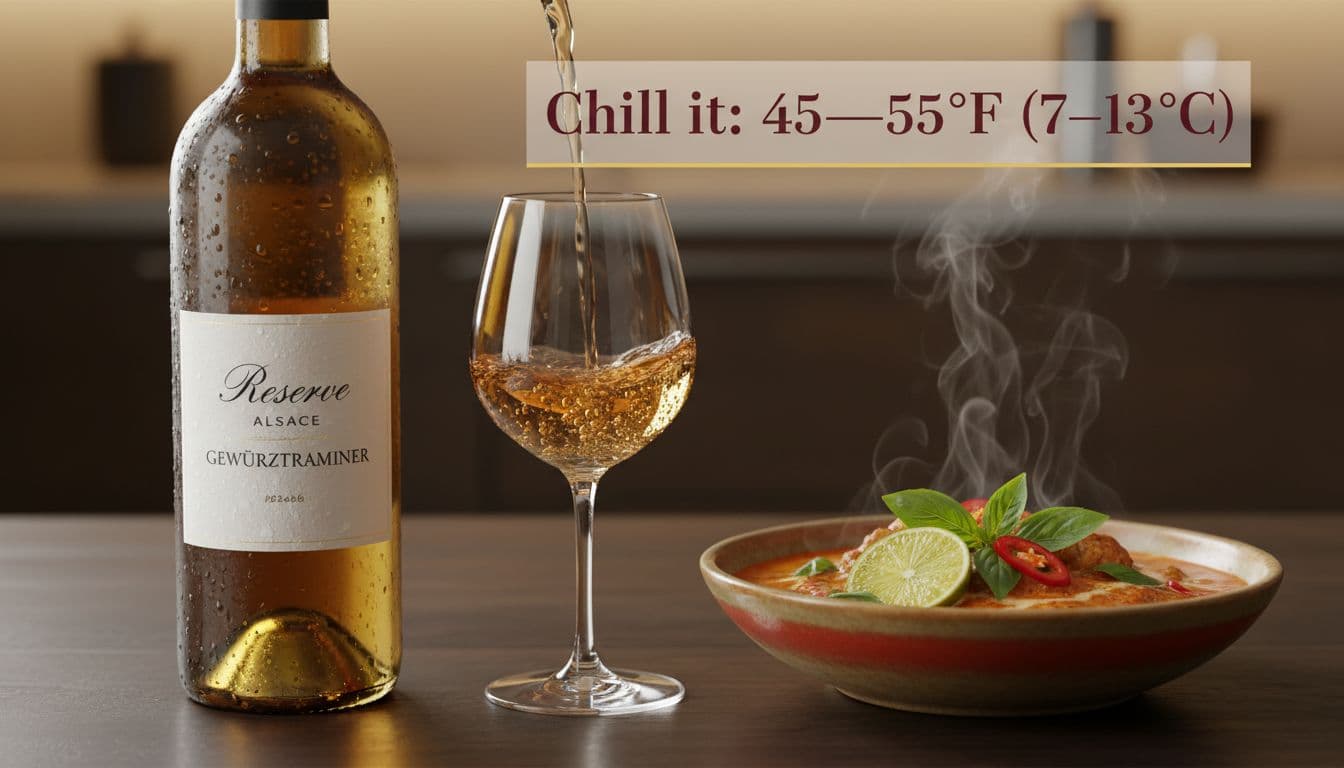
Cold makes a wine's acidity more prominent and its alcohol less so, and both of those changes help against chili. The same bottle that tastes sharp and thin on its own can taste balanced and refreshing at the right temperature next to a hot curry. If dinner arrived faster than the chilling did, our guide to chilling a bottle quickly covers the ice-and-salt trick that actually works.
What alcohol goes best with Thai food if not wine?
Beer is the traditional answer and an honest one, particularly a cold lager, because carbonation and low alcohol do most of what an off-dry Riesling does at half the price. Thai iced tea does the same job without alcohol, since the sweetened condensed milk cools chili the way sugar and fat always do.
What wine gives you that neither of those does is flavor that talks back to the food. A Riesling's lime and green apple pick up the lime in the dish, and a Gewürztraminer's lychee note sits inside the same aromatic family as the basil and the kaffir lime leaf, so the pairing adds something rather than just resetting your mouth. Beer refreshes, and the right wine converses. Both are fine, and you don't have to pick only one for the table.
How do you order wine at a Thai restaurant?
One sentence does it: say you're eating something spicy and you'd like an off-dry white that isn't high in alcohol. Any server can act on that, and it points them at the whole right family rather than at one bottle they may not stock.
If the list is short and Riesling isn't on it, ask for an aromatic white, which is the trade term for the Riesling, Gewürztraminer, Pinot Gris, Torrontés and Muscat group. If nothing there works either, sparkling is almost always available and almost always fine. If you want red, ask for the lightest red on the list and ask them to bring it cool, which is a normal request and not an eccentric one.
Shopping for takeout at home is simpler still. Look for Riesling with the word off-dry or Kabinett on it, and check the alcohol on the back label, since anything at or below about 11 percent is doing you a favor. Our guide to spotting a dry Riesling from a sweet one helps when the label refuses to say. And if you're standing in the aisle with a bottle you've never heard of and a curry waiting at home, Sommy's Fit Check will tell you whether it fits both the meal and your own taste.
Frequently asked questions about wine with Thai food
What's the best drink with Thai food?
Off-dry Riesling is the best wine, and cold lager is the best non-wine option. Both work for the same reason: low alcohol, refreshing character and something to counter the chili, whether that's a little sweetness or carbonation. Thai iced tea is the strongest choice if you're not drinking alcohol, since sugar and dairy fat both cool heat directly.
What alcohol goes best with Thai food?
Lower-alcohol drinks beat stronger ones, because alcohol amplifies chili heat. Beer, off-dry Riesling, sparkling rosé and lightly chilled Gamay all sit in the right range, while spirits, high-alcohol reds and heavily oaked whites all make the food taste hotter. If you want one bottle for a mixed table, sparkling rosé is the safest.
What white wine pairs well with Thai cuisine?
Riesling first, especially in the off-dry style, then Gewürztraminer for aromatic dishes and Pinot Gris for milder ones. Grüner Veltliner and Chenin Blanc both work well when the dish is sour rather than hot, such as tom yum. Heavily oaked Chardonnay is the white to avoid, since oak and chili turn bitter together.
Is white or red wine better with curry?
White is better with a hot curry and red can be better with a mild one. A green or red curry with real chili heat needs the sweetness and acidity of an off-dry white, while massaman curry is mild, sweet and beefy enough to suit a chilled Gamay or a light Pinot Noir. The heat level decides it, not the color of the sauce.
What red wine goes with Pad Thai?
A chilled Gamay is the best red for Pad Thai, and a light Pinot Noir is the alternative. Pad Thai is more sweet and sour than spicy, so a juicy low-tannin red can work, but the tamarind and lime mean an off-dry Riesling still handles it better. Serve any red for this dish cool rather than at room temperature.
Does sparkling wine work with Thai food?
Very well, and it's the most underrated option on any Thai wine list. Bubbles reset your palate between dishes that have nothing in common, which is exactly the problem a shared Thai table creates. Choose a brut or extra-dry sparkling rosé for spicy dishes, and a bone-dry brut nature only when the food is mild.
What wine goes with mango sticky rice?
A late-harvest Riesling or a Moscato d'Asti, because the wine has to be at least as sweet as the dessert or it tastes sour beside it. Moscato has the advantage of being light and lightly sparkling, so it doesn't sit heavily at the end of a big meal. A demi-sec sparkling wine is the other good route.