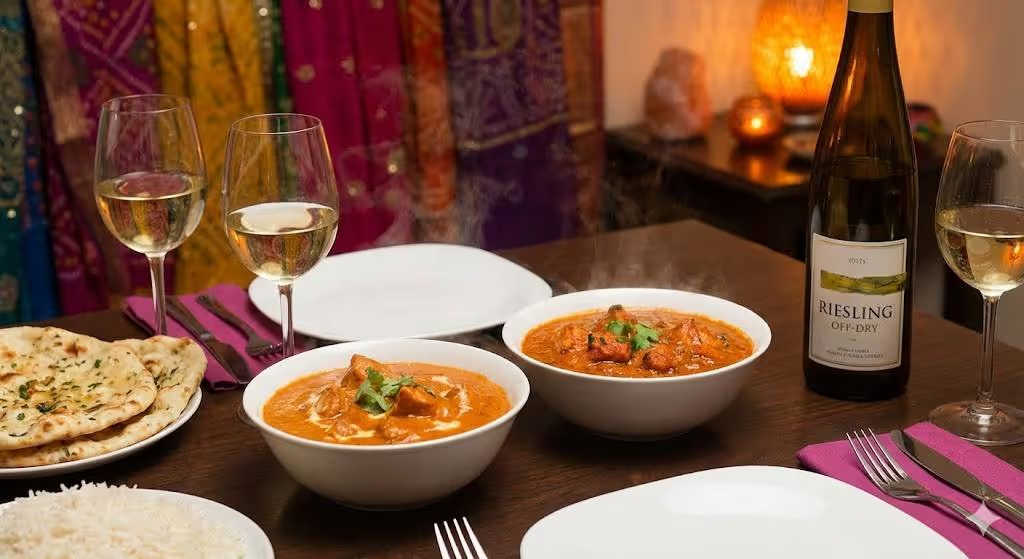

Off-dry Riesling is the most reliable bottle to open with butter chicken, and a dry rosé or a lightly chilled Pinot Noir will handle chicken tikka masala better than a big Cabernet handles either dish. Cream, tomato and chili each pull a wine in a different direction, so the styles that work share three habits: they carry low tannin, they keep fresh acidity, and they sit closer to 11 or 12 percent alcohol than to 15. Get those right and the grape matters far less than most wine lists suggest.
Why does chili heat make some wines taste harsher?
Because capsaicin, the compound that makes chili hot, dissolves in alcohol but barely dissolves in water at all. The US National Library of Medicine’s PubChem record for capsaicin lists it as practically insoluble in cold water and freely soluble in alcohol, and that single difference explains most of what happens at an Indian dinner table.
Water doesn’t move capsaicin off the nerve endings it’s already bound to, which is why reaching for your glass of water doesn’t help much. Alcohol does move it, but moving it isn’t the same as removing it. A high-alcohol wine picks the compound up and carries it across more of your mouth, so a 15 percent Zinfandel can genuinely make the next bite feel hotter rather than calmer. That’s the mechanism behind the usual advice to avoid heavy reds with curry, and it’s worth knowing because it tells you what to do instead of just what to avoid.
The thing that actually settles the burn is dairy. Casein, the main protein in milk, lifts capsaicin away and lets it wash off. Butter chicken already contains a great deal of it, which is the quiet reason this dish is far friendlier to wine than its reputation suggests: the gravy is doing the cooling work before the wine arrives. Your job is to pick a bottle that doesn’t undo it.
What’s actually different about butter chicken and tikka masala?
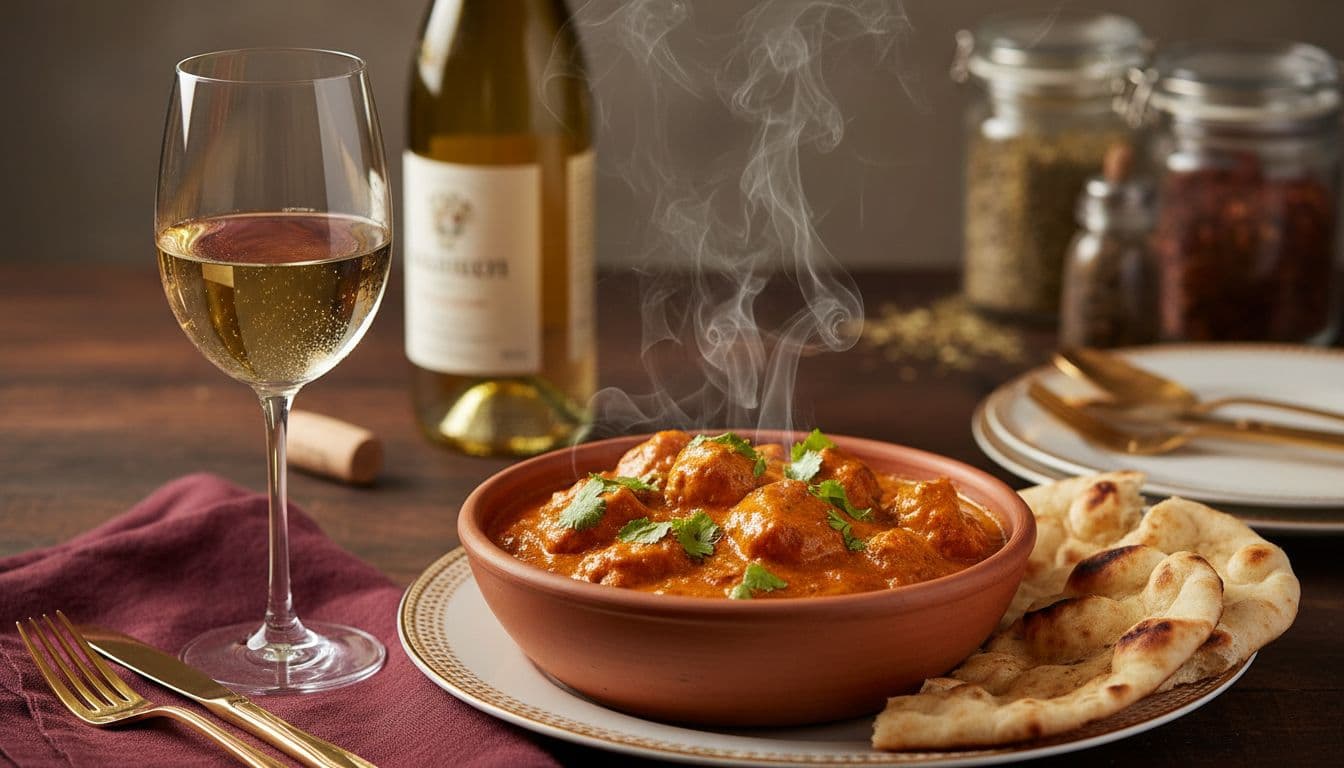
Butter chicken is a consistent dish and tikka masala isn’t, which matters more for your wine choice than any flavour note. Butter chicken, or murgh makhani, was popularised at the Moti Mahal restaurant in the Daryaganj neighbourhood of Old Delhi in the 1950s, built around a tomato and butter gravy that gives the dish its name. Order it in two different restaurants and you’ll get roughly the same thing: rich, gently spiced, heavy on cream and butter.
Chicken tikka masala went the other way. It’s widely thought to have been created in Britain rather than India, and a 1998 British survey of the dish found that among 48 recipes, the only ingredient all of them shared was chicken. That variability matters at the table, because the name on the menu tells you almost nothing about how much cream, how much tomato, or how much chili is going to arrive.
So the practical rule is to pair to the bowl in front of you rather than to the word on the menu. If your tikka masala shows up pale, thick and mild, treat it as butter chicken. If it arrives brick red, looser and sharper, it needs more acidity and a bit more fruit than butter chicken does. You can judge this in about two seconds once you know to look.
What’s the best wine for butter chicken?
An off-dry Riesling is the safest single answer, because it brings high acidity to cut through the butter and a touch of residual sugar that reads as relief against the warm spice. German labels make this easy to find: a bottle marked Kabinett or Spätlese will usually sit in that gently sweet range, and the alcohol is often printed somewhere between 8 and 11 percent, which is exactly where you want it. If you prefer a version that leans properly dry, our guide to finding a Riesling that actually tastes dry covers the label language in more detail.
Chenin Blanc is the next most dependable choice, particularly one labelled demi-sec. It tastes of apple, pear and a little honey without turning syrupy, and it holds enough acidity to keep up with the tomato underneath the cream. Gewürztraminer is the more aromatic option and suits a butter chicken that leans heavily on cardamom and garam masala, though it’s a bottle that varies a lot between producers, so our notes on matching the Gewürztraminer bottle first are worth a look before you commit.
Sparkling wine deserves more credit here than it usually gets. Bubbles and acidity together scrub the fat off your palate between bites, which is the single most useful thing a wine can do against a butter-based gravy. A bottle labelled Brut stays crisp enough to do that job, while Extra Dry is slightly sweeter despite the name and works if the dish carries real heat.
What’s the best wine for tikka masala?
Dry rosé is the most forgiving choice for tikka masala, because it has the fruit to sit alongside a tomato-forward sauce and almost none of the tannin that turns tomato bitter. It also covers you across the wide range of recipes hiding behind that dish name. Readers often assume rosé means sweet, and it usually doesn’t, which we unpack in what rosé actually tastes like.
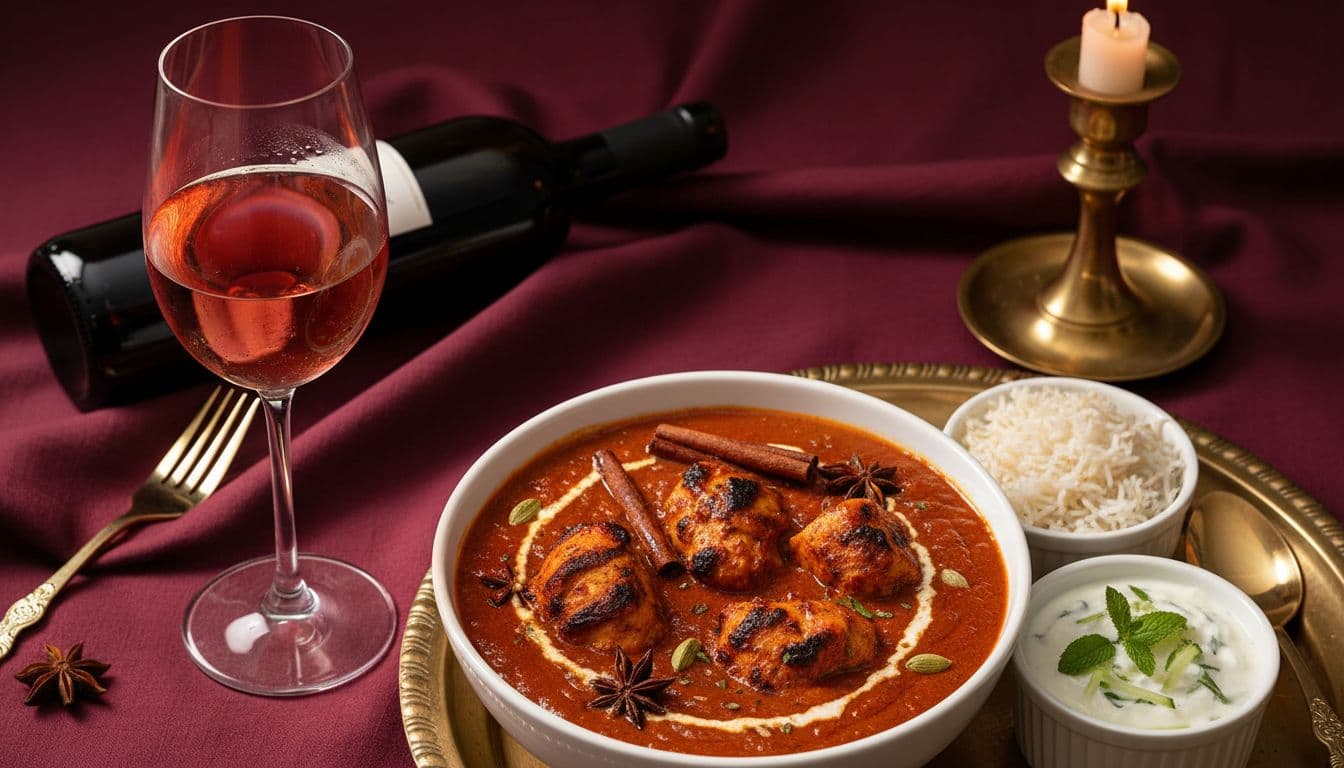
If you want red, keep it light and give it a short chill. Pinot Noir and Gamay both taste of cherry and cranberry, both stay soft enough not to clash with tomato, and both improve with 15 or 20 minutes in the fridge before you pour. The trap with red and curry is almost always tannin rather than colour, and our guide to spotting a low-tannin red will steer you away from the bottles that go wrong.
When the kitchen has been generous with the chili, go back to the off-dry white plan. Sweetness works on heat in a way that dryness simply can’t, and there’s no prize for drinking something austere alongside a dish that’s actively burning you.
How do you choose between them at a glance?
The differences come down to how much cream is in the bowl and how much heat is behind it. This table covers the four situations you’ll actually meet.
| What’s in the bowl | Best direction | Why it works |
|---|---|---|
| Pale, thick, mildly spiced butter chicken | Off-dry Riesling or demi-sec Chenin Blanc | Acidity cuts the butter, light sweetness softens the spice |
| Extra creamy, heavy on cashew and cardamom | Brut sparkling or Gewürztraminer | Bubbles clear the fat, aromatics meet the spice blend |
| Brick red tikka masala, tomato forward | Dry rosé | Fruit matches the tomato, no tannin to turn it bitter |
| Noticeably hot, whichever dish it says | Off-dry white, lower alcohol | Residual sugar calms heat, low alcohol avoids spreading it |
How do you pick a bottle from a grocery shelf?
Read the alcohol percentage before you read anything else, because it’s the one number on the label that maps directly onto how the wine will behave against chili. Anything at or below about 12.5 percent is a reasonable bet, and anything at 14.5 or above is likely to sharpen the heat rather than settle it. The figure is legally required on the label, so it’s always there, usually in small print near the base.
After that, a handful of words do most of the work. Kabinett and Spätlese on a German Riesling point to a touch of sweetness. Demi-sec on a Chenin Blanc means the same. Brut on a sparkling wine means it’s dry, and Extra Dry confusingly means it’s a little sweeter than Brut. Words like bold, oaky, full-bodied and jammy are all signals to put the bottle back for tonight.
If you’re buying for a table where people want different things, the aromatic whites are the ones that stretch furthest. They suit both dishes, they suit a vegetable curry, and they handle rice and flatbread without complaint. The same logic applies to other spiced rice dishes, which we cover in our biryani pairing guide.
What should you ask for in an Indian restaurant?
Describe the style you want rather than naming a grape, because the wine list at most Indian restaurants is short and the grape you want may not be on it. Asking for an off-dry aromatic white, or a dry rosé that isn’t sweet, or a light red with soft tannins that can take a chill, gives the server something they can actually match against what’s in the cellar.
If someone recommends a Cabernet Sauvignon or a Malbec with tikka masala, it’s fine to decline politely. Both are tannic by nature, and tannin plus tomato is the combination most likely to leave a metallic edge on your palate. You’re not being difficult by asking for something lighter, you’re avoiding the one pairing that reliably disappoints.
House sparkling is the underrated order in a restaurant setting. It’s usually inexpensive, it works across a table where three people have ordered three different curries, and it does the fat-cutting job better than most still whites on a short list.
Which wines go wrong with curry, and why?
Big tannic reds fail first, and the reason is the tomato rather than the spice. Tannin and acidic tomato together taste bitter and slightly metallic, which is why Cabernet Sauvignon, Syrah and bold red blends all struggle with tikka masala in particular. The dish isn’t too strong for them, it’s the wrong shape for them.
Heavily oaked whites fail for a different reason. A buttery, oak-driven Chardonnay puts richness on top of richness, then has no acidity left to cut through any of it, so the whole pairing turns heavy by the third mouthful. Light oak is fine, and a lot of oak isn’t.
High-alcohol wine of any colour is the third failure, and it comes straight back to the chemistry at the top of this page. Alcohol moves capsaicin around your mouth, so the hotter the dish, the more a strong wine works against you. If the choice is between a 14.8 percent red and a 11.5 percent white you’re less excited about, the white will taste better with the food.
Pair to the bowl, not the menu name
Butter chicken and tikka masala aren’t difficult to drink with, they’re just badly served by the habit of reaching for a big red because the sauce looks rich. Look at what’s actually in front of you, judge the cream and the heat, then pick something with low tannin, real acidity and alcohol under about 12.5 percent. Off-dry Riesling covers the widest range of situations, dry rosé is the better call when tomato leads, and a chilled Pinot Noir is there when the table wants red.
Tastes vary more than pairing charts admit, and the version of a dish your local kitchen makes is its own variable. If you’d rather not work it out from first principles every time, Sommy learns what you actually enjoy and gives personalised wine recommendations for the meal in front of you, including the ones you photograph on a restaurant table.
Questions people ask about wine with butter chicken
Is red wine ever a good match for butter chicken?
Yes, as long as it’s light and low in tannin. Pinot Noir and Gamay both work, particularly after 15 minutes in the fridge, because they bring red fruit without the grip that clashes with tomato. Heavier reds like Cabernet Sauvignon are the ones to avoid.
Does sweet wine really help with spicy food?
A little sweetness genuinely helps, and a lot of it usually doesn’t. Residual sugar takes the edge off chili heat in the same way a spoonful of yoghurt does, but a dessert wine alongside a main course tends to make the food taste salty. Off-dry is the range worth aiming for, not sweet.
What wine goes with both butter chicken and tikka masala at the same table?
An off-dry Riesling or a dry rosé will cover both without much compromise. If you want one bottle for a mixed table, sparkling wine labelled Brut is arguably the safest of all, since acidity and bubbles work against cream, tomato and spice alike.
Why does my wine taste more bitter after a bite of curry?
That’s usually tannin meeting the acidity of the tomato in the sauce. The combination reads as bitter or metallic, and it gets worse as the meal goes on. Switching to a white, a rosé or a genuinely light red removes the problem entirely.
Does the wine choice change if the curry is very hot?
It changes in one direction: lower the alcohol and raise the sweetness. Capsaicin is freely soluble in alcohol, so a stronger wine spreads the burn further, while a touch of residual sugar counteracts it. A German Riesling at around 9 percent is close to ideal for a genuinely hot dish.
Is beer just a better choice than wine with Indian food?
Beer is an easy choice rather than a better one. Lager works because it’s cold, light and low in alcohol, which are the same qualities that make off-dry Riesling work. Once you know what to look for on a wine label, wine gives you more range across different curries than a single lager does.