
The second-cheapest bottle on a restaurant wine list is not the rip-off everyone says it is. Economists at the London School of Economics and the University of Sussex Business School studied 6,335 wines across 470 menus from 249 London restaurants and found the markup on the second-cheapest wine sits significantly below the third, fourth, and fifth cheapest. The genuinely expensive slot is the middle of the list, which is exactly where most people feel safest.
That single finding flips the advice most of us have been repeating for years. Below is what the research actually found, why restaurants price lists the way they do, and a method for picking a good-value bottle that doesn't depend on counting positions at all.
What does the research actually say?
Professor David de Meza of the LSE Department of Management and Dr Vikram Pathania, Reader in Economics at the University of Sussex Business School, tested the myth directly against real menu data. Their work, published in 2021, compared percentage markups across every price position on hundreds of London wine lists.
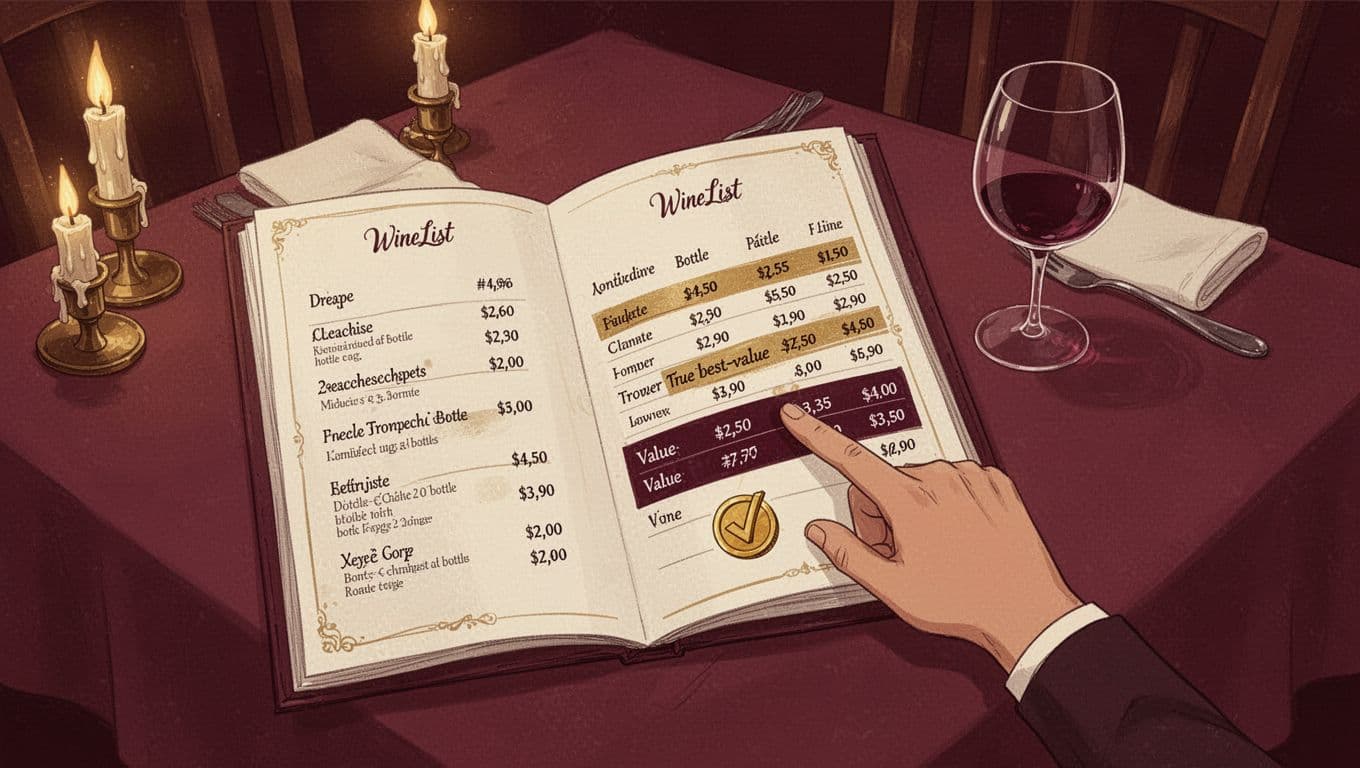
The headline result is that the second-cheapest bottle carries a lower percentage markup than the several bottles priced just above it, and the peak markup lands around the median wine on the menu. You can read the write-up from the University of Sussex on the second-cheapest myth if you want the researchers' own words.
De Meza also made a neat logical point about why the myth was always shaky. If everybody knows the second-cheapest bottle is a trap, then choosing it signals both a bad buy and an obvious attempt to look well off, which would make it the worst possible choice rather than a clever one. A rule that self-destructs the moment it becomes common knowledge was never a reliable rule.
Why is the middle of the list the expensive part?
Because restaurants have good commercial reasons to keep margins thin at both ends and fat in the middle. Pathania explained the logic plainly: low margins at the cheap end encourage people to order wine at all, and low margins at the expensive end tempt customers into trading up to a pricier bottle.
That leaves the middle doing the heavy lifting for profit. It's also where the largest number of diners naturally land, since the middle feels responsible, unshowy, and safe from judgment in either direction. Restaurants price against that instinct rather than against the counting trick people think they're outsmarting.
So the practical inversion is worth stating clearly. If you're scanning a list and your eye settles somewhere comfortably mid-range because it feels like the sensible adult choice, that's the position most likely to carry the heaviest markup on the whole page.
Where did the myth come from in the first place?
It grew out of a plausible story about human embarrassment rather than out of any pricing data. The reasoning went that nobody wants to be seen ordering the cheapest bottle on the table, so the second-cheapest becomes the natural refuge, and a restaurant that knows this can quietly load its margin onto that slot.
The story spread widely because it flatters the person repeating it, since knowing the trick implies you've seen behind the curtain. It also has the shape of good advice, offering a specific, memorable rule you can apply without knowing anything about wine, and rules like that travel much faster than accurate ones.
What the story never had was evidence. It circulated for years through articles, dinner tables, and eventually social media without anyone checking it against real menus, which is precisely the gap the LSE and Sussex researchers set out to fill.
How far should you trust the study?
It's solid evidence from a large sample, and it's worth knowing its edges. The data covers 249 London restaurants, so it reflects one city's market at one point in time rather than a universal law of restaurant pricing.
The broader logic behind it does travel well, though. Thin margins at the cheap end to encourage ordering, thin margins at the top to tempt trading up, and the heaviest markup where most customers land are all standard pricing behavior rather than anything peculiar to London, and they apply to United States wine lists for the same commercial reasons.
The measurement itself is also worth reading precisely. The researchers compared percentage markups, which tells you where the restaurant's margin is heaviest, and that isn't quite the same question as which bottle gives you the most enjoyment per dollar. A wine with a modest markup can still be a dull wine, which is why position alone was never going to be enough.
Does this mean I should always order the second-cheapest?
No, and swapping one counting rule for another misses the point entirely. The study measured markup percentages, not whether you'll enjoy the wine, and a well-priced bottle you don't like is still a wasted $40.
Markup also varies enormously between venues. A neighborhood bistro with a five-bottle list, a steakhouse with a leather binder, and a wine bar that makes its margin on food are all pricing differently, and the London restaurant data won't map perfectly onto every menu you meet. Treat the finding as permission to stop worrying about position rather than as a new position to worry about.
It's a bit like buying shoes because they're on sale. The discount is real and completely irrelevant if they pinch, and wine works the same way, which is why every method below starts with what you like rather than what something costs.
How do you actually find value on a wine list?
Set your ceiling, name a style in everyday words, mention the food, and ask for two options. That takes about thirty seconds, works on any list from five bottles to twelve pages, and never requires you to count positions.
Start by picking a number you'd be content paying even if the wine turns out merely decent. Having that ceiling before you open the list matters more than anything else, because it removes most of the page instantly and stops the slow upward drift that happens when you shop by comparison.
Then describe a style rather than a grape. Words like light and crisp, smooth and easy, bright and refreshing, or bold and rich are understood by every server anywhere, and they're far more useful than a grape name you half remember. Add one plain sentence about the food, something like "we're mostly having seafood" or "steak and fries", and the person helping you can filter the list far better than you can.
Finish by asking for a choice instead of a recommendation. A question like "could you give me two good-value options around $45, one lighter and one richer" gets you a genuine comparison, gives the server room to point at something they actually rate, and leaves the final call with you. Our guide to selecting wine at a restaurant with confidence has more phrasing you can borrow.
Where does the value usually hide?
In the regions and grapes nobody at the table has heard of. Restaurants can't charge a premium for a name that carries no prestige, so the same quality costs noticeably less when it arrives under an unfamiliar label.
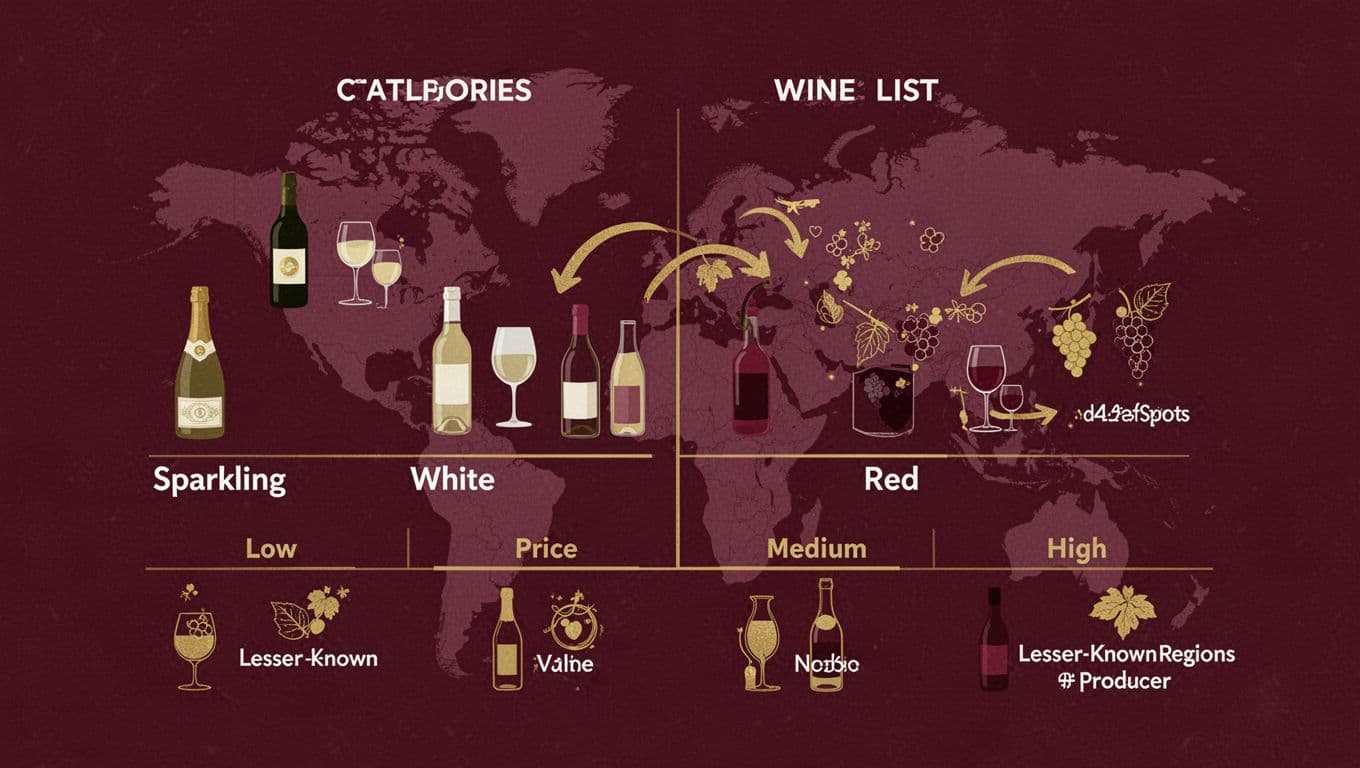
In practice that means looking slightly sideways from the famous names. Portugal, Sicily, Greece, southwest France, and the less fashionable parts of Spain all deliver more wine per dollar than Burgundy or Napa on the same list, simply because the region isn't doing any of the selling. A Douro red next to a Bordeaux at the same price is very often the better glass.
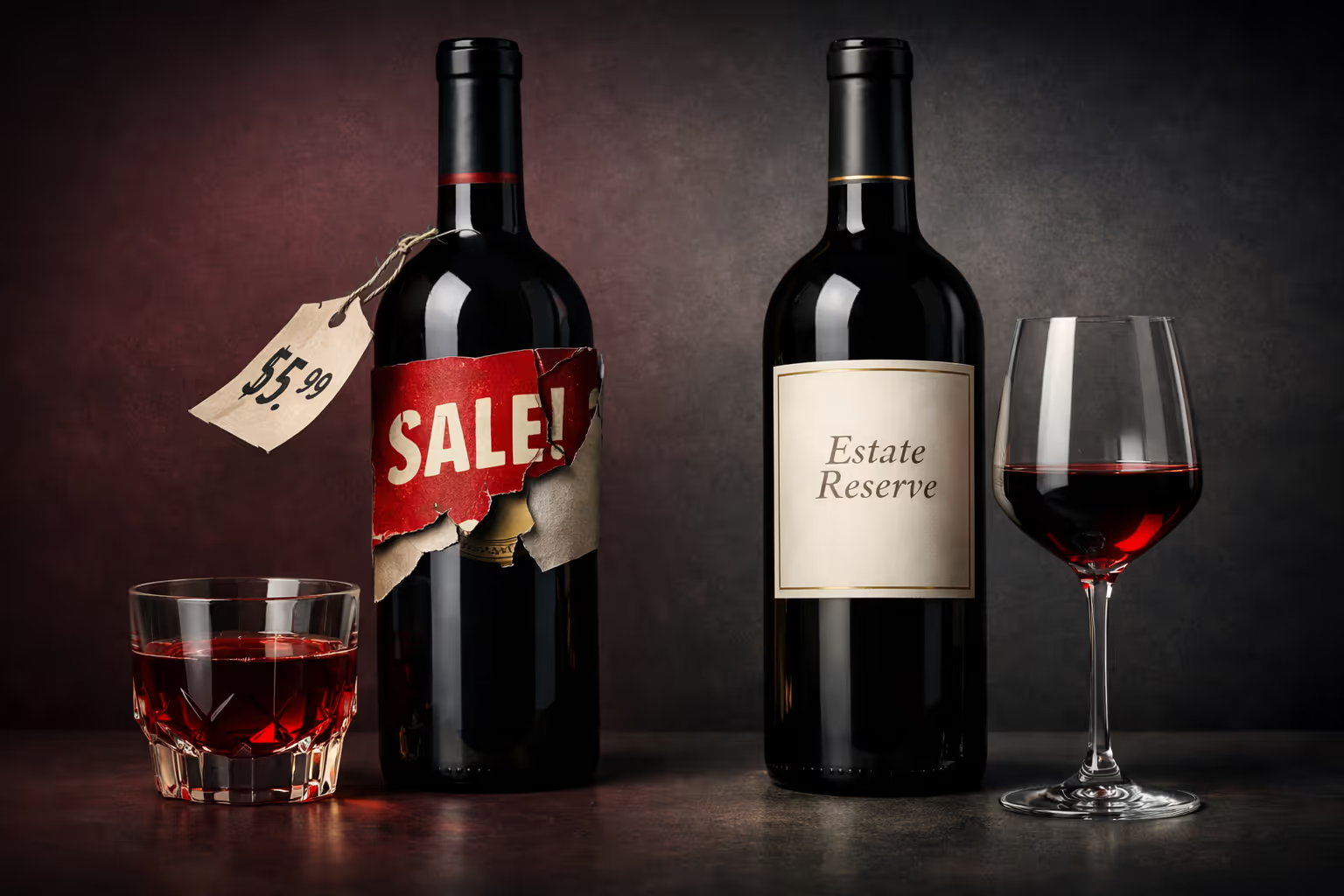
Two other habits protect your money. Prestige names carry a markup built on recognition rather than what's in the bottle, so a famous château at a restaurant price is rarely where value lives. Flowery language like reserve, old vine, or estate selection is largely unregulated on United States labels, which means it can dress up perfectly ordinary wine, and it's worth reading past it.
How do you read the tasting notes on the list?
Take them literally, because those short descriptions are more honest than the region names beside them. Crisp means refreshing and not sweet, round or creamy means softer and richer, bright means lively and mouth-watering, and smooth means it won't dry your mouth out.
Those four words map onto how a wine will actually feel, which is the thing you're deciding about. A list that describes a bottle as bright and citrusy is telling you something genuinely useful, whereas a list that only tells you the vintage and the village is telling you nothing you can act on unless you already know the region.
If you're stuck between three bottles that read almost identically, that's the moment Sommy helps. Scanning the list with Vision and letting Current Venue filter it against your Taste Profile narrows a long page down to the ones that suit you, and Fit Check gives you a straight verdict on a specific bottle you're hesitating over. Our guide on how to read a wine list covers the same moment in more detail.
Common questions about the second-cheapest wine myth
Is the second-cheapest wine really a rip-off?
No, according to the LSE and Sussex research it carries a lower percentage markup than the next few bottles up the list. The heaviest markup tends to sit around the median price on the menu instead.
Which bottle on the list has the biggest markup?
Usually the one near the middle of the price range. Restaurants keep margins slimmer at both ends to encourage ordering at the bottom and trading up at the top, which pushes the peak into the middle.
Is the cheapest bottle on the list any good?
Often it's perfectly fine, and it's frequently better value than the bottles just above it. Restaurants generally don't want their entry wine to be embarrassing, since it's the one that shapes how people judge the whole list.
How much do restaurants mark wine up?
Two to three times the retail price is a common range, though it varies widely by venue and by position on the list. That's why a bottle you recognize from a shop can look startling on a menu.
Is wine by the glass better value than a bottle?
Rarely on pure price, since a glass is often priced at close to the wholesale cost of the whole bottle. It's still the smarter choice when you want to try something unfamiliar or when the table isn't drinking much.
Should I just pick a wine I recognize?
That's usually the most expensive way to order. Recognition is exactly what a restaurant can charge a premium for, so an unfamiliar region at the same price tends to give you more.
What to do instead of counting positions
The myth survives because it offers a rule to follow when you feel exposed, and the research shows the rule was pointed at the wrong part of the menu all along. Decide your ceiling, describe the style you want in ordinary words, mention the food, and ask for two options.
Doing that gets you a better bottle than any counting trick, and it works whether the list has five wines or five hundred. If you'd rather have the shortlist made for you, Sommy Chat answers wine list questions in plain language, and your Taste Profile gets sharper every time you rate something, so the recommendations start coming from your own history. Our broader guide to finding the best value wine and liquor covers shops and spirits as well as restaurants.